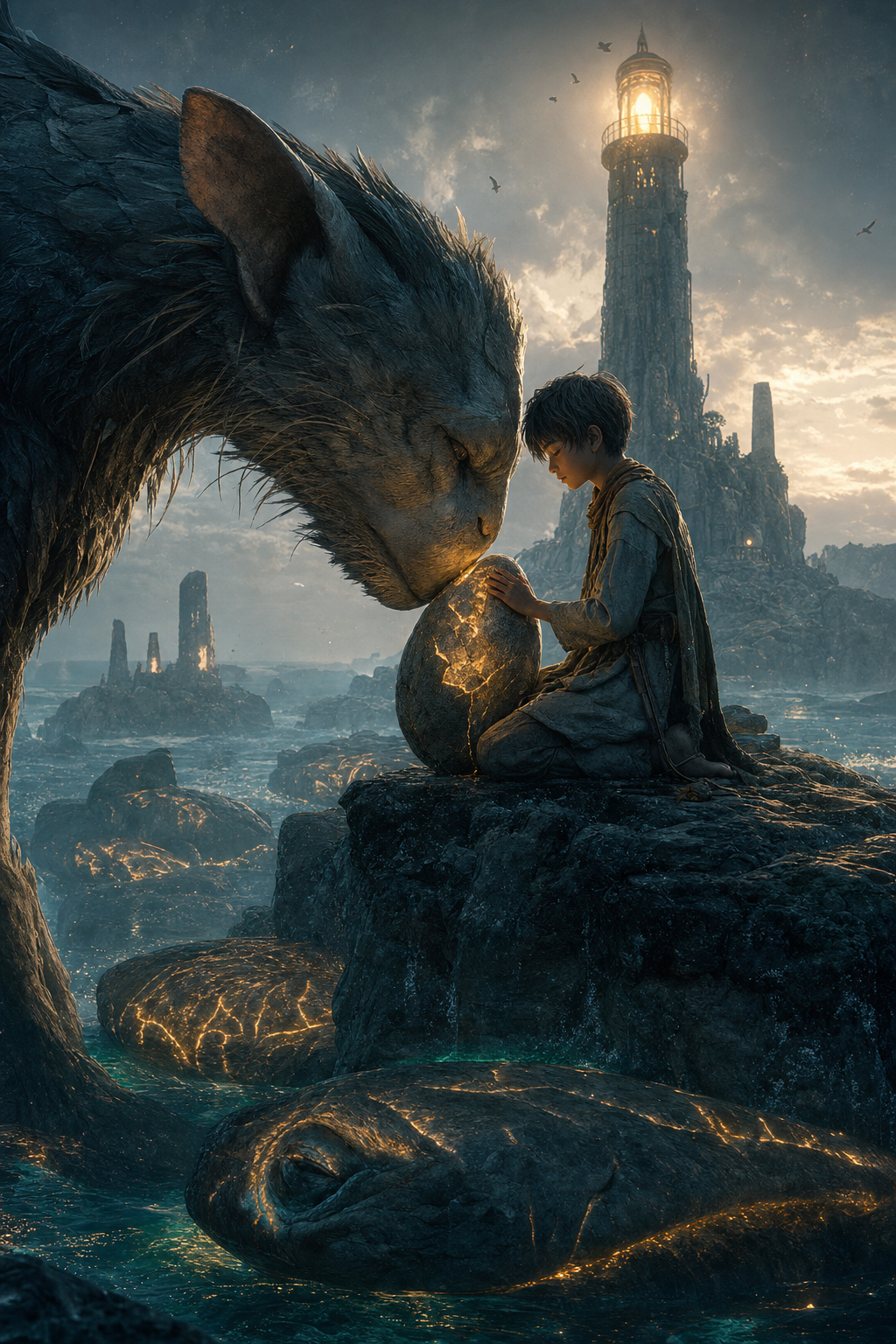
WHAT THE STONE HOLDS
On an island where lighthouse beams keep living stone asleep, a silent young keeper risks the dark to touch what waits below.
Chapter 1
The stone was warm before the lamp was lit.
Wren stood barefoot on the floor of the lamp room, oil can in one hand, rag in the other, and felt the heat through the soles of their feet. Not much. Just enough to be wrong. The tower had held the day's cold in its walls. Wind came through the narrow slit windows smelling of salt and rain. The glass of the great lens was cool under Wren's fingertips where they wiped the last crescent of soot away.
But the floor held a warmth that did not belong to evening.
Above the western sea, the light was thinning. The last of the day lay low on the water, a strip of dull silver beneath the cloud. Everything else had gone to stone-gray: cliff, grass, the black backs of the rocks below the tower where the tide climbed and withdrew. Gulls wheeled once in the wind and vanished inland. The island emptied itself of sound with the falling dark.
Wren finished with the lens and stepped back.
The lamp waited in its iron housing, wick trimmed, reservoir full. The rotation gears had been cleaned that morning. When the flame took, the whole machine would wake: click, sweep, click, sweep, the amber beam turning over sea and cliff and the western ridge below. It had done so every night since before anyone on Tharn had been born. Wren had tended it for eleven months now. Their hands knew each latch and pin by touch. Their body moved through the work without asking thought to come with it.
They set the rag aside, bent, and struck the tinder.
Flame caught. Small at first. Then steadier. The crystal lens gathered it, magnified it, sent its first weak bar of amber against the curved wall. The mechanism shuddered once and took hold. Gears engaged. The beam began its slow turn.
Light crossed the sea.
Passed over the harbor on the island's eastern side, where the cottages crouched close together against the wind.
Passed over the black grass and the low stone walls that no one remembered building.
Passed over the western ridge.
Passed on.
Dark came back for three breaths before the beam returned.
Wren stood still while the first full circle completed itself. The lamp room filled with its old rhythm. Click. Sweep. Click. Sweep. The turning lived in the tower's bones. It traveled down the spiral stair, through the stone walls, into the narrow rooms below where Wren slept and ate and kept the logbooks dry.
Beneath it, just under the reach of hearing, another rhythm moved.
Wren felt it more than heard it. A low tremor, so deep it might have been the sea striking the cliffs below. It came up through the warmed floor into their ankles and stopped there, as if the rest of their body refused it entry.
The beam swept west again. Amber lit the ridge, the split rocks, the narrow path that wound down toward the cliff edge.
Nothing moved.
Dark again.
The warmth under Wren's feet held.
They crossed to the western window and rested one palm against the frame. Outside, the dark between sweeps was whole. The island did not fade when the beam passed; it vanished. Then the amber returned and cut it into being again—stone, grass, drop, sea—and took it away once more.
In those few seconds of black, the tower felt inhabited.
Not by a person. Not by anything with breath in the human sense. Only by weight. By the fact of something below the visible world, vast enough to alter the air without touching it.
Wren waited through three more turns of the lamp.
The warmth did not change. The tremor came and went beneath the mechanism's heartbeat. If they had been new to the island, they might have called it settling, the way old keepers did. Islands settle at night, Torf had said when he left Wren here the previous spring with a week of instruction and a sack of onions. The rock shifts. You'll feel it in the floor if the weather's turning.
But the weather had been steady for two days. And the feeling in the stone was slower than any shift of cooling rock. It came in intervals too regular to be chance.
Wren moved to the logbook on its narrow desk beside the stairwell. Date. Wind from the northwest. Moderate sea. Low cloud. Visibility reduced after dusk.
The pen paused in their fingers.
They wrote: Floor warm at lighting.
Then, after a moment: Low vibration under west quarter of tower.
They looked at the words as if someone else had written them.
The page smelled faintly of damp and ink. The lamp turned overhead. The beam crossed west. Returned.
Wren closed the book.
The rest of the evening unfolded in its usual shapes. They carried coal down to the kitchen hearth though the night was not yet cold enough to need a full fire. Cut bread. Ate standing at the table with a piece of smoked fish and yesterday's hard cheese. Washed the plate. Checked the lower door bolts. Climbed halfway back up the stairs to listen for any change in the gearing. None came.
The tower held around them, old and weathered and sufficient. The attached cottage leaned against it like a smaller stone against a larger one. Between the two buildings, Wren's whole life on Tharn could be crossed in twenty paces: bed, table, stove, books shelf, stair, lamp, door. Beyond them, the island widened into cliff and grass and silence.
No one came to the outer light after dusk.
Tam had been there that morning with flour and lamp oil and two letters from the Council, neither of which Wren had opened yet. He had stayed long enough to haul the barrels inside and ask if the roof over the east room still leaked in hard rain. Wren had said, "Less now."
Tam had nodded as if this were an answer large enough to keep. Before he left, he had set a smooth white stone on the windowsill without comment. From another island, maybe. One of the pale ones farther in, where the beaches held more shell than basalt.
Wren had not asked why.
The stone sat there now, catching the lamp's sweep each time amber crossed the room. White, then gray. White, then gray.
By the time full dark settled, the tremor under the tower had strengthened. Not enough to shake anything loose. Just enough that the spoon hanging by the stove clicked softly against the wall every few minutes, too low for the ear unless the room was otherwise empty of sound.
Wren climbed the stairs again.
The lamp room windows were black mirrors between sweeps. In each brief reflection Wren saw the same narrow figure moving in the amber flash: dark hair cut uneven at the jaw, shoulders sharpened by the thin wool of their sweater, hands marked with old scrapes from stone and rope and gear teeth.
The beam crossed west.
For a moment—only that—a line of dim color showed on the ridge below.
Not lamp-light. Not reflection. Something in the rock itself. A thread of amber laid low against the ground, there and gone before Wren could lean closer.
The dark came back.
Wren did not move.
When the beam returned, the ridge was ordinary again. Black stone. Salt grass flattened by wind. The path pale where feet had worn it. Nothing else.
Their fingers found the window frame and closed on it hard enough that the old wood creaked.
Another sweep. Another dark interval.
There. Again.
A faint seam of color along the western ridge, too warm in tone to be moonlight, too low and steady to be any lantern. It did not shine so much as hold. Amber in the stone. A line no longer than Wren's forearm, pulsing once before the beam returned and washed it pale.
Then gone.
The mechanism clicked overhead and turned on, faithful as ever, carrying light where it was meant to go.
Wren stayed at the window until the next pass. And the next.
Sometimes the line appeared in the dark interval. Sometimes it did not. Each time it seemed to be in the same place, just beyond the tower's western shoulder where the ridge dipped before the cliff edge. Too far to make out clearly. Too brief to trust.
The floor beneath Wren's feet was warm now all through.
Below, the sea struck the rocks in its own long rhythm. Wind leaned against the glass. The tower breathed lamp-oil heat and old salt. Under all of it lay that slower motion in the stone, immense and patient and almost, almost knowable through the soles of the feet.
Wren went downstairs only when the wick needed trimming near midnight. They performed the work automatically, hands steady, eyes already turned toward the stair again. When the adjustment was done, they should have slept. The lamp would run true till dawn. There was nothing else to tend.
Instead they stood in the kitchen with the unlit hearth at their back and looked toward the door.
The western ridge lay somewhere beyond it. The dark. The line in the stone. The warmth under the tower rising from below instead of falling from above.
Wren lifted the latch.
The wind met them first—cold, wet, carrying sea spray all the way up the slope. Then the dark, thicker outside the tower's amber sweep than it ever seemed through glass. The beam turned over the path and moved on, leaving the island to itself for three breaths.
Wren stepped out onto the stone threshold barefoot.
The warmth in the ground was stronger here.
It came up through the rock into their feet like heat held all day by sun, except the day had been clouded and cold and the stone should already have given back whatever little warmth it had taken. This heat was from beneath. Deep. Alive in its own way.
The beam returned, passing over the yard, the low rain barrel, the path to the western side. Wren saw it all in amber. Then darkness again.
They did not go farther.
Not tonight.
They stood on the threshold through five sweeps of the light, feeling the warm stone and the slow tremor under it. Once, in the dark between passes, the amber line showed again on the ridge. It pulsed. Faded. Returned to black.
When Wren finally went back inside, their feet carried the heat with them.
They barred the door, climbed down the short passage to the bed built into the wall, and lay on top of the blanket without undressing. Above them the mechanism turned. Click. Sweep. Click. Sweep.
Their palms still held the shape of the window frame. Their soles still held the warmth of the stone.
Sleep did not come quickly.
Somewhere below the tower, below the cottage, below the western ridge and the black roots of the island buried in sea, something moved through the rock with a slowness too large for restlessness and too steady for chance. Wren lay listening until the lamp's rhythm and the deeper one nearly matched, and then did not match, and then drew apart again.
When at last they closed their eyes, they could still see it.
A line of amber in the dark.
Waiting where the light did not reach.
In the Hekla Archipelago, night turns stone permeable and ancient mineral-organic beings called the Underliving can rise—unless lighthouse beams keep the islands sealed. Seventeen-year-old Wren, a solitary keeper on the outer island of Tharn, lets the light fail and begins a wordless bond with the vast creature beneath their tower. When the Keeper Council replaces the old rhythmic lamp with a brighter constant light, Wren must face the human world they have long avoided to protect what the dark has revealed.
- —Wren — A seventeen-year-old lighthouse keeper on the isolated island of Tharn, small, meticulous, and built for long silences. Shaped by years of grief and quiet caregiving, Wren believes presence is the truest form of love until saving the creature beneath the stone demands speech.
- —Maret Halsvik — A sixty-two-year-old senior keeper on neighboring Skerry, weathered, sparse, and deeply observant. She once formed the same kind of bond Wren now has and lost it when she stayed silent, making her both warning and ally.
- —Tam Erikson — A twenty-year-old supply runner who moves between the outer islands with warmth, steadiness, and an easy patience. He keeps reaching toward Wren without pressure, becoming the human counterpart to the devotion Wren offers the creature.
- —The creature beneath Tharn — An immense Underliving organism buried under Tharn's western ridge, warm basalt by touch and streaked with slow amber bioluminescence. It cannot hear or understand language, only pressure, heat, and heartbeat through stone, so its bond with Wren forms over weeks of shared presence.
- —The Keeper Council — The archipelago's governing body of senior keepers, conscientious and methodical rather than cruel. They believe stronger, constant light will stabilize the islands, not realizing they are suffocating living beings below the rock.
- —Wren's father — A grieving man from Wren's past, distant rather than harsh, who could never turn loss into words his child could receive. Though absent from the main action, his silence haunts Wren's fear that speaking what matters will only widen the distance.
- —The Dark Below: Wren tends Tharn's aging lighthouse in near-total solitude until a lamp failure reveals warmth, tremor, and a faint amber presence beneath the island's western ridge. Drawn by something alive in the stone, Wren begins leaving the lamp dark and ventures out to touch it.
- —The Long Keeping: Night after night, Wren returns to the surfaced creature and builds a bond through patience alone: a brightening glow, an echoed heartbeat, a sheltering curve of living stone. As the creature slowly responds, Wren finds in it the first relationship that fully answers their instinct to keep watch without words.
- —The Light That Kills: Hints from Maret reveal that Wren is not the first keeper to know this hidden life, just as the Council announces new constant-burn lamps for the archipelago. As neighboring islands fall cold and silent, Wren realizes the new light will seal the creature away and cannot find a way to warn anyone in time.
- —Breaking Silence: When Tharn's new lamp is installed, the creature calcifies into cold basalt and Wren's wordless devotion can no longer reach it. Driven past the limits of silence, Wren turns to Maret, speaks the impossible truth aloud, and together they confront the Council with what lives beneath the islands.
- —Warmth That Remains: A hard-won compromise restores darkness in measured intervals, allowing the damaged creature to stir again, though never as fully as before. As the surviving Underliving begin to migrate toward deeper freedom, Wren must let go of the bond they fought to save and carry what it taught them into a fragile human reaching of their own.
Lyrical but restrained, with intimate close-third prose rooted in touch, temperature, weight, and the physical language of stone. The voice is patient, spare, and mournful, building wonder and grief through repetition, darkness, and small sensory shifts rather than overt explanation.