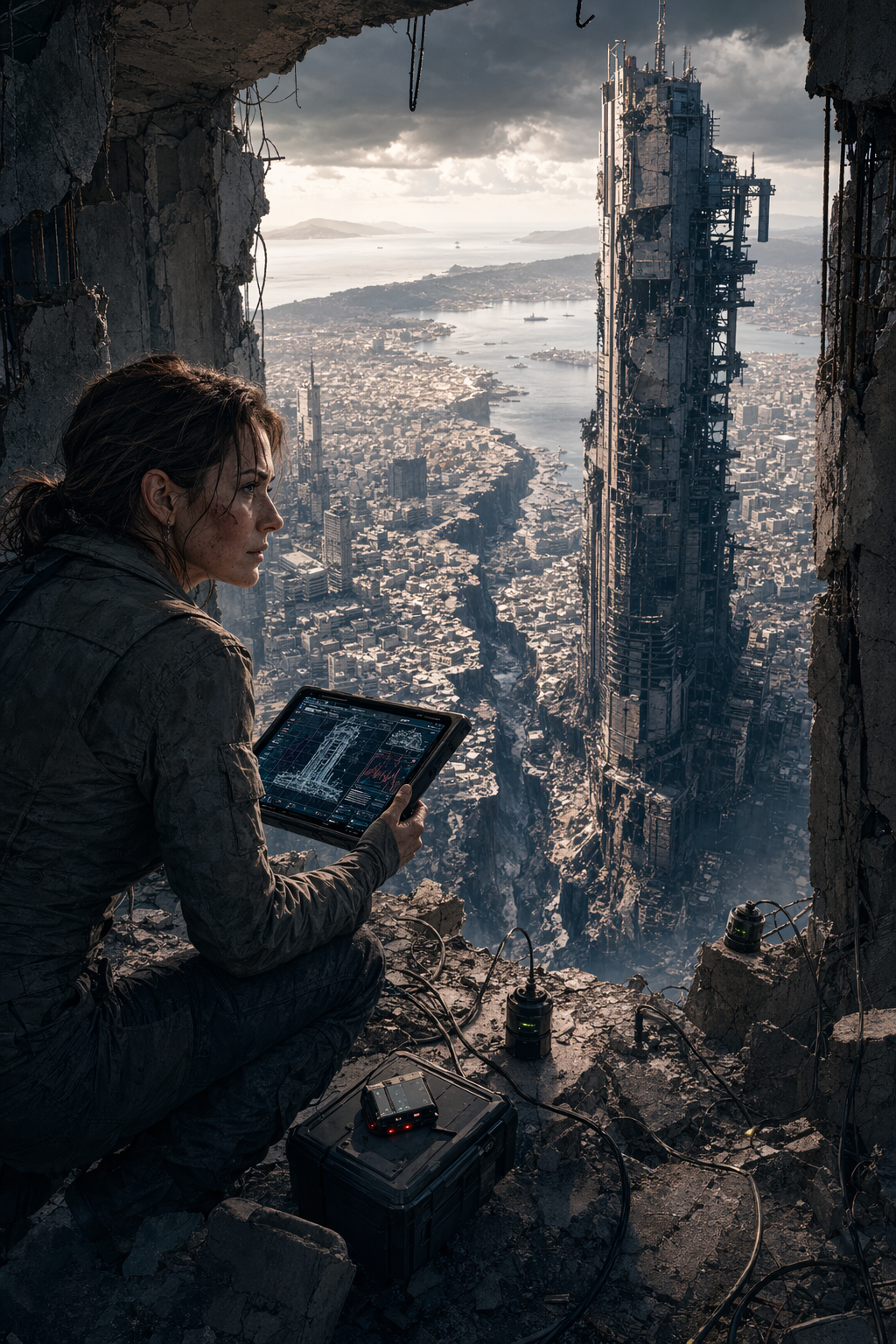
THE FAULT LINE
After a devastating quake, an elite engineer must judge dying buildings before the next aftershock does it for her.
Chapter 1
The transport dropped through a brown haze that turned the morning sun into a dull coin. From the window, Varda looked less destroyed than altered. That was worse in its own way. Collapse declared itself cleanly. Alteration had to be read.
Maren Calder watched the skyline resolve through dust and vibration. A tower near the harbor had lost three upper floors, its roofline flattened into an abrupt horizontal where the building had once continued. A construction crane leaned five degrees off vertical above a cluster of commercial blocks, the deviation small enough that most passengers would miss it and large enough that no engineer could. Along the inland ridge, a row of mid-century residential slabs stood intact except for one whose stair core had split from the main frame by a shadow-width gap.
Each deformation was a sentence. Lateral loading from the southeast. Differential settlement in the reclaimed districts. Torsion in the taller frames where soft commercial podiums met heavier residential towers above. The city was speaking in damaged geometry, and Maren was already translating.
The aircraft touched down hard on a military strip north of the port. By the time the wheels stopped, she had her gloves on and her field tablet awake.
A convoy took the international assessment teams into the city. Roads were passable in sections, blocked in others by fallen masonry, utility trenches, and the temporary architecture of disaster: tents, barricades, stacked water tanks, ambulances with rear doors open. Varda's older quarters had shed stone into the streets. Its newer districts had kept standing at a price visible only in the fractures running through columns, spandrels, beam-column joints. The fault under the city had not chosen a style. It had chosen force, and force translated into every era's weaknesses with equal indifference.
Sector 7 was a dense district of six- to ten-story residential blocks, shops at street level, apartments above, construction dates spanning five decades and several code revisions. The field camp sat in a cleared parking lot behind a damaged supermarket. Prefabricated steel units formed a square around a generator trailer and a row of folding tables covered in chargers, radios, and spare sensors. The air smelled of concrete dust, diesel exhaust, and hot metal.
Dex Okafor looked up from a case of accelerometers as she crossed the lot.
"You took your time," he said.
"The pilot preferred altitude to velocity."
"Conservative of him."
Dex was broader than she remembered from the last deployment, or maybe just wearing more equipment. He had already mounted two portable server racks inside the main unit and run cables in neat loops that wasted no motion and no space.
"Array status?" Maren asked.
"Primary sensors online. Backup battery at eighty-nine percent. Server sync stable if the generator doesn't decide to have feelings. Sector maps loaded. Twelve priority structures in queue, three elevated after overnight reports." He handed her a tablet. "One partial collapse in the neighboring district. No fatalities confirmed."
Maren scanned the queue. Occupancy counts, construction years, visible damage summaries, utility conditions, access limitations. The first building on the list was a six-story reinforced concrete residential block from 1964 with commercial frontage and reported ground-floor column cracking.
"We start there," she said.
Dex capped the case and stood. "I assumed your answer would contain something surprising. Disappointed again."
They crossed two streets on foot because the van could not get through the debris field at the intersection. The building stood on a corner lot between a pharmacy with shattered glazing and a bakery whose sign had torn free from one side and hung at an angle that suggested the anchor bolts had partially pulled out of failed masonry.
At street level, the residential block looked superficially intact. Windows broken, plaster fallen, one balcony railing twisted. The dangerous buildings were often the ones that still knew how to imitate safety.
A police cordon held residents across the street. Some watched with the flat stare of people who had not slept. Others tracked Maren's hard hat and tablet as if both contained a verdict already written.
She entered through the commercial arcade. Dust had settled into a fine layer over the tile floor. A diagonal crack cut across the first visible ground-floor column, running from lower left to upper right at roughly thirty degrees from horizontal. Maren crouched beside it.
Four millimeters at maximum width. More open at mid-height than near either edge. The crack origin and angle were consistent with shear demand under lateral loading from the southeast, matching the recorded ground motion. She laid two fingers lightly beside the fracture, not touching the break itself, gauging displacement at the concrete skin. Then she stepped back and looked up at the beam-column joint.
"Photo set," she said.
Dex was already taking them.
She pulled the as-built drawings from her tablet. Symmetric plan. Ground-floor retail bays, residential grid above, no major irregularities indicated. She looked from screen to structure and back again. On the north side, a later addition had enclosed what had once been an open exterior corridor. Blockwork infill. Lightweight compared to structural concrete, but enough to alter stiffness distribution at the perimeter.
"As-built doesn't show the enclosure," she said.
Dex glanced over. "Surprise. Buildings lie in paperwork."
"Paperwork lies about buildings."
She placed the first accelerometer on the column's north face, 1.2 meters above floor level, checked adhesion, and waited for the reading to stabilize on her screen. Lower than expected. Not catastrophic. A stiffness reduction in the range she would expect from visible shear cracking of this width.
She moved methodically through the critical load path: adjacent column, opposite bay, beam line, stair core wall. Visual documentation first, then sensor placement, then vibration data, then correlation against drawings and damage pattern. She spoke only when necessary. Dex matched the rhythm without needing instruction.
On the second floor, she found the first inconsistency.
The beam outside Apartment 2B had a narrow tension crack at its soffit near the support. Maren stopped. Her model, preliminary but already constrained by the lower-floor readings and the building geometry, predicted compression in this region under the main shock's principal force direction. The fibers here should have closed, not opened.
She checked the crack again.
Hairline, but real. Fresh edges, dust settled unevenly inside it. Not old shrinkage. Not superficial plaster. The concrete itself had opened.
She looked at the column line, the slab edge, the enclosed north corridor. Then at the tablet.
"If the force path rotates there, it shouldn't rotate enough for this," she said, mostly to the screen.
Dex, placing a sensor near the stair landing, said, "You talking to me or the building?"
"Neither."
She photographed the crack, tagged its location, and continued. One anomaly was a note, not a conclusion.
By early afternoon the model had enough inputs to run at useful resolution. Maren stood in the shade of the arcade while the progress bar advanced across the tablet. Residents watched from behind the cordon with the strained patience of people who understood that the answer mattered and did not care how elegant the process was.
The result stabilized.
Damaged but stable under aftershocks up to magnitude 5.0. Above that, the ground-floor columns on the southeast line moved into failure territory, with the highest demand concentrated in the commercial bays where the open frontage reduced redundancy. Occupancy possible with restrictions. No access above the fourth floor. Reassess after any aftershock above 4.5 in-sector.
She read it twice. Then once more with the field observations overlaid.
The second-floor crack remained unexplained. It did not materially change the global assessment. It remained what it was: a fact her model did not yet account for.
She crossed to the police line and gave the placard code and restrictions to the local coordinator, who began relaying instructions to residents. Relief moved through the crowd unevenly. Relief for some floors. Anger for others. One woman asked why her mother could return to the third floor but she could not collect medicine from the fifth. Maren answered with the only thing she had.
"Because the fifth floor carries less margin than the third."
The woman stared at her as if margin were an insult. Maybe, in that moment, it was.
Back at camp, the generator hummed under the evening light. Maren uploaded the assessment, flagged the unexplained beam crack for later review, and reached for the next file.
Her radio clicked before she touched it.
"Sector 7 update," said the coordination dispatcher. "Building V-7014, pending assessment, partial facade and stairwell collapse during 16:12 aftershock. Three injuries, no fatalities. Occupants had remained in place pending inspection."
Maren looked at the queue. V-7014 had been fourth. She had spent four and a half hours on the building she had just cleared.
No one spoke for a moment.
Dex broke the silence first, voice flat and exact. "Could've been worse."
"Yes," Maren said.
Could have been better was the arithmetic she did not say aloud.
She opened the anomaly file instead. The second-floor crack filled the screen. She reran a secondary analysis with varied material properties. Then with altered boundary assumptions for the north enclosure. The crack still did not fit.
Outside, somewhere beyond the camp, another siren started and kept going.
Much later, when the light had gone and the steel walls of the field unit held the day's heat like a slowly cooling machine, a coordination bulletin arrived. Sector leads, adjacent assignments, data-sharing protocols.
Maren read the list once.
Then again.
Sector 8: Jonas Rask, Team Lead.
She set the tablet down faceup on the desk and looked at the name until it stopped being letters and returned to being a problem.
In Varda, a layered Mediterranean megacity built across active fault lines, a major earthquake leaves thousands of damaged structures and too few engineers to decide which ones will stand through the aftershocks. Maren Calder, a world-class specialist in computational post-seismic assessment, arrives believing rigorous modeling is the only defense against fatal error. But as the city destabilizes and one impossible building resists every clean answer, she is forced into collision with Jonas Rask, the rival engineer whose observational method may reveal what her models cannot.
- —Maren Calder — A 38-year-old structural engineer renowned for model-based seismic assessment, Maren reads damaged buildings with near-surgical precision. Her certainty in verification was forged by childhood trauma, and the disaster in Varda drives that creed toward its breaking point.
- —Jonas Rask — A 39-year-old engineer and Maren’s longtime rival, Jonas combines computation with disciplined field observation, trusting what buildings reveal in sound, vibration, and damage patterns. He is the only person who truly matches her rigor, and the one whose method most directly threatens and completes her own.
- —Dex Okafor — Maren’s field technician and former military engineer, Dex keeps her sensor systems running under extreme conditions. Dry, exact, and deeply competent, he serves as her operational mirror and the one person who can reflect her limits without triggering her defenses.
- —Director Adana Soro — The head of Varda’s Emergency Structural Assessment Division, Soro is a former engineer now responsible for triage across the whole city. She is not malicious but relentlessly practical, forcing Maren to confront the human cost of precision when time and manpower are running out.
- —Professor Tomas Hale — The deceased mentor who trained both Maren and Jonas still shapes every choice they make. His principle that the building is the final authority became the foundation of their split, and his legacy haunts the possibility of reconciliation between their methods.
- —The Reading: Maren arrives in quake-shattered Varda and begins assessing damaged buildings with her usual exacting model-driven method. Early successes are shadowed by aftershock pressure, triage failures elsewhere in the queue, and small structural anomalies her models cannot explain.
- —The Rival Signal: A citywide coordination push forces Maren into data-sharing with Jonas Rask, the rival engineer working the adjacent sector. As aftershocks escalate and her timelines shrink, she discovers that his supposedly inferior method is not careless at all and that both teams are seeing the same unsettling pattern in the damage.
- —The Horizon: The crisis centers on a massive, heavily altered tower housing hundreds of trapped occupants, a building whose hidden retrofits, missing records, and contradictory damage exceed Maren’s model resolution. Under impossible deadlines and pressure from Director Soro, she reaches the edge of what calculation alone can honestly decide.
- —The Joint Assessment: Maren and Jonas enter the critical building together, combining sensors, modeling, touch, sound, and field protocol to uncover hidden voids, asymmetries, and load paths neither could fully find alone. Their converging methods sharpen the picture, but not enough to erase uncertainty before a final life-and-death decision must be made.
- —The Revision: Maren commits to a perilous certification during a rescue operation that turns their combined assessment into real-time survival. In the aftermath, collapse data proves that her model and Jonas’s observations were both right and most powerful together, leading her to revise her life’s work into a more complete engineering truth.
The prose is taut, precise, and intelligent, moving with the clarity of an engineer’s field report under pressure. Technical language is concrete and legible, with emotion carried through restraint, timing, and operational detail. The sensory world is dust, steel, cracked concrete, generator hum, radio chatter, and the changing voice of buildings under strain.