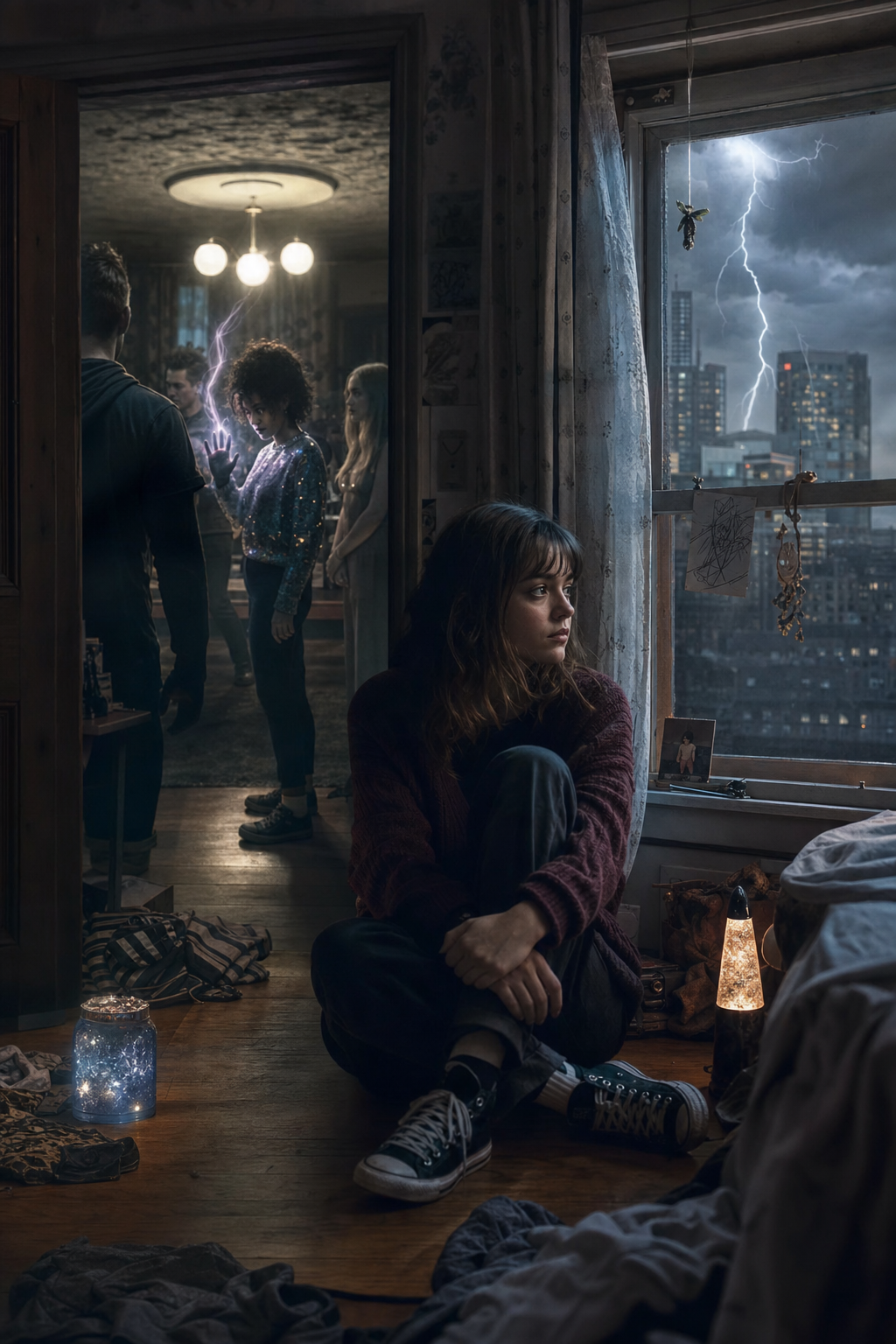
What Sticks
In a drab city split by arbitrary powers, a socially erased young woman hunts the stolen first impression that made her disappear.
The barista handed Mira a plain white cup with no name on it and called, “Next.”
That was it. No hesitation. No “sorry, what was it?” No Sharpie pause over cardboard. Just the cup, the steam, the tiny social deletion of a person who had been standing right there a second ago.
Mira took it and said, under her breath, “And the crowd goes wild.”
The barista had already moved on to a man behind her whose phone was hovering an inch above his palm while he scrolled. Powered, obviously. Not in an interesting way. Just enough to make the room bend a fraction toward him. Mira stepped aside before anyone could ask her to.
Outside, the sky was doing its usual thing: low, gray, damp-looking without committing to actual rain. The strip mall car park shone with old puddles. A trolley lay on its side near the bins like it had given up mid-errand.
She put one earbud in. The left one only. The right had died three weeks ago and she kept forgetting to replace them, which was probably symbolic of something deeply irritating.
“She exits the café,” Mira muttered into the cold, documentary voice pitched exactly for an audience of zero. “Armed with a coffee nobody named and a level of self-respect best described as seasonal.”
The automatic doors of QuickPrint shuddered open when she got close. They did that for everyone. It still felt generous.
Inside, the fluorescent lights buzzed with the tired determination of government infrastructure. The copy shop smelled of warm paper and dust and the specific plastic tang of laminated things. Two copiers. One printer the size of a coffin. A rack of cheap stationery no one bought unless their life had gone slightly wrong that day.
Mira shrugged off her coat, came behind the counter, and logged in to the till.
At 9:07, the first customer came in: a woman in a navy suit holding a stack of forms and talking into a headset that wasn’t connected to anything visible. Powered, probably. One of the subtle office ones. Thought-to-device, maybe. Or audio projection. Or maybe she was just committed to looking unavailable. Mira respected that.
“Can you do copies of these?” the woman asked, already setting them down.
“Absolutely not,” Mira said. Then, at the woman’s blink: “Yeah. Sorry. Yes.”
The woman didn’t laugh. Didn’t seem offended either. The joke just hit the air and dropped dead between them. Mira had long ago stopped expecting resuscitation.
She fed the papers into the machine. Powered-status registration forms, among other things. The heading sat there in block letters like a dare. VOLUNTARY DISCLOSURE OF MANIFESTED ABILITY. Most powered people filled it in because why wouldn’t they? It made things easier. Jobs. Housing. Insurance. Dating, probably. Add a little sparkle to the admin of being alive.
The woman took a call halfway through. “No, tell him if he wants the environmental audit by noon he can duplicate himself properly, not just the voice thing.”
Mira looked up. The woman didn’t notice.
“Cool,” Mira said to the copier. “Love a workplace with range.”
The copier jammed on page fourteen.
“Traitor.”
By 11:30 she had copied: two passports, one set of divorce papers, three CVs, a child’s project on the water cycle, and seven identical flyers for a man offering guitar lessons with the phrase NO POWER REQUIRED printed across the bottom in aggressively hopeful font.
At some point her manager, Raj, emerged from the back office with his shirt half untucked and said, “Can you cover lunch?”
“I am lunch,” Mira said.
He stared at her for a second too long, trying to place the sentence inside a person, failed, and said, “Right. Cheers.”
There it was. That little slide. Eyes landing on her and not quite gripping. Not invisibility. Worse, in some ways. Being looked at and not sticking. Like wet glass. Like trying to write on steam.
She was used to it. Which was not the same as fine.
At 1:15 she took her break in the stockroom because there was nowhere else to sit unless she wanted to eat a sad sandwich on the curb outside next to the vape shop. The stockroom had towers of printer paper, a broken swivel chair, and a tiny high window showing a square of white sky.
Mira sat on an upside-down box of envelopes and drank the coffee that had gone lukewarm in exactly the way all coffee eventually betrayed you.
“She retreats to headquarters,” she narrated softly, unwrapping her sandwich. “The operative reviews the morning’s intel. The enemy remains paper-based. Morale mixed.”
She checked her phone.
A stream of things she didn’t really care about: a man from school posting engagement photos with someone who could generate light from her hands in tasteful gold arcs; her brother’s latest video turning the family kitchen tiles bright blue because he was bored; an ad for some startup looking for “dynamic candidates, powered and non-powered welcome,” which translated roughly to powered preferred, non-powered tolerated if they had exceptional cheekbones.
She kept scrolling.
A local news clip started autoplaying with the sound off. Police tape. Corrugated metal. Yellow sodium light over a row of storage units. Mira’s thumb froze.
She turned the sound on.
“...break-in at a self-storage facility on the Granton ring road late last night. Several units were forcibly entered, though authorities say one appears to have been specifically targeted. The tenant, listed as L. Saddler—”
Mira sat up too fast and hit the back of her head on the low shelf above her.
“Jesus—”
Paper reams shifted overhead with a soft threatening slide.
On the screen: a brief shot of the facility gates, then a close-up of a police officer talking about ongoing investigations, then back to the row of units. Ordinary. Ugly. Concrete and metal and cheap locks and weather stains.
L. Saddler.
For a second the room thinned. Not visually. More like the world had stepped half an inch sideways and left her body needing to catch up.
She hadn’t thought about Lorna in— not never, obviously. You don’t do something like that at seventeen and then wipe it clean. But she had packed it away. Sealed it up. Put it on the mental shelf with all the other things too embarrassing to examine in daylight.
The storage unit. The folding chair. The shelves of little objects. The middle-aged woman with tired eyes saying, Are you sure? And Mira, seventeen and hot with the fury of being ordinary, saying yes before she could hear herself saying it.
The disposable camera.
She could see it with horrible clarity. Yellow plastic. Pharmacy cheap. She’d picked it because it was the first thing her hand landed on. That was the lie she told herself. The truth was worse. A camera was for seeing. She was about to make herself un-seeable and some stupid part of her had wanted a joke in the architecture.
“Excellent,” she said to the stockroom wall. “Very normal reaction to a lunch break.”
Her sandwich sat open in her lap, forgotten.
If the unit had been emptied, then the collection was gone.
If the collection was gone, then the camera was gone.
And if the camera was gone, then her impression—her old one, the one she had hated so much she’d paid to lose it—was out in the world. In someone else’s hand. On someone else’s shelf. Being held by a stranger.
Mira put the sandwich back in its packet with exaggerated care, like someone diffusing a bomb in a film with no budget.
At 1:43 Raj opened the stockroom door and said, “You coming back or—”
“Yep.”
“You all right?”
“The coffee’s bad.”
He nodded as if that answered something, because in fairness it answered enough.
The rest of the shift dragged itself by the ankles. Customers came and went. Mira copied things. Printed things. Smiled in the shape required. Her body kept doing the motions while the rest of her circled one thought hard enough to wear grooves into it.
The camera is gone.
At 5:58 she shut down the till. At 6:04 she left. No one said goodbye. Raj shouted something from the back office that might have been “See you tomorrow” or might have been a cough.
The bus stop smelled like wet fabric and chips. Three teenagers in school uniforms argued over whether one of them could actually slow time or just moved weirdly fast when stressed. A woman in a supermarket fleece stood smoking under the shelter while tiny arcs of static jumped between her fingers and the metal pole beside her.
Mira got on the bus, sat by the window, and watched the city go by in smeared evening light. The same ugly parade as always: takeaway fronts, betting shops, a boarded-up pharmacy, a church wedged between two off-licenses, blocks of flats with satellite dishes clinging to them like barnacles.
“She travels north,” she murmured. “Or south. Honestly who can tell anymore.”
No one looked at her.
At home, the building’s front light was out again. The lobby vending machine still contained the same bag of salt-and-vinegar chips stuck behind the coil in B7. They had been there so long she’d started to think of them as a roommate.
She pressed the button anyway.
The coil turned one-third of the way, paused, and stopped.
“Coward.”
The elevator was broken.
Of course it was.
She took the stairs, six flights, coffee still sour in her stomach. By the fourth her calves burned. By the fifth she was breathing through her mouth. On the landing before her floor she stopped and leaned her forearm against the concrete wall.
The wall was cold. Real. There.
The camera is gone.
Not gone exactly. Stolen. Moved. Untethered.
Want rose in her so suddenly it felt like a physical drop, like missing a step in the dark. Not abstract regret. Not the old low hum of this is my life now. Something sharper. Specific.
She wanted it back.
Not because it had made her happy. It hadn’t. Not because the old impression had been good. It hadn’t. Loud. Ordinary. Trying too hard. She knew all that without needing it read aloud.
But it had been hers.
Her hand flattened against the wall.
“She pauses on the landing,” Mira said softly, to the concrete, to her own pulse, to nobody. “The heroine considers her options. They are, currently, bad.”
She pushed herself upright and kept climbing.
Four years after a strange electrical storm gave powers to most of the city and left the rest behind, social status hinges as much on being visibly chosen as on what any ability can actually do. Mira Cole, an unpowered twenty-year-old who paid to have her own first impression removed, now lives as a social null that people see but cannot quite register. When the storage unit holding stolen impressions is robbed, she joins a ragged crew of damaged misfits to recover what she gave up, only to find the hunt is tangled with deeper questions about visibility, shame, and what it means to be known.
- —Mira Cole — A twenty-year-old copy-shop worker with no power and no social signal, Mira has spent three years as a living blank spot after choosing to have her first impression extracted. She survives with nonstop muttered commentary and sharp humor, then gets pulled into a search for the self she threw away.
- —Silas Ware — A withdrawn twenty-two-year-old whose storm power forces him to feel the worst moment in the life of anyone nearby. Dry, avoidant, and permanently armored behind headphones, he becomes the first person in years who can sense Mira clearly and cannot slide past her.
- —Thea Cross — A polished bartender who can project a chosen false impression onto one person at a time, making herself seem trustworthy, fascinating, or harmless on command. Her control is brittle, because years of tailoring herself to every room have left her unsure what anyone sees when the power drops.
- —Dex Okafor — Lorna Saddler's eager nineteen-year-old nephew can only tell when someone is lying about their name, a power so narrow it feels like a cosmic joke. Overhelpful and painfully earnest, he brings the missing inventory of stolen impressions and fights to prove he belongs in the room.
- —Webb Harlan — The thief who stole Lorna's collection can wear another person's extracted first impression and borrow the warmth or attention it creates. He is not a mastermind so much as a starving man using stolen social skin to feel something back from the world.
- —Lorna Saddler — A middle-aged woman who can perceive, extract, and store first impressions, Lorna built a quiet trade out of removing the labels people begged to escape. She now lives under the weight of what her work actually did, keeping a private box of the impressions she most regrets taking.
- —The Void: Mira's daily life as a social null unfolds in a stubbornly ordinary city where powers have only sharpened old hierarchies. When news breaks that the storage unit holding Lorna Saddler's collection has been robbed, the old shame she buried turns into a desperate need to get her impression back.
- —The Crew: At Lorna's flat, Mira collides with Silas, whose empathy power reads her wound with frightening precision, and the search widens as Thea and Dex are pulled into orbit. Their investigation reveals a black market in stolen first impressions and points them toward a man using those signals as a way to be felt.
- —False Signals: The crew tracks Webb through pubs, parties, and public spaces, where he moves through the city wearing borrowed warmth while Thea's own performance skills start to fray. As plans fail and tempers spike, the group keeps returning to Mira's cramped flat, and shared meals, small jokes, and mutual irritation harden into attachment.
- —The Floor: A heist at Webb's storage unit strips away the fantasy of a clean recovery when Mira's missing impression is nowhere to be found. In the aftermath, the hunt shifts from theft to confrontation, and each member of the crew is forced to expose the hidden self beneath the role they have been playing.
- —What Sticks: A direct meeting with Webb and a final visit to Lorna uncover where Mira's original impression has been kept all along. Faced with the chance to reclaim the old label the world gave her, Mira must decide whether recognition is something strangers grant on sight or something built slowly by the people who stay.
The voice is sharp, intimate, and darkly funny, with clean declarative prose that slips into longer, restless observations when characters have room to breathe. The sensory world is fluorescent, overcast, and aggressively mundane: takeaway grease, damp concrete, buzzing lights, bad coffee, and ugly rooms where impossible emotional damage becomes painfully ordinary.