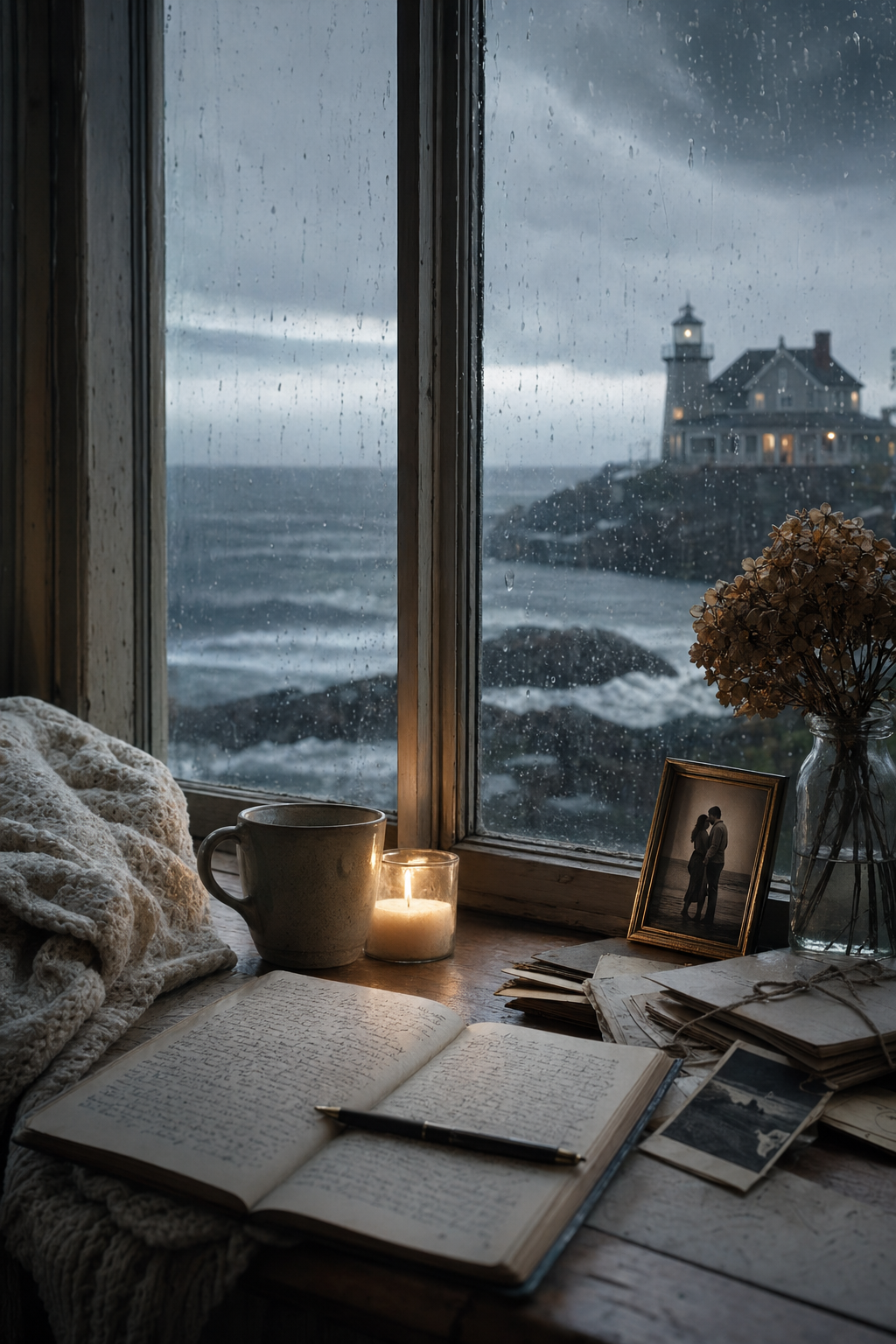
What Remains
On a storm-bound Maine island, a married woman and a photographer disturb the life she thought was enough.
Chapter 1
The kitchen smelled the way it always smelled in early October: coffee, dish soap, and the faint sweetness of maple leaves gone damp against the screen. Nora stood at the sink with her sleeves pushed to her forearms and her hands in warm water, looking out the east window while the last plate from last night dried in the rack beside her. The light had not fully decided what kind of morning it was. Gray still held at the edges of the yard, but a thin gold had begun to move through it, catching in the steam above her cup where it sat untouched on the counter.
Outside, Birch Lane was quiet. The maples had turned all at once this week, it seemed—red, exhausted orange, a yellow so clear it looked lit from inside. One leaf came loose and skidded across the porch boards. She watched it until it disappeared from the window's frame.
On the windowsill, the transistor radio murmured through static and weather.
“Coastal waters forecast for Penobscot Bay and outlying islands…” The voice was flat, practiced, familiar. Nora dried one hand on the dish towel and turned the volume up with one finger. “…northeast winds increasing tomorrow night. Seas building Thursday into Friday. Chance of gale conditions with a nor’easter tracking up the coast…”
She listened the way Ruth had taught her to listen to weather: not for drama, just for facts. Wind direction. Timing. The shape of what was coming.
Tomorrow night. Thursday into Friday.
She would already be on the island by then. Three days, as always. Close the cottage. Drain the pipes. Board the shutters. Check the roofline before winter set in for good. Carl would take her out midmorning tomorrow and bring her back Saturday, weather permitting. If the storm came faster than forecast, she might have to stay an extra night. It had happened before. The cottage could take it.
The plate in her hand was clean. She kept rinsing it anyway, thumb moving over the glaze in small circles while the warm water ran across her knuckles. In the sink, a cluster of soap bubbles drifted toward the drain and caught the light. For a moment they flashed green and violet and then went clear again. She stood there looking at them longer than made sense.
The coffee had gone from hot to merely warm by the time she picked it up.
Upstairs, Meg’s white-noise machine hummed through the floorboards, a soft electrical rush like distant surf. Ethan had left half an hour ago. She had heard the back door, then the familiar cough of his truck starting in the drive, then the brief metallic rattle of the tailgate he kept meaning to fix. It had all happened beneath sleep and inside habit. Twenty-two years of mornings had worn grooves through the house. Each sound knew where to go.
She crossed to the table with her cup and sat for a moment in the chair nearest the window. The butcher-block counter held the marks of years—knife scores, a faint ring from a hot pan, the darkened patch by the stove where olive oil had soaked in and been scrubbed away and soaked in again. Her hands knew every inch of this kitchen. They could find the mugs in the cabinet above the sink without looking, the drawer where the tea towels lived, the stubborn corner of the screen door that swelled in wet weather and stuck against the frame.
She loved this room. That was the difficulty. There was nothing false in the warmth of it.
On the refrigerator, old magnets held up older things: a crayon drawing of a blue house with smoke coming from the chimney, Meg’s second-grade turkey made from traced handprints, Sam’s fifth-grade science fair ribbon curling at the edges. The turkey had one googly eye left. The other had disappeared years ago. Nora looked at it every morning and never took it down.
The coffee in her cup had cooled another degree. She drank anyway.
The stairs creaked once overhead. Then again. Meg.
Nora set the cup in the sink and moved back into the day.
By the time her daughter came down, hair tangled, sweatshirt sleeves over her hands, toast was in the toaster and a pan was warming on the stove for eggs. Meg crossed the kitchen with the heavy-limbed gait of someone not yet fully returned to her body, dropped into a chair, and put her forehead briefly on the table.
“Morning,” Nora said.
A muffled sound from the wood.
Nora smiled despite herself and cracked two eggs into the pan. Butter hissed. The smell of coffee thickened in the room as she poured a second cup and set it by Meg’s elbow, mostly milk, mostly habit.
“Is it cold?”
“Enough,” Nora said.
Meg lifted her head. Her hair had fallen across one eye. “Are you still going tomorrow?”
“To the island? Yes.”
Meg wrapped both hands around the cup. “Even with the storm?”
“It won’t be bad until Thursday night.” Nora slid the eggs onto a plate and put it in front of her. “And if it is, the cottage has seen worse.”
Meg nodded, accepting this with the easy faith of someone who had grown up hearing that Hark Island was both place and fact. Something that existed in the family the way weather did. Nora went every October. The house got closed. Winter came. In spring it opened again.
“You want a ride or are you driving?” Nora asked.
“I’m driving.” Meg tore toast into pieces and ate without looking up. “I have student council before homeroom.”
Her phone, face down beside the plate, lit once and went dark again. Nora saw the glow and looked away. Outside, another leaf let go.
“Your English paper come back?”
Meg nodded. “A.”
“That’s good.”
“Mr. Donnelly said my conclusion was too abrupt.”
“Was it?”
A shrug. “Maybe.”
Nora sat across from her with her own coffee and watched her eat. Seventeen. Senior year. There were mornings when Meg still looked, at a certain angle, like the child who had once stood on a chair in this same kitchen and insisted on stirring muffin batter with both hands around the wooden spoon. And then she would look up and there would be the face of a woman not yet fully visible but already there, waiting in the features.
“Mom,” Meg said, still looking at her plate, “did Nana Ruth ever live on the island all year?”
Nora felt something small move inside her, like a latch touched in another room.
“Yes.”
“Alone?”
“Yes.”
Meg looked up then. “Wasn’t that hard?”
Nora turned her cup once on the table, feeling the warmth through the ceramic. “For most people, probably.”
“For her?”
“For her it was where she wanted to be.”
Meg considered this. “Huh.”
The phone lit again. This time she picked it up, glanced at the screen, and stood.
“Can you leave in ten?” Nora asked.
“Yeah.” Meg carried her plate to the sink, kissed Nora quickly on the cheek in passing—already moving toward the mudroom, the keys, the rest of her life—and was gone up the back hall before Nora could answer with more than a hand at her shoulder.
A minute later the side door opened, shut. The gravel in the drive crackled under tires. Then silence again.
Nora stood in the kitchen with one hand on the edge of the counter.
The house had a different quiet after everyone left. Not emptiness. Shape. The rooms settling into themselves. The refrigerator humming. A pipe giving a soft knock in the wall. Wind moving the leaves against the porch screen with a dry, papery sound.
She rinsed Meg’s plate. Wiped the table. Set the pan to soak. Then she went upstairs to pack.
The bedroom she shared with Ethan still held the warmth of sleep under the rumpled comforter. His side of the dresser was a neat geography of practical things: wallet tray, work watch, folded receipts, a tape measure he must have emptied from his pocket last night and forgotten to bring back down. Her side held a hairbrush, a hand cream she kept meaning to use, a stack of library books with slips sticking out from the tops.
She packed the same canvas duffel she packed every October. Wool socks. Work jeans. Flannel shirts. Rain gear. Toiletries. The paperback novel she had been carrying around for three weeks and had not opened. The small toolbox for the cottage—screwdriver, wrench, extra screws, flashlight, batteries. She paused over the flashlight, remembering the weather report, and added two more batteries.
At the bottom of the closet, behind a pair of boots she no longer wore, sat the old yellow slicker Ruth had kept at the island for years and which Nora had brought home after her death and never used. The rubber had stiffened at the shoulders. She touched the sleeve and left it where it was.
Downstairs again, she stood at the counter with a pad of paper and wrote in her usual hand:
Back Saturday. Meatloaf in the fridge.
She looked at the note after she tore it off. The letters leaned slightly right, the way they always had. She set it by the sugar bowl where Ethan would see it when he came home tonight.
For a second she thought of adding more. Love you. Call if you need anything. Don’t forget Meg has the game Friday.
Her pen hovered above the paper and then lowered without touching it. The note was enough. It had always been enough.
She carried her cup to the sink and stopped again at the window.
The light had strengthened while she was upstairs. It lay clean across the counter now, catching in the grain of the wood, turning the steam from her coffee pale gold before it vanished. Dust moved in it. Not much. Just enough to make the air visible.
She stood there with the cup cooling in her hand and felt, without yet knowing it, the morning hold for one beat longer than it should have.
Every October, Nora Caldwell-Blake leaves her warm, carefully built life in inland Maine to close her late grandmother's cottage on a small island being eaten away by the sea. This year she arrives to find Liam Hale, a photographer studying the island's erosion, already staying there with permission from her family's trust. Trapped together by a nor'easter, Nora is forced to face the buried artistic self she set aside for marriage, motherhood, and duty.
- —Nora Caldwell-Blake — Nora is a 47-year-old middle-school art teacher, wife, and mother whose life in Marfield is loving, decent, and quietly incomplete. Once a gifted painter shaped by summers on Hark Island with her grandmother, she has spent seventeen years burying the most vital part of herself beneath ordinary devotion.
- —Liam Hale — Liam is a 50-year-old fine-art photographer known for documenting landscapes stripped down by time and loss. His patient, exacting way of seeing unsettles Nora because he recognizes the artist she stopped allowing herself to be, even as he carries his own regrets about choosing work over family.
- —Ethan Blake — Ethan is Nora's steady, capable husband, a contractor who expresses love through reliability, care, and the small repairs of daily life. He is no villain; his tragedy is that he loves Nora fully within the limits of what he has ever been allowed to see.
- —Ruth Caldwell — Ruth, Nora's late grandmother, was a fiercely devoted island painter who taught Nora to tell the truth in art rather than chase prettiness. Though dead, she haunts the cottage, the studio, and the story as the clearest witness to Nora's lost self.
- —Meg Blake — Meg is Nora's perceptive teenage daughter, old enough to sense that her mother once had a larger life than the one she now inhabits. Her unguarded questions press against truths Nora has spent years avoiding.
- —Sam Blake — Sam is Nora's affectionate college-age son, practical and easy in the way of a child who has always trusted his mother's steadiness. He represents the real warmth and history of the life Nora built.
- —Carl Dyer — Carl is the taciturn lobsterman who carries Nora to and from Hark Island each year. As the only regular link between mainland and island, he quietly marks the passage between Nora's settled life and the stripped-down place where she cannot hide.
- —The Crossing: Nora leaves her familiar October routines in Marfield and travels to Hark Island for her annual ritual of closing the family cottage for winter. The island, already charged with memory, is immediately unsettled by the discovery that a stranger is living in the house she expected to have to herself.
- —The Intrusion: Liam Hale's unexpected presence forces an uneasy intimacy inside the cottage's cramped rooms. As they share meals, chores, and weather, Nora begins to recognize in his photographs and his attention the same truthful eye that once defined her own work.
- —The Storm: A nor'easter seals them on the island, cutting off easy escape and shrinking the world to firelight, rain, and shared silence. In that confinement, small disclosures deepen into artistic recognition, and Nora is drawn toward the locked-away identity she has spent years refusing to name.
- —The Opening: Confronted by her grandmother's tools, the eroding shore, and Liam's uncompromising way of seeing, Nora finally admits that she did not stop being a painter simply because life became busy. When she puts charcoal to paper again, the act breaks open years of grief, longing, and hunger, and the bond between them turns fully intimate.
- —The Carrying: When the storm clears, time resumes and the island can no longer hold them outside the claims of ordinary life. Nora must close the cottage, part from Liam, and return home with a knowledge she cannot explain away: the self she buried is still alive and will now have to be carried inside the life she chose.
The voice is intimate, restrained, and luminous, staying close to Nora's body and perception. The prose favors weather, light, touch, and silence over overt declaration, giving the story a hushed, coastal melancholy. Its sensory world is built from salt air, stove heat, rain on tin, old wood, coffee, and the lingering scent of paint.