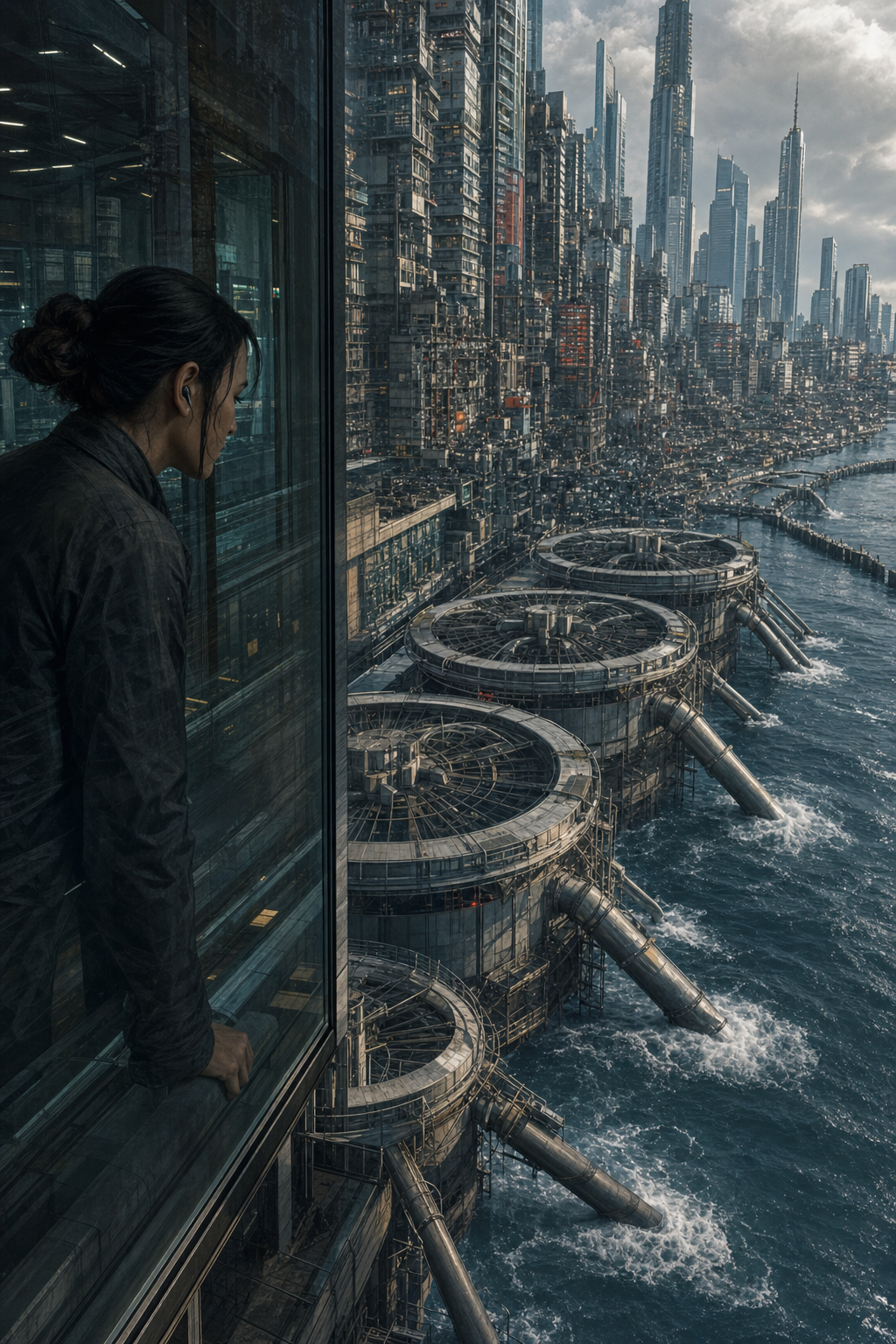
The Weight of Still Water
In a desal-dependent megacity, the same pipes that keep millions alive also dose the poor against grief—and rebellion.
Chapter 1
The Levothene order came through at 05:42, before the first intake surge reached full pressure.
Noor Qadir was already on the mineralization floor of Intake Three, standing between the AffiBind injection manifold and the calibration console while the plant woke around her. Reverse-osmosis pumps built their pitch in stages, a low mechanical thrum resolving into the steady frequency she had known long enough to hear as information rather than noise. Intake Three always started rougher than Intake One or Two. Older membranes. Lower replacement priority. More scale in the secondary lines. The plant served the Lower Tiers and public infrastructure, which meant its failures were expected to be survivable.
She tapped the directive open on her console.
PSB ADJUSTMENT ORDER / HEAT EVENT PREPARATION / ALL-TIER DOSAGE REVISION LEVOTHENE TARGET: 17.2 ppb PRIOR BASELINE: 16.7 ppb EFFECTIVE IMMEDIATELY
A three-percent increase.
Noor read it once, then again, not because the order was unusual but because dosage shifts were part of the plant's daily weather and weather mattered. Seventeen point two at Intake Three would deliver slightly lower by the time the water reached the bottom floors if the corroded secondary lines behaved as predicted. Slightly higher if the AffiBind bond held more efficiently than last week’s test curve suggested. Enough variables remained in a city this size that precision was always partly aspiration.
She keyed the new target into the console. The calibration screen split into its usual panels: calcium reintroduction, magnesium balance, pH correction, Levothene concentration, AffiBind ratio. Numbers moved. Servo valves adjusted with soft pneumatic clicks. Somewhere behind the concrete wall, treated water entered the mineralization chambers stripped clean of salt and almost everything else. Human-use water had to be rebuilt after purification. Mineral by mineral. Compound by compound.
The AffiBind feed lagged by 0.4 seconds before stabilizing. Noor watched the line settle.
“Morning,” said Javier from the adjacent station, not looking up from his flow report.
“Morning.”
“Bureau nervous already.”
“They’re always nervous.”
He gave one breath of amusement through his nose. “Forecast says forty-nine by noon.”
“Forty-seven,” Noor said. “Fifty in the lower corridors if the cooling sheds load again.”
Javier nodded as if this were a correction of a decimal, not a mortality estimate.
Noor logged the order, confirmed the new ratio, and moved down the catwalk toward the membrane diagnostics bay. The air on the mineralization floor smelled the way it always did: antiseptic, metallic, and faintly bitter where the treatment chemicals aerosolized around seals and joints. Below the catwalk, stainless piping crossed and re-crossed in parallel runs, labeled in municipal blue and hazard yellow. Treated water. Brine waste. Mineral feed. Levothene line. AffiBind line. Every surface carried a film of condensed labor.
At Diagnostics South, a maintenance flag pulsed amber over the Lower Tier distribution branch. Noor opened it.
SECONDARY LINE MEMBRANE DEGRADATION / FLOORS 1–7 ACCELERATED FOULING RATE: +11% ABOVE MODEL RECOMMENDED ACTION: HOUSING INSPECTION / CARTRIDGE REPLACEMENT
She expanded the trend graph. The decline had been gradual for six weeks, then sharper over the last eight days. Enough to affect consistency downstream. Not enough to trigger emergency priority over commercial-zone filtration or the high-pressure lines serving the administrative district. The system had its own hierarchy of urgency, and it matched the city’s.
Noor filed the repair order anyway, adding a note on treatment variability risk. She knew where it would land in the queue. Below anything that threatened top-tier continuity. Below anything visible from a boardroom.
A hiss of pressure equalization ran through the line beneath her feet. She rested a hand on the rail and felt the vibration through the steel. The plant was coming fully online now, all three intake trains moving toward morning peak. Out beyond the walls, sixty miles south, Gulf water was being dragged through conduit and prefilter and membrane until it became a city.
Her shift passed in parts measured by gauges. Conductivity readings. Pressure differentials. A brief alarm from a mineral feed pump that resolved into a sensor fault. At 08:17 she approved a temporary bypass on a fouled tertiary line. At 09:04 she reviewed the previous night’s quality assays and noted a slight flattening in the magnesium profile for the lowest distribution branches. At 10:26 she watched the Levothene concentration hold steady at target and thought, as she often did, that the plant’s mercy was statistical. People lived because the numbers stayed inside tolerance.
At 11:10 she took her break standing up in the shadow of the east wall, drinking from a stainless bottle filled at the staff tap. Intake Three water, fully treated, same as the city’s, but fresher by hours because it hadn’t yet spent itself in the distribution lines. It tasted of almost nothing. Mineral-balanced. Clean. The taste of a process completed correctly.
“Did you see the board this morning?” Javier asked, joining her with his own bottle.
“No.”
“Fourteen new overnight. Heat exposure mostly.”
Noor nodded.
“South corridors again,” he said. “Lower cooling failure.”
“Which blocks?”
He named them. One of them was the block where Tariq had died three years earlier, when a deferred cooling repair turned a service corridor into an oven.
Noor swallowed water that was colder than anything outside these walls had a right to be. “Maintenance?”
“Deferred, probably.” Javier lifted one shoulder. “Always is.”
The break ended. They went back to work.
At 14:38, Noor signed off the next shift handover and left through the plant’s west exit into a wall of heat that made the inside of her nose tighten. The light outside Intake Three was white with thermal weight. Concrete, rail, pipe casings, the transit barrier three blocks away—everything stored the day’s heat and returned it to the body. The city in summer was less an environment than a transfer system.
She adjusted the strap of the empty canister hanging at her side and started toward the station.
The route ran past Building 7-South, one of the older Lower Tier towers, where the municipal memorial board occupied a recessed panel beside the lobby entrance. The screen was large enough to be unavoidable and cheap enough to fail by columns. A line of dead pixels ran down the left edge. The rest of it worked perfectly.
Names scrolled upward at a fixed rate.
Surname. Given name. Date. Cause code. Status.
HE. IF. WC.
Heat exposure. Infrastructure failure. Water contamination.
PROCESSED.
Noor slowed without deciding to. The board’s refresh cycle advanced and there he was near the lower third of the list, where older entries sank as newer ones accumulated above them.
QADIR, TARIQ M. 2079.08.14 HE PROCESSED
Same font as everyone else. Same municipal spacing. Same white text on blue-grey background. Three years compressed into four lines and a code.
She stood there and counted because counting was what her mind did when it encountered anything it could not alter.
One. Two. Three.
The lobby behind the glass smelled faintly of overheated wiring and chloramine from the sub-basement purification unit. A woman came out carrying two liters in a transparent ration pouch. A child crossed behind her, barefoot, too fast for the heat. The board kept moving.
Four. Five. Six.
A sensation sat under Noor’s sternum, dense and familiar. Not sharp. Not enough to interrupt function. A weight without edges. She had carried it long enough to classify it with other bodily nuisances: posture strain, acid, the residue of too much caffeine at the start of a double shift. Some days it thickened when she saw Tariq’s name. Some days it did not. Either way, the day continued.
Seven. Eight. Nine.
Above Tariq now, fourteen new names from overnight. Heat had moved through the lower corridors again and the city had registered the output.
Ten. Eleven.
Noor shifted the canister strap higher on her shoulder and walked on.
The transit platform was crowded with second-shift workers and daytime ration carriers moving in opposite directions. Overhead, exposed municipal pipes ran beside the elevated track, insulated in patched foam. One section had been recently resealed; the solder shone bright against older dull metal. Infrastructure always told on itself if you looked long enough.
She rode up to Mid Tier transfer, then walked the rest because the stairwell in her building was faster than waiting for the lift during late heat. By Floor 9 her shirt was damp under the arms and along her spine. By Floor 12 the stairwell smelled stronger than usual of treatment chemicals drifting up from the lower purification station—chloramine and something flatter beneath it, almost chalky. They were compensating for a stressor somewhere. Membrane wear, maybe. Source-line bacterial count. She filed the thought automatically and kept climbing.
Her apartment on Floor 14 was a narrow rectangle of concrete, utility composite, and habits worn into place by repetition. Cooling vents along the ceiling pushed air that was livable rather than comfortable. She filled her domestic canister from the wall tap. The meter clicked in liter increments. The water ran clear. She drank a glass standing at the sink.
Still almost no taste.
She ate lab-grown protein grain with broth reconstituted from recycled stock and checked the maintenance queue on her home terminal out of reflex she never called work. Her repair request for the Lower Tier membranes had already been assigned a low-priority review window: eleven days.
Eleven days meant longer at current heat.
She read the line twice, then archived it. There was no one to escalate to without making it a formal challenge, and formal challenges consumed favors and visibility. Visibility was vulnerability in institutions that ran on technical competence and political obedience in equal parts.
Outside, somewhere below Floor 10, a siren rose and cut off. The sound did not sharpen her pulse. It joined the city’s other operating frequencies—the plant hum in the distance, the cooling system’s intermittent choke, the water riser in the wall behind her kitchen making its evening pressure adjustment.
Noor washed her bowl, set it to dry, and stood for a moment with her hand braced on the counter while the sternum-weight returned for no reason she could name.
Not pain. Not exactly.
Just pressure.
She looked at the water glass in her hand, at the faint mineral residue drying where a drop had run down the outside and evaporated in the apartment heat. In the plant, the numbers had held all day. Seventeen point two. Correctly balanced. Correctly bound. Correctly delivered.
Down on the lower floors, the old membranes would keep degrading until someone above their altitude decided degradation had become important enough to count.
In the wall, the riser gave a soft hydraulic knock as the building shifted demand.
Noor set the glass in the sink and went to check the next day’s forecast.
Fifty by noon now, not forty-nine.
The revision sat on the screen in clean municipal type, as neutral as the memorial board, as neutral as dosage orders, as neutral as any system that had learned to turn bodily risk into information.
She read the number, committed it to memory, and began calculating what the plant would need to hold.
In 2082, Punto Seco survives on desalinated water controlled by rival consortiums and distributed by floor, with the poorest residents drinking a compound that selectively suppresses grief. Fen Ayari, a lower-floor membrane technician at Plant No. 4, has spent her life inside that chemically blunted world without knowing what has been taken from her. When failures in the system expose a hidden link between water production and emotional control, Fen is drawn into a dangerous effort to break the loop that keeps the city compliant.
- —Fen Ayari — A 27-year-old membrane maintenance technician on Floor 6, Fen knows desalination hardware better than anyone around her and works at the very plant that sustains her district. She has lived on grief-suppressed water her entire life, making her practical, reliable, and emotionally intact in every way except the one the system has stolen.
- —Nuria Delgado — A senior LPC process engineer living on Floor 22, Nuria rose from the lower floors into the administrative tier by mastering the city's water architecture. When internal data reveals that treatment levels are calibrated for compliance rather than care, her professional loyalty begins to collapse under the weight of what her expertise serves.
- —Davi Okonkwo — A data analyst at the Directorate of Municipal Hydration, Davi reads the city's water reports closely enough to see design hiding inside official numbers. Formerly raised on lower-floor water himself, he becomes the witness who can prove the system's patterns but lacks an obvious way to act on them.
- —Oksana Marchetti — A former LPC biochemist now running an informal testing clinic on Floor 3, Oksana helped develop the delivery system for the compound that erased grief. She holds the biochemical map of the city's central mechanism, but years of forced exposure have chemically dulled the urgency that once drove her to resist.
- —Rami Nassar — A 19-year-old sub-grade water trader, Rami moves through the city below official notice, carrying water through flooded corridors and tower gaps. A rare genetic resistance leaves him partly able to feel grief, a hidden difference he has always mistaken for weakness.
- —The Hum: Punto Seco runs on a brutal equilibrium: desal plants feed the towers, floor level determines caste, and death is processed without mourning on the lower tiers. Fen works inside Plant No. 4, while Nuria and Davi each begin noticing anomalies in dosage, compliance metrics, and maintenance decisions that do not fit the public story.
- —The Crack: A cascade failure at Plant No. 4 exposes the cost of deferred maintenance and reveals a hidden pharmaceutical branch inside the water system's brine-processing infrastructure. As allocation cuts deepen and suppression intensifies, Rami experiences grief directly and Oksana's buried knowledge starts to connect the chemical, political, and mechanical layers of the city.
- —The Assembly: Fen, Nuria, Davi, Oksana, and Rami converge piece by piece, each bringing a part the others lack: access, data, chemistry, mobility, and feeling. Through smuggled clean water and hard-won trust, Fen encounters grief for the first time and learns that the same membrane system producing water also generates the precursor that keeps the lower floors emotionally leveled.
- —The Turn: With the mechanism finally legible, the group builds a plan to sever precursor production without stopping freshwater output, while Davi works to expose the truth and Nuria risks the access that made her useful. The city tightens around them through shortages, security protocols, and bureaucratic self-defense, turning every act of coordination into a race against the system's own immune response.
- —Still Water Breaks: The attempt to disrupt the dual-extraction chain pushes suppressed feeling back toward the population that has been denied it, beginning with those closest to the failing infrastructure. As grief returns and old losses gain weight, private damage becomes collective recognition, and the struggle shifts from seeing the machine clearly to surviving what clarity unleashes.
The prose is precise, tense, and materially grounded, using the language of hydrology, maintenance, and chemical treatment without losing human immediacy. Heat, mineral taste, pump-hum, chloramine sting, and flooded concrete give the story a dense sensory signature. Its voice is unsentimental but deeply felt, treating infrastructure as both setting and instrument of pressure.