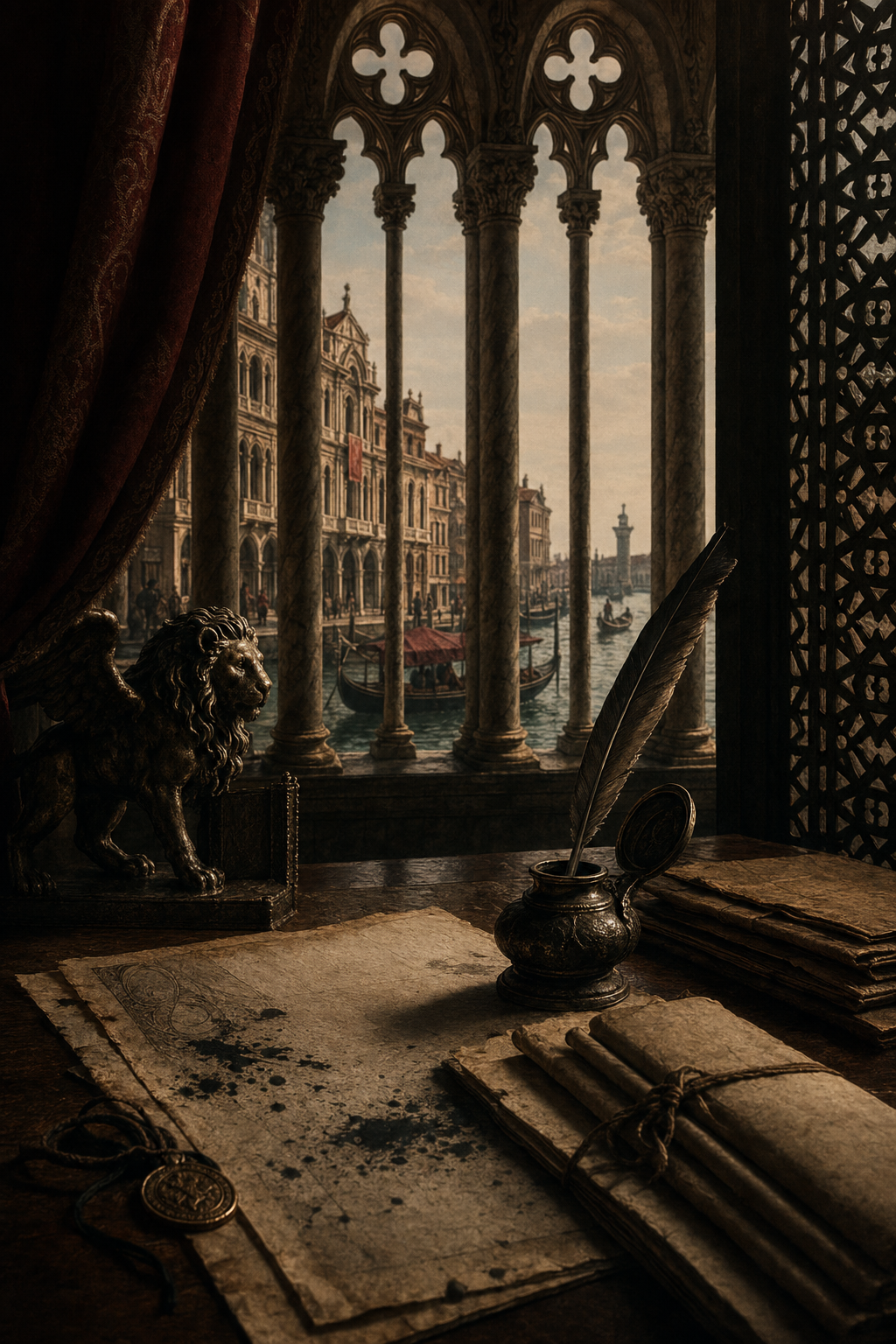
THE WEIGHT OF INK
In 1511 Venice, an invisible state secretary detects a forged trail that could ruin a great house and expose his own dangerous brilliance.
Chapter 1
The brazier in the Ducal Chancery had not yet been lit, and the room held the night's cold the way stone holds old instructions: without complaint, without haste, and for longer than was comfortable to the flesh. Matteo Soranzo set his leather case on his desk, drew off his gloves, and stood a moment with his hands flat on the wood, letting his fingers register the familiar scratches in the elm. The desk had belonged to two secretaries before him. He knew where each had pressed hardest with a pen. He knew which corner warped in damp weather. He knew, by touch alone, where the wax from a broken seal had once spilled and been scraped away.
Beyond the shuttered windows, the lagoon moved against the palace foundations with the soft, patient sound of water worrying stone. Inside, the Chancery was empty except for rows of desks, dark presses of walnut and cypress, and the shelves where the Republic's memory slept in leather, parchment, and dust. Venice still lay in darkness. The bell for matins had not yet sounded at San Marco. Matteo preferred this hour for that reason. At this hour the city had not begun its performances.
He struck flint, lit the candle on his desk, and opened the overnight dispatch bag.
The bag had come in from the courier service after midnight, sealed at Padua, brought by water before dawn, and left with the palace porter for the Chancery's first secretary. Matteo broke the cord, tipped its contents onto the desk, and began to sort. Customs declarations from Chioggia. A report from the Arsenal on timber deliveries delayed by weather. A diplomatic packet from Ferrara, still tied with blue silk. Two private petitions improperly sent through official channels. A grain price summary from the Rialto markets.
His hands moved without waste. Urgent matters to the left. Routine business to the right. Foreign correspondence in a separate stack. Anything for the Senate session placed nearest his elbow. The order comforted him not because it was simple, but because it was exact. A government, properly handled, was a matter of exact placements.
At the bottom of the pile lay a fleet dispatch.
Matteo paused only long enough to note that he had not requested one.
The paper was folded in the naval manner, broader than the Chancery's standard foolscap, the outer leaf marked with the reference of a routine transfer from the fleet archives. That in itself was not unusual. Since the war there had been constant movement between offices: inventories revised, losses reconciled, old commands compared against new expenditures. The Republic, after nearly dying, had developed a mania for looking backward with official seriousness. Every committee wanted files. Every magistracy wanted records. Every senator wanted to know whose fault the disaster had been, provided the answer could be made to point somewhere useful.
Matteo broke the seal.
The wax was correct. Not merely red, but the darker crimson used by the provveditore d'armata during the crisis of 1509, when ordinary supplies had briefly run low and the Chancery had substituted from a reserve batch bought in haste from a Murano factor. Matteo remembered the purchase because his father had complained, years before, that cheap wax took poor impressions. This wax had taken the impression well. The seal was clean. The paper was right for the period. The hand was a competent chancery cursive, a little hurried, as field dispatches often were.
He unfolded the sheet and read.
A routine report concerning galley positions during the lagoon defense. Weather. Visibility. Orders relayed from the flagship. In the third paragraph, a note on the maintenance of reserve vessels at the western approach. The phrasing was ordinary enough that another man might have read past it. Matteo did not. He knew the lagoon defense files as a priest knows his office. He had copied dispatches from that campaign himself, bent over a desk not far from this one while wet-mantled messengers stamped salt water across the floor.
He read the paragraph again.
Then he looked to the upper right corner of the first page, where the Chancery's internal filing notation had been entered.
The notation was correct in form: three numerals, a stroke, a letter code, another numeral. It would place the document exactly where it belonged within the archive's logic. It should have reassured him. Instead he set his forefinger on the ink and traced the characters lightly, feeling the slight ridge the pen had left in the paper.
The hand was wrong.
Not clumsy. Not obviously false. The numbers were well made, the angle of the slant within accepted habit, the pressure controlled. Yet it was not his hand.
Every document in the lagoon defense files that had passed through the Ducal Chancery during those months bore Matteo's filing notation. He had entered them himself, often in the half-light before dawn, often after midnight, sometimes with fingers cramped so badly he had to straighten them one by one before picking up the pen again. He knew the pressure of his own hand, the way his sevens leaned, the slight narrowing he gave to the second numeral when space ran short. This notation had been written by someone else.
He held the sheet nearer the candle.
Nothing else changed. The room remained cold. Water touched stone below. Somewhere in the palace a door closed, distant and heavy. Matteo laid the dispatch flat on the desk and read it a third time, slower now, not for meaning but for construction. The hand imitated urgency well. The seal had been impressed with confidence. The fold was exact. Only the notation betrayed it, and only to someone for whom notations were not clerical litter but signatures of custody.
He placed the dispatch aside.
A younger man might have reached for alarm in that moment, or satisfaction, or fear. Matteo did none of these things visibly. He drew the brazier closer with his foot, set kindling beneath it, and touched the candle flame to the shavings. Fire took reluctantly, then with a low breath. Heat would come slowly. He returned to the dispatch bag, sorted the remaining papers, and began drafting the agenda for the morning's Senate session.
Grain imports first; the matter had waited since Tuesday. Then Arsenal expenditures. Then a petition from the silk guild requiring formal acknowledgment and no discussion. His pen moved in a narrow, disciplined line. The suspicious dispatch lay at the top right corner of the desk, within reach but not touched again.
By the time the first of the other secretaries arrived, the room had altered from darkness to dim utility. Candles had been lit at three more desks. A clerk crossed to the windows and opened the shutters a hand's breadth, letting in the black-blue of predawn over the Piazzetta. The Chancery's ordinary noises began: chairs set down, boxes opened, the brief cough of a man not yet warm, the murmur of greeting among copyists.
Nicolò Balbi arrived with ink on one cuff and an apology already on his face.
"I overslept, Messer Soranzo."
"You are early," Matteo said, without looking up.
Nicolò glanced toward the windows, where the light was still hardly light at all, and smiled despite himself. He was twenty-six and still capable of smiling in cold rooms before dawn. His handwriting was excellent. This quality excused much in a copyist.
He set his own case on the neighboring desk and began arranging fresh foolscap. His movements were quick, earnest, not yet moderated by years of labor into economy. Matteo, hearing the rustle of paper, said, "The Ferrara packet goes first to the diplomatic desk. The customs declarations remain here. There is a Senate agenda to be copied once I have finished it."
"Yes, Messer Soranzo."
Nicolò moved to obey. As he passed Matteo's desk his eyes flicked, as any Chancery man's would, to the papers laid out in working order. The fleet dispatch lay where Matteo had left it. Nicolò's glance slid over the seal and away again. He saw a routine naval report, nothing more. Matteo registered, without surprise, that the young man's eye did not linger on the notation.
From the corridor came the first bells of San Marco.
The city would be waking now. Servants crossing bridges with market baskets. Patricians' households beginning the controlled disorder of dress, breakfast, and departure. Barges nudging at landing steps along the Grand Canal. Senators entering their day with faces arranged for public use. Venice, which was a state before it was a city and a machine before it was either, beginning again the work of appearing serene.
Matteo sanded the final line of the agenda, shook the excess into the tray, and sat for a moment with the quill between his fingers.
There was a simple explanation for the dispatch. The files from 1509 had been disturbed repeatedly in the past two years. Naval clerks borrowed what they should not. Registers were mislaid and restored. Men under pressure took shortcuts. A document might have been copied elsewhere and later inserted into the transfer batch with every appearance of correctness. Such things happened. Institutions survived not because errors were impossible, but because errors could be traced.
Yet the notation remained.
He picked up the dispatch once more, folded it carefully, and slid it into a separate portfolio of papers requiring personal review.
Nicolò returned with a stack of fresh-cut sheets. "Shall I carry the grain summaries to the Senate clerk, Messer Soranzo?"
"In a moment."
Nicolò hesitated, then said, "Is something wrong?"
Matteo looked at him. The young man had asked without calculation. That, too, was a form of youth.
"No," Matteo said. "Something has been filed."
Nicolò, who did not yet understand that these could be different conditions, nodded and took the grain summaries from the desk.
The brazier had begun to give off heat. Day had found the room, if not yet warmth. Matteo opened the portfolio again, drew out the fleet dispatch, and let his fingers rest for one instant on the unfamiliar notation in the upper corner.
Then he set the paper before him and began to read it as if it were the first dangerous thing he had ever seen.
Venice in 1511 is a surveillance state disguised as a serene republic, where documents shape truth and reputation can outlast blood. Matteo Soranzo, a senior ducal secretary from the hereditary citizen class, has spent his life serving the Chancery's archives from the shadows. When altered records begin to rewrite the wartime legacy of a dead admiral, Matteo becomes the only man able to trace the forgery—and the one least able to reveal what he knows without making himself a threat to the machine he serves.
- —Matteo Soranzo — A forty-four-year-old ducal secretary whose ink-stained hands and exacting memory make him one of the Republic's hidden custodians. Dismissed as a harmless clerk, he quietly understands Venice's political machinery more completely than many senators, and must decide whether truth is worth the cost of visibility.
- —Lorenzo Contarini — A young patrician newly elevated to the Council of Ten, heir to one of Venice's oldest dynasties and son of the admiral whose reputation is under attack. Warm, intelligent, and genuinely fond of Matteo, he rests his identity on a heroic version of his father that may not survive scrutiny.
- —Caterina Morosini — A senator's widow in black mourning, outwardly retired and inwardly sustained by a private intelligence network built from political wreckage. She and Matteo share a rare intimacy of perception, but her survival has left her compromised by the very faction moving against the Contarini.
- —Andrea Loredan — A seasoned senator and faction leader who believes Venice must break the dominance of old houses to survive after Cambrai. Efficient, persuasive, and frighteningly lucid, he is not a cartoon villain but a patriot willing to revise the record by force.
- —Nicolò Balbi — Matteo's young assistant in the Chancery, gifted with a copyist's hand and still innocent enough to believe the archive is incorruptible. He reflects the man Matteo once was and sharpens every choice about secrecy, mentorship, and risk.
- —Giacomo Contarini — The dead admiral at the center of the struggle, present only through testimony, memory, and documents. His public legend as a wartime hero is the target of the conspiracy, while his private writings reveal a more painful and human truth.
- —The Machine: In the cold routines of the Ducal Chancery, Matteo notices a single filing notation that should not exist and discovers that key naval records have been altered. As a Senate review of wartime commands is proposed, he realizes the anomaly is part of a deliberate campaign against the late Admiral Giacomo Contarini.
- —The Pattern: Tracing missing files, vanished copyists, and carefully coordinated political moves, Matteo sees that the attack on the Contarini family is systematic and institutional. His conversations with Lorenzo and the watchful widow Caterina Morosini turn the matter from archival irregularity into a personal and moral crisis.
- —The Hidden Truth: Caterina reveals that Venice has destroyed men this way before, through rumor, procedure, and authenticated lies. As Matteo maps the full architecture of the plot, he also uncovers Giacomo Contarini's private letter about a brutal wartime decision, proving that the truth he wants to defend is more troubling than the myth.
- —The Countermove: Forced out of pure observation, Matteo uses the Chancery's own channels to smuggle authentic evidence into the Senate review without openly exposing himself. At the same time, he is drawn into a dangerous intimacy with Caterina and a philosophical confrontation with Andrea Loredan, who insists that history is only the Republic's latest useful story.
- —The Weight: The forged case begins to collapse under scrutiny, but restoring the true record also exposes a fatal gap that points toward Giacomo's sealed private correspondence. The Contarini name survives public ruin, yet Matteo, Lorenzo, and the archive itself are permanently changed, and the final movement returns Matteo to his desk as another suspicious document enters the machine.
Measured, intelligent, and atmospheric, the prose moves with patient precision through rooms, records, gestures, and silences. The language is elegant but unsentimental, grounded in administrative detail, stone, wax, water, and ink. Venice feels tactile and watchful throughout: damp archives, cold chambers, candle smoke, canal light, and the constant pressure of being observed.