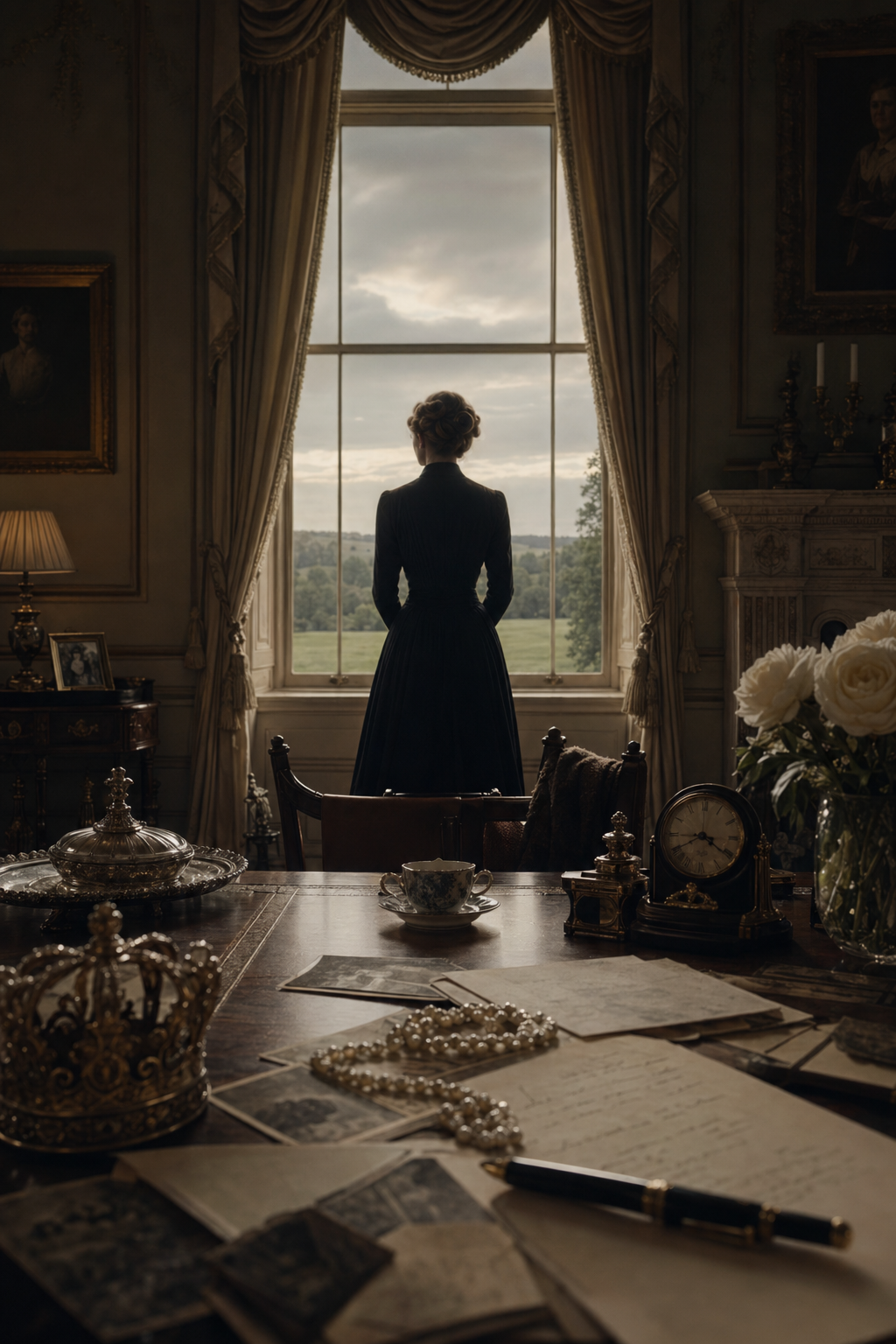
THE WEIGHT OF HOURS
In a fading English estate ruled by ritual, a widow must stage one perfect dinner as whispers of sale threaten her life's work.
Chapter 1
Eleanor woke before the house, as she always did, and lay still in the dark for three breaths, counting them not because the counting mattered but because the interval did. The room held the night's last cold. On the chair by the window her dressing gown waited, folded rather than draped, the sleeves aligned with a care that would have looked excessive to anyone who had not lived long enough in one room to understand that the difference between folded and dropped was the difference between being attended to and merely used. On the bedside table the glass of water stood on its mat, preserving the wood from the ring it would otherwise take in time, and time, in this house, was not allowed to mark anything if vigilance could prevent it.
On the fourth breath she rose.
The carpet received her without sound. She crossed to the chair, put on the dressing gown, belted it once, and lifted the glass to drink. The water was cool. She set it back exactly where it had been and went to the window.
The curtains were heavy, lined, chosen by David's mother long before Eleanor came to Aronhurst, and they required both hands to draw them evenly. She opened the left panel first, then the right, preserving the fall of the pleats where her fingers had disturbed them. Light entered in a thin late-October wash, grey with gold beneath it, enough to make the shapes in the room emerge one by one: the wardrobe, the chest, the bed behind her with its second pillow undisturbed and ornamental now for eleven years.
The garden below was where it ought to be. Lawn. Border. Gravel path. Beyond that, the line of oaks, still mostly green, though one or two had begun to admit the season at their edges. The herbaceous border had passed its height but not its dignity. A few dahlias persisted. The roses were fading. Everything was in its place.
Then she saw the crack.
It ran from the inner corner of the window frame, no more than two inches, a hairline diagonal in the plaster that had not been there yesterday. She lifted her hand and touched it with one finger. The plaster was dry, sound under the skin, not crumbling, not damp. There was no practical urgency in it. Farrow could fill it in half an hour. But it was new.
She stood with her finger resting there a moment longer than the fact required. Then she withdrew her hand, straightened the curtain where she had caught it with her sleeve, and turned away.
By six o'clock she was downstairs.
This hour belonged to no one but the house and herself. Mrs. Callum would not arrive until half past. Jean later than that. Catherine and Hugh would remain above stairs until breakfast. For these ninety minutes Aronhurst existed in its purest form: not as a family seat, not as a performance, not as an inheritance under discussion in rooms where such matters ought never to have been spoken, but as a series of spaces waiting to be properly awakened.
She began in the dining room.
The long table stood bare, dark wood polished to a depth that held the first weak light from the eastern windows. Tonight twelve would dine there. The annual autumn dinner had always required the full table, the full service, the full submission of the house to its ceremonial self. Eleanor crossed to the sideboard and opened it.
The silver lay wrapped in its cloths, each piece in its compartment, the arrangement as exact as notation. She checked the serving pieces first, then the candelabra branches, then the ladles and fish knives. Near the back, in its own sleeve, was the serving spoon David's mother had given them as a wedding present, engraved only on the underside of the handle where one saw it by accident rather than design. Eleanor took it out and held it in her palm. It had a satisfying weight, heavier than modern silver, and the bowl had been worn to a softness at the edge that came only from years of use and careful polishing. She did not think of David while she held it. The thinking was unnecessary. The weight itself was sufficient. After a moment she replaced it, drew the cloth smooth across it, and closed the sideboard.
From the dining room she went to the morning room and knelt at the grate. The room faced east and was used only before noon; by afternoon its light had gone thin and made conversation feel overdistinct. Catherine preferred it at breakfast, though she would never have said she preferred it, only that she found herself there. Eleanor laid the kindling, set the coal above it, and lit the fire though the air did not yet require one. Warmth was not the point. A room properly made ready had its own kind of temperature.
When the flame had taken, she stood and looked over the room. The two chairs by the hearth. The small table between them. The newspapers folded on the side table in descending order of size. The tray for the post, empty now, already in place. The post would not arrive until nine. The tray was ready because the tray was always ready.
In the kitchen she put the kettle on and stood while it heated, looking out through the back window toward the kitchen garden, where the earth was dark with last night's damp and the rows had begun their autumn thinning. She made her tea in the plain white cup she used before the others were up and drank it standing, one hand around the warmth of the porcelain, the other resting lightly against the sink's edge.
At half past six the back door opened with its usual careful economy.
“Good morning, Mrs. Callum,” Eleanor said without turning.
“Good morning, Mrs. Weld. The frost held off.”
That was sufficient. I am here. The day has begun. The world, for the moment, remains in order.
Mrs. Callum moved past her toward the dining room, her tread as familiar to the house as the creak of a board or the settling of a pipe. She had been at Aronhurst thirty-one years and knew every surface by hand and habit. Eleanor rinsed her cup, set it on the draining board, and listened as the sideboard in the dining room opened. Mrs. Callum, performing her own check. The same silver. The same order. Two readings of the same sentence.
At eight precisely Catherine came down.
Eleanor heard her before she entered: not because Catherine was noisy, but because Eleanor knew the cadence of each person on the stairs. Hugh descended with a contemporary carelessness, occupying space before he had fully read it. Catherine still moved as she had as a girl at Aronhurst, with an unconscious accommodation to the house's quieter expectations, though city life had loosened her in ways the stairs could not entirely conceal.
She came into the morning room in a soft jumper the color of oat straw, loose at the collar, more garment than attire. Eleanor noticed it at once. It was wrong for the room, though not offensively so; wrong rather in the way a chair from another house would be wrong, by speaking a different grammar. Catherine kissed her cheek and sat where she always sat, to Eleanor's right, nearest the fire.
“You’re up early,” Catherine said, then smiled at the inadequacy of the remark, because of course she was.
“The tea will spoil if I wait,” Eleanor said.
It was not wit, exactly, but Catherine smiled with gratitude as though it had been. Eleanor poured her tea and set the cup beside her plate, handle angled where Catherine's hand would meet it most naturally. Catherine did not notice the angle. She never had. That did not make it less part of what Eleanor gave her.
They spoke of the drive down from Edinburgh, of the weather holding, of the flowers that still needed doing after luncheon. When Catherine asked if there was anything she could help with, Eleanor said, “The flowers will need doing after lunch.”
An invitation, plainly phrased as information. Catherine understood enough of the language to receive it. “Of course,” she said, too quickly, too warmly, and then lowered her eyes to her tea.
At eight-twenty Hugh came in.
He was rested, open-faced, carrying his ease with him like scent. He greeted them both, crossed to the sideboard, and poured himself coffee rather than taking the tea Eleanor had set out. Then he sat down.
One chair to the left of where he had sat at every previous breakfast in this room.
It was a small displacement. A practical mind might have attributed it to light from the window, to whim, to nothing at all. But the new position altered the room's balance. From there he faced outward rather than inward; the axis of the breakfast table shifted by a degree. Eleanor's hand, reaching for the marmalade to pass to Catherine, paused in air for the length of a single breath. Then it continued.
Hugh was saying something about the drive and a podcast and a property he had seen in a Sunday supplement—“beautifully done, completely modern inside, you’d never know it was three hundred years old”—with the harmless enthusiasm of a man speaking of improvements. Catherine's gaze flicked up, then toward Eleanor, then away. Eleanor took a sip of tea.
“More toast?” she asked.
If Hugh noticed nothing, it was because nothing visible had occurred. The marmalade was passed. The toast was taken. The room continued. But the effort required to preserve that continuation had increased, if only by the smallest measurable amount, and Eleanor felt the adjustment travel through her body the way a building feels a new strain through stone.
When breakfast was over she gathered the plates herself, though Mrs. Callum was already in the kitchen and would have done it without comment. She lifted the tray with both hands, the china steady, and carried it through the hall with the composure of one carrying something more breakable than porcelain and better accustomed to surviving falls.
At Aronhurst, an old English family estate governed by exacting custom, every room, gesture, and hour carries social meaning. Eleanor Weld has spent twenty-three years holding the house together through ritual, taste, and invisible labor, only to learn that her son-in-law means to sell it. Over the course of a single autumn day culminating in the annual dinner, she must preserve the estate's flawless surface while the future beneath it begins to shift.
- —Eleanor Weld — A fifty-seven-year-old widow who has made herself the living intelligence of Aronhurst, maintaining its order with near-sacred precision. The threat of sale is not merely practical to her; it endangers the identity she has built through decades of disciplined care.
- —Catherine Weld Ashton — Eleanor's thirty-one-year-old daughter, now living away from the estate in a looser, more modern life she chose on purpose. She loves her mother deeply and wants to reach her, but no longer fully speaks the emotional language of the house.
- —Hugh Ashton — Catherine's well-meaning husband, a financially minded outsider to Aronhurst's code. He believes selling the estate would free Eleanor from an impossible burden, not understanding that the burden is also the form her life has taken.
- —Mrs. Callum — Aronhurst's long-serving housekeeper, small, exact, and almost as fluent in the house's silent grammar as Eleanor herself. She is both Eleanor's closest ally in preserving the estate and a troubling vision of what total devotion to duty can become.
- —Margaret Cole — Eleanor's oldest friend, elegant, widowed, and unusually willing to say aloud what others leave implied. Having already let go of her own estate, she reads Eleanor with rare accuracy but mistakes endurance for entrapment.
- —David Weld — Eleanor's late husband, dead for eleven years yet present in every maintained object, room, and annual ritual. His memory shapes the house's emotional architecture and the standards by which Eleanor still orders her days.
- —The House Wakes: Before dawn, Eleanor moves through Aronhurst's morning rituals, restoring each room to its proper order and revealing the intimate precision with which she governs the estate. Small disturbances—a crack in the plaster, a shifted breakfast seat, an unfamiliar letter—suggest that the house's equilibrium is under threat.
- —The Pressure Builds: As preparations for the annual autumn dinner gather force, Eleanor and Mrs. Callum set the house like a stage for continuity and control. Hugh's practical talk of the future and Catherine's hesitant attempts at honesty force Eleanor to absorb strain without ever naming it.
- —The Perfect Performance: By evening, Eleanor has arranged every detail of the dinner, from flowers and silver to seating and candlelight, and receives the guests with commanding grace. The table becomes a public display of family continuity even as private tensions sharpen beneath its polished form.
- —The Breach: A direct question about Aronhurst's future breaks the evening's carefully managed code, compelling Eleanor to answer in public while revealing almost nothing. She holds the room together, but the effort leaves her stripped of any remaining margin between duty and self.
- —After the Guests: Once the house falls silent, Eleanor clears the last traces of the dinner and moves alone through the rooms she has spent years preserving. In these private acts of order, she confronts what her care has truly meant and reaches, however slightly, toward a self that exists beyond the rules of the house.
The voice is intimate and formal, staying close to Eleanor's disciplined consciousness without ever becoming confessional. The prose is precise, restrained, and richly sensory, with emotion carried through objects, gesture, timing, and the textures of a meticulously kept house. Its atmosphere is autumnal, elegant, and quietly devastating.