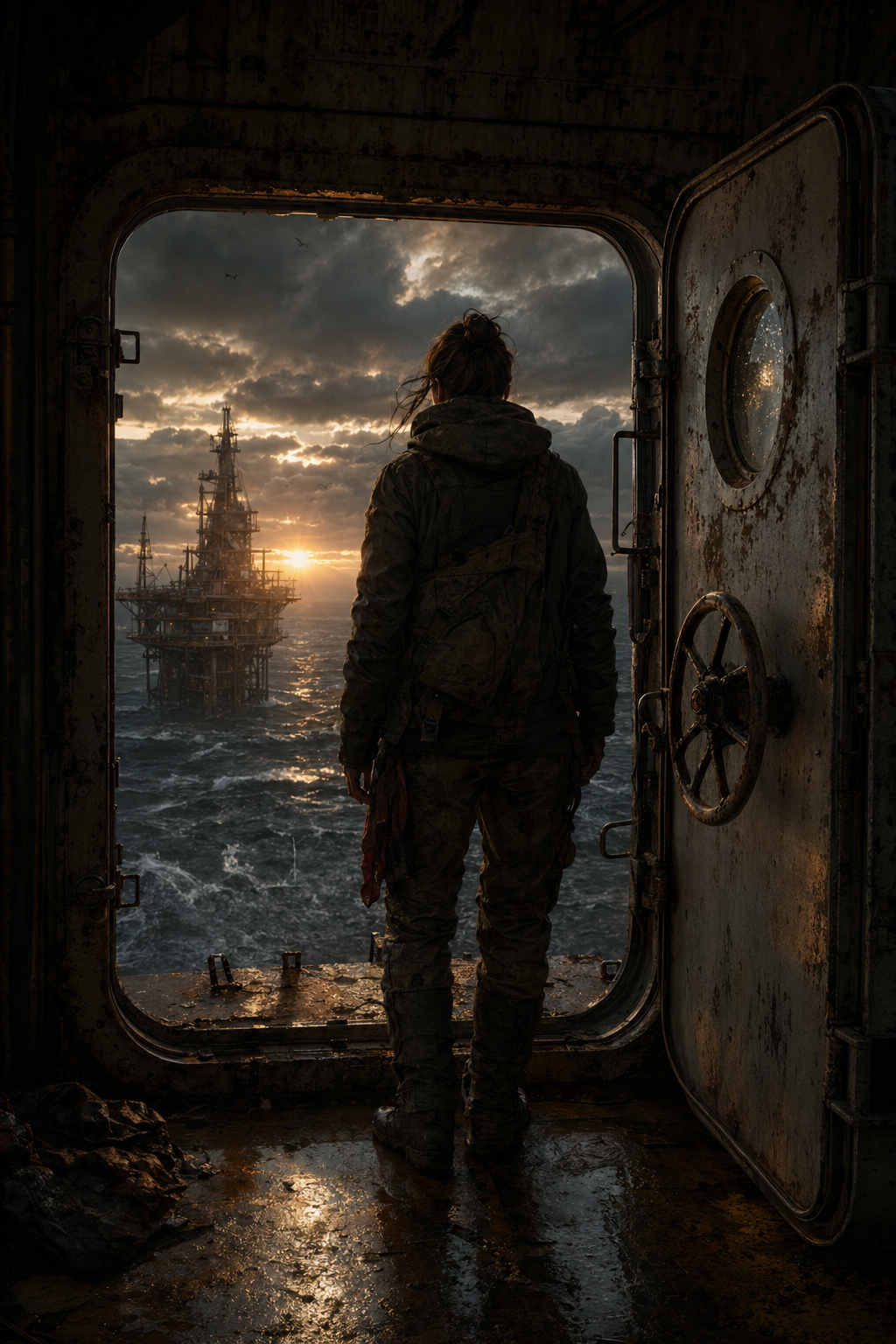
THE WEIGHT OF THE DOOR
On a dying offshore rig, a hardened scavenger risks everything when survival math collides with forbidden attachment.
Chapter 1: Inventory
The lower deck smelled of salt, diesel, and old metal.
Lena clipped the work lamp to the boat’s gunwale and bent into the cone of yellow light. The rest of the platform stayed dark around her, steel disappearing into black water and black sky. The ocean moved under everything. Not loudly. Just enough to make the deck plates answer with a low, tired groan.
She started at the bow and worked aft.
Hull first. Her knuckles tapped along the rigid skin of the inflatable, listening for the change in note that meant weakness. Seams next. She ran two fingers along the patched joins, feeling for lift or softness. Nothing new. She checked the tie points, the emergency line, the fuel cans lashed in place under a damp tarp. Then the outboard.
Her hands knew the order. Clamp bolts. Mounting bracket. Fuel line. Primer bulb. Cooling intake.
She held the lamp lower.
The rubber gasket around the cooling intake had gone gray-white where the salt had been eating it. A crack ran from one edge like a split lip. Lena touched it with her thumbnail. The rubber gave too easily.
One more run, maybe two.
After that the engine would start running hot. After that the motor would seize, or warp, or do one of the other ugly things dying machines did when asked for more than they had left.
She sat back on her heels for a second, the cold of the deck finding its way through her trousers. Add gasket to the list. Add another intake housing if they found one. Add luck, if any had been left on the mainland. She reached into the tool pouch at her belt, took out a grease pencil, and marked a short line on the engine casing where anyone who knew her habits would understand it meant watch this.
Then she moved on.
Bilge pump housing intact. Battery terminals clean enough. Emergency kit sealed. Spare line coiled dry inside its locker. Two flares left, both in date if dates still meant anything. She checked the knife strapped beneath the port seat and the pry bar under the starboard one. Touched each. Confirmed what her eyes had already told her.
Three passes, always.
The first for what was there.
The second for what shouldn’t be.
The third for what would kill you if you missed it twice.
By the time she finished, the lamp had drawn a mist of insects from somewhere below the lower railings, though there shouldn’t have been enough fresh water on the Rig to support anything so trivial. They battered themselves against the glass. Lena switched the lamp off.
Darkness took the boat back at once.
She stood with one hand on the outboard cowling and let her eyes adjust. The sea was more sound than sight, a long black respiration around the platform legs. Far above her, the derrick tower cut a darker shape against a sky that had just begun to thin in the east. Dawn out here never arrived cleanly. It leaked into the world.
The steel beneath her boots vibrated with the generator’s hum. Steady. Good.
She turned for the interior corridor and saw Petra’s new drawing on the bulkhead.
Charcoal on painted steel. A house with a square body and a roof too steep for any weather that actually existed anymore. A sun in the upper corner, all blunt rays. Two figures holding hands. One taller, one smaller. No water. No platform. No horizon of gray.
Lena stopped.
The lamp was off, but a strip of weak deck light from the stairwell caught the wall enough to make the marks visible. Child’s lines. Confident in the wrong places, hesitant in the right ones. The taller figure had five fingers on one hand and three on the other.
She stood there three seconds. Four.
Then she went inside.
The corridor air was warmer by a degree and stale with sleeping bodies, machine heat, old cooking. Her boots rang softly on the grated floor. Somewhere deeper in the platform a pipe knocked twice, paused, knocked again. The Rig had its own language if you stayed long enough. Creaks, hums, knocks, the wet hiss of valves, the slap of loose cable against metal in wind. Most people heard noise. Lena heard status reports.
The mess hall used to be a control room. You could still see it in the sloped front windows, most of them plated over now against storms, and in the dead screens bolted high on one wall. Someone had welded tables from scrap plate and angle iron. Someone else had painted the benches years ago, and the paint had long since given up. Fluorescents buzzed overhead, bleaching everyone to the same tired color.
Fifteen people, maybe a few more. First shift.
Lena took her bowl from the galley counter, nodded once at the woman portioning oats, and crossed to the wall. She sat where she always sat, back protected, line of sight to both doors. Steam lifted from the bowl and vanished.
Across the room, Harlan was already at the front table with Sable and two of the fishing crew. Harlan ate with one hand on a stack of handwritten maintenance sheets, reading between bites. Sable leaned in when Harlan spoke and sat back when he didn’t. The greenhouse workers clustered near the far corner, damp cuffs and the smell of plant rot still clinging to them. Thea sat by herself near the cabinet where she kept the medical stores, spoon moving slow, eyes on nothing anyone else could see.
The room carried the kind of quiet that came from too little sleep and no excess food. Spoons against bowls. A cough. A chair leg dragging across steel.
Lena ate.
Not fast enough to call attention to it. Not slow enough to taste anything.
Halfway through, Donal dropped onto the bench opposite her with his own bowl and a piece of hard bread he’d somehow traded for. He was thirty and looked older in the gray light, beard gone reddish where the salt had dried in it.
“Sea’s decent,” he said.
Lena nodded once. “For now.”
“Window hold?”
“Till noon, maybe one.”
He tore the bread in half. “Cass says we should push north of the usual route. Old depot near Fraserburgh.”
“Cass says a lot of things.”
That got the edge of something from him. Not a smile. Close enough.
He dipped bread into his oats. “Fuel’s low.”
“I know.”
“You still taking her?”
“If she keeps her head.”
Donal grunted. On the Rig that meant agreement, doubt, and acceptance all at once.
Below them, through the floor, came the clean steady hum of the generator.
Then a sharp metallic clatter. A wrench hitting concrete. A beat later, a muffled curse from the level beneath.
Nobody in the mess hall reacted much. A few heads lifted. Then spoons resumed.
Lena did not look at the floor. She kept eating. Listened instead.
Bootsteps on the stair. Two sets. One slow and heavy, one quick.
Mikkel came through the doorway first, wiping his hands on a rag already black with grease. His shoulders looked narrower than they had last winter, though the coveralls hung the same. Behind him, Brin carried the dropped wrench in one hand and a fuel injector assembly in the other, both held with equal care.
It was the way she moved that caught Lena before her face did.
Not cautious. Not nervous. Absorbed.
Brin crossed the room as if the tables and people in it were temporary obstacles on the edge of a larger problem only she could see. She kept her eyes on the injector housing, thumb rubbing a ring of carbon from the metal while she walked. Pale hair tied back badly, a strand loose at her cheek. Grease dark on both hands up to the wrists. Small frame under two layers of patched clothes, moving fast enough that Mikkel had to angle slightly to keep beside her.
Mikkel said something low as they passed Harlan’s table. Brin answered without looking up. Short. Precise.
Lena knew the component from where she sat. Generator fuel injector. Taken apart before breakfast meant trouble, or maintenance done by people too worried to wait for proper light.
Brin reached the service counter, set the injector assembly down on the edge with a gentleness that would have fit glassware better than machinery, and only then looked up long enough to ask for food.
Her eyes moved over the room once. Quick. Measuring. They passed over Lena without catching or pretended to.
Lena realized she was still watching.
She looked back at her bowl.
Donal had noticed nothing. Or had and was decent enough not to say. He scraped the last of his oats together.
“You heading back down?” he asked.
“In a minute.”
“To the boat?”
“After I hear what that part’s doing on a breakfast table.”
Donal nodded as if this was obvious. It was.
At the counter, Brin took a bowl in one hand and lifted the injector assembly with the other. Mikkel said something else. She shook her head. Not irritated. Certain. The gesture had a familiar shape to it. The shape of somebody young enough to think certainty could still bargain with the world.
Lena finished eating and stood. Her spoon clicked once against the bowl as she set it in the wash bin. On her way to the door she passed the service counter close enough to see the scoring inside the injector chamber, the corrosion at the seam, the thin dark crescent where fuel had been leaking by degrees.
Brin had seen it too. Of course she had.
For one second, as Lena crossed past, Brin looked up properly. Her eyes were very pale in the fluorescent light. Not soft. Not hard. Focused in a way Lena recognized from engine rooms and storm decks and all the places where attention was the only thing between a person and the end of them.
Recognition flashed there. Small and clean.
Then it was gone, and Brin was already angling the part to show Mikkel something in the metal.
Lena kept walking.
The corridor outside the mess hall was colder. She paused by the hatch and put her palm flat against the steel for a moment, feeling the generator’s steady vibration through it. Still running. The boat below was waiting. The mainland was waiting. The broken gasket was still a mark on the engine casing. Fuel was low. The weather window was narrowing.
Behind her, from the mess hall, came the murmur of voices starting to rise with the day.
Ahead of her, down the stairwell, the lower decks smelled of oil and sea.
Lena pushed off the wall and went back to work.
Eleven years after rising seas swallowed the coasts, forty-seven survivors cling to life on a decommissioned North Atlantic oil platform held together by failing machinery, rationed water, and ruthless utility. Lena Vasik, the Rig’s indispensable supply-run lead, survives by turning grief into competence and never letting anyone get close. That begins to fail when she forms an unwanted bond with Brin, a young generator mechanic whose life may soon be weighed against the platform’s brutal arithmetic.
- —Lena Vasik — A thirty-eight-year-old former merchant marine engineer who leads the Rig’s dangerous supply runs to the drowned mainland. Scarred, disciplined, and relentlessly useful, she has built her life around competence so she never has to face the losses that made her this way.
- —Brin — A nineteen-year-old generator mechanic from a lifetime of failed settlements, sharp-eyed and quietly brilliant with engines. She resists being anyone’s burden, even as her connection with Lena awakens the need to belong somewhere for real.
- —Harlan Cole — The Rig’s de facto leader and former offshore engineer, respected because he understands the systems keeping everyone alive. He rules by hard math, believing attachment is a luxury that threatens collective survival, which puts him on a collision course with Lena.
- —Mikkel Brask — An aging mechanic losing his sight and steady hands, and the closest thing Brin has to family. Gentle, observant, and increasingly expendable in the Rig’s hierarchy, he becomes the first human cost of its survival logic.
- —Thea Park — A former emergency room nurse who guards the Rig’s dwindling medical supplies and its remaining conscience. Calm, practical, and morally stubborn, she opposes Harlan’s cold calculus without ever becoming naïve about the stakes.
- —Sable — An ambitious greenhouse worker eager to rise by aligning himself with Harlan’s harsh pragmatism. He senses weakness quickly and helps turn private attachment into public liability.
- —Petra — The youngest person on the Rig, a nearly silent nine-year-old who draws houses, suns, and boats on the walls. She embodies the future the Rig claims to protect and the kind of life its logic is most ready to discard.
- —The Rig: Lena’s world is established aboard a decaying offshore platform where every person is measured by what they can keep running. A failing boat part, a coughing generator, and Brin’s arrival at the edge of Lena’s attention begin to reveal both the fragility of the Rig and the softness Lena has buried.
- —The Crack: A targeted mainland run and the generator crisis force Lena and Brin into close mechanical partnership, where trust forms through work rather than confession. As Mikkel declines and the platform’s resources tighten, Lena’s protectiveness becomes harder to hide and more dangerous to sustain.
- —The Cost: Storms, ration cuts, and formal contribution assessments strip away any illusion that the Rig can carry everyone. Mikkel’s fall from usefulness and eventual death make the platform’s cruelty personal, and Lena’s bond with Brin becomes visible to Harlan and impossible for either woman to deny.
- —The Choice: Harlan proposes a salvation plan built on abandoning the least useful, forcing Lena to confront how close her own thinking has come to his. Brin refuses to be protected from the decision, and together they shape a riskier alternative that could save everyone only by sending Brin away.
- —The Return: Separation tests what their bond has become as Lena holds the Rig together, waits through dangerous silence, and begins to care for what remains. When Brin returns with the means to extend the platform’s life, survival is no longer just endurance but the fragile possibility of staying human together.
Spare, tactile, and unsentimental, with prose that stays close to bodies, machinery, and hard decisions. The language is grounded in steel, salt, diesel, hunger, and weather, but it opens into sudden moments of aching tenderness. The atmosphere is bleak and pressure-tight, warmed only by small gestures that carry enormous weight.