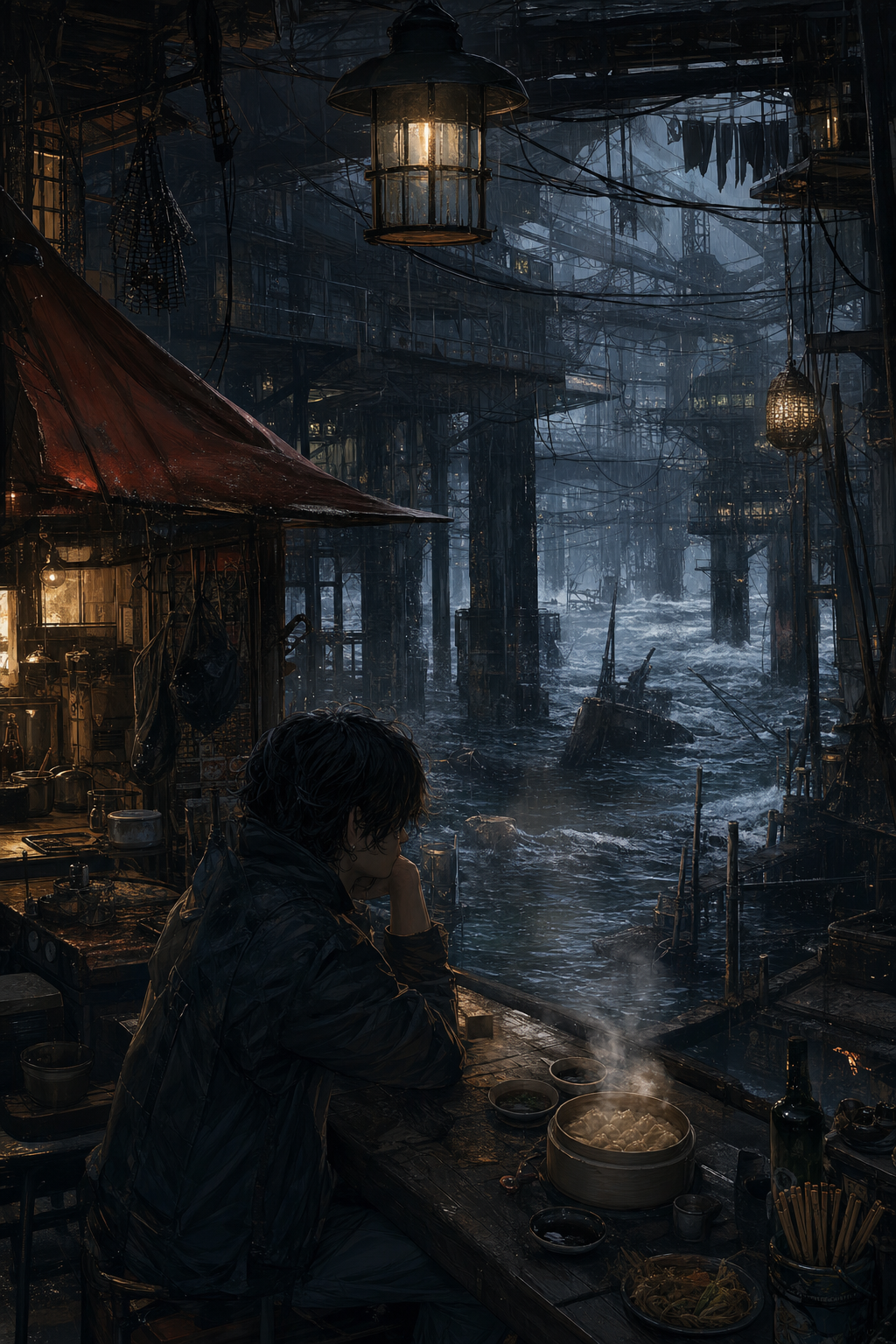
WATERLINE
In a storm-eaten harbor city, a sea-marked salvager shelters something the water changed too far for the world to forgive.
Chapter 1
The water under the Grate never went still. Even at slack tide it moved under the metal streets in a slow black shove, carrying silt, bits of weed, chemical sheen that caught on the underside of the grating and turned every puddled reflection green. Sable worked below it in a sealed suit that smelled of old rubber, oil, and his own sweat gone sour in the seams. The suit's joints pulled when he bent. Cold pressed through the layers anyway.
His headlamp cut a narrow cone through the harbor murk. A collapsed piling lay ahead, half buried in sediment, the pump housing wedged under it at an angle that said someone had tried to haul it before and failed. He set his boots against the harbor floor and got both hands under the edge of the concrete sleeve. The water thickened with disturbed grit. His breath rasped loud inside the helmet. The housing shifted a fraction, scraped, stuck again.
Something moved at the edge of the light.
He stopped.
Only the water at first. Particulate drifting. A strip of torn kelp folding on itself. Then a pale shape glided through the dark below the beam and was gone before the lamp found it: too many jointed legs or too many trailing filaments, impossible to tell. Not coming at him. Just passing through.
He set his shoulder against the piling and pushed harder. The concrete lifted enough for him to drag the pump housing free. Metal grated on stone. Rust flakes rose around him like dirty snow. He got the salvage line through the housing's frame, locked it, and thumbed the winch signal twice.
Above him, through the shadowed lattice of the street, the line tightened.
The housing lurched upward. He followed, boots leaving the harbor floor. The water changed color as he rose, from black-green to a fouled bottle green full of floating grit. Through the grating overhead he could see the gray day in pieces.
Hands hooked the line from above. He got one gloved hand through the grating and hauled himself after the pump housing, the metal wet and cold under his palm. Water sheeted off him onto the walkway.
The Grate smelled the way it always smelled after a working tide: brine, machine oil, hot metal from a torch going somewhere nearby, and frying fish from a stall that had no business being open this early and was open anyway. Beneath his boots the harbor moved in dark bands through the gaps in the street. A radio crackled two walkways over. Somebody shouted for a wrench. Somebody laughed.
Sable dragged the pump housing toward the shop.
Its walls were corrugated metal patched with older metal, newer steel, and one slab of marine composite that didn't match anything around it. The door had been repaired enough times that the hinges were three different kinds. Inside, the air held a thicker version of the outside smells: salt and oil and old heat worked into every surface. The workbench took up most of the front room, scarred and blackened, the edge polished pale where hands had leaned for decades. Tools hung on pegs in exact rows. Some of the hooks sat a little low, as if set for someone shorter than the man who worked beneath them now.
He set the pump housing on the bench with a weighty clang, shut the door against the damp, and stripped the gloves off first. His hands came out large and square, knuckles scarred, nails cut down blunt. He unsealed the suit one clamp at a time. When the helmet came off, cold air hit the sweat on his scalp and neck. He stood a moment breathing oil and salt instead of filtered rubber.
His shirt underneath was dark with sweat. Long sleeves, collar high. He rolled neither.
He took the housing apart on the bench. Bolts loosened under the wrench with a steady metal complaint. Salt had crusted the interior in white veins thick as tendon. He scraped them free with a flat tool, brushed corrosion from the intake channels, checked the rotor by touch before sight, feeling for warp along the blades. His left hand steadied the frame while the right worked the tool in short efficient strokes. No wasted motion. He moved the way working parts move when they're still in tolerance.
A drip from his hair struck the bench and spread through old oil.
When the mechanism turned cleanly again under his hand, he reassembled it, set it aside, and wiped the tools before hanging them back where they belonged. The rag came away black. He folded it once and put it on the edge of the bench for later.
Then he went to the kitchen.
It sat in the back room under a lower ceiling, the heat held close there even with the sea moving under the floor. Two burners. One wide-bottomed pot, dented near the base. The handle had been wrapped in wire where the original grip had broken long ago. A narrow counter stained dark by years of cutting and spilled broth. A table with two chairs tucked under it. One chair's seat had worn smoother than the other.
A salvage hook hung on the wall by the door. Old steel, cleaned and oiled, never used.
Sable opened the cold-box, took out wrapped fish, a bundle of kelp, a jar of oil cloudy with chill. He set the pot on the burner and lit the flame. Oil first. It hit the metal with a soft spit. Then fish. Then water. The kitchen filled with the smell of salt rising warm instead of cold.
He cut the kelp in strips on the board. Knife down, knuckles guiding, the rhythm easy from repetition. Steam climbed the wall in a wavering line. The burner ticked. Somewhere in the front room a loose panel tapped once in the wind and settled.
When the broth was done he poured one bowl and ate standing at the counter. Not quickly. Not slowly. The steam fogged the lower edge of the window over the sink. A bit of fish skin clung to the lip of the pot. He scraped it back in with the spoon and finished the bowl.
The second chair stayed pushed in.
He washed the bowl, set it to dry, and carried the pot off the heat. The metal handle clicked lightly against the stove grate. The sound hung in the room a second after his hand let go.
At the front of the shop, the small window beside the door looked out on the walkway and the rail beyond it. Mounted on a hook outside was an oil lamp in a heavy metal housing with thick glass made for weather that wanted to break it. The glass was clouded with old smoke at the top edge. The lamp was dark.
Sable stopped by the window.
Outside, people crossed the Grate in coats stiff with salt. A woman from two platforms over carried a crate of shellfish against her hip. Below the grating a dark shape rolled just under the surface and vanished under the next walkway. The lamp hung still despite the wind, its chain rusted at one link and repaired with wire.
He lifted his hand and touched the inside of the window frame beside it. Not the glass. The frame, where the paint had long ago worn off under other hands.
Then he turned away.
The stairs to the loft were narrow and metal, welded on at some later date than the rest of the shop. They rang under his weight. Above, the sleeping space held a cot, a locker, a shelf with folded clothes, and a roof low enough that he had to duck near the far wall. Through the floor grating he could see the front room below in strips: the workbench, the edge of the stove in the kitchen doorway, the dark floor where damp from his suit was drying in uneven patches. Beneath even that, lower and shifting, the water.
He pulled his shirt off. On the left side of his neck and down under the shoulder, where the sleeve had stuck damp against him, the skin carried sea-marks dark as oil in one light and deep violet in another. Not sheen anymore. Structure. The skin there caught the gray through the wall slats and threw back a muted iridescence like scales under cloth. He dried off with the same ragged towel as always, pulled on another shirt, long sleeves again, high collar again.
Then he sat on the edge of the cot and bent to unlace his boots.
From below came the ordinary sounds of the shop settling around him: a pipe tapping once, the stove metal cooling, the distant harbor horns from farther out where the larger rigs worked the channel. All of it inside the constant under-sound of water moving beneath the city, never hidden, always there. Even at rest it had weight. Through the gaps in the floor grating he could see it shifting black-green around the pilings.
He lay back without undressing further. One arm over his eyes. The cot gave under him with a familiar complaint.
A smell still clung to his hands despite the wash: fish broth and machine oil together. He left them where they were.
Below, the lamp outside the door stayed dark. The hook held its weight. The sea moved under the floor. The shop breathed salt and old heat around him.
After a while, with the day still gray on the walls and the sounds of the Grate moving on without him, Sable slept.
Carrick's waterline district survives on salvage pulled from a hostile sea that burns skin, mutates bodies, and floods the city without warning. In the present, sea-marked salvager Sable pulls a feral, heavily changed survivor from surge wreckage and brings them into the repair shop and kitchen he inherited from Maren, the woman who once did the same for him as a child. As fear spreads through the Grate and officials move to remove the unwanted, the story pits communal survival, bodily monstrosity, and inherited tenderness against a world that treats softness as a fatal weakness.
- —Maren — A legendary Grate salvager turned repair-shop owner with a maimed hand, a brutal competence, and a habit of feeding anyone who crosses her threshold. In the past timeline, she takes in a sea-marked boy without explanation and becomes the model of a tenderness that never stops being practical, costly, or fierce.
- —Sable — A sea-marked salvager in his thirties who now runs Maren's old shop and keeps her kitchen exactly as she left it. Hard in the water and quiet on land, he inherits her instinct to shelter the feared and is forced to defend that choice when the Grate turns on the being he rescues.
- —Lume — A heavily sea-changed, near-feral survivor with bioluminescent skin, an altered arm, and a body others read as monstrous on sight. Taken in by Sable, they move from animal wariness into presence, work, and care without ever becoming less strange or less visibly transformed.
- —The Boy — A silent, underfed sea-marked child found by Maren after an earlier surge, and the clear younger mirror of Sable. His growing trust is expressed through labor, touch, and food, revealing how Maren's way of loving becomes Sable's inheritance.
- —Doss — A longtime Grate salvager who appears in both timelines as one of the few people willing to accept what Maren and later Sable refuse to abandon. Blunt, dependable, and generous in the practical ways that matter, he embodies the district's rough communal warmth.
- —Selka — The Harbormaster in the present timeline, a pragmatic official balancing the Grate's needs against the systems above it. She respects Sable and deals honestly with him, but cannot shield Lume once fear becomes policy.
- —Reth — A Grate resident leading the effort to drive Lume out after losing his daughter to a feral sea-changed person. His grief is genuine and his fear understandable, making him a human source of pressure rather than a simple villain.
- —Merchant Enforcers — Shoals representatives who enter the Grate under the language of safety, assessment, and public order. In the past timeline, their bureaucratic hunt for unregistered sea-changed bodies turns Maren's home into a contested space.
- —The Taking-In: In the present, Sable works the hostile waterline and pulls a heavily changed survivor from post-surge wreckage, bringing them back to his repair shop instead of reporting them. In the past, Maren finds a sea-marked child after a surge and does the same, establishing the shop and kitchen as a refuge built through action rather than promises.
- —The Warm Room: Lume and the boy each begin to learn the shop through tiny acts of trust: watching, handling tools, sharing meals, and stepping into the work. The same stove, pot, lamp, and routines bind the two timelines together, showing tenderness as a practiced habit passed hand to hand.
- —The Pressure: Outside suspicion hardens into organized threat as neighbors, officials, and merchant agents begin treating the sheltered sea-changed as risks to be cataloged or removed. Sable faces petitions and warnings over Lume, while Maren confronts bureaucratic claims on the boy, tightening the world around both households.
- —The Surge: Catastrophic flooding collides with social persecution in both eras, forcing the protected and the protector into open danger. Maren fights through the worst surge of her time to reach home, while in the present Sable and Lume enter the water together, turning rescue, violence, and care back on the people and structures that would cast them out.
- —What Stays Lit: After the surges, both timelines return not to safety but to work, scars, food, and the stubborn continuance of the shop. The acts once taught in silence are taken up by new hands, proving that care in this world survives not by changing the furnace, but by being repeated inside it.
Close, physical, and salt-heavy, the prose dwells on metal, brine, blood, machinery, and food with the same unsentimental attention. Violent body horror and domestic tenderness coexist without tonal apology, shifting from dense sensory immersion to stark, stripped moments of care. The voice is hard-edged, tactile, and intimate, with dark humor surfacing through labor, absurdity, and survival rather than banter.