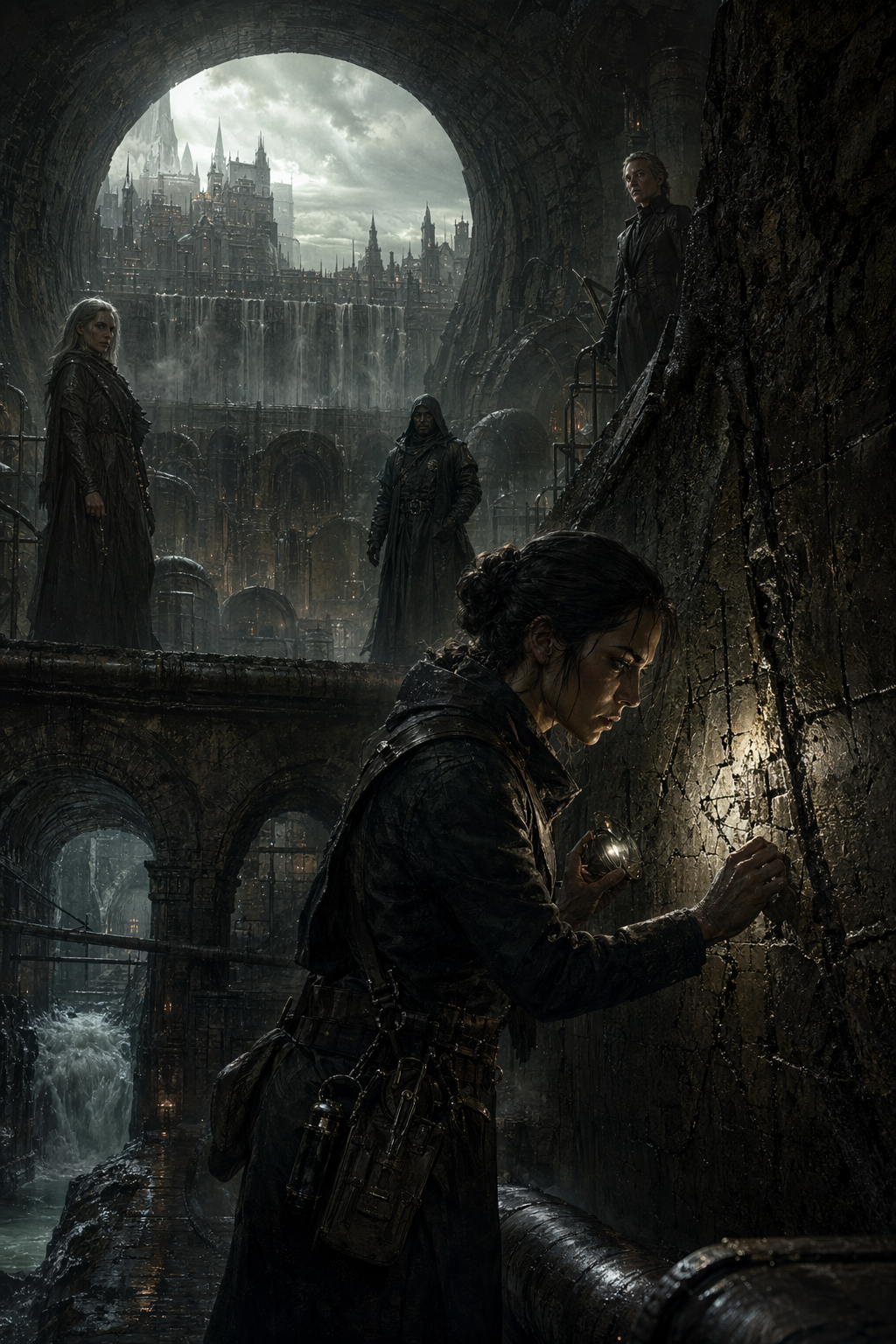
THE UNDERWORK
In a flood-doomed delta city held up by ancient tunnels, a master inspector finds sabotage at the seams of a buried crime.
Chapter 1
The mortar in the lower Middle Galleries was the color of old teeth.
Seren Drave ran two fingers along the joint and came away with a faint yellow dust on her skin. Lime-based. Third-century restoration work, laid thick and practical over older stone, then patched again in places with the thin gray neatness of recent repairs. Three periods in half an arm's span. The wall had been spoken to by generations, and all of them had left an accent.
She marked the section in her field journal without looking down.
Gallery Nine-East, lower transition sector. Lime mortar degraded at joint line, moderate seep through western seam, no active displacement.
The script of her notes was narrow and compressed, built for damp paper and poor light. She tucked the journal back into the oilskin sleeve at her belt and lifted the sounding hammer.
One tap. Then another, three handspans lower.
The wall answered in dull stone and wet pressure. No void behind it. Good. She moved on.
The tunnel around her sloped gently toward the junction zone, where the Middle Galleries gave way to older work. The air changed as she descended. Upper sections smelled of brick damp and rot from street runoff, with the sour edge of the city's drains. Down here the smell was cleaner, colder, all mineral water and old stone. The lamps fixed to the wall at measured intervals burned with a steady amber light that never reached the tunnel crown. Beyond that was dark, and beyond the dark more dark still, full of water moving where she could not see it.
Seren preferred it here.
On the surface, late-winter light flattened everything and left her squinting. In the Middle Galleries the world arranged itself properly. Stone. Water. Load. Pressure. Cause and effect. No one lied on purpose, not down here. If a wall failed, it failed where the strain had been, and the crack would show you how it got there if you knew how to look.
She knew how to look.
She crouched at the base of a support pillar where a line of damp ran down into the floor channel. Not seepage from above; too clear, too cold. Lateral pressure from the east reservoir pushing through a hairline fracture somewhere deeper in the seam. She put her palm flat to the pillar and waited.
A faint vibration. Regular. Mechanical.
Not water. Gate movement.
She stood, turned her head, and listened. Far ahead, beyond two curves and the next brace assembly, one of the larger sluices was cycling. Slow. Heavy. On schedule, if the pressure charts from this morning were right. They usually were.
She moved toward it, boots scraping stone smoothed by four centuries of traffic. The lower galleries carried every age of the city in their surfaces. The newer work was squared and imposed, built by men who thought in lines and corners. The older sections bent where the ground required it, widening and narrowing with a confidence that felt less like command than conversation. The Middle Galleries held because the Deep Graft beneath them held first, though no one in the Sounding House said it in those terms.
Ahead, the tunnel opened into the first junction chamber.
It was a broad, low space where the yellow-mortared Middle Gallery construction met older dark stone in a seam so sharp it looked cut with a blade. On the near side stood the brace assembly: fitted limestone buttress, iron clamps, anchoring pins sunk into the older substrate below. It was one of six major junction braces in this sector, all installed during the second-century expansion to tie newer flood infrastructure into the foundational works beneath.
Seren stepped into the chamber and stopped.
Something was wrong with the iron.
At first it was only a line where there should not have been one. Then the line arranged itself.
She went to the brace, set down her lamp, and bent close. The lower shank pin had been cut almost through.
Not broken. Not sheared by pressure. Cut.
The incision was clean and narrow, following the grain of the iron where it entered the collar. Someone had worked carefully enough to hide the damage under a skin of rust and mineral crust. In poor light, from six feet away, it looked like age. Up close, with a wall-reader's hand on it, it became intention.
Seren touched the metal lightly. Cold. Dry. Old cut, not fresh, but not ancient either. Weeks, perhaps. Long enough for the tunnel damp to begin its work. Not long enough for the corrosion to spread naturally.
She checked the second pin. Scored. Not yet severed, but started.
The load map assembled itself in her head. Under ordinary conditions the brace would hold. During flood rise, with the eastward pressure differential climbing and the Deep Graft channels taking full draw, the stress on the lower anchorage would increase. If the first pin failed, the second would take the load. If the second had been weakened far enough—
She looked up at the seam where old stone met newer work.
Severe under flood-load.
Seren straightened slowly. Her hand found the scar on her left forearm without thought, thumb pressing the raised white line once, hard, then releasing.
She took out the journal.
Junction Brace 9-E1: deliberate tool damage to lower anchor pin and scoring to secondary. Concealed under surface corrosion. Load risk moderate now / severe at flood crest. Immediate reinforcement required.
She underlined immediate.
Then she sketched the cut.
Her pencil moved quickly: collar, pin, incision angle, probable tool entry. Whoever had done this understood both metal and load. A laborer with a grudge might hack at exposed iron. This was different. This was someone making the brace fail later, under strain, where the river could be blamed.
She stood in the center of the chamber for a moment after she finished writing, listening.
Water moved beneath the floor in channels she could not see. Above and behind her, a sluice gate thudded shut with the soft finality of a giant fist closing. The chamber took the sound and folded it around the stone.
No voices. No footsteps.
She checked the wall for hidden fractures radiating from the damaged brace, then the floorline for settlement. Nothing visible yet. The sabotage had been placed before the failure, not after it. Precise work. Patient work.
Seren picked up her lamp and crossed deeper into the chamber, toward the transition line itself.
The difference in construction here had always interested her. The Middle Gallery stone was competent: squared blocks, thick joints, the practical confidence of expansion-era builders trying to make a city permanent on ground that did not want one. The stone beyond the seam was another argument entirely. Darker. Harder. Cut so closely that the joints nearly vanished in the lampglow. No mortar. None at all. Stone resting against stone by precision alone.
She laid her hand across the seam.
Lime mortar above. Bare fitted basalt below.
The quality difference was obvious once the hand learned to ask for it. Better cut. Better joined. Better understanding of pressure and settlement over time. The Deep Graft had no right to be older and superior at once, but it was.
Seren traced one of the lower stones where a shallow line crossed the surface. Then another. The marks were worn almost smooth, easy to mistake for tool chatter if you did not pause.
She paused.
They were not random.
She bent, lowering the lamp until the side-light caught them. Carved forms, shallow and narrow, arranged in a repeating pattern she did not recognize. Not mason's marks; too fluid. Not later scratches; too regular. Writing, perhaps. Or some older notation system from the foundational works.
She took out the journal again and copied what she could.
Five marks in sequence. Hooked line. Forked angle. Three parallel cuts intersected by a curve.
The shapes meant nothing to her. That bothered her more than she liked.
She was still sketching when movement touched the edge of the chamber light.
Seren looked up.
Three figures were coming through the lower tunnel beyond the seam, where the lamps thinned and Deep Graft dark took over. They wore the close-woven black of the Hollow Wardens, fitted tight at wrist and ankle against the constant damp. Pale faces. Compact builds made for low ceilings and long climbs. They carried tools slung high across their backs so the handles would not catch.
Wardens, then. A work crew moving along their own routes.
Seren stepped back from the seam to clear the passage. Officially the boundary here was cooperative access, Middle Gallery on one side, Foundation Stratum on the other, each maintained by its own authority. In practice the two bodies passed each other and said little. The Wardens rarely came high. Inspectors rarely went low.
The first Warden passed without looking at her.
The second glanced at the brace, then at Seren's open journal, and kept going.
The third met her eyes.
He was broad-shouldered for a tunnel man, his face lean and pale in the lampglow, his hands scarred across the knuckles in the pattern of close stone work. Nothing in his expression offered greeting or challenge. He looked at her the way she looked at a wall she had not yet decided how to read. Measuring. Waiting to see what held.
Then he moved on into the dark with the others, their footfalls fading into the older tunnels below.
Seren stood still until the sound was gone.
Then she looked back at the cut pin, the scored iron, the seam in the wall.
She wrote one more line in the margin beside her sketch.
Possible internal actor. Skilled.
The lamp hissed softly.
Far overhead, beyond forty meters of stone and shifting delta earth, Cairnholm sat on its winter foundations and waited for the spring melt to come down from the Ashridge Mountains. When it came, the reservoirs would fill, the channels would strain, and every seam in the Underwork would declare itself.
Seren closed the journal and sealed it.
Then she turned for the access shaft, already arranging the incident report in her head.
Cairnholm survives on the Siltplain only because of the Underwork, a colossal subterranean system that keeps the river from reclaiming the city. Seren Drave, the Inspectorate's finest wall-reader, has built her life around reading every flaw before disaster strikes. When she discovers precise sabotage at the boundary between the known tunnels and the forbidden Deep Graft, her investigation uncovers a foundation of coercion the city has survived by refusing to see.
- —Seren Drave — A veteran Middle Gallery inspector who reads stone, pressure, and failure with near-unnerving precision. After losing her mother to a tunnel collapse, she made the Underwork her vocation and her shelter, until a deeper truth exposes the limits of everything she thought she knew.
- —Maren Gault — Seren's vanished mentor and the greatest wall-reader the Inspectorate ever produced. After disappearing into the Deep Graft, she returns as a saboteur armed with a devastatingly coherent case that Cairnholm deserves to fall.
- —Oram — A Deep Graft engineer descended from the people who built Cairnholm's true foundations. Controlled, exact, and impossible to patronize, he becomes the voice of the Wardens' own will when others try to decide their fate for them.
- —Lenne Hasker — A senior Councillor who inherits generations of private knowledge about what keeps the city standing. Coldly composed and morally compromised, she embodies the logic of preserving a monstrous system because the alternative may kill thousands.
- —Davi — Seren's young apprentice, bright, eager, and still trusting the institution that shaped them both. As the truth seeps upward, Davi becomes a measure of what the next generation of inspectors might become.
- —Renna Drave — Seren's dead mother, once a brilliant inspector, whose fatal collapse still governs Seren's life. Her death is not just backstory but a buried consequence of the same divided system Seren begins to unravel.
- —The Anomaly: As flood season approaches, Seren discovers a series of expertly sabotaged braces and channels in the lower Middle Galleries. The damage clusters at the seam between the Inspectorate's domain and the Deep Graft, while her superiors respond with evasive delays that feel increasingly deliberate.
- —The Deep Below: Digging through archives and descending past long-accepted boundaries, Seren finds that the city's official record simply stops where its most vital foundations begin. In the Deep Graft she encounters inhabited Warden quarters and engineering older and finer than anything the Compact ever claimed to build.
- —The Buried Truth: An unseen guide leads Seren to Maren Gault, who reveals that the Deep Graft was built by the Sulene under coercion and that the Hollow Wardens are their trapped descendants. Maren has turned her mastery of the Underwork toward dismantling Cairnholm itself, convinced the city cannot be reformed without preserving its original crime.
- —The Third Answer: Pressed between Maren's destruction and Hasker's preservation, Seren turns to Oram and the Wardens rather than choosing for them. Their demand is neither silence nor annihilation, but public truth: the city must be forced to see who keeps it alive and decide in the open what kind of city it means to be.
- —The Flood: With the river rising and Maren's sabotage threatening a cascading failure, Seren races to keep the Underwork from collapsing long enough for the truth to surface. In the chaos of the flood she chooses the hidden people beneath the city as worthy of protection, and the buried foundation of Cairnholm is dragged into daylight where it can no longer be denied.
The prose is close, severe, and tactile, grounded in engineering language, stonework, and the hydraulics of a city under siege. Emotion comes through pressure, silence, and physical detail rather than confession. The sensory world is damp basalt, iron, cold mortar, stale air, and the constant pulse of water moving behind walls.