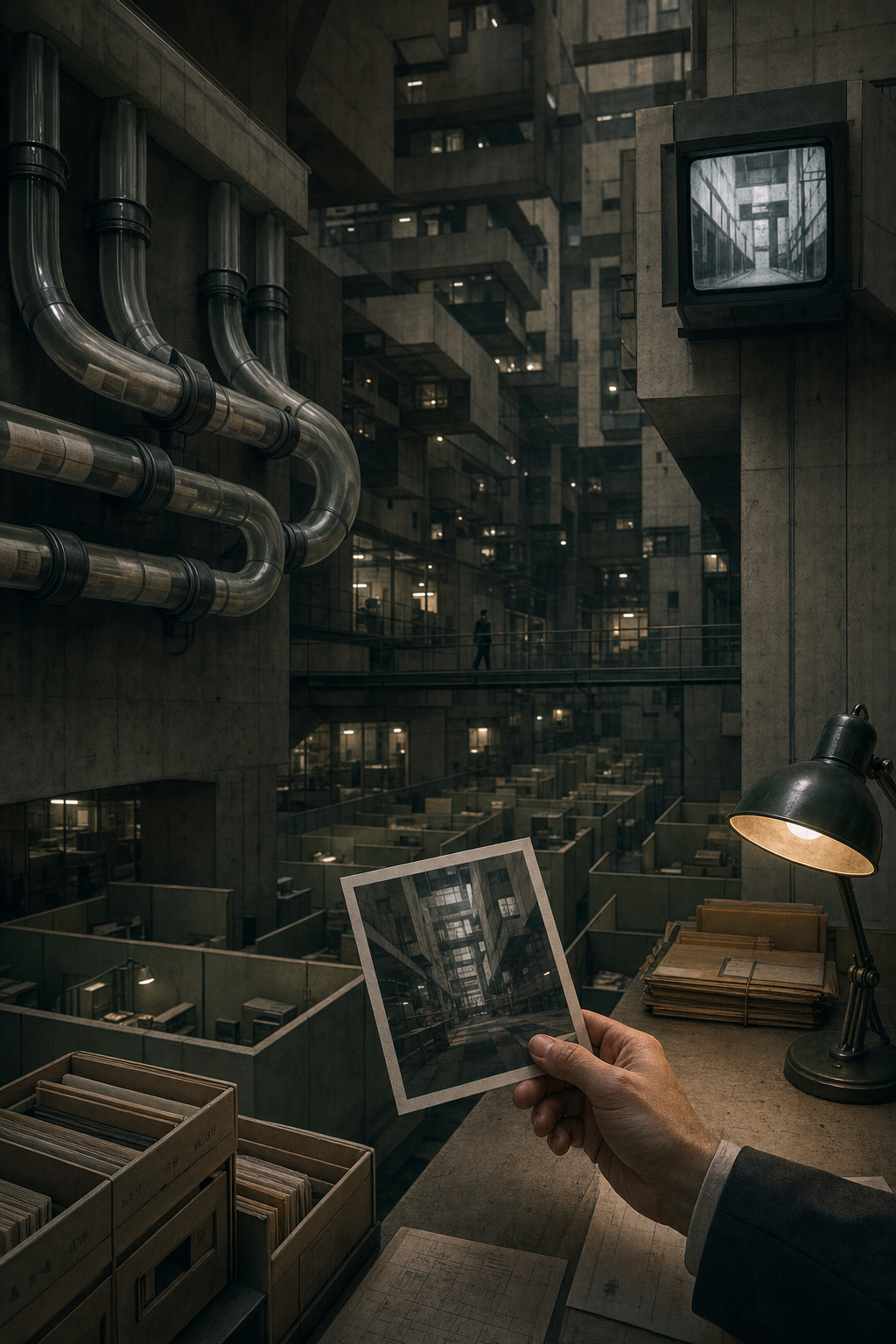
TRUST THE DISCREPANCIES
In a federal office where buildings rewrite their own records, one analyst's memory may be the only map left.
Chapter 1
The elevator to the seventh floor required a keycard and a four-second exhalation. This was not documented in the Employee Handbook, the Facilities annex, or the onboarding module on variable interior configurations, all of which Sable Kaan had read with the attention usually reserved for legal threats and bridge schematics. The requirement was transmitted the way most useful knowledge in Building 51 was transmitted: quietly, person to person, without official sponsorship and therefore with a higher probability of being true.
Sable badged in at 7:19, eleven minutes before her shift, and entered the elevator alone. The lobby behind her retained its usual properties—stable dimensions, beige tile, the laminated mission placard from 1994 with one corner beginning to separate from the wall. To maintain, verify, and ensure the structural continuity of federally administered facilities in accordance with Executive Order 11258 and subsequent directives. The placard had been there since before Sable was hired. The sentence had always read as if the building had written its own cover story.
She pressed 7. She exhaled for four seconds.
The elevator ascended without incident. This was not guaranteed. Building 51 preferred routine but did not honor it consistently.
Before the doors opened, she identified the floor by the quality of light leaking through the seam. The seventh floor fluorescents ran at a colder, whiter register than the sixth. Not brighter. More exacting. Sable had once measured the color temperature with a borrowed instrument from Survey Operations and confirmed what she had already known by eye: 4,100 Kelvin on seven, 3,800 on six. The difference was enough that her shoulders prepared for the cold before the doors parted.
The seventh floor was three degrees colder than the sixth. This had been true for years. The automated survey system classified the differential as an HVAC irregularity and filed it under maintenance variance. Sable classified it as a habit of the building.
She stepped out into the corridor and began her morning walk.
Comparative Survey occupied the west half of the floor. Structural Acoustics occupied the east half. Between them ran a corridor that Sable had been privately measuring for fourteen months and that the building had been privately narrowing for the same period at a rate too slight for the institution to care about and too consistent for her to ignore. She would check it later. First, the route. Always the route. The building's morning behavior was most legible before the floor filled with other people and their coffee, conversations, chair movements, and administrative confidence.
Gerald's office came first. Door open. Desk lamp on. Motivational poster on the inner wall: Accuracy Is Our Foundation. The poster had hung slightly crooked since last month's minor vibration event. Gerald had not straightened it. Either he had not noticed, which was possible, or he had noticed and accepted the angle as within tolerances, which was more likely. Gerald believed in tolerances the way some people believed in providence.
The break room came next. The coffee stain remained on the laminate counter near the sink, six years old, irregular at the edges, roughly shaped like Delaware if Delaware had experienced moderate seismic stress. The room had not changed location in eleven consecutive years, making it one of the most stable spaces in the building. Sable trusted it accordingly.
Then Carla Voss's desk.
Sable slowed without meaning to.
Carla's desk was clean. Not empty—clean. There was a difference. Empty implied absence with residue: a missing person, unfinished work, a chair pushed in by someone other than its user. Clean implied intervention. Monitor on. Screensaver cycling the FASC logo in patient blue and gray. Keyboard centered. Pen cup aligned with the desk edge. No loose papers. No cardigan on the chair back. No yellow sticky note with Carla's compressed handwriting reminding herself to request revised overlay outputs from Records.
The coffee mug remained.
White ceramic. Chipped handle on the left side. Handle turned right because Carla was right-handed and had adapted to the chip in the practical manner of someone who had no interest in replacing a serviceable object because a small part of it had failed. The mug sat to the left of the monitor.
Sable knew the distance every workday for three years without ever deciding to know it.
Two inches from the monitor's left edge. That was Carla's placement. Two inches meant first coffee consumed, mug set down with minimal thought, alignment preserved by repetition. Building occupants arranged objects the way buildings arranged heat: according to patterns they would deny if asked directly.
Today the mug was four inches from the monitor's left edge.
Sable stood for one second longer than routine required.
Then she walked past.
Her own desk was in the third row near the windows, where the morning light did what it could against federal glazing and institutional gray. She set her bag down, removed her current notebook, and placed it beside the keyboard. The notebook had no FASC markings. Black cover. Elastic band. Inside, nine months of private notations in a shorthand she had developed from architectural symbols, survey annotations, and the need to write quickly when the building offered something worth preserving.
She turned to a fresh page and wrote:
7:23 a.m. Carla mug displacement +2". Desk cleaned, not vacated.
Then she drew a small symbol beside the note: a square interrupted on one side, her personal marker for a discrepancy involving object placement in a stable zone.
The overnight survey data loaded slowly, as if the terminal objected to being asked questions before official hours. Building 51 upper floors, standard reconciliation package. Overlay comparisons, variance calculations, automated flag summary. The system was polite enough to present uncertainty in a font that implied certainty.
Sable reviewed the seventh floor first.
Most measurements fell where the system said they should: minute shifts, cosmetic drift, no action necessary. A vent register on the north wall had migrated 1.2 centimeters. Ceiling height in Conference Room 7B showed a variance the software attributed to calibration scatter. The floor's gross dimensions remained, according to the survey, unchanged.
Then she reached the east-wing corridor.
Yesterday's measurement: 18.4 meters.
Today's measurement: 18.1.
Eight days ago: 18.7.
She ran the sequence again. The contraction pattern held. Not dramatic. Not enough to alarm anyone who believed the baseline. Enough to matter if one compared the corridor to memory instead of to a floor plan that had already adjusted itself to preserve institutional calm.
The automated system should have flagged the change. It had not.
Sable opened the flag parameters. She did not expect to find anything. Expectations in Building 51 were most useful when kept low and private.
Threshold for linear contraction anomaly: adjusted from 0.6 meters to 1.0 meters.
Adjustment date: two weeks ago.
No memo attached. No revision note. No sign-off visible at her access level.
Sable looked at the line until it became what it was: either an administrative change with no announced rationale, or evidence that someone else in the building had noticed the corridor and decided the system should notice less.
She wrote in the notebook:
East corridor contraction continuing. Flag threshold raised +0.4m approx. 2 wks prior. Unannounced.
A second symbol this time: a vertical line through a square. Discrepancy involving record behavior.
By 7:31 the floor had begun to populate. Chairs rolled. Badge clips tapped against lanyards. Someone in Acoustics laughed once, sharply, before the sound was absorbed by concrete. The building's morning legibility decreased in proportion to occupancy. People did not merely occupy space; they interfered with it.
Gerald arrived at 7:34, carrying a paper folder despite the agency's digital transition initiative entering its sixth year. He paused outside his office, noticed Sable at her desk, and gave the slight nod of a department chief acknowledging punctual competence.
“Morning, Sable.”
“Morning.”
He went into his office. The poster remained crooked.
Sable filed the SDR for the overnight upper-floor survey at 7:42. Classification: Class-1, cosmetic drift, within parameters. Supplementary observations: none requiring escalation. She entered the language correctly. She attached the right cover sheet. She submitted a document she knew to be accurate within the institution's preferred relationship to accuracy.
At 8:03 she made coffee in the break room and stood by the six-year-old stain while the machine considered her request. The air smelled of burnt grounds, cleanser, and the faint metallic dryness specific to buildings with too much forced circulation and too little fresh air. Through the doorway she could see the corridor leading back toward Comparative Survey.
Carla's desk was still visible from this angle.
Monitor on. Mug four inches from the monitor's left edge.
No one stopped there. No one asked where Carla was.
Sable returned to her desk with the coffee and opened the common deployment board on the internal network. Survey Operations updated field status at 8:00 each morning, though “updated” in FASC practice often meant the previous day's status had been recopied into the present with institutional confidence.
She scanned the list until she found the name.
Kaan, Oren — Field Surveyor
Deployment: Sub-Level 7
Day 6 of 10
Status: Active — Normal Operations
Expected Return: 4 days
She read the line twice, not because the information changed under rereading, though in this building one never excluded that possibility entirely, but because seeing Oren's name on the board was a daily calibration point. Her brother below ground. Her above it. His work measured in deployment days and status language. Hers in summaries that did not include what mattered.
Sub-Level 7. Day 6. Normal Operations.
The term had always interested her. Not because it was false. Because it was imprecise. In Building 51, normal was not the opposite of anomalous. It was merely the name assigned to whatever the institution had decided to continue surviving.
At 8:17 Lorna Sato passed her desk on the way back from Structural Acoustics, a folder tucked under one arm, expression neutral in the manner of someone listening to more than the room provided.
“The seventh floor’s quiet today,” Lorna said.
Sable looked up. “Which kind?”
Lorna considered for half a second. “Second kind. Maybe moving toward third.”
That was enough. Second kind meant the building was dampening ambient scatter. Third meant directionality beginning to emerge.
Sable nodded. “I noticed the corridor.”
“I heard it.”
Lorna kept walking. No explanation required. None possible, really, that would improve on the exchange. The value of certain alliances lay in not having to convert perception into public language.
Sable turned back to her screen.
The SDR had already entered the system. The system now contained her official assessment of a floor that was colder than it should be, a corridor that was shrinking, a coworker's desk that had been too neatly preserved, and a mug displaced by two inches in a pattern she had no sanctioned category to describe. Her notebook contained the unsanctioned version. Between the two records, one of them would survive contact with the building. She knew which one she trusted.
At 8:26 she opened a new page in the notebook and drew the seventh floor from memory: Gerald's office, break room, her desk, Carla's desk, the corridor to Acoustics. The lines went down cleanly. She marked the mug. She marked the corridor. She marked the cold.
Then, after a pause long enough to qualify as deliberation, she wrote one more line beneath the map:
Trust the discrepancies.
Elaine Marsh had said it seven years ago in a corridor that was wider then. Sable had been at FASC for eleven months, still new enough to believe that data and interpretation were sequential rather than adversarial. Elaine had pointed at an overlay inconsistency everyone else had classified as instrument error and said the sentence in the tone of someone passing along an instruction too useful to repeat often.
Sable had followed it ever since, mostly without understanding that she was following anything at all.
Now she closed the notebook and placed her coffee mug exactly two inches from her own monitor's left edge.
A personal calibration point. A measurable world in miniature. If the building intended to say something, it could begin there.
The Federal Archive of Structural Continuity monitors government buildings that change shape, all while operating from a brutalist headquarters whose interior no longer matches its official records. Sable Kaan, a meticulous spatial analyst, has spent nine years privately tracking the small discrepancies everyone else ignores. When her brother vanishes into the building's unregistered sub-levels and an old report reveals the agency's baseline is a lie, Sable must decide whether to trust the institution's protocols or the map she has built in secret.
- —Sable Kaan — A Spatial Analyst II in Comparative Survey, Sable survives FASC by filing obedient reports while privately recording the building's real behavior in coded notebooks. Her gift is exacting spatial memory, and that private competence makes her the one person able to see what the institution cannot.
- —Oren Kaan — Sable's younger brother is a field surveyor deployed into Building 51's shifting sub-levels. His disappearance turns Sable's private vigilance into urgent action and makes the building's mystery painfully personal.
- —Lorna Sato — A senior acoustic analyst, Lorna hears the building the way Sable sees it. Their bond rests on shared perception rather than confession, and her corroboration is one of the few things that keeps Sable anchored in reality.
- —Gerald Paik — Sable's department chief is sincere, diligent, and completely loyal to the classification system. He is not malicious; he is dangerous because he genuinely believes the paperwork describes the world.
- —Maren Holst — The deputy director understands far more than she admits and manages information to preserve her own leverage. Where Gerald is blind, Maren is strategic, making her the story's sharpest institutional obstacle.
- —Elaine Marsh — Sable's retired mentor trained her to read gaps instead of summaries and left behind the buried report that warped the agency's entire understanding of Building 51. Her old lie hangs over the story as both a moral stain and an act of protection.
- —Victor Yuen — Once a surveyor, Victor disappeared into the deep sub-levels years ago and still pings the security system from floors that do not officially exist. He is proof that the building recognizes certain people and that being chosen by it may be a calling, a trap, or both.
- —Director Caul — FASC's political appointee runs the agency through budgets, metrics, and procedure from the building's most stable floor. His authority rests on a reality so buffered from the building's true nature that he barely knows the crisis exists.
- —The Hum: Sable moves through Building 51's routines with ritual precision, noting cold spots, corridor shifts, and altered records no one else seems to notice. Her brother Oren is deployed below, while official reports keep insisting the building is stable and ordinary enough to classify as minor drift.
- —The Crack: A coworker is erased so thoroughly that even the roster forgets her, and Sable's search through cold storage uncovers SDR-7734, a fifteen-year-old report filed by her mentor. Its summary says Class-1, but the buried data clearly describes a far more dangerous and active building.
- —The Hidden Map: As Oren's return date passes, Sable traces Elaine's archival trail, encounters hints of a secret Department of Structural Intent, and discovers Victor Yuen still reporting from impossible sub-levels. Her notebooks, thermal patterns, and Victor's pings reveal that Building 51 is not deviating at all but growing according to its own internal logic.
- —The Descent: Realizing the institution's response would either misread the crisis or seal Oren below, Sable abandons official channels and enters the sub-levels herself. Inside, the building begins to respond to her presence, stabilizing corridors and guiding her toward Victor, who reveals the cost of serving as the building's navigator.
- —New Doors: Sable reaches Oren's team and leads them upward as the building undergoes a massive reorganization that no existing FASC category can explain. In the aftermath, the institution scrambles to adapt while Sable takes up a new role inside the building's living architecture, where each new discrepancy becomes the start of another conversation.
The voice is dry, exact, and bureaucratic, treating impossible spatial phenomena with the same calm precision as office procedure. Prose favors observational detail over overt emotion, building dread through temperature shifts, fluorescent light, corridor dimensions, missing forms, and records that quietly rewrite themselves. The result is absurd, claustrophobic, and quietly intimate.