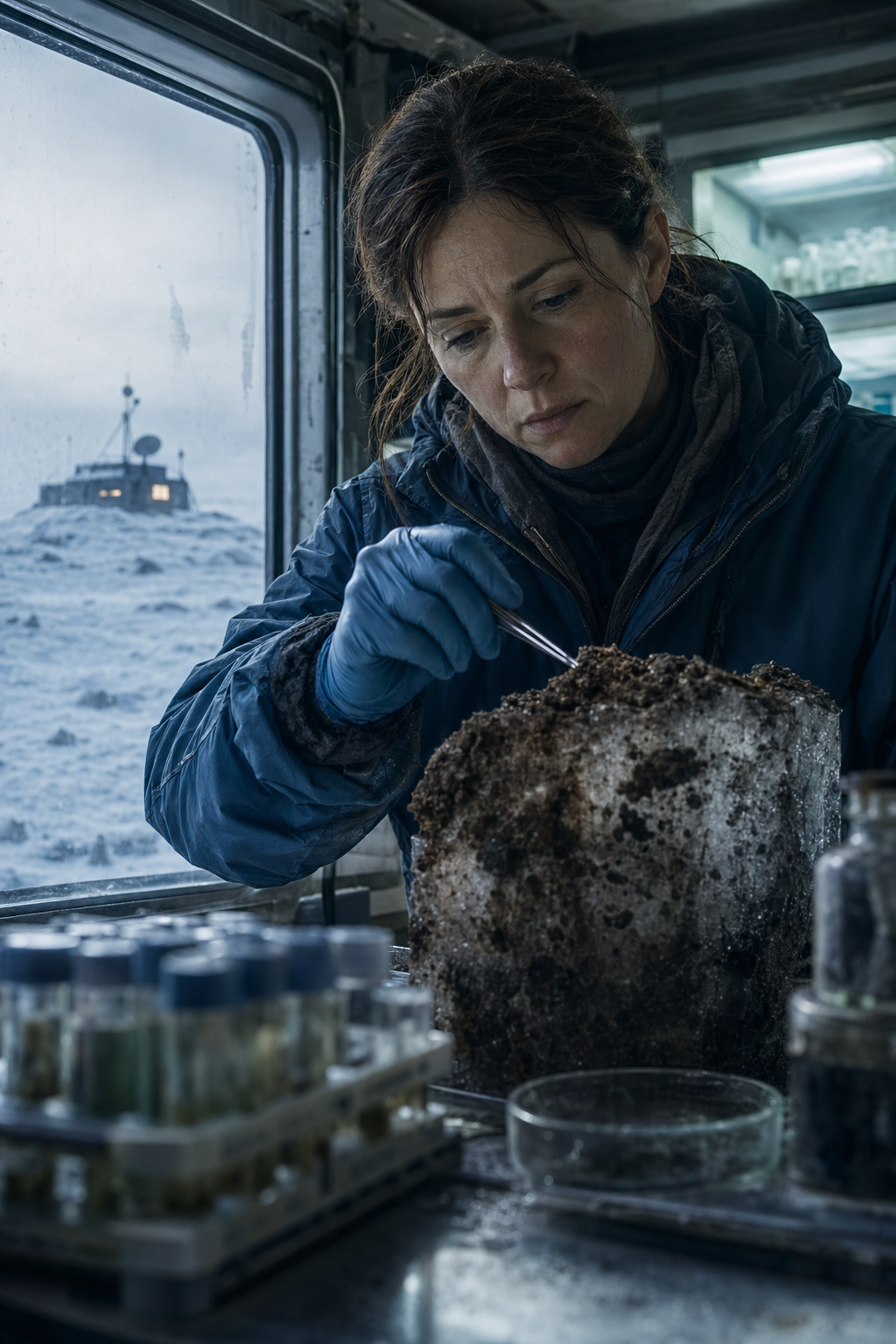
THAW LINE
A CDC epidemiologist in the thawing Arctic traces a breach from ancient permafrost before evacuation turns into a quarantine trap.
Chapter 1
The digital display on the cold storage wall read minus nineteen point eight degrees Celsius.
Below the current temperature, the twenty-four-hour graph held a smaller story: a narrow rise from minus twenty to four degrees and back down again over four hours and five minutes, clean as a pulse on a monitor. The fluorescent tube overhead buzzed. The cooling unit in the ceiling hummed with the steady, indifferent note of a machine that had returned to function and would not explain where it had been.
Dr. Lena Karraker stood in the doorway with her inspection tablet in one hand and looked at the curve until it resolved from anomaly into event.
The room was seven meters by four. Steel shelving ran along both long walls, bolted through the concrete. Core sample containers sat in ordered rows, white cylinders labeled with station codes, dates, and depth notations. Thirty thousand years of frozen ground reduced to inventory. The air smelled like nothing. Her breath did not fog; the cooling unit kept the space dry enough to erase moisture as soon as it formed.
She stepped to the panel and tapped the log history forward, then back. The spike remained. Timestamp: 23:47 to 03:52. Peak internal temperature: 3.8°C. Alarm status: none.
No one had flagged it.
Lena lifted her phone, photographed the display, then crouched in front of the lower shelf where GS-31 sat between two deeper cores from the same survey line. The label read 30.2 m, late-season extraction. She ran a gloved thumb along the lid. Near the seal, a faint ring of frozen residue caught the light—thin, almost invisible, the mineral outline left behind when condensation had formed and dried and frozen again.
She photographed that too.
Behind her, footsteps crossed the corridor outside and stopped at the threshold.
“You found our excitement for the week,” Tom Aldersen said.
Lena did not turn immediately. “How long was the outage?”
“About four hours. Windstorm took the line. Generator transfer hiccupped.” His voice had the measured steadiness of a man used to incident reports that ended with the phrase resolved by morning. “Marcus got the backup online before dawn.”
She stood and looked at him. Tom filled the doorway in a station parka, cheeks reddened by cold and years of field weather. He wore his watch over his sleeve. The second hand moved visibly when he shifted his wrist.
“Who checked the samples after power was restored?” she asked.
Tom thought about it. Not long. “I don’t think anyone did. Temperature came back into range.”
“The alarm threshold?”
“Ten degrees above normal.”
“For biological storage?”
He gave a short exhale. “For the unit as installed. It used to hold food stock before they repurposed it.”
Lena looked back at the graph. Minus twenty to four. A restaurant standard applied to thirty-meter cores from thawing permafrost. She entered the numbers into her inspection notes with the stylus pressed hard enough to squeak against the screen.
Outside the storage room, Station Alpha continued its morning around them. A kettle clicked off in the common room. Somebody laughed once, briefly. From the mechanical end of the building came the lower vibration of the diesel generator settling under load. The station was a set of modules bolted onto frozen ground, held together by schedules, maintenance logs, coffee, and the assumption that all deviations eventually returned to baseline.
“Did the outage affect any other systems?” Lena asked.
“Heat dipped. Lights out. Sat uplink went down for a while. Standard storm nuisance.” Tom checked his watch without looking at it. “You want me to pull the maintenance log?”
“Yes.”
“I can do that after lunch.”
Lena capped the sample container and set it back in place with two fingers, aligning the label to the shelf edge. “Now.”
Tom held her gaze for half a second, then nodded. “All right.”
He moved off down the hall. Lena remained in the cold room long enough to examine the floor. Concrete, painted gray. Clean, at first glance. In the back corner a shallow drain was set into the slab beneath the lowest shelf, covered by a metal grate no wider than her hand. She crouched again. The grate held a line of frozen dust and one filament of pale dog hair caught in the edge.
She photographed that as well.
By the time she stepped into the corridor, the station’s interior heat felt excessive after the storage room. The fluorescent-lit hallway smelled of wet nylon, diesel, and instant coffee. Triple-glazed windows showed a world reduced to white ground, low light, and a horizon so flat it looked measured.
She passed the common room. Jamie Vasquez sat at the table with a laptop open and two external drives beside it, watch strap pinched between thumb and forefinger in a repetitive adjustment Lena had noticed within ten minutes of arrival. Twenty-six, first Arctic rotation, climate data analysis. Good at trend models. Too new to hide nerves yet.
Jamie looked up. “Dr. Karraker. Coffee?”
Lena paused. “How long were you in the storage area yesterday?”
Jamie blinked. “Yesterday?”
“After the outage.”
“Oh. Maybe a couple of hours? Tom had me helping move gear so you’d have room to inspect.” A small smile, eager and apologetic at the same time. “Why?”
“Which shelves?”
“Mostly lower. We had to clear the repair boxes.”
Lena nodded once. “Coffee, yes.”
Jamie stood too quickly, chair legs scraping the floor. In the kitchenette alcove the electric kettle had already boiled dry enough to click back to standby. Jamie refilled it from the iron-tasting tap and started it again. Lena watched Jamie’s hands move around the mug, the spoon, the jar of instant coffee. Young hands. No tremor. No lesions. No cough.
Tom returned with a binder under one arm and Marcus Chen behind him carrying a folded maintenance printout darkened with grease at one corner. Marcus wore a wool cap indoors and had oil ground into the creases of his fingers. The multi-tool on his belt knocked lightly against a table leg as he stopped.
“Power line sheared at 23:47,” Marcus said before anyone asked. “Transfer switch failed closed. Backup didn’t engage until I bypassed it manually. Main generator back online 03:52. Cooling unit cycled normal after that.” He handed Lena the printout. “Storage room drain exterior outlet’s on the east wall. Runs near the kennel.”
Lena looked up. “Why do you know that?”
“Because every pipe in this place becomes my problem eventually.”
The kettle clicked. Jamie poured the water. Steam rose, then vanished into the dry room air.
Lena turned to Tom. “I want the east exterior checked. Drain outlet, ground around it, kennel line.”
Tom’s brow tightened. “For what?”
“I don’t know yet.”
That answer unsettled people more than certainty. She watched it land in the small changes of their faces. Tom’s mouth compressed. Jamie stopped stirring. Marcus shifted his weight and waited.
“All right,” Tom said. “Marcus, can you—”
A sound cut across the room from outside: one bark, sharp and abrupt, followed by another that broke midway through as if something had caught in the dog’s throat.
Marcus was moving before the second sound ended. He shoved through the outer door into the white glare. Cold knifed briefly through the room before the door slammed behind him.
No one spoke.
Lena set her coffee untouched on the table and followed.
The station’s east side opened onto wind-scoured hardpack snow and a shallow drainage channel crusted with ice. The kennel sat twelve meters from the wall, chain-link fenced, six huskies lunging and barking at the disturbance at one end of the run. At the other end, Marcus was kneeling beside a gray-and-white dog on its side in the snow.
Boone, one of the older animals. Seven years, if Lena remembered the kennel tags correctly. Good shoulders. Clear eyes yesterday when she had walked the perimeter.
Now the body lay half-curled, snow kicked up around the forelegs. Blood stained the fur around the muzzle and had frozen in small dark clots along the whiskers. One nostril was rimmed red. The dog’s open mouth showed a strip of gum almost black in the cold.
Marcus looked back at her. “He was fine last night.”
Lena stopped two steps short of the body. The wind carried the clean mineral smell of snow and something metallic under it. She followed the line from the station wall to the drain outlet: a short pipe emerging at ground level, its lip rimed with ice. Beneath it, a fan-shaped stain in the snow where water had pooled and refrozen. The edge of the stain led toward the kennel fence, where the snow was broken by paw marks.
She crouched. The blood around Boone’s mouth was not a trauma pattern. No tearing. No puncture. No sign of struggle with another dog. She pressed gloved fingers lightly into the fur over the rib cage. The tissue beneath gave too easily.
“Did you touch him?” she asked.
“I rolled him over when I found him.” Marcus held up his bare hands as if presenting evidence. “No gloves.”
“When?”
“Thirty seconds ago.”
Lena straightened. The other dogs were still barking, throwing steam from their mouths. Behind her she heard the outer door open and shut again—Tom and Jamie coming out into the cold, boots crunching toward them.
She looked once more at the pooled ice beneath the drainpipe, then at the dog, then at the station wall above them, where the cold storage room sat behind insulated panels and fluorescent light and a temperature log that had risen to four degrees in the dark while everyone slept.
“Bring a sample kit,” she said.
Tom stopped. “From the lab?”
“Yes.”
“For a dead dog?”
Lena kept her eyes on Boone. “For the chain.”
The wind moved over the tundra without changing speed. Beyond the kennel, the horizon held where it had always held, a ruled line under a low Arctic sky. Inside the station, the generator ran. The coffee on the common-room table would be cooling already. Somewhere under thirty meters of thawing ground, the rest of GS-31 remained in its cylinder, labeled and shelved and waiting for a category the station had never been built to name.
In the Canadian High Arctic, remote permafrost research stations watch ground that has stayed frozen for thirty thousand years. When a power failure silently reactivates something inside a deep core sample, CDC field epidemiologist Dr. Lena Karraker arrives for a routine biosafety inspection and realizes the station may already be carrying a novel pathogen. As illness spreads and help is days away, she must map the transmission chain fast enough to decide whether escape would save lives or unleash catastrophe on the nearest town.
- —Dr. Lena Karraker — A forty-four-year-old field epidemiologist with the CDC's Arctic Health Program, Lena is austere, exacting, and trained to notice the anomaly everyone else misses. Her gift is pattern recognition under pressure, and her terror is being the one who fails to see the breach in time.
- —Dr. Yuri Orlov — Station Alpha's veteran microbiologist, Yuri is one of the only researchers who has always taken Lena's biosafety warnings seriously. His cellular expertise and Lena's outbreak logic make them a seamless diagnostic pair, bound by trust expressed through work rather than words.
- —Marcus Chen — A former combat engineer now keeping the station alive, Marcus is the practical mind behind generators, heaters, snowmobiles, and fuel margins. In a crisis ruled by biology, his mechanical competence becomes just as essential as any lab result.
- —Dr. Sara Okafor — A permafrost geologist and principal investigator on the core-sampling project, Sara brought the ancient sample to the surface through ordinary, careful science. She becomes the face of a system that failed without anyone acting carelessly, and her growing guilt deepens the human cost of the outbreak.
- —Tom Aldersen — The station manager is a seasoned logistics professional whose instincts are built around protocol, evacuation, and operational continuity. He is not a villain so much as the embodiment of an institutional response that makes sense on paper and could be disastrous in this specific emergency.
- —Jamie Vasquez — A twenty-six-year-old junior climate researcher on a first Arctic rotation, Jamie is bright, eager, and unprepared for the scale of risk around them. Their ordinary ambition and narrow innocence make them the story's clearest measure of what Lena is trying to protect.
- —The Breach: Lena arrives at Station Alpha for a routine inspection and notices a cold-storage temperature spike that no one treated as dangerous. When a sled dog dies with signs of hemorrhagic illness, she and microbiologist Yuri begin tracing a possible chain from a thawed permafrost core sample to a living host.
- —The Exposure Map: As a dry cough appears among the staff and communications with the CDC turn fragmentary, Lena reconstructs who was where, for how long, and under what airflow conditions. At the same time, the station's failing heat and contaminated infrastructure make staying in place increasingly untenable.
- —The False Escape: The team evacuates by snowmobile toward a midpoint supply cache, believing it to be a step toward help. During the traverse Lena identifies the first unmistakable human signs of infection, and once at the cache she learns that taking the sick to Tulita could ignite a mass casualty event.
- —The Siege: The cache is converted into an improvised quarantine ward while Lena, Yuri, and Marcus build barriers, airflow fixes, and a transmission model from scraps and field notes. As Jamie deteriorates, Sara follows, Tom begins to sicken, fuel runs low, and Lena races to determine who is infected before rescue arrives too late.
- —Containment: A military containment team finally reaches the cache, taking over triage, decontamination, and quarantine. In isolation, Lena records the full chain of the outbreak, waits to learn whether her own model was right about who remained clean, and returns to a world where the immediate crisis is over but the larger threat beneath the Arctic is not.
The voice is clinical, controlled, and closely tied to Lena's perception, favoring precise observation over overt sentiment. The prose is cold, procedural, and tactile, rich with diesel hum, fluorescent light, dry air, blood, frost, and improvised machinery. Brief moments of human connection emerge through work, silence, and physical detail rather than confession.