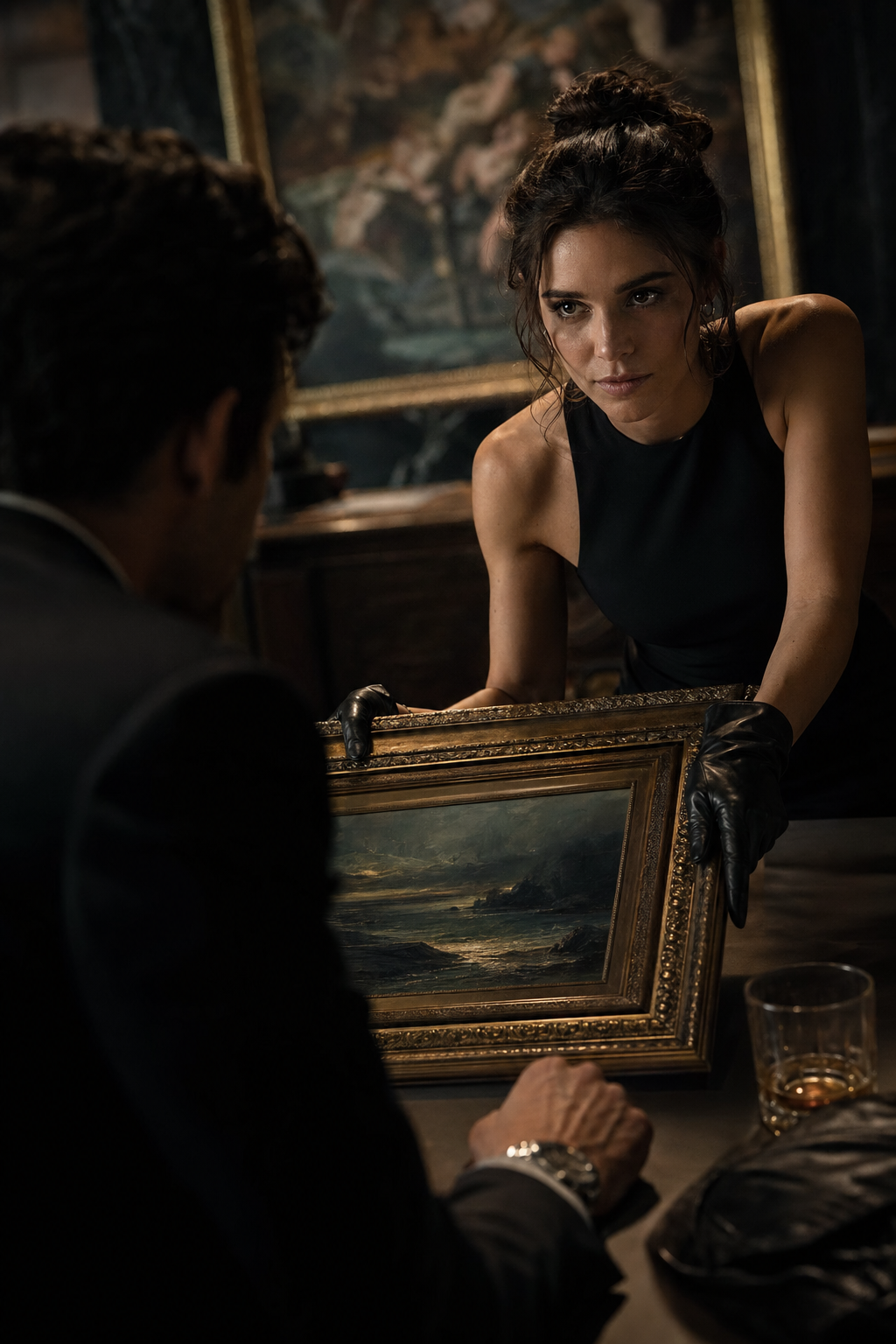
THE TAKE
In the cutthroat world of art recovery, a top specialist is forced to partner with the rival who knows exactly where he breaks.
Chapter 1
The tape on the crate had lifted in one corner. Leon saw it before he saw Constance Harker's face, before the receptionist rose, before the gray glass door hissed shut behind him. A bad seal. Air had gotten in. Not enough to matter, not if the crate had only crossed one room. Enough to register. Enough that his body noted it and filed it with the rest.
Constance's office was all matte surfaces and disciplined light. No art on the walls. Insurance firms that handled art rarely displayed any. Superstition, maybe. Or embarrassment.
"Leon."
He nodded once and stayed standing until she gestured to the chair. She liked that. Procedure observed. Constance Harker wore a silk scarf the color of old bone and had a file open in front of her with three tabs already flagged. Efficient, controlled, expensive in ways that weren't loud.
"Coffee?" she asked.
"No."
She folded her hands. "We have intelligence on a recovery."
He sat. The chair was too low by half an inch. He adjusted without making it visible.
Constance turned the file toward him. A glossy photograph. Artemisia Gentileschi. Judith and Her Maidservant. Oil, shadow, two women bent toward an act the painter had frozen at the edge of completion. Leon took in dimensions first, then condition, then frame. His thumb pressed once against the pad of his index finger. Calculation.
"Stolen fifteen years ago," Constance said. "Private Swiss collection. Payout was eight-point-two million. We were prepared to write it off as gone for good. It appears we were wrong."
Leon kept his eyes on the photograph. "Source?"
"Nikos."
That made him look up.
Constance saw the movement and did not acknowledge it. "He says the painting resurfaced in Naples. Mid-level broker, organized channels, likely held as leverage rather than inventory. He can get us into the conversation."
"Can he get us into the room?"
"He says yes."
Leon let the silence sit. In this world, there was what people could do and what they said they could do. Nikos usually knew the difference. Usually.
Constance slid a second page across the desk. Policy terms. Recovery fee. Deadline. Standard language around authentication, chain of custody, discretion. Leon read quickly. His left palm itched. The scar there, white and narrow, always woke when he was working.
"What are the constraints?" he said.
Constance's fingers moved to the third tab in the file and stopped there. That was the tell. Not hesitation. Preparation for irritation.
"Nikos has a condition."
Leon felt his shoulders set before he could stop them.
"He wants Margot Ellis on the job."
The room did not change. The fluorescent hum stayed steady. A car passed six floors below. Constance remained exactly as she had been. Only Leon's body moved, and even that movement was small: one flex in the left hand, the scar opening and closing like an eye.
"Why," he said.
"Nikos claims authentication concerns. The painting's been off-grid for fifteen years. There are forgery rumors around two related works that circulated in the early two-thousands. He says Ellis is the safest choice."
"She could authenticate from photographs."
"Yes."
Constance said it flatly. No comfort in it. No apology. The scoreboard did not care how a condition felt.
Leon looked back at the Gentileschi. Judith's hand, the maidservant's hand, the angle between them. Two people doing one dangerous thing because one pair of hands wasn't enough.
"What's the real reason?" he asked.
Constance lifted one shoulder. "If Nikos told me his real reasons, I would be in a different line of work."
Leon almost smiled. Almost. It didn't reach far enough to count.
He knew Margot's rate. Sixty-nine over thirty-eight. He knew which jobs made up the thirty-eight. He knew the Prague miss wasn't her fault and the Antwerp recovery had been cleaner than the industry gave her credit for. He knew the way she stood in rooms when she was listening—weight balanced, chin slightly down, father's watch too large on her wrist. He knew all this in the useless way a man knows the dimensions of a blade pointed at him often enough.
Constance waited. She did not fill silence unless billing required it.
Leon turned another page. Naples. Preliminary contact point near the port. Nikos in place. Margot arriving separately. He read the line with her name twice, not because he needed to, but because reading it was easier than looking at Constance while she watched him not react.
"You've missed two in the last year," she said.
There it was. Not unkind. Not kind either. Just the number on the board.
"Athens wasn't mine to miss," he said.
"No." Constance's voice stayed level. "And Tangier failed because the holder panicked. The market does not care."
He set the file down. "I'm aware."
"I know you are."
That, from her, was nearly tenderness.
He stood and went to the window because standing still in front of her desk would have made the room too small. London below was wet and gray and orderly in the way only very expensive cities managed. He could feel Constance behind him, not as a person exactly, but as institutional pressure given a human spine.
Margot Ellis.
He had not worked a full job with her. Not once. Adjacent cases, competing bids, one Zurich conference, two auctions where they had stood on opposite sides of the same room and monitored the same liar. Twelve years of orbit. Twelve years of measuring himself against a woman whose expertise entered a room before she did.
He could say no. He could take the professional line: compromised operational structure, unnecessary duplication, broker overreach. Constance would hear it. She might even respect it. But saying no would make something visible he had spent twelve years keeping inside his own ribs.
It would say Margot affected the calculation.
That was intolerable.
"When do I leave?" he asked.
Constance didn't blink, but something in the room settled, a contract finding its mechanism.
"Tonight, if you can. Tomorrow morning at the latest. Nikos is in Naples already. He wants the first exploratory contact within forty-eight hours."
"And Ellis?"
"Two days behind you."
Of course. Enough time to prepare alone. Not enough time to get used to the idea.
Constance slid a slim folder across the desk. Travel documents. Preliminary dossier. Contact numbers. "Use the secure line for me. Burner for Nikos. Do not use either for anything else."
Leon picked up the folder. It was heavier than it looked. Paper always was when enough money sat behind it.
"One more thing," Constance said.
He waited.
"If this goes badly, it goes badly publicly. The painting is known. The client is litigious. And if Nikos is wrong, or using us to settle something personal, I will need to know before it costs me more than the fee."
"You'll know."
Her eyes stayed on him for one beat longer than necessary. Measuring. Not his competence. The cost. Constance had been in this business long enough to know they were never the same.
He gave a short nod and turned for the door.
"Leon."
He stopped.
"Him asking for her doesn't mean he trusts either of you."
Leon looked back.
Constance rested one finger on the photograph of the painting. "It means he knows exactly where to press."
Outside, the corridor smelled faintly of carpet glue and air conditioning. Leon walked its length without breaking stride. At the lift he opened the folder again, not because he needed to, but because movement helped. The first page was the image of the Gentileschi. The second, the timeline. The third, Naples contacts. The fourth, a typed line:
MARGOT ELLIS - AUTHENTICATION CONSULTANT
Consultant. As if there were anything consultative about her. As if she entered rooms lightly.
His thumb found the scar in his palm and pressed until the skin whitened.
In the lobby he called his car, then canceled it and stepped out into the rain instead. Walking was better. Walking let the body work before the mind caught up. He went east without deciding to, collar up, folder inside his coat. Water darkened the shoulders of his suit. He didn't notice until three blocks later.
At a corner near Holborn he stopped under an awning and called Nikos from the number Constance had marked in blue.
The line clicked. Quiet breathing. Then Nikos's voice, low enough to make Leon lean in despite himself.
"You took it."
"I'm calling, aren't I."
A soft sound that might have been amusement. "London still making you polite?"
"What aren't you telling me?"
Rain hit the awning in a hard, steady line. On the street, a courier swore at a van. Leon watched a woman across the road struggle with an umbrella that had turned itself inside out.
Nikos said, "If I told you everything, you wouldn't need me."
"Try me."
"Naples is hot. The broker is vain. The painting is real enough to make greedy men careful. And Margot lands Friday."
There it was again. Her name, placed gently and with intent, like a blade set on linen.
Leon shifted the phone to his other ear. "She isn't necessary for first contact."
"Neither are you," Nikos said. "And yet here we are."
Leon said nothing.
Nikos let the silence stretch, then added, "You still drink espresso standing up?"
"Did you call to discuss my posture?"
"I called because by tomorrow you'll be in my city and you'll start mistaking preparation for control."
"It's not your city."
Another soft sound. Not amusement this time. Age, maybe. Fatigue.
"Get in before dark if you can," Nikos said. "The streets negotiate differently at night."
The line went dead.
Leon lowered the phone and stood still until the screen went black in his hand. Then he put it away and kept walking.
By the time he reached his flat, his suit had dried in streaks. He packed in twenty-two minutes. Two dark suits, shirts, one extra pair of shoes, the small lamp he used in rented rooms because most overhead lighting was useless, the file, his laptop, chargers, a folded set of photographs from an old case that had nothing to do with this one and still ended up in the bag because habit moved faster than sense.
He paused at the kitchen counter, staring at the espresso cup he'd left in the rack to dry that morning. White porcelain. Thin crack near the handle. He set it upright. Left it there.
Then he sat at his desk and opened the dossier again.
Margot Ellis. Age forty-one. Doctorate, Warburg Institute. Recovery rate. Selected case history. It was all information he knew already, and the fact that he knew it already made the official page feel obscene. As if a file could contain twelve years of peripheral vision.
He read anyway.
At the bottom of the page, under current contact details, there was a London mobile number he had never used. He had other numbers for her. Temporary ones from jobs, from conferences, from a late-night call in Brussels that had lasted ninety seconds and altered his sleep for a week. This one was the settled number. The one attached to a life.
He closed the file.
His flight left in three hours. Naples by morning. Nikos by noon. Margot in two days.
Leon stood, slid the chair back under the desk, and switched off the lamp.
In the dark, the room held its shape for a second longer than it should have. The desk. The coat over the back of the chair. The packed bag by the door. A life arranged for movement.
Then the dark settled fully, and he went.
Leon Dura is one of the world's best art recovery specialists, a freelance operator whose reputation lives and dies by his recovery rate. When a stolen Artemisia Gentileschi resurfaces in Naples, he takes the high-profile job only to learn the broker controlling access will work with him on one condition: he must partner with his longtime rival, Margot Ellis. In a world where trust is currency and only one name should get the credit, their combined skill becomes both their greatest advantage and their most dangerous vulnerability.
- —Leon Dura — A self-made London-based art recovery specialist from Marseille, Leon built his career on patience, tactical calm, and an elite recovery rate. He is superb under pressure, but his precision hides a deep terror of being seen trying and failing.
- —Margot Ellis — A formidable recovery specialist with a doctorate in art history and an inherited fluency in the art world, Margot knows paintings, provenance, and fraud better than almost anyone alive. Her expertise is both her weapon and her shield, masking how badly she needs her success to feel fully earned.
- —Nikos Sava — A former art thief turned indispensable broker, Nikos sits at the center of the stolen-art ecosystem by controlling information and access. He forces Leon and Margot onto the same job for practical reasons on the surface, but underneath he is staging a reckoning about trust, relevance, and the power of making others perform.
- —Constance Harker — The immaculate insurance handler who hires specialists like Leon and Margot and measures them by results, not excuses. She embodies the institutional scoreboard pressing on every decision.
- —Tomás — Nikos's young nephew in Naples, serving as driver, translator, and quiet observer of the adults' dangerous trade. He offers a next-generation view of a world that is both seductive and corrosive.
- —Cesare — The polished intermediary for the painting's current holders, Cesare tests whether Leon and Margot have the leverage and credibility to complete the recovery. He turns every meeting into a negotiation of pressure, price, and control.
- —Dario — Nikos's former partner from his years as a thief, Dario is the absent presence behind the job for most of the story. His long grievance with Nikos transforms the recovery from a professional operation into a personal reckoning over betrayal and what was taken from both men.
- —The Contract: Leon is offered a career-resetting recovery: a stolen Artemisia has resurfaced after fifteen years. The catch is that access to the painting runs through Nikos, who insists Leon must work with his longtime rival Margot Ellis.
- —The Compression: In Naples, Leon and Margot are pushed into shared space, shared meetings, and an increasingly undeniable professional sync. Their rivalry sharpens every interaction, but forced proximity turns competitive attention into something far more intimate and difficult to manage.
- —The Crack: A proof photograph reveals the painting is deteriorating and exposes that Nikos has concealed how personally entangled he is with the job. Leon and Margot split over how to proceed, then recalibrate, building a recovery plan that depends completely on trusting each other's strengths.
- —The Exchange: Together they outmaneuver the intermediaries, authenticate the Gentileschi, and push the recovery toward a final handoff at a rural estate outside Siena. As Nikos faces the ghost of his criminal past, Leon and Margot are forced to confront how much of themselves has become bound up in the partnership they were never supposed to need.
- —The Return: After the painting changes hands, the real question becomes what survives once the job is over and the structure holding them together disappears. Back in London, Leon makes a choice he would once have avoided, opening the door to a new version of their rivalry built on deliberate collaboration instead of accident or coercion.
Close, controlled, and sensuous without romantic excess, the prose stays tight to the body and to the mechanics of professional expertise. The language favors precise physical detail over abstract declaration: hot apartments, fluorescent storage rooms, scar tissue, old canvas, espresso, stone kitchens, and the charged silence between two people who know exactly how hard the other is trying.