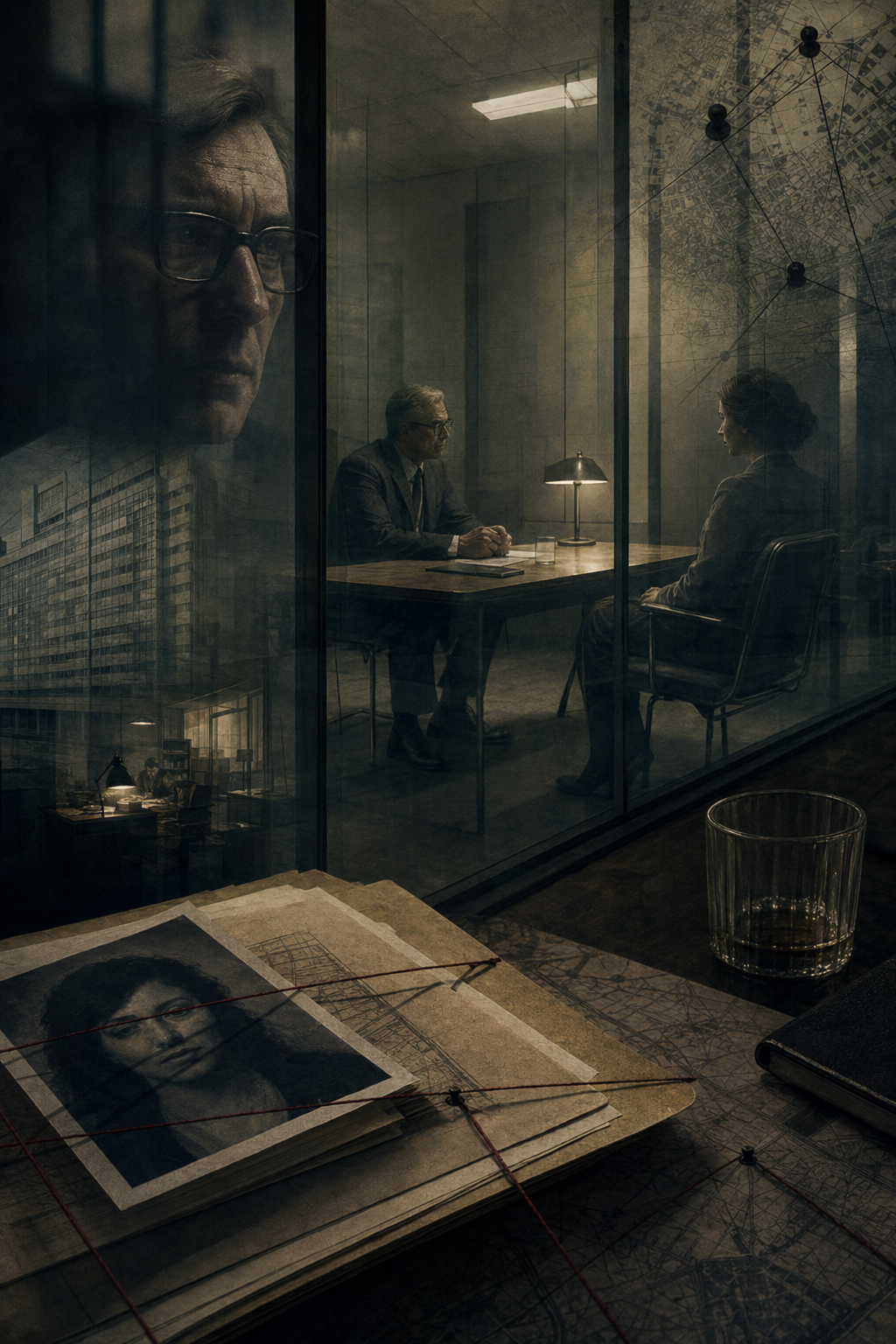
SURFACE CONDITIONS
In a beige Northern European spy service, a leak hunt forces a disciplined analyst to confront the hidden architecture of her life.
Chapter 1
The meeting lasted forty minutes.
Hendricks spoke for most of it. He chaired the Tuesday section review with the same manner he brought to all routine procedures: patient, slightly compressed, as though he regarded efficiency not as a virtue but as a form of politeness owed to everyone in the room. Seven analysts sat around the conference table. Legal pads, folders, institutional coffee in white cups with the Service crest half-scraped away by industrial washing. The conference room had no windows. The air handling unit produced a low, even sound that became noticeable only when someone stopped speaking.
Helen Garrity took notes in the compressed notation system she had developed over eleven years, which saved time and had the secondary benefit of being illegible to anyone who borrowed the pad. She sat midway down the table, neither near Hendricks nor far from him. David Chen sat across from her, his file closed for the first twelve minutes, which she read as agreement provisionally withheld pending further error by someone else.
The review moved through active files in the usual order. Baltic shipping routes. A stalled liaison request from an allied service. A source reliability downgrade that everyone agreed had been overdue for months and which therefore required fifteen minutes of procedural language to accomplish what four direct words would have done. Helen spoke twice. The first time to clarify a date discrepancy in an intercept summary. The second to ask whether the missing reporting from the northern transit corridor might reflect collection weakness farther east than they had assumed.
The question was shaped as a possibility. It redirected the discussion from a broad regional gap to a specific sub-region Helen had already marked for closer analysis, and it did so without requiring anyone to acknowledge that the previous framing had been imprecise. Hendricks nodded, made a note, and assigned a review. Nobody in the room appeared to register that the discussion had been moved.
David did.
He looked up from his notes for less than a second. The glance crossed the table and settled on Helen with the economy of a prearranged signal: noted. Helen did not return the look. She turned a page on her legal pad and wrote down the new tasking in the same hand she used for everything else.
Peter Galvin arrived ten minutes before the meeting ended.
He did not apologize, which in the Service's hierarchy would have been an unnecessary distortion of the atmosphere. The deputy director's late arrival to a routine section review was not something that required acknowledgment. It was incorporated. Chairs shifted by degrees too small to qualify as movement. Hendricks repeated the active item under discussion in a slightly cleaner summary than the room required. Peter sat in the empty chair near the end of the table, listened, and asked two questions that were brief, informed, and directed not at the substance of the file but at the handling of it. Access. Timing. Distribution.
His voice carried easily without ever becoming loud. He had the face of a man to whom people entrusted complicated things because he appeared to understand complication as a normal condition rather than a crisis. Silver hair, soft build, dark suit that had been made well enough not to call attention to itself. When he looked at someone in a meeting, the look gave the impression of having room in it.
Helen answered one of his questions about archival retrieval lag. He thanked her by surname, as he thanked everyone in meetings where rank was present and familiarity would have been a category error. Nothing in the exchange was unusual. Nothing in his presence altered the room visibly. The meeting completed its agenda and dispersed at 09:40.
Folders gathered. Chairs returned under the table. The institutional weather shifted from collective attention to corridor movement. Hendricks left first, carrying two cups because one of them had been forgotten. The others followed in their own rhythms. David paused at the door to say something to an analyst from assessments and then disappeared into the corridor. Peter left in conversation with Hendricks, both men already speaking in the abbreviated language of the next matter.
Helen remained seated.
At the surface level, she was reviewing her notes before returning to her office. This was ordinary and required no explanation. The conference room door stood open behind her. From the corridor came the softened sounds of weekday continuity: a phone beginning to ring in another office, heels on tile transitioning to carpet, the elevator's arrival bell from the far end of the floor.
She looked at the chair Peter had occupied for the final ten minutes.
Her face changed by so little that, had someone entered at that moment without prior knowledge of her, they would not have named it as change. The jaw lost a degree of its set. The eyes settled, not on the chair exactly but on the space around it, as though the useful information had not been contained in what had been said and required a second hearing. It was the expression of someone listening for an echo and finding that the room had altered the sound before returning it.
The change lasted three seconds.
The door opened wider. Raymond Cross stepped back into the room, one hand already extended toward the side table where a blue folder lay under the remains of the coffee service.
“Sorry,” he said. “Forgot this.”
Helen's expression restored itself before he finished the sentence. “Of course.”
Cross retrieved the folder. He was forty-seven, operations, European Desk, careful with his grooming in a way that suggested either discipline or recent disruption being corrected after the fact. He smiled with the distracted embarrassment of a man mildly inconvenienced by his own oversight. Helen handed him the folder although he had already reached it.
“Thank you,” he said.
She inclined her head. “Nothing urgent in there, I hope.”
“Only my continued employment.”
There was enough truth in the joke to make it function. Helen allowed the appropriate response, a brief movement at the mouth that did not develop into anything memorable. Cross left. His shoes receded along the corridor. The conference room returned to the mechanical quiet of an institution continuing without witnesses.
Helen did not look back at Peter's chair.
She closed her legal pad, then adjusted its position so its lower edge aligned with the lower edge of the folder beneath it. The correction took a moment because the folder had drifted half a centimeter off square with the grain of the table. When the edges matched, she stood, gathered her things, and left the room.
The corridor outside changed texture halfway to her office: tile near the conference rooms, then a section of carpet installed during a renovation seven years earlier, then tile again. The ceiling lowered by an inch and a half at the transition point. Most people never noticed these changes after a few months in the building. Helen noticed them every day, though not with the active attention of observation. The building altered register constantly. One learned its grammar or moved through it approximately.
David was at the copier alcove when she passed. He had a stack of retrieval forms in one hand and a pen balanced against his wrist.
“You moved Hendricks east,” he said.
It was not praise. It was not even comment. It was a statement of event.
“He was already leaning that way.”
“Not that far.”
Helen stopped. “You disagree?”
“No.” David capped the pen. “I was confirming that you meant to.”
She looked at the retrieval forms. Archive requests, color-coded by priority. “And?”
“And you did.”
“Apparently.”
He nodded once, satisfied by the answer or by the fact of answer itself. They resumed walking in the same direction for several paces before his route diverged toward records.
“There’s a backlog in basement retrieval,” he said. “I flagged the March files.”
“I saw.”
David's mouth shifted in what, from him, constituted the social equivalent of a full sentence. “Of course you did.”
He turned off toward the stairwell. Helen continued to Counter-Intelligence, where the offices were arranged in a compromise between openness and surveillance: glass partitions up to shoulder height, enough transparency to suggest institutional confidence, enough obstruction to make every line of sight partial.
Her office was not fully hers. She shared the larger room with David, their desks arranged at an angle that allowed each to work without facing the other directly. A connecting shelf held common files, current matrices, reference binders with white labels and black print in the Service template. On Helen's desk: the legal pad, two sharpened pencils, a secure-line phone, the morning's meeting folder, and a ceramic mug in an unremarkable gray that had once been darker before years of washing reduced it to its current tone.
She set down her things and began to reconstruct the meeting in sequence.
This was not unusual. Helen routinely reviewed institutional conversations after they concluded, not because she mistrusted her own perception but because time changed the weight of what had been said. A sentence spoken in minute twenty-seven could alter the meaning of a sentence spoken in minute nine. The room as lived and the room as understood were not the same room.
She wrote down three items from the meeting that warranted follow-up. The northern transit corridor. The archive lag. Peter's questions.
At the third item she paused, pen held just above the page.
Questions: access / timing / distribution.
The words were ordinary. More than ordinary. They belonged so completely to the Service's daily vocabulary that any one of them, standing alone, would have been functionally invisible. Together they were still only professional language. But Peter had arrived late to a routine review and had directed his attention not to the substance under discussion but to the movement around it. Not the intelligence itself. The channels through which it had passed.
Helen underlined nothing. She closed the pad.
The office around her remained in weekday motion. A phone rang two desks over and was answered on the third ring. Someone in assessments laughed once, softly, at something not repeated. The ventilation system carried the smell of reheated coffee and paper warmed by electronics. The building had the faint, persistent odor of being occupied by people who handled information all day and left traces of almost nothing else.
At 10:12 the secure line on Helen's desk rang.
She picked up on the first tone. “Garrity.”
Peter Galvin's voice, softened slightly by encryption. “Helen. Have you got ten minutes?”
“I can make them.”
“Good. Come upstairs.”
The line went dead with the clean efficiency of someone for whom endings required no social cushioning.
Helen replaced the receiver. For a moment she remained still, one hand resting beside the phone. Then she opened the drawer nearest her knee.
Inside were standard office contents arranged with more precision than necessity required: spare pencils, adhesive flags, a sealed packet of aspirin, a keycard sleeve, a small stack of paper clips separated by size. Nothing personal. Nothing that would look different in any other analyst's drawer.
She closed it and stood.
On the way to the fourth floor she took the stairs rather than the elevator. The stairwell smelled faintly of concrete dust and old paint under fresh institutional cleanser. Halfway up, where the landing window looked across the courtyard between buildings, she stopped long enough to register the weather. Low cloud. Dry. Light flattened against the opposite facade until the glass looked less like transparency than polished absence.
Then she continued upward, one hand on the rail, the scratched steel of her watch catching the stairwell light and returning it without emphasis.
At a mid-sized Northern European intelligence service built on layers of concealment, senior counter-intelligence analyst Helen Garrity is assigned to find the leak behind a string of deadly compromises. Her mentor points her toward a clean structural investigation, but a newly arrived allied analyst begins uncovering a more intimate pattern in the data. As institutional suspicion tightens, Helen is pushed toward the one mode of seeing she has spent her career refusing.
- —Helen Garrity — A 44-year-old senior counter-intelligence analyst, Helen is known for being precise, calm, and almost impossible to read. Beneath that professional surface, she lives through a rigid internal partition that keeps her emotional self buried even from her own conscious attention.
- —Maren Solberg — A communications analyst seconded from an allied Nordic service, Maren arrives as a technical outsider with a direct, quietly unsettling presence. She reads the human cost of concealment with unnerving accuracy, becoming the one person who notices what Helen cannot safely admit.
- —Peter Galvin — The Service's warm, polished Deputy Director of Operations is Helen's longtime mentor and the architect of her professional identity. His authority, affection, and institutional fluency make him both the embodiment of the Service and the most dangerous hidden force inside it.
- —David Chen — Helen's longtime analytical partner is a disciplined, elegant professional who knows her operational mind better than anyone. Their bond is built on work, silence, and trust in action, but it has always existed inside the same emotional blind spot Helen lives by.
- —Raymond Cross — An operations officer on the European Desk, Cross becomes the investigation's strongest visible suspect. His secrets are real, but they belong to a personal collapse rather than treachery, turning him into both a diversion and an uncomfortable mirror for Helen.
- —The Surface: Helen is pulled from routine counter-intelligence work and tasked by her mentor, Peter Galvin, with leading a secret mole hunt inside the Service. As she begins mapping access patterns with her longtime partner David Chen, a newly arrived allied analyst, Maren Solberg, starts asking questions that cut across the institution's preferred distance.
- —False Patterns: The formal investigation narrows toward operations officer Raymond Cross, whose access, finances, and instability make him look like the obvious leak. At the same time, Maren detects a transmission pattern tied less to operations than to the private rhythms of a person's life, and Helen begins resisting evidence she cannot comfortably explain away.
- —The Crack: Watching Cross under surveillance, Helen realizes his concealment belongs to personal distress, not espionage, and the certainty of the official case starts to erode. A new compromise raises the pressure, Peter pushes harder toward the wrong target, and Helen experiences the first visible fractures in the control that has defined her for years.
- —Both Registers: When Maren's analysis aligns with places and patterns Helen knows too well, suspicion shifts toward Peter and transforms the investigation into a betrayal of origin as much as of state. Forced to use emotional perception alongside structural analysis, Helen rebuilds the case from the ground up and sees how decades of institutional design may have hidden the truth in plain sight.
- —The Breach: Helen brings David and Maren into the complete picture, revealing to each of them the half of herself they had never been allowed to see. The case against Peter becomes undeniable, and confronting him collapses the old meaning of mentorship, loyalty, and professional identity even as Helen finds a more complicated way to remain intact.
The prose is cool, exact, and restrained, with the cadence of intelligence work and the emotional charge buried inside what goes unsaid. Its sensory world is fluorescent hum, institutional coffee, glass partitions, and winter air against concrete. When feeling breaks through, it does so in minute physical shifts and precise observations rather than overt confession.