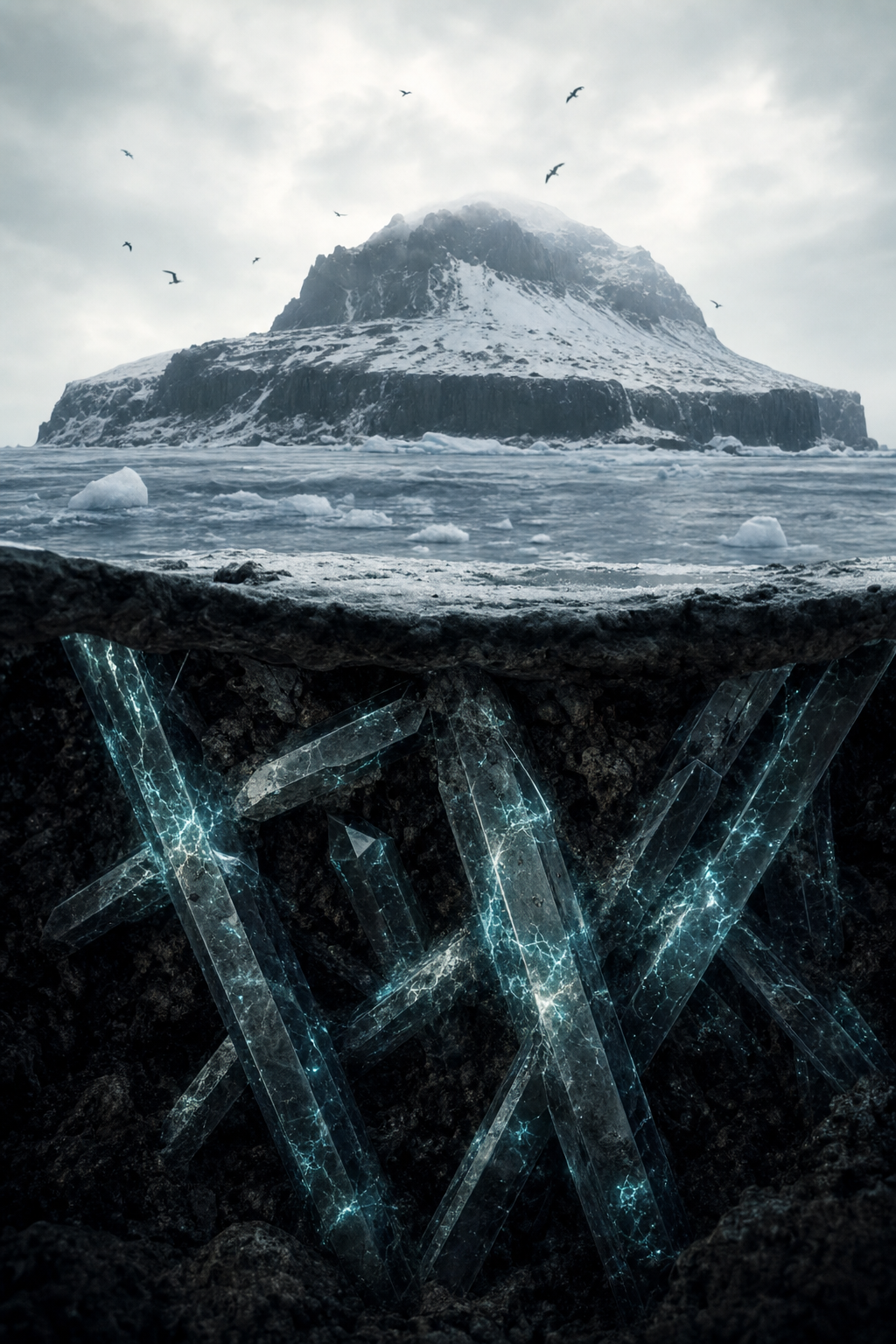
Substrate
On a polar island where the ground changes after sunset, a failure analyst must read a station being rewritten by the dark.
Chapter 1
The spray hit Elian Marsh's face at three degrees above freezing and stayed there as a film until the wind took it. She stood in the inflatable with one hand on the rope line and watched Halvorsen Island come out of the gray. At first it was only density. Then edge. Then rock. Black basalt. Columnar faces where the lava had cooled in long hexagonal joints seventy million years before anyone would decide to anchor steel into it and call the result a station.
The sea lifted them and dropped them. The rubber hull deformed against the swell. Elian felt the flex through her boots and corrected her balance without thinking. The island grew. No snowfield. No clean white. Only dark rock, old and wet, with frost in the seams and the Southern Ocean striking its base in heavy, arrhythmic blows. Everything visible on it was geological except the station.
The station sat above the beach on steel legs and expansion bolts and insulated panels. Gray-white. Rectilinear. Temporary. It had the look all prefabricated structures had in severe places: a statement of confidence made in a language the landscape did not speak.
Jonas Brink stepped off first when they landed. Large body. Careful boots. He turned at once toward logistics, shouting over the wind, assigning cases, directing Paal toward the fuel drums already cached above the tide line. Kira came after, already looking up at the ridge behind the station, eyes narrowed behind fogged glasses, as if the island might offer data by sight alone. Maren Velde stepped onto the rock without looking around. No pause. No moment of arrival. She moved toward the station as if she were crossing a threshold she had crossed before in sleep.
Elian was last. She crouched once and pressed her gloved hand to the basalt beside the landing site. Cold. Fine-grained surface. Stable. Daylight. The rock gave her nothing except temperature and texture. She stood and followed the others uphill.
Inside, the station smelled of diesel, damp insulation, metal warmed and cooled too many times. The corridor walls were paneled white. The floor was composite over slab. Functional light from overhead LEDs gave everything a clinical flatness. Jonas briefed them in the main room. Safety protocols. Generator schedules. Water ration margins. Weather contingencies. Evacuation procedures. His voice filled the room well. It was a voice made for daylight, for briefings, for men and women sitting upright at tables with clipboards.
Elian listened and looked instead at the wall seams. Hairline variation at the joints. Minor out-of-plumb at one corner of the main corridor. A door frame near the storage room with a hinge-side compression mark that suggested previous binding. She said nothing. She had not yet touched enough surfaces to trust her first impressions.
Her room was narrow. Bunk. Desk bolted to wall. Storage crate beneath. She unpacked in eight minutes. Field notebook. calipers. flashlight. thermal strips. pencils. spare gloves. She laid them out in the order she used them on failure sites. The ritual steadied her hands. Then she began her first walk through the station.
She moved slowly. Palm to wall. Fingers along seams. Pressure on the floor through the soles of her boots. She made no notes for the first ten minutes. She only took readings through contact. The previous winter's damage was visible but, in daylight, legible. Settlement stress. Thermal fatigue. Repeated loading in high wind. The ordinary vocabulary of structures in severe climates.
At 18:14 the light outside changed.
Not dramatically. The sun this far south in late March did not set with color or spectacle. It thinned. Flattened. Dropped behind the horizon as if being withdrawn through a slot. But the station felt the transition before Elian consciously saw it.
She had one hand on a corridor seam when the vibration entered.
Low frequency. Sub-audible at first. It came through the wall panel into the heel of her hand, up the radius and ulna, and settled at the base of her skull. She went still. The seam beneath her fingertips widened by a fraction. Not enough to see. Enough to feel. A tenth of a millimeter, perhaps less. Cold air touched the side of her index finger where no air had been a second earlier.
She pressed her palm flat to the panel.
The vibration persisted. Steady. Sourceless. Not generator. Not wind. Wind shook structures irregularly. This had no gust pattern, no mechanical pulse. It was continuous and patient, as though something beneath the station had begun an operation and saw no reason to hurry.
Eleven seconds. Then the amplitude dropped below her threshold of perception.
Elian removed her hand and wrote in her notebook.
Wall seam C-7. Lateral displacement approx. 0.1 mm. Coincident with sunset. Subsurface vibration felt through panel. Duration 11 sec observed.
She held the pencil above the page for a moment, then added:
Displacement did not reverse.
In the galley, Paal was checking a valve on the heating line. His thick hands moved with the economy of long habit. Kira sat at the table with three instrument cases open around her, sorting cables into functional and questionable piles. Jonas was inventorying emergency food by lamplight though the overheads still worked. Maren was standing at the darkened window over the sink, looking out at nothing visible.
“Elian,” Jonas said. “Anything immediate?”
She closed the notebook. “Not immediate.”
He accepted that. Daylight still held enough authority for such answers to mean something.
They ate dried cod reconstituted into stew, dense bread, tea with a metallic taste from the tank. The station shifted once while they were at the table. Very slightly. Kira looked up. Jonas kept speaking, as if continuity of voice might preserve continuity of structure. Maren lowered her spoon, listened with her head tilted a degree, then resumed eating.
“What was that?” Kira asked.
“Thermal adjustment,” Jonas said.
Elian did not correct him. It was not yet useful to say that thermal adjustments did not usually begin exactly at sunset and travel through walls with the tonal steadiness of a buried machine. She watched the steam from her mug thin into the room’s cooler air and disappear.
That night she slept badly. Not from fear. From the station’s changing geometry. She had spent enough years inside compromised buildings to know that sleep in an unstable structure was not an act of trust but of temporary surrender. At 23:07 she woke and knew, before opening her eyes, that the hum was back.
She sat up. The bunk frame carried it into her spine. Low. Persistent. She dressed and stepped into the corridor.
The overhead LEDs were dimmer than they had been at dinner, though the generator output should have been constant. The corridor felt narrower. Not by sight. By body. As though the planes of wall and floor had adjusted to angles her eyes had not yet recalibrated to.
She checked three seams. All wider than in daylight. Minutely. Permanently, if the first one was any guide.
At the rear exit she found Maren already dressed for outside travel. Full cold-weather gear. Hood up. Gloves on. One hand on the latch.
“Where are you going?” Elian asked.
“Out.”
The answer came flat. Not defensive. Not explanatory.
“Why?”
Maren looked at her. In the corridor light her face showed almost nothing. Calm or vacancy. Elian could not tell.
“The ground is different now,” Maren said.
She opened the door.
Cold entered first, hard enough to tighten the skin across Elian’s teeth. Then the sound beneath the wind made itself known. Not a true sound. A pressure in the air and floor combined. The hum was stronger outside, unbuffered by insulation, and for a moment Elian felt it in her sternum with the clarity of a second pulse.
Maren stepped into the dark and pulled the door shut behind her.
Elian remained in the corridor with her hand still half raised from the instinct to stop her. She lowered it. Through the floor she could feel the same low oscillation, patient and steady. She stood there until the cold leaking around the door seal reached her boots.
By morning the vibration was gone.
Sunrise came at 07:48 as a gray increase rather than an arrival. Elian went directly to corridor C-7 and put her fingers on the seam. It had not returned to its prior width. Whatever moved at sunset had left the station altered in a way the daylight did not undo.
She spent the next hour on her knees with calipers and notebook, beginning the formal survey. Crack by crack. Joint by joint. Bolt heads, panel stress, floor levels, hinge resistance. The work steadied her. Structures failed for reasons. Materials yielded according to properties. Loads moved along paths. Even ruin had grammar.
Yet by midday she had marked four irregularities that resisted immediate classification. A hairline crack running against expected stress direction near the storage corridor. Lateral displacement in two foundation bolts that should have settled vertically if they settled at all. A shallow concavity in one section of floor with no corresponding deformation in the support frame. She marked each with a small X in the margin.
At lunch Kira was talking quickly about the island’s basalt composition, about unusual mineral readings from the previous summer survey, about piezoelectric effects in extreme conditions. Her excitement was genuine. Jonas listened with professional patience. Paal checked his watch every few minutes, thinking in maintenance intervals. Maren ate without joining the conversation.
Elian looked at her hands around the mug. Long fingers. Fine tremor from cold and too little sleep. Sensitive pads at the tips. Those hands had signed specifications for Kingsford Bridge. Those hands had touched the fractured steel afterward and understood in seconds what had gone wrong. She flexed them once under the table until the tremor settled.
Outside, the island lay under low daylight. Black rock. Gray sky. Dark water beyond. Nothing in the landscape suggested intention. Nothing in it acknowledged the station. The station stood on its bolts and panels and rated insulation because humans had put it there. The island did not contest this. It simply continued being older than the station, deeper than it, and subject to laws the station had not been built for.
Elian finished eating and returned to the corridor.
She placed her palm once more against the wall seam at C-7, as if confirming the existence of a bruise. The panel was still. The daylight had restored the world to comprehensibility. Measurements would hold for a few hours. Tools would behave. Reports could be written in nouns and numbers.
But sunset was coming again. She could feel that fact in the station the way a body feels weather before the pressure changes. The exhale of day was already shortening. The next state was waiting below the horizon, below the floor, below the language she had brought with her.
She wrote the date at the top of a fresh page.
Then she began.
Halvorsen Island is a remote Southern Ocean outcrop whose buried crystal lattice becomes active in darkness, shifting ground, warping instruments, and altering human perception through cold, gas, and vibration. Structural failure analyst Elian Marsh arrives to assess a damaged research station after a deadly winter, hoping to measure one more collapse from a professional distance. As the days shorten toward polar night, the island steadily strips away the rules she trusts and forces her to confront whether her competence survives outside them.
- —Elian Marsh — A British structural engineer who now specializes in forensic collapse analysis after a bridge she designed failed and killed seven people. She arrives to judge whether Halvorsen Station can survive another winter, only to find that the island's failures obey no known model and force her to rely on something deeper than training.
- —Maren Velde — A Norwegian atmospheric physicist who survived the previous polar night alone on the island and returned altered in ways no one can quite name. She moves through darkness with uncanny practical accuracy and becomes Elian's guide, mirror, and most unsettling possible answer to what the island leaves behind.
- —Dr. Jonas Brink — The veteran Norwegian glaciologist and official team leader, confident and authoritative in daylight and procedure. As the nights lengthen and precedent fails, his institutional competence thins into routine without command.
- —Kira Tanaka — A young Japanese-American geophysicist drawn to the island's extraordinary crystal formations and determined to explain them. When her instruments stop being equal to the phenomena, she shifts from pure measurement to disciplined observation and becomes one of Elian's closest allies.
- —Paal Sørensen — The station's Norwegian maintenance engineer, a practical man whose identity lives in keeping systems running with his hands. He wages a losing but dignified battle against the station's accelerating physical breakdown as the island outpaces every repair.
- —Søren Lund — A member of the previous winter team who died after falling through a cavity that opened beneath the station during the dark. His death becomes a crucial clue to the island's hidden structural logic.
- —Yuki Hasegawa — A scientist from the prior expedition who died when lethal CO2 accumulated overnight in her quarters. Her fate haunts the station and reveals how the island kills through indifferent atmospheric shifts rather than obvious attack.
- —Arrival: Elian reaches Halvorsen Island with a small winter team and begins a formal structural survey of a station already scarred by last year's deaths and evacuation. At the first sunsets she detects subtle shifts in the walls and floor, signs that the island enters a different state when light disappears.
- —Alignment: As nights grow longer, Elian's assessment uncovers crack patterns and foundation movement that do not follow engineering logic but the geometry of the crystal-rich substrate below. Kira builds a partial scientific picture, Jonas tries to manage the danger through protocol, and Maren keeps walking into the dark as if the island has rules only she can read.
- —Descent: With daylight collapsing, Elian learns that the station is not simply failing but being reorganized by the geology beneath it, while hidden node points threaten sudden openings under the floors. Forced beyond instruments and models, she begins reading vibration, heat, and shifting load through her own body, an ability that both empowers and destabilizes her.
- —Polar Night: Once the sun vanishes, the station, hierarchy, and ordinary cognition all erode under continuous Night State activation. Elian and Maren become the team's only reliable navigators through the moving landscape, and a series of ruptures in and around the station pushes Elian to test what remains of her when every professional framework has been stripped away.
- —Return Light: The first weak light quiets the island just enough for the survivors to regain a workable version of daylight order and prepare for extraction. Elian writes the official report in technical language, but what the island revealed to her resists any clean translation back into the world she came from.
The prose is cold, exact, and bodily, favoring precise physical observation over overt emotional language. Its voice is clinical yet immersive, moving between close tactile detail and the vast indifference of rock, sea, darkness, and geological time. Sound, vibration, temperature, and pressure shape the story's sensory texture as strongly as sight.