STILL OPEN
In a tiny Seoul soup shop below street level, a son chases his late mother’s perfect broth and finds memory won’t hold still.
Chapter 1
The ladle is warm where Jun grips it, the handle polished smooth by years of use, by his mother's hand before his and now only his. He tilts it over the earthenware bowl and the doenjang-jjigae falls in a thick, bubbling pour—broth first, then tofu, then a wedge of zucchini and softened onion, the last of it carrying the dark, deep smell of fermented soybean and pork fat and scallion. Steam rises hard enough to blur the line of the counter for a second. He wipes the bowl's rim with the corner of a folded cloth and sets it down on the wood.
Across from him, Shin is still talking.
"—and then the customer says it was the wrong building, but the address was exactly the same, so tell me how that's my fault."
Jun slides the bowl in front of him. "Rice is coming."
Shin laughs once through his nose, already reaching for the spoon. His phone buzzes against the counter. He turns it face down without looking. That, Jun notices.
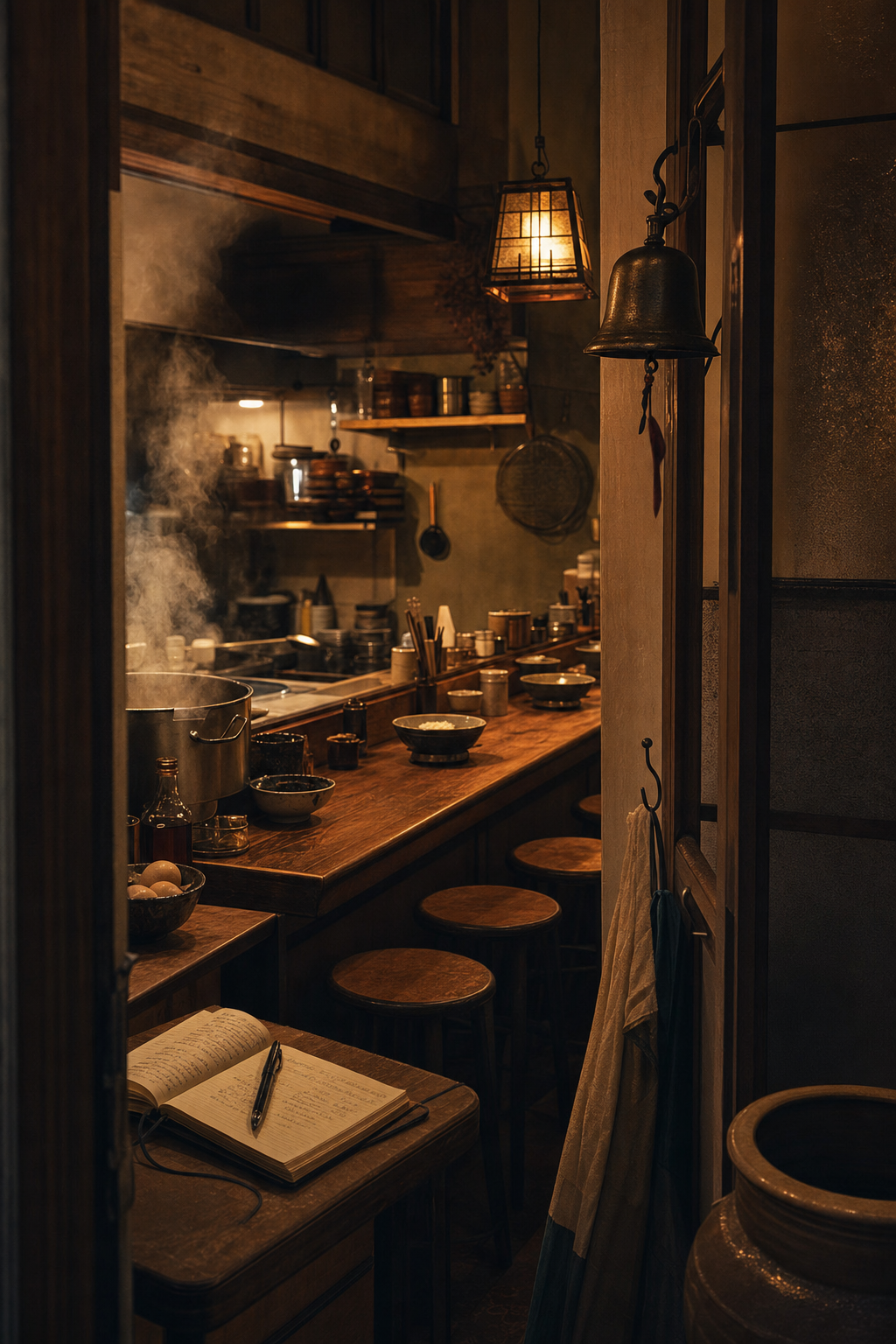
The shop holds heat the way a cupped hand holds water. Eight seats. Amber light. The stock pot on the back burner giving off a low, steady murmur. The exhaust fan hums above the range. Somewhere under that, almost too soft to separate from the rest, the tick of the wall clock. Jun moves inside the sounds without thinking. Rice bowl in the left hand, banchan plate in the right. Set down. Turn. Lift the lid from the pot of ramyeon for the older woman three seats down. Add the egg. Watch the white pull in around the yolk.
The floor mat gives slightly under his feet. His towel rests on his left shoulder, warm at the fold where steam has dampened it. Soy sauce, second shelf, right side. Sesame oil below it. Salt crock by the stove. He reaches without looking and his hand finds everything.
The older woman eats slowly, breaking the yolk with the side of her spoon and letting it cloud the broth. Shin blows across his jjigae and talks between bites, words running ahead of thought. Jun listens with the part of himself that can spare listening. The rest is with the food: the ramyeon's heat, the rice cooker almost ready to click, the green onion on the board waiting for tomorrow's prep.
One seat stays empty all night. Second from the wall.
By nine-thirty the room has thinned to just Shin, then to the older woman alone, and then to no one. The door shuts behind her with a soft catch of rubber seal. Cold presses briefly at the glass and stays there.
Jun stands still for one breath.
Then he turns the sign.
The cleaning begins in the order it always begins. Bowls soak first. Chopsticks and spoons into the steel basin. Wipe the counter from the far corner in toward the register, pushing crumbs and drops into the cloth until the paulownia wood shows pale again under the light. The grain lifts under his palm in places where years of elbows have worn it soft. He washes the earthenware pots one by one, careful with the rims. His mother stacked them largest to smallest on the drying rack, handles all facing left. He still does.
Water runs. Steam rises. The room empties of customer-sound and fills with maintenance: ceramic against steel, the brief rush of the faucet, the cloth dragged once, folded, dragged again. The stock pot on the back burner goes on murmuring as if service has not ended, as if the kitchen belongs to the act of simmering more than it belongs to people.
When the last bowl is dry, Jun hangs the cloth over the sink and crouches at the lower cabinet. From the back he pulls a parcel wrapped in butcher paper, damp now where the cold has sweated through it. Bones.
He sets them on the prep table. Unwraps them. Beef leg bones, split clean, pale marrow showing at the center. He does not look toward the menu board. He does not need to. This part of the night has nothing to do with the menu.
A clean pot. Cold water. Bones lowered in one by one, the water climbing over them with a hollow sound. He lights the burner and turns the flame low. Not low enough to stall. Low enough to begin properly.
The room changes when he starts this. Service has its own rhythm—outward, responsive, measured against other people's hunger. This is narrower. Closer. The kind of attention that pulls the rest of the world to the edges until only the pot remains, the surface of the water, the first faint gathering of foam.
He watches for the blanch. White-grey impurities rise slowly, collecting at the edges first. He waits until they are fully there, then kills the flame, carries the pot to the sink, tips the cloudy water away. Steam rushes up against his wrist. He rinses the bones under cold running water, one by one, rubbing loose clots and scum from the cut surfaces with his fingers until the water runs clear. Clean pot. Fresh water. Bones back in. Flame lit again.
The clock passes ten. Outside, somewhere above the level of the shop, a scooter goes by in the alley. The sound fades. Jun skims with a fine mesh strainer, dipping just under the surface and lifting away what doesn't belong. The broth is still only water becoming something else. The smell is faint now—raw bone, a sweetness not yet fully opened, the first suggestion of depth.
He bends close. The heat touches his face.
This is where his hands change.
During service they move as if the body has already decided and the hands are only carrying it out. Here they are more careful, almost too careful. He adjusts the flame, then checks it again. Skims, waits, skims again, though there is almost nothing there the second time. He stands with one hand braced on the counter and watches the liquid as if watching can keep it honest.
Hours fold down small in this kind of work. The broth clears by degrees. A fine shimmer of fat gathers on the surface and breaks apart when the pot gives a small breath. Jun tastes only once before midnight, just enough to know where it is. Not there yet. He keeps going.
The kitchen smells warmer now. Deeper. The kind of smell that settles into cotton and wood and stays until morning. He turns off one of the lights over the counter, leaving the stove-side fixture and the hood lamp. The room narrows further. Stainless steel, pale wood, the black mouth of the back window showing only the concrete wall outside.
When he lifts the spoon again, he does it with both concentration and restraint, as if too much wanting might get into the broth.
He blows once across the surface. Takes a sip.
The liquid is clean. It has body. The marrow has opened into it. The flavor reaches the back of his tongue and stays there, thinly sweet, almost right.
He holds it in his mouth a second longer.
Sets the spoon down.
Nothing in his face changes enough that another person would see it. But alone in the kitchen the difference is plain. His shoulders, which had been angled toward the pot, settle back by less than an inch. His fingers release the spoon and rest flat against the counter for a beat before moving again.
He tastes a second time.
The pause after is longer.
The broth is good. It is not what he is looking for.
He turns off the flame.
For a moment he stands with the pot between his hands, feeling the heat come off it. Then he finds the lid, settles it on top, and waits until the rattle of simmer has gone still. He carries the pot to the refrigerator and lowers it carefully to the shelf he cleared for it earlier, as if he had already known this was where the night would end.
The kitchen is quieter with the burner off. The clock comes forward. So does the hum of the refrigerator. Jun wipes the edge of the prep table though it doesn't need wiping. Folds his towel. Unfolds it. Hangs it over his shoulder again out of habit before catching himself and taking it off.
When he finally turns out the hood light, the reflection in the glass door briefly shows him back to himself: dark shirt, faded apron, the lean shape of someone who has been standing since afternoon. Then the reflection disappears into the alley's darkness.
He locks the register, checks the knobs, runs his hand once along the counter's edge.
At the back of a shelf behind a row of earthenware jars, the corner of a blue spiral notebook shows for an instant when he reaches to switch off the last light. His hand misses it by a finger's width. He doesn't notice.
The shop goes dim.
Outside the glass, the three concrete steps wait, carrying the day's tracked dust and the night's cold. Jun climbs them with the careful heaviness of tired legs. At the top he pulls the door shut behind him. The seal catches. Warmth stays below. Cold finds the gap at his neck immediately.
His breath shows white in the air.
Above the door, the carved wooden sign hangs in the dark: Guk. The letters have softened under years of steam, the grooves dark with it. He looks at the sign only long enough to make sure the light behind the glass is really off. Then he puts his hands in his coat pockets and starts down the alley.
On the main street, the convenience store is still lit, bright and indifferent. Cars pass. Somewhere farther off, a train folds through the city underground. Seoul keeps going without needing to know where he has been.
Jun walks home with broth still in the cuffs of his sleeves, in his hair, in the skin of his hands.
Behind him, below street level, the shop sits dark and warm for a little while longer.
In a quiet Seoul alley, Jun runs the below-street soup shop his mother left behind, feeding a small circle of regulars night after night. By day he cooks well enough to keep the place alive; after hours he secretly tries to recreate the clear broth only his mother could make. As customers, neighbors, and old routines gather around him, Jun is forced to confront the gap between inherited craft and a memory that may never have been true in the first place.
- —Jun — Thirty-two-year-old Choi Jun-ho inherited his late mother’s tiny soup shop and the habits of her kitchen, but not yet confidence in his own voice. He is a gifted, observant cook who expresses care through food while privately obsessing over a clear broth he cannot reproduce.
- —Mrs. Ohn — A sixty-three-year-old tofu and fermentation maker two doors down, Mrs. Ohn is Jun’s quiet mentor and one of the few people who truly understands his craft. Her patience, precision, and complicated history with her own daughter make her both a guide and a warning about devotion’s cost.
- —Mr. Bae — A retired postal worker who has eaten at the shop every Thursday for years, Mr. Bae now comes alone after his wife’s Alzheimer’s erased their shared rituals. His steady presence and unspoken grief show Jun what care looks like when memory cannot answer back.
- —Yuna — A young office worker who wanders into the shop by accident, Yuna becomes a regular drawn to the calm honesty of Jun’s cooking. Quiet and observant, she recognizes the meaning in his food before he fully does and gradually becomes the story’s opening toward the future.
- —Shin — A talkative delivery driver who drops in between shifts, Shin brings the city’s motion and noise into the warm stillness of the shop. Beneath his easy chatter is a loneliness Jun reads clearly, making him a small but telling measure of the shop’s reach.
- —Choi Eunji — Jun’s mother appears only through memory, tools, habits, and the lingering authority of the kitchen she built. Her legendary clear broth is less a recipe than the shape of being known, and Jun’s struggle begins with mistaking that living relationship for something fixed.
- —The Kitchen: Jun’s life is measured by market trips, prep, service, and secret late-night broth attempts in the tiny soup shop his mother once ran. He feeds regulars with instinctive care, but every private try at her clear broth ends in the same almost-right failure.
- —The Crack: As Yuna begins returning, Mr. Bae’s quiet rituals deepen, and Mrs. Ohn remarks that Jun’s mother never made the broth the same way twice, Jun’s certainty starts to fray. What seemed like a technical problem begins to expose a harder question about inheritance, identity, and whether memory can be trusted at all.
- —The Unmaking: Visits beyond the shop and time in Mrs. Ohn’s workroom show Jun that food can still reach people without nostalgia or recognition, yet he remains trapped by the past. Then his mother’s supply notebook reveals there was never one fixed recipe to recover, only daily adjustments she made while alive and present.
- —The Turn: The revelation leaves Jun hollow for a time, and even his cooking loses some of its warmth. But a simple bowl made without striving draws from Mrs. Ohn the words he most needs to hear: his food tastes like him, not like an echo.
- —Still Open: Jun returns to broth by choosing ingredients for the day in front of him rather than chasing a vanished memory, and he finally creates something honest and his own. He begins serving it to the people who have sustained the shop, and when Yuna asks him to teach her, the kitchen opens into a living future instead of a preserved past.
Close, warm, and restrained, the prose stays near Jun’s body and hands rather than explaining his feelings outright. Sensory detail carries the emotional weight: steam, stock, knife rhythm, wood, fermentation, and winter air against the shop’s gathered heat. The voice is intimate and precise, with quiet dialogue and a lingering atmosphere of nourishment, ache, and small mercies.