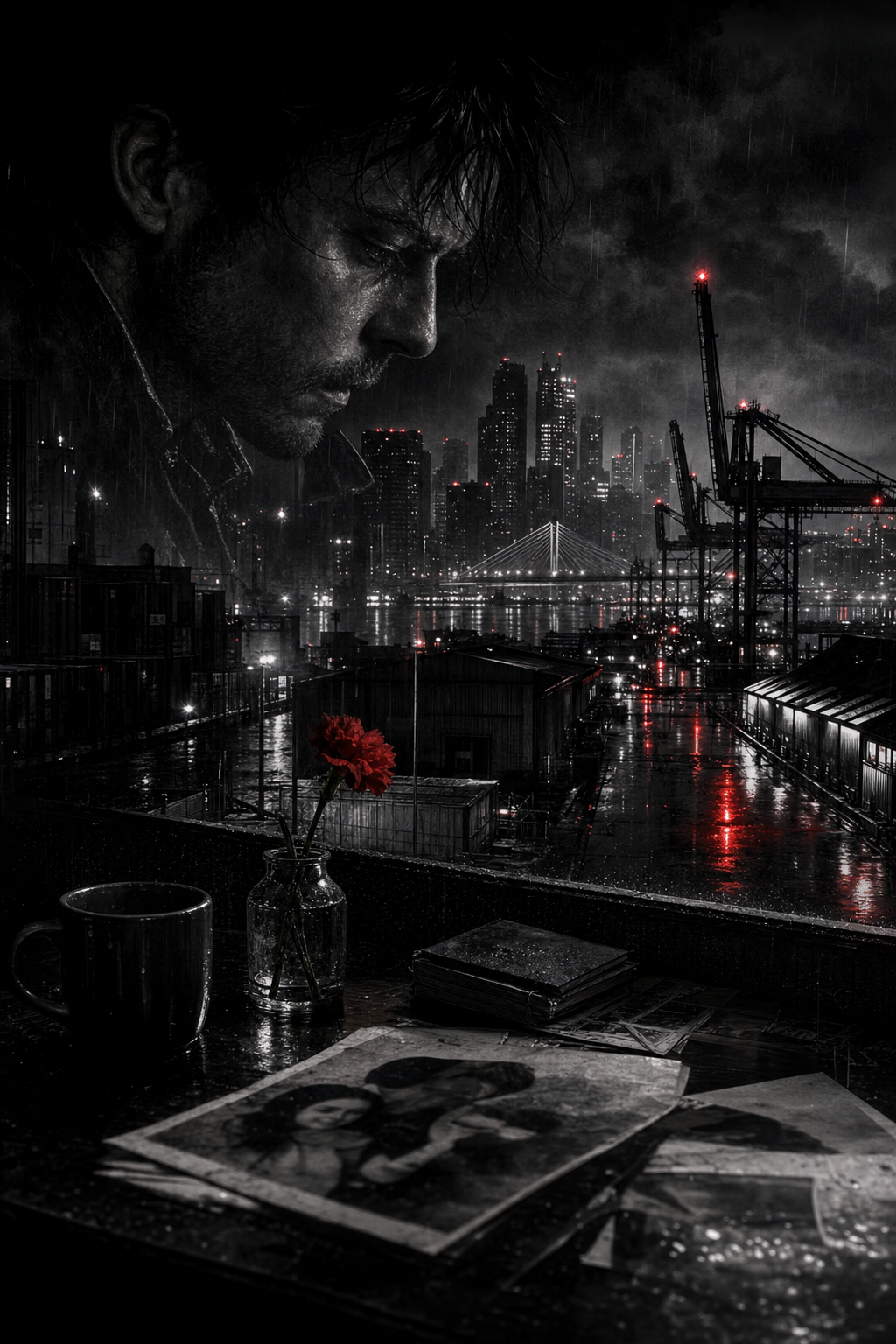
SMALL FIRE
In a rain-choked port ruled by corporate logistics, a grieving welder hunts a stolen lighter and uncovers a machine built to erase people.
Chapter 1
The rain had been falling long enough to earn squatters' rights. It lived in the window frames, in the seams of the floorboards, in the swollen wood of the kitchen cabinets that didn't close right even before the police kicked one of them open and called it procedure. Bridewell took water the way bad men take excuses: constantly, without gratitude, until the whole city smelled faintly of rot and diesel and the chemical sting drifting up from the treatment yards south of the port. Outside the east-facing windows, the cranes stood over the waterfront like iron saints with their heads bowed. The port lights came through the rain in smeared orange lines and moved across the walls whenever a truck turned on Wharfside. The room kept changing shape. The absence in it didn't.
I sat on the edge of the bed because there was nowhere else to sit that didn't feel like trespassing. The sheets were still twisted in the geometry of two people. They hadn't had time to forget us. Three days and the apartment was still performing a bad imitation of our life. Her coffee cup sat upside down in the drying rack in the kitchen. A book she'd been halfway through lay facedown on the chair by the window, spine bent in a way she'd usually correct with a small frown and her thumb along the crease, as if books could be bruised. The hallway still smelled like cheap paint and damp plaster. The third stair on the landing still complained under weight. The city had not changed anything important. That's how it does business. It kills what matters and leaves the furniture where it was.
The police had come and gone. They had peeled their tape off the doorframe and taken their photographs and written their report in the grammar of institutions, where a body becomes an incident and an apartment becomes a scene and a dead woman becomes a line that can be filed. Burglary gone wrong, Detective Dekker had said in a voice so practiced it sounded laminated. Things happen in the port district. As if weather had killed her. As if she had slipped and fallen into a system.
I got up because stillness had started to feel like surrender, and I wasn't ready for that particular religion.
The chair in the kitchen was on its side. One drawer hung open too far, tracks bent. The staged violence had an amateur theatre to it. Every cabinet door open. Every cushion turned over. Burglars don't make exhibits out of disorder. Burglars take what fits in their hands and leave. This had been arranged for people who liked paperwork. This had been decorated for a report.
Her books were still on the shelf. Her old blue sweater was still over the back of the couch. A bowl with two clementines sat on the counter, one already softening at the bottom. Her medical bag was gone, taken as evidence, they said. Her coat was gone too. Evidence. The word had the clean smell of someone else's conscience.
I moved through the bedroom last. Not because I was avoiding it. Because it was the room with the most gravity, and I needed to arrive there with enough of myself left to survive the pull.
The nightstand was where it had always been. Water glass. Paperback. A receipt folded under the lamp base. My hand went there before I told it to, muscle memory taking the shift before the rest of me clocked in. I reached for the lighter the way I had reached for it a thousand times—when she asked me to hand it over, when I moved it so it wouldn't fall, when I woke in the dark to the small metallic click and took it out of her fingers so she would stop flicking flame into insomnia.
My fingers found wood. Cool glass. Paper.
Then air.
I stood there with my hand closed on nothing.
The nothing had shape. That was the worst part. It wasn't empty in any honest sense. It was the exact size and outline of a brass Zippo with a cross scratched into the bottom and an initial cut crooked into the lid. The air where it should have been felt counterfeit. The room had accepted a replacement and expected me not to notice.
I checked the floor. Under the bed. Between the nightstand and the wall. The bathroom shelf where she set it when she showered. The kitchen counter beside the stove. The windowsill above the sink. I checked places it had never been because grief makes scavengers out of the body. The lighter wasn't in the apartment.
A scratched old Zippo wasn't evidence to anyone who had gone to the academy and learned how to mistake procedure for thought. They hadn't logged it. A burglar wouldn't have taken it. There was no resale value in sentiment. Which left one possibility. Someone had stood in this room, looked at the nightstand, seen a small brass thing where her hand had left it, and put it in their pocket the way you'd pocket change from a dish by the door.
The city moved outside. Tires hissed over wet streets. Somewhere out near the docks a horn sounded, deep and lonely, the port reminding itself it still had a voice. I sat back down on the bed because my knees had begun entertaining ideas of their own.
The lighter. Not her body, already taken from the room. Not the blood they cleaned, because systems are efficient about surfaces. Not the notebook from her bag, not yet, because I didn't know that was gone. The lighter. Small enough for a palm. Specific enough to follow. Everything else they had taken from me was too large to aim at. The lighter fit inside the machinery of action. A thing can be found. A thing can be returned. A thing can stand in for the larger theft until the larger theft learns how to wear a face.
I looked at the nightstand and saw her hand.
Not all of her. Just that. Her fingers curled around the lighter, thumbnail worrying the hinge, the quick practiced flick of the wheel. A candle on the nightstand because she liked the room gentled at the edges. The small flame rising between us in the dark. Orange light in her eyes. She'd held it up once and the brass had warmed in her palm and I remember thinking fire looked less dangerous when she was the one carrying it.
The memory lasted a second. Long enough to cut. Then the room took it back and left me with wood, glass, and rain.
I leaned forward, forearms on my thighs, hands hanging between my knees. My hands looked like they always did—scarred, blunt, black half-moons of work still embedded where soap never quite won. Hands the world read correctly for labor and incorrectly for everything else. Hands she had never been afraid of. Hands she put her own into as if the size difference was a fact worth noting and nothing worth fearing.
I don't know how long I sat there after that. Time in grief is a corrupt foreman. It clocks you in, then misplaces the hours. Eventually I stood, put on my jacket, and looked once around the room as if I were leaving instructions with the walls.
The apartment said nothing. Rooms are good at silence. They practice.
The hallway outside was dim, one bulb failing at the far end. The third stair creaked under me, faithful to its role. Down on Sill Street the rain was patient and fine, too small to be dramatic, too steady to ignore. It got into the collar of my coat at once. Across the district the sodium lights painted the wet pavement the color of old bruises. Beyond the warehouses the cranes kept their vigil over the water, enormous and motionless except for the little mechanical corrections they made against the wind, like men shifting in their sleep.
Bridewell at night never looked dangerous in the theatrical sense. No glamour in it. No romance. It looked processed. Lit in hard segments, orange and black, light and its absence with no negotiation between them. A city divided into what could be seen and what could be denied. Moisture swallowed the sound of traffic and conversation, muffling the district until everything seemed to happen behind damp cloth. Even the port's heartbeat came softened—water slapping the pilings, chains striking metal, a container settling somewhere in the dark with the low finality of a door closing on somebody else's life.
I started walking downhill toward the waterfront because that's where all roads in Bridewell tell the truth eventually. Past the shuttered clinic on Wharfside. Past the diner on Chandler where the neon hummed weakly through the rain. Past bars with steamed windows and men leaning in doorways pretending the weather couldn't find them if they kept one shoulder inside. People knew my face down here. Not well. Enough. They nodded and left room. The scar did half the work. My size did the rest. The world had built me a wall and taught me to live inside it. Tonight the wall was useful. Tonight I needed people to step aside without asking whether I was all right.
I wasn't all right. The phrase was too small for the weather system moving through my ribs.
At the waterfront rail I stopped. The water below was black enough to pass for an idea. Rain stippled it without changing it. Across the harbor a ship moved under the grey lid of the sky, all function, no face. Cargo in. Cargo out. Ledger entries. The city built on transfer and disappearance. Maren had seen something in that machinery. Enough to die for. I knew that in the way the body knows a storm before it reaches the windows.
I put my hands on the cold rail and thought about the lighter in someone else's pocket. Against someone else's leg. Warm from a stranger's body. The thought landed with surgical precision. Not broad pain. Not the whole ruin. Just one exact blade between the ribs.
A small thing. Brass. Scratched. Hers.
Mine.
No. Not mine. That word was too crude for what it had been. It belonged to the life we had made around it. Nightstand. Jacket pocket. Kitchen counter. The geography of habit. The private liturgy of passing a flame back and forth through ordinary days.
The rain kept falling. The port kept breathing. Somewhere behind me the city was already filing its paperwork and moving on.
I pushed away from the rail.
The lighter was out there.
That was enough. That was north.
Bridewell is a soaked, industrial port city where cargo, money, and human lives vanish into the same bureaucratic machinery. Days after nurse practitioner Maren Solberg is murdered and her death dismissed as a burglary, shipyard welder Elias Cade fixates on one missing object: her brass lighter. Tracing it through killers, cops, and the corporate empire that owns the waterfront drags him into the hidden system Maren died trying to expose.
- —Elias Cade — A massive, scarred shipyard welder from Bridewell's port district, Elias is outwardly intimidating and almost wordless. Inside, he is a fiercely precise mourner whose search for Maren's stolen lighter becomes a relentless assault on the system that killed her.
- —Maren Solberg — A nurse practitioner at the Harbor Free Clinic, Maren spent her days caring for people Bridewell preferred not to see. After quietly documenting disappearances tied to the port, she is murdered before the story begins, and her absence shapes every choice Elias makes.
- —Dana Varela — A young night cleaner at the Voss Maritime offices, Dana survives by staying unnoticed and treasuring the small discarded things other people ignore. When she unknowingly buys Maren's lighter, she becomes the living link between Elias's grief and the machine's next target.
- —Tomas Beck — A low-level enforcer who does violent jobs for men above his pay grade, Beck helped kill Maren and pocketed her lighter as an afterthought. He is the first human face Elias reaches in the chain, and his carelessness reveals the murder was ordered.
- —Carl Dekker — A port-division detective on Voss Maritime's payroll, Dekker specializes in cleaning scenes and burying truth beneath official paperwork. He is tired, compromised, and fully aware of what the system does, which makes his complicity all the more corrosive.
- —Lars Renard — Voss Maritime's operations director, Renard runs atrocity with the tidy efficiency of a logistics manager. He approved the decision that made Maren a liability, embodying the machine's coldest principle: people reduced to throughput and risk.
- —Aldric Crane — The polished CEO of Voss Maritime, Crane is Bridewell's public benefactor and private architect of the order that protects trafficking with civic respectability. He is not a theatrical villain but a powerful man who long ago accepted human ruin as a business cost.
- —The Absence: Three days after Maren's murder, Elias returns to their ransacked apartment and discovers her brass lighter is missing. That small, deliberate theft gives his grief a direction and sends him into Bridewell's port district looking for whoever touched what was hers.
- —The Chain: Elias traces the lighter from street enforcer Tomas Beck to corrupt detective Carl Dekker and finally to a pawnshop that sold it for almost nothing. Each stop strips away the burglary fiction and reveals that Maren was killed on purpose by people protected inside the city's institutions.
- —The Echo: The search leads Elias to Dana Varela, a young cleaner who now carries the lighter with an unconscious care he cannot ignore. While the machine begins to notice him, Dana's glimpses from inside Voss Maritime start aligning with what Maren had feared about disappearances at the port.
- —The Unmasking: Elias recovers Maren's hidden records at the clinic and confirms that she had traced a trafficking network embedded within Voss Maritime's legitimate business. Driven upward through the hierarchy, he collides with operations chief Lars Renard and learns how methodically the machine selected and erased her.
- —Small Fire: When Dana is drawn into the danger, Elias entrusts the lighter to her and finishes what Maren started by pushing the evidence toward exposure. His final descent on Aldric Crane becomes less a bid for justice than a refusal to let Maren's life, work, and memory be processed into silence.
Hardboiled noir in a lyrical first-person register, with prose that moves between industrial precision and bruised interior poetry. The sensory world is all rain, salt, rust, sodium light, diesel, and muffled harbor sound. Violence is blunt and costly, while memory arrives in intimate flashes that make ordinary tenderness feel sacred.