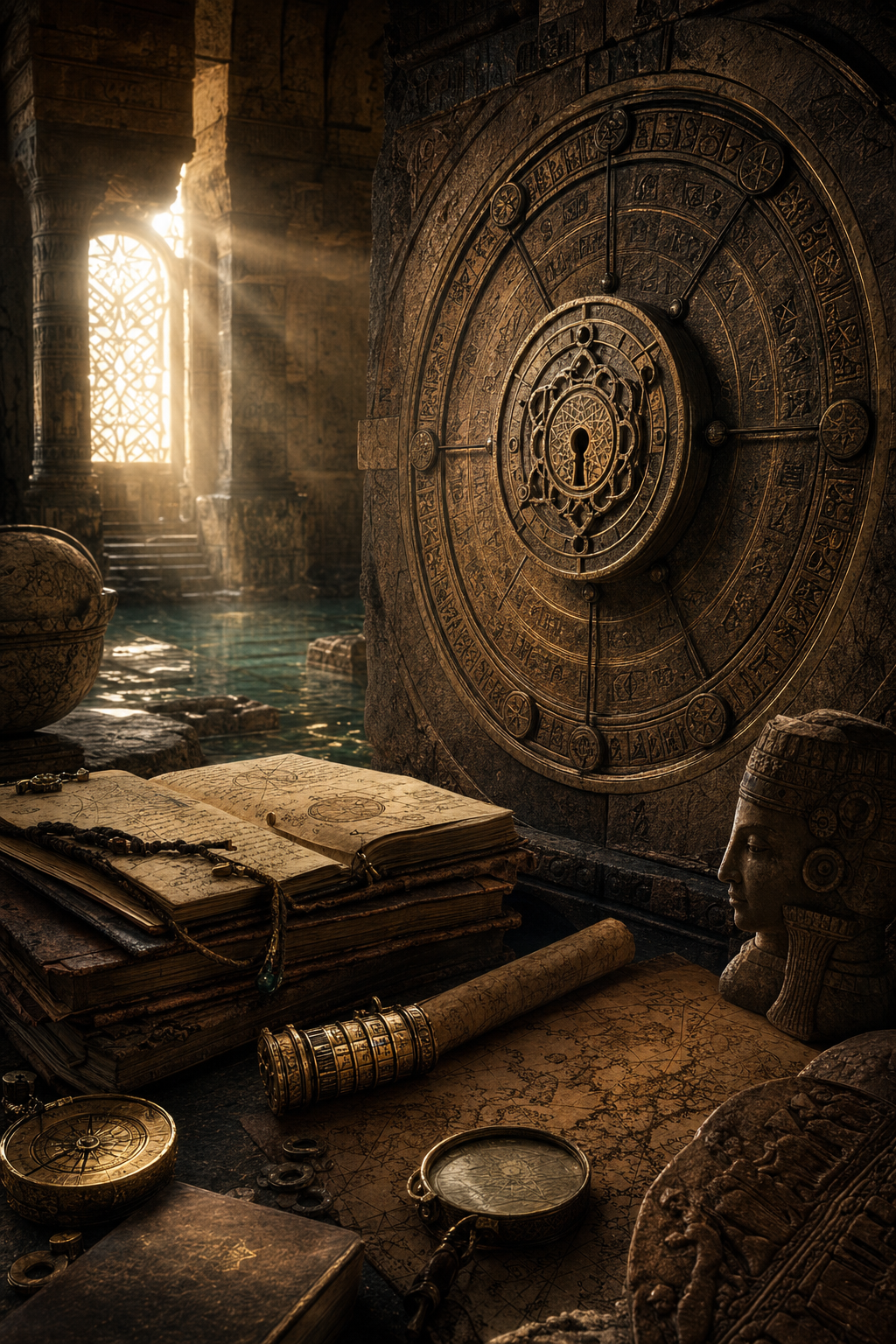
THE SCHOLAR'S LOCK
An overlooked museum relic points to a hidden ancient network, but decoding it demands two rival scholars and a step ahead of hunters.
Chapter 1
The fluorescent tubes in Sub-Basement 2 had a way of making every object look equally unloved.
Noor Kassis stood with one hand on the edge of Crate 1923-OA-17 and looked down at a century of indifference: chipped ceramic nested in old paper, a tarnished oil lamp, two coins fused green with corrosion, a brass hinge wrapped in twine that had become almost as brittle as the twine itself. The crate had arrived at the Hartwell Museum in 1923 as part of an Ottoman-era acquisition lot from Istanbul. It had then done what most things did at the Hartwell. It had waited for someone underpaid to care.
The label tied to the crate handle had gone soft with age. Ottoman Acquisitions, Istanbul, 1923, Unsorted.
Unsorted, Noor had learned, was a category that could last longer than nations.
She shifted her lamp, angled the beam across the bottom layer, and saw the cylinder.
Not at first as a revelation. First as weight. Even before she touched it, she could see from the way the packing paper sagged around it that it was denser than it should have been. Fifteen centimeters long, perhaps, four in diameter, dark beneath a skin of green-black patina. Bronze, or not quite bronze. Too dark for that. Too heavy-looking.
She set down the lamp, reached in with both hands, and lifted it free.
Cold. Denser than expected. The metal held the chill of the basement in a way that felt deliberate, as if the alloy resisted warmth. Her fingers adjusted automatically, conservator's grip, thumbs under the weight-bearing points, nothing resting against a vulnerable edge.
Then the inscriptions caught the light.
Three bands encircled the cylinder's body, each recessed slightly, each separated by a fine raised ridge. She turned it once and felt the faintest resistance under her fingertips. Rotating bands. Independently mounted.
Noor went still.
She pulled the lamp closer and tilted the cylinder under the fluorescent wash. The shadows changed. The text was not simply incised; the cuts varied in depth and angle, engineered to read differently depending on illumination. Whoever had made this had expected light to matter.
Her eyes went to the outermost band first, and the recognition was immediate enough to tighten something low in her chest.
Nabataean.
Not maybe. Not broadly Semitic, not vaguely Aramaic-derived. Nabataean. The cursive flow was unmistakable. But the letterforms—
She frowned and rotated the cylinder half an inch.
No.
No, the kaph was wrong.
Open-topped, not closed. A variant so rare she knew the two published examples by site number. Both from the Hejaz. Both dated too early for the conventional developmental sequence. She had built an entire rejected article around that problem. Open-topped kaph as evidence of a contact zone no journal editor wanted to touch because it implied routes, and therefore relationships, that the accepted chronology did not comfortably allow.
She set the cylinder down on a foam pad, opened her messenger bag, and took out her hand lens.
Under magnification the problem only sharpened. Nabataean, yes—but contaminated, if contaminated was the wrong word for something more interesting than purity. The top stroke leaned one way, the lower curve another. The hand that cut this had known the script intimately enough to alter it on purpose.
Noor smiled without meaning to.
“All right,” she said to the object, because there was nobody in Sub-Basement 2 to hear her except shelves of dead things and a dehumidifier that rattled like old lungs. “What are you?”
She turned to the second band.
South Arabian. Sabaean, most likely. The angular geometry was cleaner, less ambiguous. But again the details refused obedience. There were ligatures here she had never seen documented in any standard chart, transitional forms that suggested movement toward Ge'ez centuries before they had any business existing. Her pulse picked up. She took photographs, close and systematic, front light, side light, oblique light, every quarter-turn.
The third band stopped her completely.
Noor lowered the lens and looked with the naked eye, then lifted it again as if magnification might make the thing confess. The characters were geometric, regularized, almost architectural. Some shared structural DNA with Proto-Sinaitic forms; she could see that much. But they had been stripped of irregularity and rebuilt into something deliberate, as if a natural script had been taken apart and engineered by someone who distrusted accident.
She did not know it.
That happened less often now than it had at twenty-five, which was one of the few advantages of being thirty-two and exhausted.
She turned the cylinder again. The third band's characters repeated in patterned intervals. Not decoration. Not nonsense. A system she could feel without yet reading.
The discomfort of that—of pattern without resolution—went through her like current.
Noor reached for her notebook, the black Moleskine already swollen from pasted slips and folded comparison charts. On a fresh page she drew the cylinder in section, marked the bands, began transcribing.
Outer band: Nabataean variant. Open-top kaph. Possible early Hejazi influence. Second band: Sabaean with anomalous ligatures. Third band: unknown. Geometric. Constructed?
Constructed. She stopped, pen hovering.
Too early to say. Too speculative. The phrase rose in three journal editors' voices at once, and she ignored all of them.
She photographed the full circumference of the first band and pulled her battered copy of Repertoire d’Epigraphie Semitique from the bag, spine broken long ago, pages furred with tabs. The basement hummed. Somewhere overhead a cleaner's trolley squealed across a corridor, muted by floors and distance. The museum had closed an hour ago. Good. Closing made the building honest.
She read.
The first band did not behave like a dedicatory inscription or a funerary text. Too many directional markers. Too many repeated distance terms. She traced one cluster with the capped end of her pen, then another. Not names. Not titles. Spatial notation.
Noor sat down on the rolling stool at her workstation and drew the repeated signs in a column. A direction marker here. A unit there. Her own unpublished work on Nabataean travel notation—laughed out of one review, politely buried by another—rose in her mind with sudden, almost embarrassing usefulness. Caravan inscriptions sometimes encoded distance relationally, not abstractly: so many days from a known water source, so many camel-days from a crossroads, so many dawns from a sanctuary. Primitive only if one had never crossed a desert.
She looked back at the cylinder.
“You absolute nightmare,” she murmured.
Another hour disappeared. Then another.
By eleven she had a working hypothesis. The first band encoded a route. Not in modern coordinates, obviously, but in relational distances from a fixed reference point she thought—thought—might be Hegra. If Hegra, then the directional sequence pushed north-northwest. Far north. She pulled up a map on her laptop, cross-referenced travel distances with terrain, old trade corridors, seasonal water access. The line kept resolving toward the same region.
Southeastern Turkey.
Near Harran.
The name lifted off the screen and held. Harran: moon temple, Sabian scholars, the last pagan astronomical tradition in the region, old enough and strange enough to fit the object in her hand.
Noor leaned back, then immediately leaned forward again. Restlessness in reverse. The floor above her might as well have been another century.
She returned to the cylinder and this time ran her fingers slowly along the ridge between the first and second bands. The metal was smoother in one section. Not worn exactly. Used. She angled the lamp lower. Tiny marks appeared at the edge of the second band, so fine the camera had flattened them into noise.
Not script.
Calibration marks.
She squinted, following the spacing. Regular intervals. Groupings. The feeling of order she could not yet parse.
A sound from the corridor made her look up.
Nothing. The strip of light beneath the basement door remained unbroken. The museum settled around her in small mechanical noises: the sigh of old pipes, the pulse of ventilation, the occasional soft tick of metal responding to temperature. London rain tapped faintly somewhere far above ground.
She looked at the cylinder again, at the three bands carrying three systems, and felt the first clean line of the story in it. Nabataean and Sabaean should already have been enough to make the object impossible. The third script made impossible feel lazy. This was not a mixed artifact in the usual museum sense, not a thing assembled by accident through trade. This had been designed. The scripts were arranged with intent. The bands turned.
Noor took more photographs, backed them up twice, and began a transcription file on her laptop with a title she changed three times before settling on: Bronze rotating cylinder, Hartwell 1923-OA-17.
Too dull for what it was, but caution was a professional reflex. Excitement did not belong in filenames.
At twelve-thirteen she finally stood, knees stiff, and crossed to her workstation drawer. She wrapped the cylinder in acid-free tissue, laid it inside, and locked the drawer. Then she checked the lock once, and once again, because the thing in there no longer felt like an uncatalogued object. It felt active. Like a sentence interrupted in the middle.
She slipped the drawer key into the small zipped pocket inside her bag.
On her way out she turned off the lamp, and the basement returned to fluorescent flatness. Ordinary shelves. Ordinary crates. Ordinary institutional neglect.
But as she closed the door to Sub-Basement 2 behind her, Noor could still feel the weight of the cylinder in her hands, and behind that weight the sharper pressure of the unresolved third band—those geometric characters waiting just beyond recognition, as if the object had not merely been found but had noticed, at last, that someone was looking back.
In the modern world of museums, flights, ruins, and forgotten collections, a bronze cylinder from a London basement proves to be the key to a vast hidden preservation network built across the ancient world. Noor Kassis, an underrecognized epigrapher, finds the first clue in its impossible scripts just as freelance archaeoastronomer Tomás Lindqvist arrives chasing the same object from a different angle. With antiquities broker Émile Sarkis and his operatives closing in, Noor and Tomás must follow the cylinder from site to site, combining script, star, and fieldcraft before the mechanism is lost or destroyed.
- —Noor Kassis — A Palestinian-British museum conservator and epigrapher at London's Hartwell Museum, Noor specializes in hybrid Semitic scripts that academia treats as fringe. The cylinder is the first object to confirm her rejected theories, and her gift for reading layered inscriptions makes her one half of the only key that can open it.
- —Tomás Lindqvist — A Swedish-Argentine archaeoastronomer living gig to gig after his career was damaged by controversial research into impossible ancient alignments. He reads ruins through stars and geometry, and his inherited notebooks from his grandfather turn out to be as crucial as Noor's scripts.
- —Émile Sarkis — A polished Lebanese-French antiquities broker with deep reach across legal and illegal markets, Sarkis wants the cylinder for what it can unlock, not what it means. He cannot truly decode the system, so he shadows Noor and Tomás, intending to take the prize once they do the work.
- —Dr. Lian Wen — A highly capable Chinese-British archaeologist working for Sarkis, Wen is the closest thing the antagonists have to a true scholar in the field. She can read enough of the trail to stay dangerous, and her competence makes her a chilling mirror of what the protagonists might become in service to the wrong goal.
- —Elif Asfour — An antique restorer in Istanbul's Grand Bazaar, Elif is the granddaughter of the dealer who sold the cylinder in 1923. Her family ledgers provide the object's provenance and her warning makes clear that the relic has always drawn dangerous attention.
- —Professor Yusuf Haddad — Noor's late doctoral advisor, Haddad was the rare academic who believed her work on cross-cultural scripts had substance. His field notes linger in the story as a scholarly inheritance that continues guiding Noor after his death.
- —Erik Lindqvist — Tomás's deceased grandfather was an amateur astronomer obsessed with the Southern Cross and the idea of a celestial doorpost. His notebooks, dismissed for years as eccentric fixation, become an indispensable astronomical archive and a quiet legacy Tomás has carried all along.
- —The Find: In a neglected London museum basement, Noor discovers a bronze cylinder engraved with impossible scripts and partial coordinates pointing toward Harran. It is stolen almost immediately, and her search collides with Tomás, another specialist who was drawn to the same object for entirely different reasons.
- —The First Locks: In Istanbul and then Harran, the provenance trail reveals the cylinder's age, danger, and link to an ancient scholarly network embedded into real places. At the ruined Temple of Sin, Noor and Tomás combine inscription and alignment to trigger the first lock, proving the mechanism works and forcing an uneasy partnership under pursuit.
- —The Web Revealed: Following the cylinder to Socotra and Crete, they unlock a second stage and glimpse a map of a civilization-spanning preservation system. As Noor deciphers a constructed script and Tomás connects the network to his grandfather's observations, trust becomes practical necessity and the scale of the hidden world expands dramatically.
- —The Loss: In Malta's sealed underground chambers, Noor learns the preparation sequence needed for the cylinder's final mechanism, only for Sarkis's people to ambush them and seize the relic. Stripped of the object but not the knowledge, Noor and Tomás track it to Algiers and recover it through intelligence, timing, and shared expertise rather than force.
- —The Door: The final trail leads to Lanzarote, where volcanic tunnels conceal the return point the cylinder was built to fit. To set the last band, Noor must draw on ancient songs from her grandmother's tradition while Tomás relies on the exact measurements preserved in his grandfather's notebooks, bringing both halves of the design into alignment at last.
The prose is sharp, intelligent, and kinetic, with a contemporary adventure pulse grounded in real archaeology, linguistics, and astronomy. It favors precise terminology, tactile detail, and physical problem-solving over melodrama. The sensory world is all stone, metal, dust, sea air, old paper, starlight, and the mechanical click of ancient systems waking back to life.