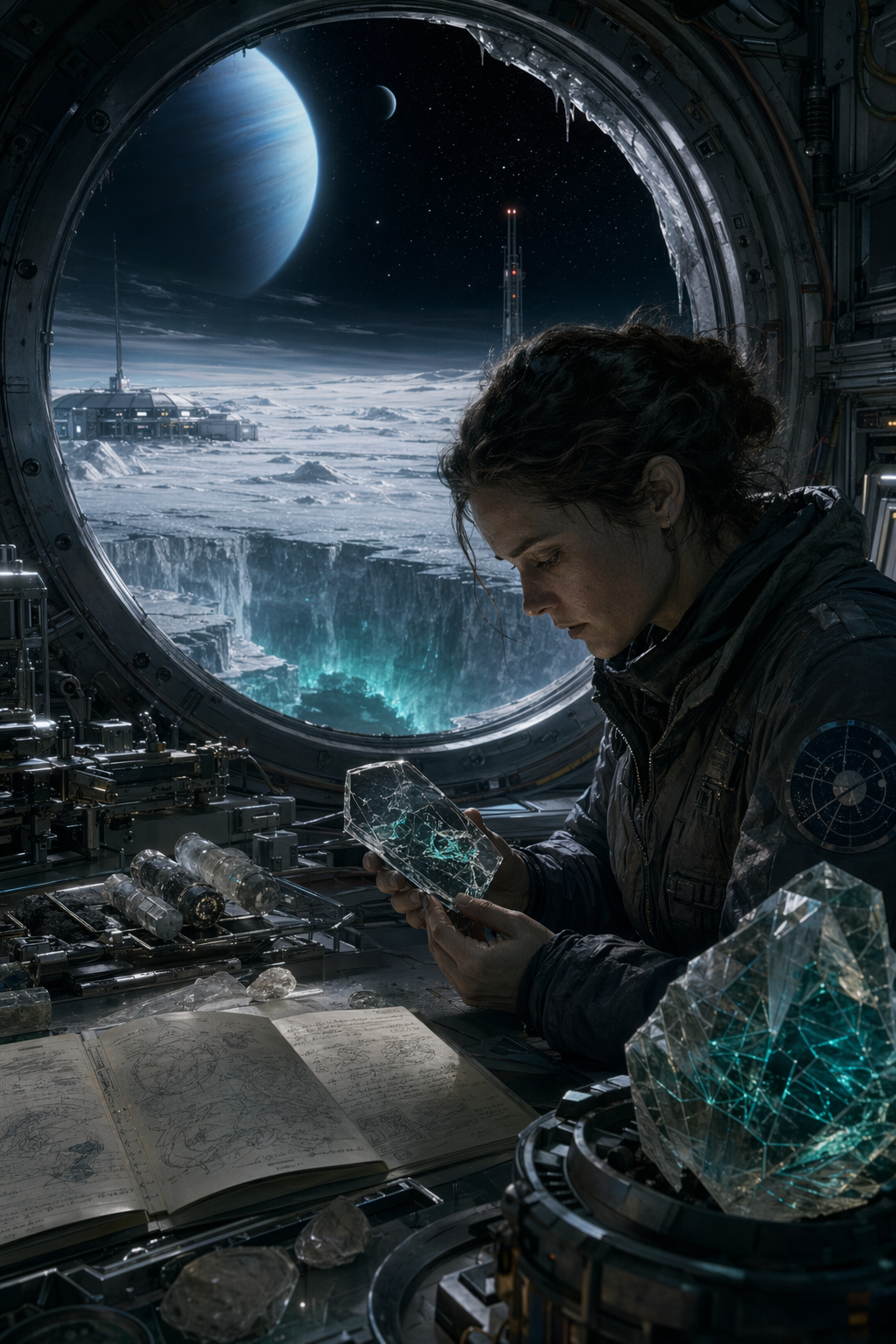
RESIDUUM
A forensic analyst arrives alone on Triton to audit a missing scientist's station and finds the ice may be answering back.
Chapter 1: Arrival
The descent shuttle from Kestrel has no windows in the crew compartment. OSRA calls it a thermal safeguard. In practice it means I come to Triton by telemetry and vibration: descent angle on the left display, hull temperature on the right, deceleration profile as a pressure through the couch. Neptune is a number until touchdown.
I read the mission brief a fourth time because rereading is a better use of four hours than staring at status lights.
Caelus Station, Triton. Coordinates 27.4°N, 33.1°E. Mahilani Thermal Anomaly. Single-occupant outpost. Primary mission: characterize anomalous ice-shell thinning above presumed subsurface ocean. Current status: contact lost with resident researcher, Dr. Yael Avram, ninety-seven days since last transmission. Probability of survival: twelve percent.
My assignment is narrow. Assess station condition. Recover all research data. Determine Avram’s status if possible. Catalog all modifications to station systems and all station property for incident analysis.
The last message from Yael Avram occupies one line at the bottom of the brief.
Station operational. Work proceeding. Comprehensive report to follow.
Timestamp: ninety-seven days ago.
No comprehensive report followed.
I have her personnel file open in the secondary pane. Thirty-four. Biophysics and geochemistry. Prior field work under Antarctic ice. Publications on mineral-mediated prebiotic chemistry. Quarterly reports from Caelus Station for the first year are regular, competent, and increasingly technical. Then the intervals widen. The reports become shorter. The final quarter contains mostly raw tables attached without summary. Then silence.
The standard explanations for silence at an outer-system station are mechanical failure, medical emergency, or cognitive deterioration. The brief trends toward the third without saying so directly. “Unexplained equipment modification.” “Deviation from reporting protocol.” “Possible environmental or biological hazard pending site assessment.”
They sent a materials analyst because broken things leave evidence. If Yael Avram died here, the station will say how.
“Surface lock in six minutes,” the shuttle says.
Its voice is neutral and faintly apologetic, as if it regrets interrupting.
I close the brief and secure the slate. The checklist proceeds. Suit seals. Portable analyzer. Personal medkit. Data drives for station archive duplication. Environmental sampler. Inventory scanner. I confirm each item with a gloved thumb.
I have worked twelve years in OSRA Incident Analysis. I have resolved thirty-seven investigations. Pressure vessel fracture at Rhea. Thermal shield delamination on the Ceres relay line. Seal failure in a cryogenic feed assembly above Titan. Every event left a sequence in matter. Force, stress, fatigue, temperature, time. The world records what happened to it. Most people do not know how to read the record. This has never seemed tragic to me. Division of labor is efficient.
The shuttle touches down with a brief metallic shudder.
“Surface contact stable,” it says. “External temperature: thirty-nine kelvin. Atmospheric pressure: fourteen microbar. Nitrogen dominant. Please proceed.”
The outer hatch cycles. Air leaves the compartment in a hard, rushing sigh. Then the indicator turns green.
I step onto Triton.
The first fact is the light. Not sunlight; at Neptune’s distance the Sun is a bright star, no more. The illumination comes from Neptune itself, a blue-green disc suspended above the black horizon, large enough to feel wrong. It casts a dim wash over the ice, too weak to make this day and too steady to be night.
The second fact is the terrain. The surface around the landing site is dimpled into broad shallow cells, the cantaloupe pattern seen in orbital survey images now scaled to the body: ridges low as drifts, hollows wide as plazas. Frost glints where my helmet lamps strike it. Beyond the station the landscape extends in pale undulations until it falls into distance and blackness.
Caelus Station stands fifty meters from the shuttle on adjustable footings driven into the ice. Four pressure cylinders intersect in a cross, exactly as in the engineering schematic and unlike it in one immediate respect: two exterior equipment mounts are occupied by hardware not listed in any station plan. I mark that before I have reached the airlock.
The station should feel abandoned. It does not.
Its hull radiators are running. A thin plume of waste heat disturbs the frost near the power module. External status lights are lit in disciplined green. No emergency beacon. No breach indicators. No visible impact damage.
I circle once before entry, recording continuous video.
Module D exterior panel: opened and resealed at least three times since factory installation. The fastener heads carry recent tool marks. Communications mast intact but additional cabling has been routed from its lower junction box to the station underside. Nonstandard.
South-facing wall of Module B: a plate has been bolted to the hull skin, then removed. The bolt holes are recent. Light frost deposition in the recess suggests removal within weeks, not months.
Near the station’s eastern side, half buried in nitrogen frost, I find a line of drilled anchor points extending away across the ice. Seven visible before the terrain hides the rest. Empty now. I photograph each one and their spacing.
None of this matches a simple casualty site.
I enter through the main airlock. Inner pressure equalizes. The hatch opens.
Warm air touches the faceplate of my helmet and fogs it for half a second.
That is the first moment I pause.
A dead station is cold. A dying station runs dirty—CO₂ levels climbing, condensate uncollected, maintenance deferred by whatever took the resident scientist away from routine. Caelus Station is warm. Lit. Breathing.
I cycle out of the suit and stand in Module A.
There is a smell that all closed-loop habitats share: metal warmed by recycled air, polymer seals, the clean bitterness of CO₂ scrubbers, and underneath it the faint wet trace of hydroponics. Here the hydroponic rack is brown and brittle, the herbs reduced to papery stems. Everything else is operational. The wall display shows internal pressure normal, oxygen partial pressure normal, water reserves normal, power output stable.
I set my equipment case on the floor and do not open it yet.
The living quarters should be the least altered space in any occupied station. People improvise in labs; they sleep where the bed is. But the first visual sweep tells me the standard layout is gone. Storage bins reassigned. Fold-down table missing from the wall mount. Galley surfaces stripped of anything decorative or even convenient. One ration drawer has been emptied and converted to parts storage. A toolkit that belongs in the primary lab sits open beside the sink.
Everything is clean. Not tidy. There is a difference. Tidy is aesthetic. Clean is functional. Functional means recent use.
I move to Module B.
This is where the station stops resembling any incident file I have seen before.
The galley table has been removed from Module A and bolted here as an auxiliary workbench. The primary lab benches have been repositioned to create open floor space in the center of the module. Instruments from the cold lab have been moved in and interconnected with cables that are not standard issue. One wall panel has been replaced by a sheet of composite packing material drilled through with mounting points. Tools are arranged by type, not by station inventory designation. Someone built here for months.
On the main bench sits a spectrometer.
I know the model. Standard OSRA optical spectrometer, field version, optimized for compositional analysis of ice and mineral inclusions. I have used the same chassis in six investigations. This one has been opened, stripped to its frame, and rebuilt.
The core optics module is original. The detector array is not. The housing has been extended with a bracket assembly cut from another instrument’s frame. Three circuit boards have been added in a stacked configuration using hand-fabricated standoffs. Two shielded cables run from the rear port to a signal processor that should not physically mate with this machine and now does. The soldering is controlled. The cable routing is efficient. The mounting geometry is exact to within a millimeter.
This is not damage.
This is engineering.
I photograph the spectrometer from twelve angles before I touch it. Then I photograph the bench around it. Then the floor under the bench. Then the nearby drawer where spare fasteners have been sorted by diameter into labeled sample vials.
Yael Avram, if she did this, knew exactly what she was doing.
I eat one ration bar standing up. I unpack the inventory scanner, the camera rig, the micrometer set. I claim the bunk in Module A because it is the nearest thing to standard left in the station. Then I open a fresh catalog file and begin.
Caelus Station, initial survey. Day 1. 18:42 local station time. Condition on entry: pressurized, heated, fully powered. Life support active. General observation: extensive nonrandom modification to station layout and instrumentation. Priority object 1: modified optical spectrometer, Module B main bench. Preliminary assessment: deliberate reconstruction by a technically competent operator. Purpose unknown.
I save the file and look again at the machine on the bench.
Outside, eight kilometers of ice separate this station from whatever heat source has kept Mahilani thin for sixteen years of survey and four thousand years before anyone was here to measure it. Inside, someone has taken a standard geological instrument apart and remade it into something I do not yet understand.
That is enough for a first night.
I set the station clocks to my preferred display format. I calibrate the bench lights. I place my tools in a row parallel to the spectrometer’s edge. Then I sit down in Yael Avram’s chair and begin to read what she left behind.
In 2087, a lone OSRA outpost sits above a mysterious thermal anomaly on Triton, where the ice shell is impossibly thin and the ocean below should be unreachable. Materials analyst Dr. Lena Sorokina is sent to catalog the station of missing researcher Yael Avram, expecting a death report and a technical cleanup. Instead, the station's altered instruments, preserved crystals, and improvised devices point toward an ongoing exchange with something vast and non-biological beneath the ice, while bureaucratic containment pressure closes in from Earth.
- —Dr. Lena Sorokina — A Russian-Canadian forensic materials expert whose gift is reading history from physical evidence. Sent to Triton to determine what happened to Yael Avram, she begins as a detached analyst and is drawn into a precise, intimate act of understanding through objects, crystals, and engineered traces.
- —Dr. Yael Avram — An Israeli-French biophysicist and geochemist who vanished after months alone at Caelus Station. She exists mostly through her notebooks, tools, devices, and later crystalline messages, revealing a brilliant improviser who turned a scientific anomaly into the first real dialogue humanity has ever had with an alien system.
- —The Substrate — A planetary-scale geochemical information network distributed through Triton's subsurface ocean and hydrothermal minerals. Slow, adaptive, and profoundly alien, it perceives through pressure, heat, and chemistry and can communicate only by growing structured crystals up through the ice.
- —Commander Alexei Turgenev — Lena's delayed-link contact at OSRA mission control, professional and quietly sympathetic. He is not a villain but the human face of an institution whose safety protocols can only interpret the illegible as threat.
- —Arrival: Lena lands at the still-functioning but badly altered Caelus Station, where every module has been repurposed and every object seems to have shifted from standard use. As she begins a forensic catalog, the precision of Yael's modifications immediately undermines the easy explanation of breakdown or neglect.
- —Pattern: By dissecting a rebuilt spectrometer, decoding unlabeled notebooks, and studying anomalous ice cores, Lena uncovers structured emissions and crystals that no known geology can explain. The evidence suggests not random phenomena but a coherent process that learns, repeats, and answers.
- —Dialogue: Yael's improvised transducers, preserved crystal sequence, and unfinished surface array reveal a full progression from observation to communication with something below the ice. As Lena reconstructs that dialogue, she also reconstructs Yael herself, finding in her tools and maker's marks a mind she comes to know with extraordinary intimacy.
- —Descent: A modified suit, a melt channel, and live biosensor readings prove that Yael did not simply disappear but deliberately entered Triton's ocean and survived there. Soon the new crystals growing through the station begin responding to Lena's own movements and methods, forcing her to realize the conversation is ongoing and directed at her now.
- —Bridge: Lena deciphers a crystalline self-portrait showing Yael integrated with the Substrate yet still recognizably herself, then completes the missing position in Yael's communication array with a device of her own. With OSRA moving toward containment, she must decide what truth to report, what truth to preserve, and whether to remain at the edge of the solar system as the bridge between human and alien minds.
The voice is exact, controlled, and evidence-driven, with prose that favors measurement, inference, and restrained revelation over overt emotional display. The sensory world is austere and tactile: cold metal, stressed composites, mineral geometry, delayed transmissions, and the black Triton sky under Neptune's blue-green light. Wonder arrives through scientific rigor rather than ornament, and intimacy emerges through attention to objects, patterns, and material detail.