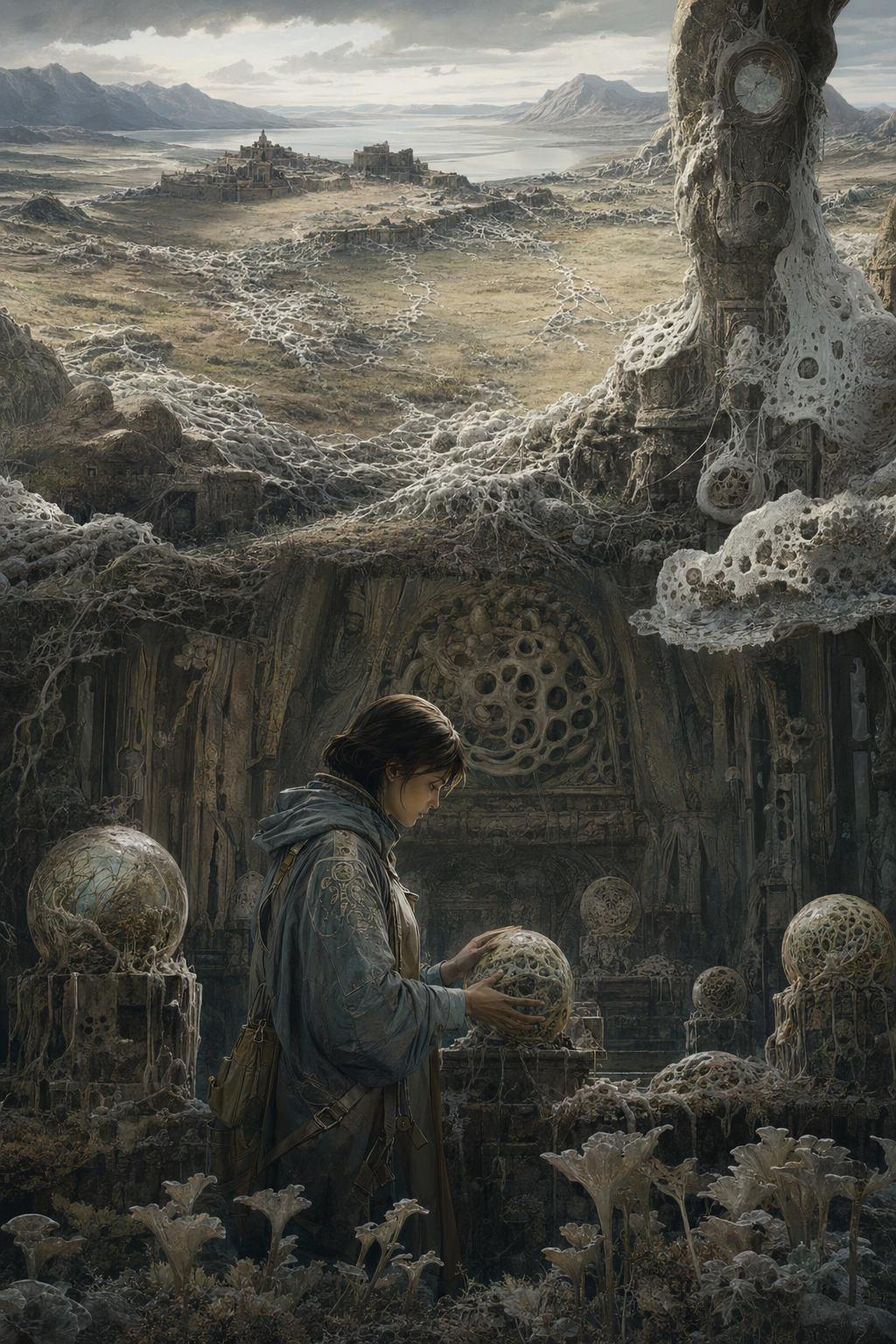
RENDERING
On a poisoned sand-worn frontier, a revered purifier hides that the deadly blight below may be the land's only cure.
Chapter 1
Sorren had long ago learned that the Quiet grew fastest where people believed themselves safest.
At first light the eastern wall of Ashward showed the night's work plainly. Pale filaments furred the lower stones in thread-fine mats, white-gray against the old mortar, creeping from the soil line in patient, branching fans. In the thin morning light they seemed almost to hold brightness rather than reflect it. By noon they would dull. By evening, if left alone, they would have thickened enough to knot in the cracks.
Pael saw them and made a small sound of satisfaction, as if the wall had offered a problem set neatly for study.
“It climbed farther north than yesterday,” they said, dropping to a crouch beside the gatepost. “See there? It found the join under the cistern run. If we render from the corner first, we can keep it from seeding the upper course.”
Sorren looked where Pael pointed. The growth had indeed followed the mortar seam in a clean line beneath the plaster, finding the wall’s weakness the way water found low ground. They nodded once.
“Gloves,” Sorren said.
Pael, who was already pulling theirs on, flashed the quick, embarrassed expression of the young when reminded of a thing they were in the middle of doing. “Right.”
The wall ran east from the gate in a long chalk-colored stretch, old stone patched over older stone, with sections of smooth gray oldite showing through where storms had worn the outer plaster away. In some places the rendering of previous seasons had revealed shallow parallel grooves beneath the surface finish, too regular for weathering and too purposeless, so far as the Ministerium taught, for structure. Sorren had stopped noting them in reports years ago. The reports had no use for marks that did not fit a known function.
They set their satchel down, unbuttoned the wrist closures of their coat, and drew off the right glove first, then the left. Morning air touched the skin and the familiar ache answered from the center of each palm, heat banked and waiting. The scars there had gone smooth with age. Across the knuckles, the skin was roughened and faintly shiny where old burns had healed. Along the inner wrists, where the light struck directly, pale lines showed for an instant, no wider than thread.
Sorren turned the wrists inward and placed both hands flat against the wall.
Rendering always began in silence. The catalytic pulse moved through tendon and bone before it reached the surface, a deep heat rather than a sharp one, and then the Quiet answered it. The filaments blackened under Sorren’s palms, curled in on themselves, and collapsed into fine ash that drifted down the stone in soft gray streams. A smell rose—dry, astringent, not unlike scorched charité. Sorren moved left to right, top to bottom, methodical as ever, burning each visible line, following the mortar courses, clearing the face of the wall.
Beside them, Pael worked with visible concentration. Their rendering was competent and still a little ragged at the edges, the burned patches wider where effort outran precision.
“I read the Redfield circular last night,” Pael said after a time, because silence sat on them only in brief tolerable amounts. “Renderer Gost’s recommendation for root-depth clearing in recurrent zones. He says if the surface regrowth comes inside three days, it means the anchor structure below the hardpan is too dense to leave alone.”
Sorren shifted to the next stone. Ash slid over their boots.
“Gost says many things,” they said.
Pael huffed a quiet laugh. “You trained with him.”
“I survived him.”
“That isn’t denial.”
“No.”
Pael straightened, flexed their fingers once, and looked down at the white-gray filaments still visible at the base of the wall where they vanished beneath the soil. “Still,” they said, “it makes sense. If we take it deeper, it has less to come back from.”
Sorren glanced at the line Pael meant. Beneath the soil lay the denser structures, the woven mycelial braids that did the real work and fed what surfaced in the night. A careful reader of walls would know where they ran. Sorren knew. They could feel the faint pressure of them through the soles of their boots, a low, distributed presence extending well beyond what the eye could mark.
“Surface rendering holds the wall,” Sorren said. “The deep structure anchors the foundation. Burn too far below the line and you trade growth for collapse.”
It was technically true, and therefore sufficient for instruction. Pael accepted it with the visible effort of a student setting aside a preferred answer without giving up on it entirely.
They worked eastward in the chalk-colored light. Above the wall the sky was clear and colorless at the horizon, the sun not yet fully risen over the scrubland beyond. Beyond the boundary, the Quiet spread low over the ground in interrupted veils between thorn-fern and brittle grass. In the distance the land broke toward a shallow alkaline basin where dawn light made the crusted edges of standing water look silver. The air carried the tang, that faint metallic edge so constant in the Pale that most people ceased noticing it except on days when wind drove it hard.
A door opened across the lane. Sorren looked up because movement at the edge of work always required noting.
A child stood in the doorway, one hand braced against the frame. Thin, in the way children were thin when the thinness came from illness rather than growth. Dark hair uncombed. Bare feet gray with dust. At six paces Sorren could hear the faint whistle in her breathing.
The child watched the rendering with grave attention, as if studying not the work but the way Sorren’s hands moved across the stone.
Pael noticed the gaze and lifted a hand in cheerful acknowledgment. “Morning.”
The girl did not answer. After a moment a woman’s voice called from within, and the child stepped back into shadow.
Sorren returned to the wall.
They had nearly reached the cistern run when Pael’s rendering faltered. A patch of filament blackened unevenly, leaving a white vein along the mortar seam. Pael swore softly under their breath.
“Stop,” Sorren said.
Pael did, shoulders tensing with annoyance at themself.
Sorren stepped behind them and took Pael’s right wrist lightly, rotating the hand a fraction inward. The bones there were fine and not yet settled into the permanent hardness of age and labor. “Not from the fingertips,” Sorren said. “From the center. Let the pulse travel before you force it.”
Pael tried again. This time the catalytic burn took cleanly, the remaining thread collapsing to powder.
“There,” Pael said, unable to keep satisfaction from their voice. “I had the angle wrong.”
“You were reaching.”
“That is what hands are for.”
“Not these.”
Pael grinned despite themself and moved on.
By the time the sun had cleared the horizon, the eastern face of the wall was clean. Ash lay in faint gray drifts at the base of the stones. Where the Quiet had climbed, there remained only blackened traces in cracks too narrow to take a full pulse, marks that would weather away by afternoon or be covered again by morning growth. Sorren crouched at the last section near the drainage cut and examined the soil line. Beneath the surface, where any other eye would have found only chalk and root-scrap, the dense braid of the Quiet ran on, intact.
Pael followed their gaze. “You really think we should leave that?”
Sorren pulled on the left glove, then the right, buttoning each wrist with care. “I think the wall is standing.”
Pael rose as well, though reluctance remained in the set of their mouth. “You always say that.”
“It’s often true.”
“That isn’t the same thing.”
Sorren lifted the satchel. “No.”
They started back along the path inside the wall. Ashward was waking now: smoke beginning from the cookfires, the creak of a cart axle somewhere near the central lane, voices carrying from the water queue by the cistern. The settlement had been built in rings according to a logic older than anyone living could explain fully—storehouses near the center on the stablest ground, dwellings thinning toward the boundary, gardens where the soil would tolerate them. From here the houses looked as they always did: stone patched with timber, timber patched with oldite, everything mended and remended until the repairs had become the visible shape of the thing.
Pael trotted half a step behind, still full of thought.
“If Rendant Davan sends the district circular this month,” they said, “do you think he’ll mention Redfield’s outbreak? If they really did root-depth rendering there, I mean. I’d like to see the measurements. The old reports at Threshold never give enough numbers.”
“You like numbers more than most Renderers.”
“They stay where you put them.”
Sorren glanced at them. “Do they.”
Pael considered this seriously. “No,” they admitted. “But they move in patterns.”
Ahead, where the boundary path bent around the last row of dwellings, the air changed. It was subtle enough that most people would not have marked it. Sorren did. Less tang. Less grit on the breath. The soil by Ama’s plot had held that difference for years now, small and local and visible only to hands that knew what other ground felt like.
Ama herself was already in the garden, bent over a narrow bed with a trowel in one hand. From the path Sorren could see the dark turn of the soil where she had opened a furrow. Darker than any ground in Ashward had a right to be.
Pael followed Sorren’s line of sight. “Her beans came up early again,” they said. “My aunt says she cheats the seasons.”
“Ama would if she could,” Sorren said.
This won the brief startled laugh it was meant to, and Pael, encouraged, launched into a story about a boy in Threshold who had tried to cultivate pulse-grain in rendered ash because a sermon had once called rendering “returning the land to readiness.” Sorren listened with half an ear. Their attention had gone ahead to the garden, to the dark beds and the straight rows and the old woman turning earth that smelled, at this distance even, almost clean.
When they reached the lane that split toward the settlement center, Pael slowed. “Reports before midday?”
“On my table.”
“I filed the western sweep logs already.”
“I saw.”
A pause, then, because Pael was sixteen and sixteen always wanted one more thing than duty had allotted. “Will you take the south boundary this afternoon?”
“Yes.”
“Can I come?”
Sorren adjusted the satchel strap on their shoulder. The request was too quick to be casual. Pael had been watching the south boundary for days, where growth patterns grew stranger and denser and where Sorren preferred not to bring an attentive apprentice unless necessary.
“Field notes first,” Sorren said. “Then we’ll see.”
Pael accepted this with visible restraint. “Yes, Renderer.”
They went toward the Ministerium annex with long, eager strides.
Sorren remained where the lane divided for a moment longer, looking past the last house to Ama’s garden. Ama had straightened and seen them now. She raised the hand with the trowel in it, neither greeting nor summons, merely acknowledgment.
Sorren crossed the lane toward her, the cleaned wall behind them, the unrendered depth still alive beneath it, and the morning settling over Ashward like chalk dust over old stone.
In the Pale, scattered settlements survive a lethal subterranean growth called the Quiet by relying on Renderers, rare figures who can burn it away. Senior Renderer Sorren secretly knows the Quiet is actually cleansing ancient contamination from the land, and has spent years quietly sparing it at the margins. When their old companion Leste arrives with evidence and a faster engineered alternative, Sorren is forced into a brutal choice between immediate human mercy and a slower, deeper healing no one asked for.
- —Sorren — A senior Renderer in Ashward, Sorren is known as precise, dependable, and almost austere in their service against the Quiet. Beneath that calm surface, they have learned the buried truth about the land and have spent years covertly preserving the very force everyone fears, even as it transforms their own body.
- —Leste — Once Sorren's closest peer in the Ministerium, Leste is now a healer whose rendering power was ruined by overuse. She uncovered the Quiet's true function through hard evidence and arrives with a directed remediation system that could save lives quickly, making her both Sorren's most trusted equal and most devastating opponent.
- —Pael — Sorren's teenage apprentice is eager, observant, and wholly devoted to the official story of heroic rendering. Their close attention to Sorren's methods makes them the first person positioned to notice the gaps between duty and truth.
- —Ama — An elderly boundary gardener, Ama has no formal authority and no taste for theory, but decades of tending soil have taught her what institutions missed. Her thriving garden sits on land the Quiet has already finished cleansing, making her humble plot the story's first living proof.
- —Cyre — A practical, furious mother in Ashward, Cyre wants only one thing: for her sick daughter Tellu to breathe. Her demands force Sorren's hidden principle into direct conflict with a human cost that can no longer stay abstract.
- —Davan — The regional Rendant of the Ministerium is a conscientious veteran who genuinely trusts Sorren and believes in the order's mission. He embodies the full moral weight of an institution built on service, duty, and a foundational error.
- —Tellu — Cyre's young daughter suffers from Quiet-lung, the slow respiratory damage linked to the land's toxic upheaval. Her fragile health gives the conflict its sharpest edge, turning competing philosophies of healing into a question of a single child's breath.
- —The Antecedents — The vanished industrial civilization beneath every ruin and custom of the Pale remains the story's haunting ghost. Their contamination created the crisis, their engineered Quiet became its unfinished cure, and their abandonment of the population defines the moral wound beneath the world.
- —The Surface: Sorren performs routine renderings in Ashward, training Pael and maintaining the image of a model Ministerium servant. Small signs accumulate: a child struggling to breathe, Ama's strangely healthy garden, hidden archive fragments, and the first hints that Sorren's own body is no longer wholly their own.
- —The Buried Truth: An inspection by Davan and a plea from Cyre tighten the pressure on Sorren's carefully managed restraint. In private, the extent of the Quiet's presence inside Sorren is revealed, and Leste arrives with independent proof that the Quiet is cleansing ancient toxins rather than causing them.
- —The False Salvation: Sorren and Leste compare records and data, assembling the full logic of the poisoned land and the Quiet's role within it. Leste then unveils a directed remediation technology that can clean soil quickly and safely, but only if the Quiet is completely eradicated first.
- —The Crack: A surge of Quiet growth, a successful test plot, and Tellu's brief easy breathing draw the community and the Ministerium toward Leste's plan. Under mounting scrutiny, Sorren's years of deception come into the open, and a shattering confrontation with Leste exposes not only the hidden truth but the intimate, bodily cost of Sorren's faith.
- —The Choice: After uncovering the deepest record of the Antecedents' abandonment, Sorren realizes the Quiet was never meant to spare the people now living above it, only to finish its work. When Davan authorizes Leste's campaign, Sorren destroys the new remediation system and accepts the ruin that follows, choosing the wounded, uncertain path of organic healing over a clean engineered answer.
The prose is controlled, exact, and mournful, with a formal quietness that lets grief gather in the gaps rather than in declarations. Its sensory world is dry air, metallic tang, chalk, old stone, pale filaments, and the startling texture of truly clean soil. Even its moments of revelation feel tactile and restrained, as if emotion can only emerge through pressure, weight, and what the body can no longer hide.