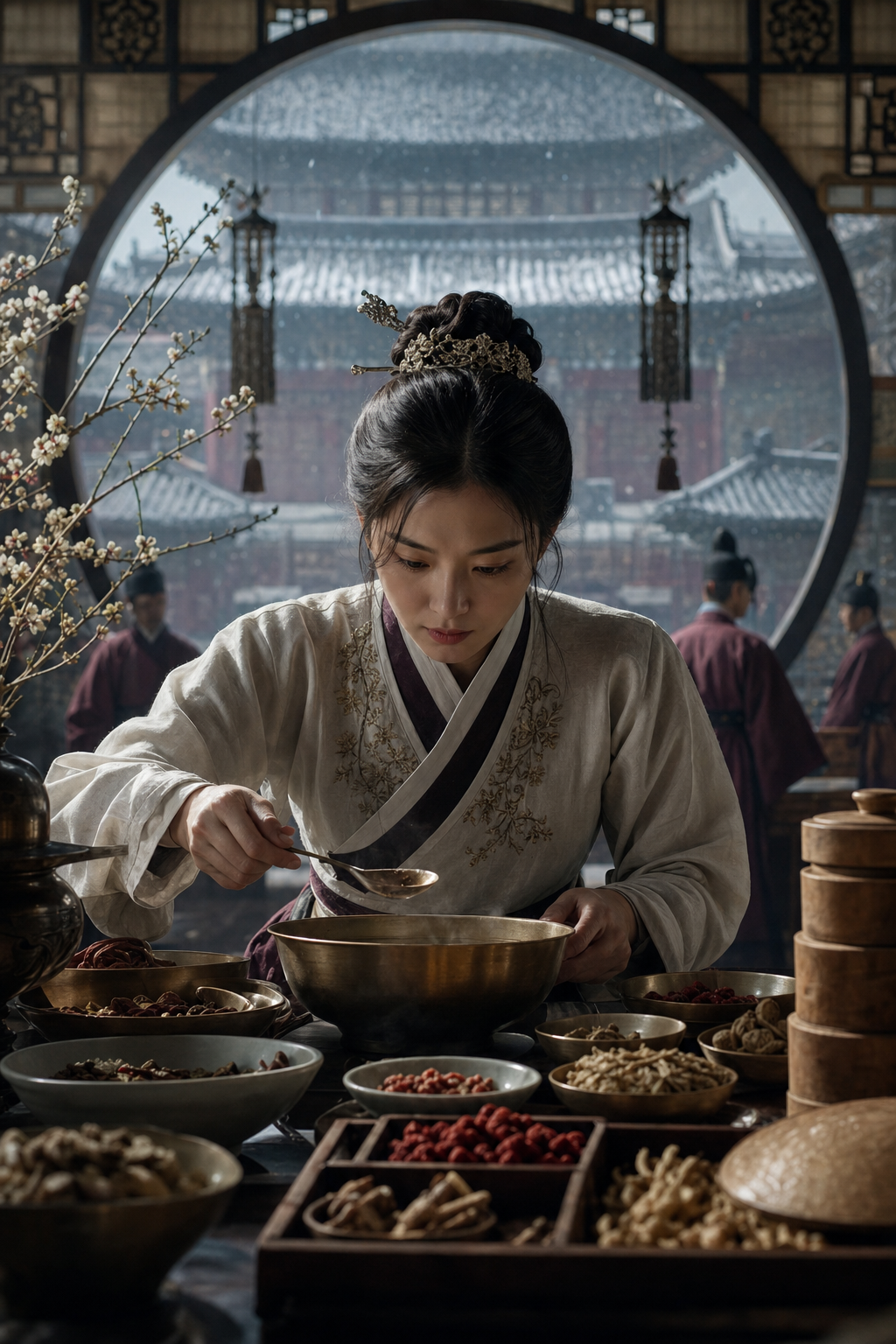
The Quiet Thunder
In a palace where taste is treated as a threat, a low-ranked kitchen worker risks everything to feed a dying emperor properly.
Chapter 1
Dawn had not yet reached the windows when Bae Yeon lifted the greens from the rolling water.
The leaves changed in an instant that was not an instant at all: dark mountain hardness loosening into a brighter, living green, their bitterness waking under heat and stopping just short of surrender. She caught them with the bamboo sieve, let the water fall through for one breath, then plunged them into the basin of cold well water beside her. Steam rose. Her fingers moved through it without hesitation, separating the stalks before they could overcook themselves in their own trapped heat.
Around her, the Secondary Kitchen was still half asleep. Fireboxes were being coaxed awake one by one. Wood snapped. A ladle struck the rim of an iron pot in the next bay, then again, sharper this time, when the assistant holding it realized she had made a sound loud enough to be noticed. At the far end of the room, someone dragged a sack of turnips across the stone floor. The scrape ran through the kitchen like a complaint.
Yeon spread the blanched greens on a draining cloth. Not too thickly. If they cooled in a pile, the trapped moisture would yellow them at the center. The instruction had not been spoken when the task was assigned to her before dawn. The senior assistant had only jerked his chin at the basket and said, “Those.”
That was enough. Greens were greens only to people who did not have to feed them to anyone. These had come packed in straw from the western hill terraces, leaves smaller than the southern varieties, stalks carrying more mineral bite because the soil there held iron from the mountain run. They needed less salt later. The palace would salt them as though all greens were the same.
She rinsed the sieve. Set it upside down to dry. Reached for the next basket.
The provincial conscripts had been in Muryeong for three days. In the dormitory, the other girls still whispered when they thought no one could hear them—about the scale of the palace walls, about the cold in the corridors before sunrise, about whether the emperor ever saw the kitchens at all. In the kitchen itself, whispering had no use. Rank moved by sound here: the clipped command of a senior cook from the Main Kitchen, the measured tread of an inspector, the dull rush of those below them making way without being told.
Yeon had learned the sounds on the first morning.
The Main Kitchen beyond the connecting doors had a different rhythm from this room. There, knives struck in even sequences and lids were lifted with the caution due to food that would travel inward, ring by ring, toward the Core. Here, in the Secondary Kitchen, the work began earlier and mattered less in the eyes of anyone who held authority. Washing. trimming. carrying. straining. The invisible part. The part that determined everything.
She was trimming lotus root when the Security Bureau inspector entered.
No one announced him. They never did. The room altered around him instead. Backs straightened without becoming stiff. Hands continued moving, but the movement grew cleaner, stripped of any habit that might be read as carelessness. The inspector wore dark winter-weight robes despite the heat from the stoves, his rank seal hanging from his belt, a narrow tablet in one hand. He was younger than some of the senior cooks, older than the newest assistants, with the expression of a man who had been trained to distrust both error and excellence.
He moved first to the ingredient shelves. Checked wax seals. Counted jars. Ran one finger along the shelf edge and looked at the dust it collected there, although there was almost none.
Yeon kept trimming.
At the doorway to the Main Kitchen, a senior protocol cook arrived to collect the emperor’s breakfast components. He was carrying a lacquer tray lined with small ceramic bowls: prepared aromatics, measured grains, roots to be simmered into the morning broth. Another assistant—one of the city girls, hands still too soft for knife work—hurried to set the final bowl onto the tray.
Yeon looked because the tray passed through the space in front of her eyes. That was all. A professional glance, brief as breath.
The dried root in the last bowl was wrong.
Not wrong enough for the room to stop.
It had been sliced to match the Formulation sample kept above the shelf, cut on the same diagonal, dried to the same pale woody curl. To anyone reading by shape, it would pass. To anyone reading by category, it would pass more easily still. The morning broth called for warming root. This was warming root. It would satisfy the line on the document and the hand of the inspector checking against it.
But the original root—the one this substitution resembled—carried a fine mineral bitterness under its sweetness, a taste that lingered at the back of the tongue and sank lower when cooked long. Her grandmother had used it in winter broths for people whose strength had begun to retreat inward. Not the sickest patients. The ones worse than sick—those who ate enough and still seemed to fade.
This substitute warmed quickly and vanished quickly. It made the body flush at the surface and left the center untouched.
The senior cook took the tray without looking closely. The inspector glanced at the bowls, at the line on his tablet, and marked them compliant.
Yeon cut through the next lotus root joint. Cleanly. The holes at its center opened in their usual pattern, neat and pale as carved bone.
The tray passed on toward the Main Kitchen, then farther, where the food would be transformed into breakfast and carried inward to a man she would never see.
She kept her eyes on the cutting board.
The knife in her hand was heavier than the one at home. Palace steel, better balanced, though the handle had been worn smooth by years of other people’s palms. She adjusted her grip slightly and continued trimming. Any correction she made aloud would do nothing. A Processing Assistant did not speak into a tray once it had left her section. A conscript from Cheongsan least of all.
Across the room, someone spilled rinse water. The senior assistant barked for a cloth. The inspector turned his head. The room tightened, then loosened again when the spill proved to be only water.
Yeon slid the cut lotus root into its basin. The pieces sank and turned slowly beneath the surface, starch clouding out from their edges in faint white ribbons.
Her grandmother had taught her that the body announced its condition long before the face did. In the hands. In the way a person reached first for broth or dry rice. In what was left uneaten on the tray. In winter, especially, hunger and cold lied to each other. A person could think herself fed because her stomach was full. The deeper systems did not answer to fullness. They answered to whether the food had arrived with what Bae Seol called attending warmth.
Her mother had stopped wanting breakfast in the second winter after the market inspectors began banning unlicensed herbs in Cheongsan. Not all at once. First she left the broth. Then the rice. Then she would lift a spoon only because Yeon was looking at her.
Yeon placed another cleaned root beside the others, all their cut faces turned in one direction. Order saved time later.
The inspector made his way down the worktables. When he reached Yeon’s station, he stopped long enough to look at her basket of blanched greens, the trimmed lotus root, the wash basins set in proper sequence. His gaze moved over her as if over shelving: useful only insofar as everything was where it should be.
“Name,” he said.
“Bae Yeon.”
“Province.”
“Cheongsan.”
He made a mark on the tablet. “You were late to second bell yesterday.”
“The grain sacks from the north storeroom blocked the east passage.”
A pause. He looked at her face, perhaps to see if she was making an excuse. Yeon gave him nothing but the answer.
He made another mark and moved on.
At the far hearth, a pot lid rattled. Someone lifted it too late. The smell of overcooked millet rose, thick and dull. A senior assistant hissed through his teeth in irritation and sent the offending pot aside to be repurposed for staff meal. Nothing was wasted here, only demoted.
The morning widened. More trays crossed from the Secondary Kitchen into the Main. More ingredients were measured, washed, cut, logged, carried. Yeon worked where she was placed, hands remembering one task while completing another. By the time the first light reached the upper windows, the greens had been dressed and sent away, the lotus root stacked for later braising, the turnips scrubbed, the rice rinsed to the exact point where the water lost its cloudiness and began to run clear.
No one spoke to her again.
That was expected. The lowest rank in the kitchen hierarchy was not required to have a voice. Only hands.
At midmorning, when the first rush had passed and the ash pits were being emptied, the senior assistant pointed his ladle toward the narrow corridor beside the storage alcove.
“You,” he said. “Archive room. Sweep it before noon.”
A punishment, perhaps, or simply work no one else wanted. The small room near the Secondary Kitchen was where the Approved Formulations were kept: scrolls, record tablets, revisions, seals. Paper work. Dust work. Not cooking.
Yeon rinsed her hands. Dried them on the rough cloth at her belt. Carried the broom down the corridor without asking why.
The Archive Room was windowless and colder than the kitchen, as if stone held itself differently around paper than around fire. Shelves lined three walls from floor to shoulder height, crowded with scroll cases labeled in a clerk’s fine hand. At the center stood a low table. Behind it sat an old woman in faded gray, bent over an open document, brush poised above the margin.
She did not look up when Yeon entered.
Her hair was white and drawn tightly back. Her sleeves were pinned clear of her wrists. Those wrists were thin enough to suggest frailty until one noticed the steadiness of the hand holding the brush. Not a clerk’s steadiness, precisely. Something older lived in it. The unconscious economy of a trained practitioner.
Yeon lowered her eyes and began to sweep.
The room smelled of ink, old paper, and, very faintly, broth gone cold.
Dust gathered in little gray crescents along the baseboards. Yeon moved soundlessly around the table legs, taking care not to disturb the stacked documents arranged in exact squares beside the old woman’s left elbow. The brush continued to move: pause, touch, lift; pause, touch, lift. Annotation work.
When Yeon came to the near side of the table, the document lay upside down from her angle. She saw only a line at first—Approved Winter Broth No. 47—and beneath it columns of measured ingredients in the clipped administrative style the palace preferred.
At the lower margin, written in smaller characters, was a note.
Seasonal variance: reduce liquid by one-eighth when ambient temperature exceeds the northern threshold.
Yeon’s broom did not slow.
The wording was bureaucratic. Dry. Entirely plausible in a room like this.
But one-eighth reduction under heat was also the old instruction for drawing mineral depth from a base stock without clouding it. Her grandmother had said it while standing over a clay pot in Cheongsan, winter wind finding its way through the shutters: Not more than one-eighth at the high boil, or the warmth will rise and leave the bones behind.
Yeon swept the dust into her tray.
The old woman still had not looked at her. Yet something in the air of the room had altered, lightly as a lid settling onto a pot.
The annotation sat in the margin like a stone dropped into deep water.
Yeon carried the dust out, emptied it, and returned for the second corner. Her face remained as composed as when she had entered. Only the hand on the broom had changed, closing by the width of a grain around the worn wood.
The old knowledge was here.
Not alive. Not spoken. But here, hidden in the language of compliance, waiting for a reader who knew what it was looking at.
From the Main Kitchen beyond the wall came the muted strike of a ladle against a bronze pot—three measured notes, the signal that the midday broth had reached serving stage.
Yeon bent to the last strip of floor, gathering what the room had shed.
When she straightened, the old woman dipped her brush again.
Still without looking up, she said, “Do not let the dust settle under the bottom shelf. Moisture gathers there.”
Her voice was thin, precise, and left no space for reply.
“Yes,” Yeon said.
She knelt. Reached farther under the shelf than necessary. Found, as instructed, the faint damp chill where stone met paper and held it.
Outside, the palace continued inward toward its hidden center, tray by tray, seal by seal, meal by meal.
In the Archive Room, broom in hand, Yeon kept working. But something had already shifted, quietly and completely, like salt reduced by a fraction until the entire dish changed.
In the northern empire of Seolha, a royal poisoning long ago turned imperial food into a tightly policed system of standardized recipes, surveillance, and emotional deadness. Bae Yeon enters the palace as an invisible kitchen laborer, carrying a forbidden lineage of medicinal cooking that reads the eater rather than the rulebook. As the young emperor wastes away on perfectly compliant meals, Yeon must prove that real nourishment lies in precise, dangerous attention to the person being fed.
- —Bae Yeon — A twenty-two-year-old Processing Assistant from a remote mountain province, Yeon enters the palace kitchen at the lowest rank and appears easy to overlook. Secretly, she inherited her grandmother's outlawed tradition of responsive medicinal cooking and believes the doctrine that governs palace food is slowly killing the emperor, just as it killed her mother.
- —Emperor Jeongmun — The twenty-six-year-old ruler was raised entirely under the palace food doctrine and has never tasted food made with genuine care for the individual eater. Intelligent, restrained, and increasingly ill, he becomes the one person capable of recognizing Yeon's craft once his body begins responding to what it has long been denied.
- —Lady Soh Eunji — The elderly Keeper of Formulations tends the imperial recipe archive and seems to be nothing more than a meticulous bureaucrat. In truth, she is a survivor of the purge who hid the old culinary tradition inside coded marginal notes, becoming Yeon's quiet mentor and link to a buried lineage.
- —Madam Goh Cheonhui — The formidable Head Cook is the empire's finest master of doctrinal cuisine, executing approved recipes with astonishing exactness. She is not malicious but deeply committed to the belief that control keeps the royal family safe, making her Yeon's most formidable professional rival and eventual reluctant witness to the truth.
- —Minister Kwon Taejin — As head of Internal Security, Kwon oversees ingredient licensing, kitchen inspections, and enforcement of the sealed-palate doctrine. He sincerely believes the system prevents another royal poisoning, but his power and legacy are bound to a structure that Yeon's success threatens to unravel.
- —Princess Nari — The emperor's younger sister is sharp-tongued, restless, and physically more volatile in her response to the palace's dead food. Her illness becomes the first case that exposes the doctrine's blind spot and gives Yeon a dangerous opening to act.
- —Bae Seol — Yeon's grandmother was once a senior imperial cook purged for practicing the old responsive cuisine. Though dead before the story begins, her teachings, techniques, and moral inheritance shape every choice Yeon makes inside the palace.
- —The Sealed Kitchen: Yeon arrives in the imperial kitchen as a lowly processing assistant and quickly sees the gap between technical compliance and true nourishment. In the archive, she discovers that forbidden knowledge still survives in coded annotations, and Lady Soh quietly confirms that Yeon is not the last heir to the old tradition.
- —The First Deviations: As the emperor's health worsens under stricter medical formulations, Yeon begins applying tiny, defensible adjustments that doctrine-trained cooks cannot perceive. When Princess Nari recovers after Yeon alters a recovery broth, Madam Goh notices that someone in her kitchen is making deliberate choices beyond the approved rules.
- —The Hidden Lineage: Yeon and Soh deepen their covert exchange through archive lessons and midnight cooking, restoring a philosophy of food as attentive dialogue rather than controlled substance. Their fragile refuge shatters when the hidden annotations are discovered and Soh is arrested, leaving Yeon alone with dangerous knowledge and no safe path upward.
- —The Emperor's Hunger: Unable to challenge the system openly, Yeon works from below by altering stocks, grains, and base preparations so subtly that the emperor's meals improve from within. His appetite begins to return, Goh is forced to taste the difference for herself, and a chance glimpse of Yeon's hands at work leads the emperor to request food made specifically by her.
- —The Meal That Answers: Kwon's investigation exposes Yeon's heritage and drags her before an inquiry, where the doctrine's legal force collides with the evidence of the emperor's recovery. Granted one supervised chance to cook directly for the throne, Yeon prepares a meal that turns a private truth into a political fact, forcing the palace to confront what food is for.
The prose is restrained, elegant, and exacting, with a close focus on hands, ingredients, heat, breath, and the physical evidence of emotion. Its sensory world is rich with broths, ferments, herbs, steam, and winter kitchens, while the political atmosphere remains cold, formal, and quietly dangerous. The voice favors precision over spectacle, letting craft carry the deepest feeling.