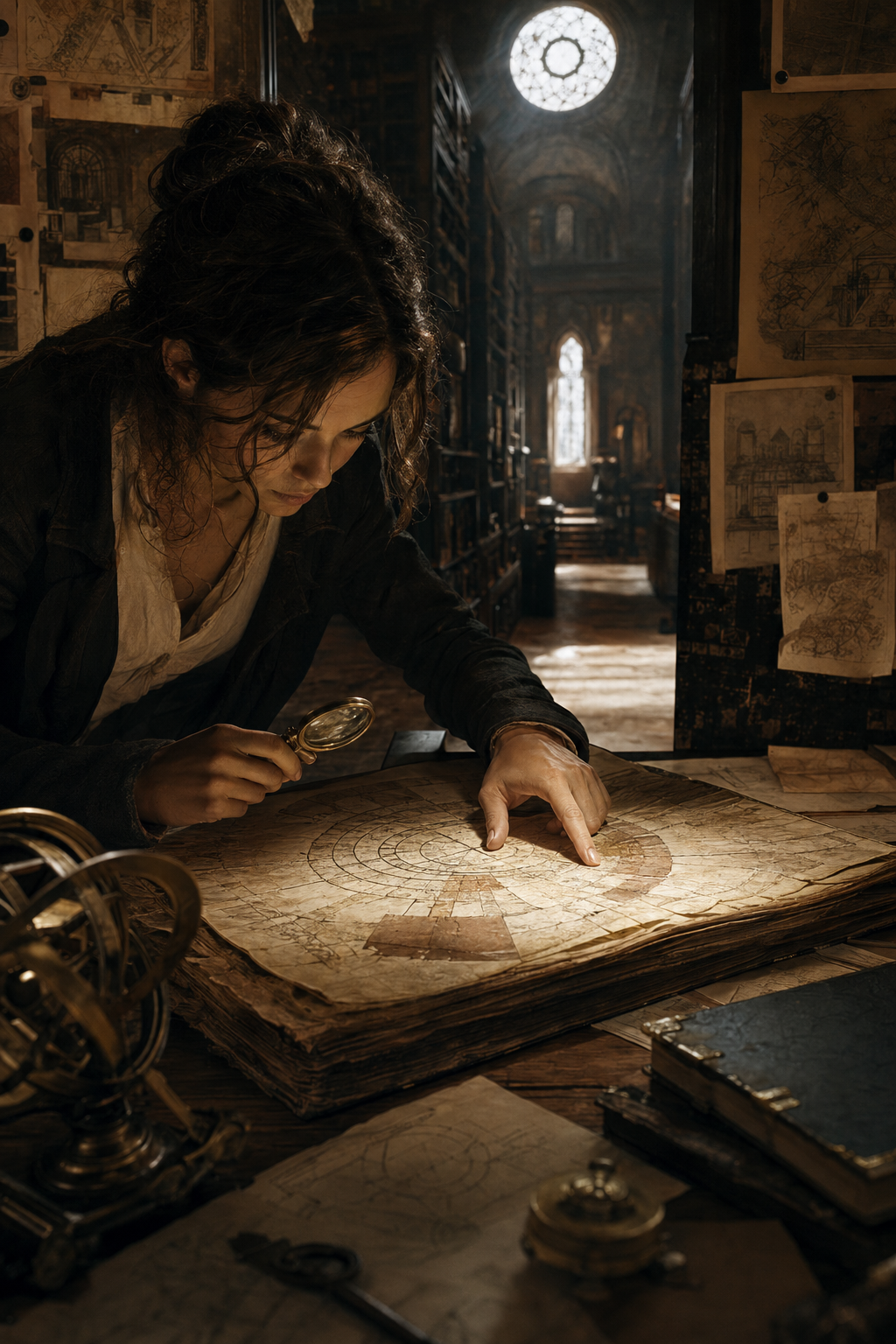
THE PALIMPSEST HEIST
In a Swiss archive built to rewrite history, a forensic scholar has one week to decode a buried name before digitization flattens the truth.
Chapter 1
The page arrived at 14:12, between a stack of graduate seminar papers on Ottoman chancery hands and an email from the dean about next year's budget freeze.
Maren Lašić looked at the courier envelope before she touched it. Copenhagen postmark. No return name. Heavy for its size. Flat, but rigid in one corner as if something had been protected from bending. She moved the seminar papers aside, cleared a section of blotter paper on her desk, and slit the envelope with the microspatula she used for lifting tape from brittle bindings.
Inside were two items.
The first was a single vellum page sealed in archival Mylar.
The second was a folded note written in a hand unsteady enough to suggest illness but disciplined enough to remain legible.
She ignored the note.
Objects first. Context after.
Maren set the Mylar sleeve on the blotter and angled her task lamp low across the surface. The page was approximately twenty-three by sixteen centimeters, ruled in three columns, filled with financial entries in a late-medieval secretary hand. Quantities of wool. Prices in Rhenish guilders. Dates. A ledger leaf, or meant to look like one.
She put on nitrile gloves. Not because the page needed protection from brief handling through Mylar. Because gloves changed the quality of attention. They told the hand to stop being a hand and become an instrument.
The script was competent. Consistent letter forms, moderate slant, abbreviations used by someone trained in merchant notation rather than monastic copying. Fourteenth century, if the hand was honest.
The hand was not honest.
She lowered the lamp another few degrees and watched the ink at the edges of the strokes, where it thinned from black-brown into transparency. There it was. Faint, but unmistakable. A green undertone.
Copper.
Not enough to identify a specific recipe, not without instrumentation, but enough to narrow a century. This iron gall ink was later than the script pretended. Late fifteenth, perhaps early sixteenth century. Someone had written in an archaizing hand with materials that did not belong to the date the page wanted to claim.
Maren reached for her loupe and moved to the margins.
The numerical notes there were in a different hand entirely—smaller, tighter, with the compressed confidence of someone who wrote for function, not display. They were not totals. Not corrections. Ratios. Progressions. 5:8. 13:21. A recurring value approximating 1.618. Fibonacci, or near enough to announce the same mind.
And mixed among the Latin numerals were other characters. Not many. Two, then four, then one again. Enough.
She had seen them before in facsimiles of Sephardic mathematical manuscripts from Catalonia: notation systems used in margins where Latin merchant arithmetic intersected with Jewish scholarly traditions. Not common. Not accidental.
One page. At least two hands. Two eras.
She opened the desk drawer and took out the UV pen light she kept beside her letter opener and pH strips. She clicked it on and passed the beam slowly over the page.
Text rose between the lines.
German words, faint and brown-violet under the ultraviolet beam, in a third hand.
Maren stopped moving.
The office was very quiet. Through the window she could see the gray shoulder of afternoon over Ljubljana, the Faculty of Arts opposite, a student crossing the courtyard with a stack of books pressed to his chest. Somewhere in the building, plumbing knocked once in the wall. Beneath it, the HVAC system hummed its steady mechanical note.
Three hands. Three layers of inscription on one sheet of vellum.
She set down the UV light and only then opened the note.
Dr. Lašić—
This page was removed from the Vossberg-Kessler private archive in 2016. I was chief archivist for forty years. The archive is a palimpsest four layers deep. This page is from the third layer—a fabrication. The marginal notations are from the first layer—the original. I can give you the key to the outermost encoding. The rest is in the building. The Helvetia Consortium begins digitization on Monday the 14th. After that, the physical archive will be destroyed. You have seven days from arrival. There is a name buried at the bottom. I was not able to reach it. I believe you can. — S.C.
Maren read the note twice. Then a third time, slower, checking for the usual signs—grandiosity, vagueness, the imprecise rhetoric of cranks who thought archives hid everything because they did not know how little most archives actually hid.
This was not that.
The note named a real archive. Private, dynastic, Swiss. Vossberg-Kessler. She knew the family by reputation, if not by direct work: old money, older records, selective scholarly access, polished institutional myth. The sort of archive that invited two kinds of outsiders—credentialed historians and fantasists. The note belonged to the first category. So did the page.
Maren photographed the page under white light with her phone mounted on the desk stand she used for quick documentation. Then again under UV. The fluorescent interlinear annotations were too faint for certainty in office conditions, but enough German words emerged to confirm syntax rather than accidental staining. A third hand had indeed written between the visible lines in ink designed, intentionally or incidentally, to disappear under ordinary viewing.
She enlarged one image. The interlinear hand was not the marginal mathematical hand. Different pressure. Different slant. Different problem.
Three minds had touched this page at different times for different reasons.
Her phone was already in her hand before she consciously decided to call.
Noor answered on the second ring. “If this is about the Dubrovnik charter scans, I told you the blue channel is lying to you.”
“It’s not Dubrovnik.”
A pause. Noor knew her well enough to hear the difference between interruption and signal. “What is it?”
Maren looked at the page again. Secretary hand pretending to be older than its ink. Mathematical marginalia in Sephardic notation. German text visible only under UV. A note from a dying archivist she had never met, naming a private archive and a seven-day deadline.
“A machine,” she said.
“That sounds promisingly unhealthy. Explain.”
“I’ve got a ledger leaf. Vellum. Late-medieval mercantile format. Main hand is archaizing. Ink composition wrong for the implied date—copper undertone at the stroke edges. Margins contain ratio notation. Fibonacci-adjacent. Also Sephardic characters. Under UV there’s a third hand in German between the lines.”
Noor was silent for exactly two beats, which meant she was no longer making coffee or answering email or pretending to work while actually rewriting code. She was listening.
“How good are your images?”
“Office good, not lab good.”
“Send them.”
Maren forwarded the white-light and UV photographs.
While Noor looked, Maren slid the note beside the page and read the signature again. S.C. No full name. But “chief archivist for forty years” narrowed possibilities. If true, a chief archivist of a private collection that size would leave a professional trace. University training. Conference proceedings. Articles in conservation journals. Footnotes in the sort of scholarship nobody outside the discipline read and everybody inside it remembered.
Her inbox chimed with Noor’s reply before she began searching.
“Well,” Noor said, “either someone has constructed an extremely expensive fraud specifically calibrated to your weaknesses, or you’ve just been handed the first piece of something very real.”
“Which part?”
“All of it. The margin hand is real enough to make me angry. Also the UV text is definitely text, not bleed or later contamination. Send me a better capture when you can, but there are repeated letter groups. Deliberate writing.”
Maren sat back.
Noor continued, faster now. “The ratio notations—13 to 21 appears twice. The spacing is too intentional to be bookkeeping noise. And those non-Latin characters. You were right. Sephardic system, or close enough that whoever forged them knew exactly what they were doing.”
“If it’s a forgery, it’s informed.”
“Informed to the point of perversity.” A beat. “What’s the note say?”
Maren read it aloud.
Noor exhaled softly. “Seven days.”
“From arrival.”
“Then the archive gets flattened into pretty images and all the physical evidence dies.”
“Yes.”
“You’re going.”
It was not a question. Noor knew the answer because the answer was structural. A page like this did not arrive twice in one career. An archive described as four layers deep by a dying insider did not present itself to someone whose doctoral thesis had argued that systematic falsification was itself legible as a text. The note had not just found her. It had selected for her.
Maren looked at the seminar papers still spread across the edge of her desk, each one discussing script variation in safe, bounded terms. She looked at the page in Mylar, where three centuries appeared to be arguing on one surface.
“Yes,” she said. “I’m going.”
She opened a new browser tab and searched the Vossberg-Kessler Foundation. Then the archive. Then Copenhagen archivists named Søren, Soren, Courcelles, Curcelles. On the third search string she found him.
Søren Courcelles. University of Copenhagen. Former chief archivist, Vossberg-Kessler private archive, 1978–2018. One article on preservation metadata in family collections. Two conference abstracts on restricted-access cataloging. A photograph from 2009: white hair, narrow face, glasses, hands resting lightly on a reading table as if the table were a text he intended to continue reading after the camera left.
Real.
Maren checked flights to Copenhagen.
There was one at 19:05.
She booked it, then packed with the efficiency of habit: laptop, chargers, loupe, gloves, portable UV light, notebook, tape measure, compact camera stand, two shirts, one sweater, field shoes. She hesitated only once, at the small ring dish near the office window. Her grandmother’s silver band lay there, plain except for the tiny mark on the inner surface that was not a scratch but a Glagolitic letter. Truth.
She put it on.
When she returned to the desk, the page seemed changed, though it was only that the next layer of reading had begun. She looked again at the marginal ratios. 5:8. 13:21. Not random. Not decoration. A sequence or a signature. The note had called this page a fabrication and the marginal notations original. Which meant the visible page was already a lie resting on an older truth.
Maren bent closer to the UV image on her monitor and made out one clearer German phrase from the interlinear text: nicht von einer Hand.
Not from one hand.
Noor’s message arrived a moment later.
“Send me everything from the airport. And Maren?”
“Yes?”
“If this is what it looks like, don’t let them digitize it before you read the walls.”
Maren stared at the message.
The walls.
Not the ledgers. Not the catalog. The walls.
She folded Søren’s note once along its existing crease and slid it into her notebook. Then she lifted the Mylar sleeve containing the page and held it at an angle to the lamp one final time.
The green undertone in the ink appeared again at the stroke edges, thin as oxidation, precise as confession. Beneath the visible text lay a margin hand from another tradition. Between the lines, a third writer had hidden commentary in a frequency the eye could not reach unaided. Three layers on one page. And according to the note, one more below them.
There is a name buried at the bottom.
Outside, the light over the courtyard had started to fail. Students crossed the paving stones with scarves and laptops and cups of coffee, moving through the visible world as if it were complete.
Maren turned off the desk lamp, slipped the page into her case, and left for the airport.
In present-day Europe, old dynastic families maintain private archives that shape history as much as preserve it. When forensic palaeographer Dr. Maren Lašić receives a torn ledger page and a dying archivist's warning, she is drawn to a fortified Swiss archive whose records hide four centuries of deliberate falsification. With digitization set to destroy the physical evidence in days, Maren must read altered ink, misbound volumes, and the building itself before the truth is buried for good.
- —Dr. Maren Lašić — A Slovenian-Croatian forensic palaeographer and archival scientist whose gift is reading the grammar of institutional lies. Drawn by a cryptic page and a dying man's codebook, she becomes the only person capable of cracking an archive designed to resist exactly her kind of mind.
- —Søren Courcelles — The former chief archivist of the Vossberg-Kessler archive, now dying after spending forty years uncovering its outer deceptions. He serves as Maren's mentor from beyond the threshold, passing her a coded map of the lies he could not fully break.
- —Bastien Kessler — The current patriarch of the dynasty and the living guardian of the archive's concealed architecture. Cultured, intelligent, and morally formidable, he does not deny the lie so much as defend its necessity, making him Maren's true intellectual rival.
- —Noor Casales — A computational palaeographer and Maren's former student, now an independent specialist in multispectral document analysis. Working first at a distance and then on site, she extends Maren's eye with technology and becomes her closest decoding partner.
- —Luzia Vossberg — Bastien's daughter, an art-history doctoral candidate who grew up inside the Stiftsbau and has long sensed its wrong proportions and missing spaces. Torn between family loyalty and the compulsion to know, she becomes Maren's inside access to both the archive and its buried inheritance.
- —Ephraim ben Moshe Sorael — A 14th-century Jewish merchant-mathematician from Girona whose innovations were stolen and attributed to the Vossberg line. He appears only through ledgers, notations, and carved proofs, yet his buried intelligence shapes the entire mystery as the ghost in the walls.
- —The Summons: Maren receives a single mutilated ledger page and a note from a former archivist claiming that the Vossberg-Kessler archive is a four-layer palimpsest. After a final bedside briefing in Copenhagen, she inherits his codebook, his unfinished investigation, and a seven-day deadline before digitization destroys the archive's physical depth.
- —The Surface Lie: At the Stiftsbau in the Swiss Alps, Maren begins reading both the catalog and the building, noting thick walls, impossible corridors, and a naming cipher embedded in the public records. As she cracks the outer substitution layer, Bastien Kessler makes clear that the archive is not unguarded but actively defended by someone who understands exactly what she is doing.
- —The Buried Pattern: Descending into the lower levels, Maren uncovers composite volumes rebound in a mathematical sequence and hidden annotations left by an uneasy earlier archivist. A miscataloged ledger and a merchant's mark finally give the erased intelligence a name: Ephraim ben Moshe Sorael, a vanished mathematician whose hand persists beneath the family narrative.
- —The Archive Opens: With Noor's imaging tools and Maren's architectural mapping, the catalog numbers resolve into coordinates for compartments hidden inside the walls. Original documents emerge from the stone, fabricated records on the deepest public level are exposed as later replacements, and the archive reveals itself as a machine built to transfer authorship while preserving the stolen originals in secret.
- —The Foundation: As Bastien argues that exposing the truth could destabilize institutions built on the family myth, Maren pushes downward to the sealed foundation with Luzia's help. There, in the original counting house, the final layer waits in carved mathematical proofs and a signed stone testimony that forces the archive, the family, and history itself to confess.
The prose is precise, tactile, and forensic, grounded in real tools, materials, and acts of observation. It carries the clipped clarity of a scholar at work, then widens into moments of architectural awe as ink, vellum, plaster, and limestone become the story's sensory language. The atmosphere blends puzzle-box tension with mythic archaeology, but every revelation stays rigorously physical and legible.