THE OVERNIGHT LEDGER
In a fading Manhattan residential hotel, an overnight ledger records the quiet labor keeping beauty alive under corporate scrutiny.
Chapter 1
The memo had been printed in grayscale, which made the Harcourt Capital logo look less expensive than it probably was. Someone had pinned it to the corkboard in the staff kitchen between the weekly schedule and a notice from management reminding employees to flatten cardboard before placing it in recycling. The paper had already curled slightly at the corners from the kitchen's uneven heat.
The Vernham welcomed this opportunity to showcase its strengths.
The sentence sat in the center of the page in a font chosen for corporate reassurance. Below it: a fourteen-day on-site property assessment beginning Monday. Staff were encouraged to continue normal operations and extend every courtesy to the assessor. Questions could be directed to the general manager's office, though no one who worked nights had ever received a useful answer from the general manager's office after six in the evening.
The memo remained on the corkboard all weekend. People read it while waiting for coffee, while signing the time sheet, while looking for a clean mug. No one wrote on it. No one tore it down. By Monday night, it had become part of the kitchen, another fixed object in a room full of objects that had outlived their intended use.
At 11:15 PM, Tomás Oliveira let himself in through the staff entrance on Seventy-Eighth Street and hung his coat in the narrow locker room off the basement corridor. He changed into his blazer, checked the brass V on the breast pocket with his thumb, and walked up to the lobby.
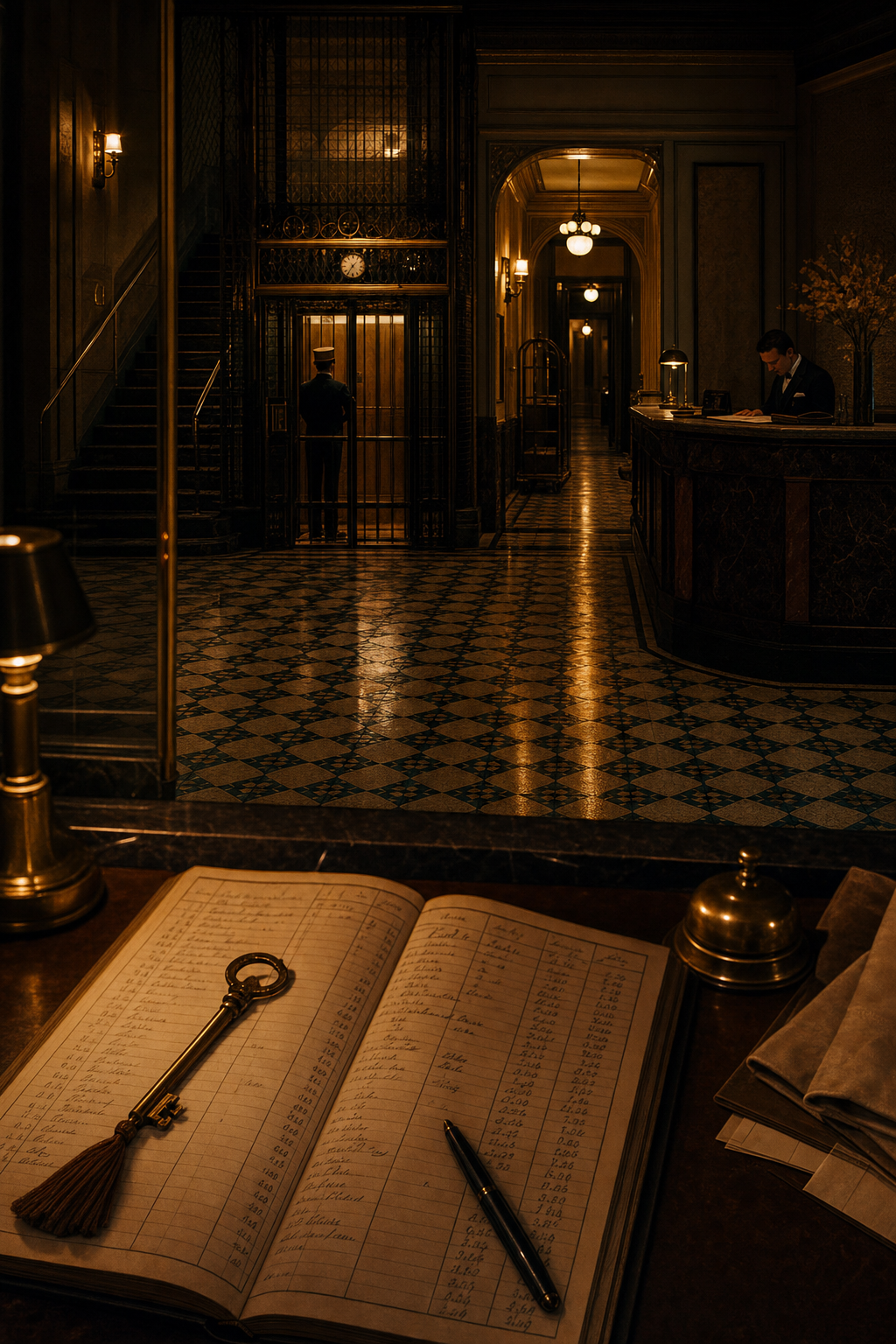
The Vernham at that hour was in its private mode. The front doors reflected the streetlamps in two long amber bars. The Moroccan tilework in the lobby, ivory and teal and umber, held the desk lamp's light without giving anything back. The brass on the elevator cage had been polished during the day shift and still carried a faint trace of polish beneath the older smell of steam heat and wood wax. Somewhere behind the walls, the boiler pushed through the building with a steady, occupied sound.
Priya, the evening clerk, stood behind the desk with the outgoing mail stacked in front of her and the notebook open to the current page.
"You're early," she said.
"Fifteen minutes."
"Which is early."
He accepted this. Priya was efficient and liked the closing rituals of her shift performed in order: cash drawer counted, messages transferred, room keys reconciled, verbal handoff completed without interruption. Tomás took his place on the staff side of the desk and looked at the occupancy board while she spoke.
"Sixty-two percent tonight. Two late arrivals still expected, both from Boston. Parson Group checks in Wednesday; the rooming list came through around seven and I left it in the office. Mrs. Ashford called once to confirm her wake-up for her matinee meeting tomorrow, then called back to say she didn't need it because she remembered it's Tuesday. I left the note anyway."
Tomás nodded.
"And the cage elevator made that clicking sound twice today. Once around noon, once at five-thirty."
He looked toward the brass doors.
"Anything else?"
Priya considered the lobby, as if the answer might be somewhere in the chairs. "No. New concierge left a thorough entry."
She said it without emphasis, but he heard the assessment in it. Priya gathered her bag, signed the log, and left through the front doors, already halfway into the rest of her night before the door swung closed behind her.
The lobby changed at once. The hotel always knew when a shift had turned over. It was not visible to guests, but the building's internal sounds reorganized themselves around new habits of movement. Tomás rested his hands on the desk and looked down at the notebook.
The leather had gone soft at the corners over the years. Olive green once, now closer to the color of old dust jackets left in sun. The first pages were crowded with earlier hands, some blocky, some slanted, some so faint the ink had browned into near-erasure. He turned to the current spread.
Lena Cárdenas's entry was neat and comprehensive. Checkout times. A water-pressure complaint from six. Newspaper delivery delayed for Room 302 and corrected with the vendor. Flowers in lobby replaced at 3:10 PM. She wrote as if she assumed the next person reading would want not only the fact of a thing but its shape.
He noted the sixth-floor pressure issue. PVC junction. Intermittent for months. He noted the flowers without looking at them yet. Then he uncapped the desk pen and wrote beneath her entry in the same steady hand he had used for years.
Occupancy 62%. Two late arrivals pending. Brass cage elevator produced cable-click twice during day shift; monitor overnight. Water pressure on 6 remains inconsistent. Will check valves. Assessment begins tomorrow. Assessor checking in during day shift.
He closed the notebook, capped the pen, and stood.
His first round began in the lobby. Locks on the side doors: secure. Desk drawers: closed. Brass mail slots painted over decades ago behind the western wall paneling: still where they had always been, whether anyone remembered them or not. The flowers were different tonight. The arrangement sat lower in the vase than the previous concierge had preferred, wider at the base, with more attention paid to the teal than the white. Hydrangeas, not lilies. He noted the decision and moved on.
In the ground-floor service corridor, the fluorescent lights hummed with their usual complaint. The corridor was narrower than the public hallway beyond it and smelled faintly of bleach, coffee, and old plaster warmed by pipes. Tomás checked the maintenance closet, then the kitchen prep for breakfast. Bread deliveries stacked correctly. Silverware wrapped. One coffee urn left unplugged for the morning shift.
He took the brass-cage elevator up to twelve and listened on the way down. The car shuddered once between nine and eight, then settled. No click until five. At five, faintly, one metallic tick from above the ceiling panel, almost polite. He rode to the lobby, stepped out, and made a note in his head to call the elevator company if he heard it again.
On eight, a corridor bulb near 812 had burned out. He replaced it from the maintenance closet, standing on the short ladder kept there for exactly that purpose. On seven, he listened outside 709 for the radiator knock that meant the bleeder valve would need attention later in the season. None yet. On six, he opened the service panel, checked the pressure, and adjusted the valve a quarter turn. The pipes answered after a pause.
On four, he stopped at the thermostat.
The fourth-floor wallpaper, installed in 1987, had faded toward a softer green than the original Willow Boughs pattern intended. One seam near 409 was beginning to lift. Tomás pressed it flat with his thumb, then checked the thermostat: sixty-six. He adjusted it to sixty-four.
The building held heat unevenly. South-facing rooms warmed faster than north. The old cast-iron and later copper met badly on four. Mr. Wellick in 302, one floor below, slept better when four ran lower. These facts belonged together. They had belonged together long enough to become one fact.
At 2:30 AM, the phone rang once at the desk, paused, then rang again.
"Front desk. Tomás speaking."
A breath, then Mrs. Ashford's voice, amplified by distress and the room's bad acoustics. "Tomás, I cannot remember whether I took my medication, and if I took it and take it again I may die, which would be embarrassing for everyone."
"I'll be right up."
Room 508 smelled of face powder, lavender lotion, and the tea she forgot she liked until someone brought it to her. Mrs. Ashford stood in a silk robe of theatrical plum, one hand to her chest, the other holding the pill organizer in accusation.
Tomás checked the compartments. Monday evening was empty.
"You took it."
"I did?"
"Yes."
She looked at the organizer, then at him. "Are you certain?"
"Yes."
The panic passed out of her features by degrees, like stage lighting dimming one bank at a time. "Then I have made a fool of myself."
"Not at all."
"I have."
"Would you like tea?"
That improved things. In the staff kitchen he filled a mug with hot water from the service kettle, added a chamomile bag from the dented tin above the microwave, and brought it up on a saucer from the dining room reserve because Mrs. Ashford preferred saucers to carrying a mug in the hand. She accepted it as if receiving a necessary prop.
"Thank you, Tomás."
"Of course."
"You're a saint."
He adjusted the lamp by her bed to its lower setting. "Just the night manager."
By four, the building had settled. The late arrivals from Boston had come and gone to their room without requiring anything beyond directions to the elevator and a map of breakfast hours. The boiler pressure had drifted and been corrected. The sixth-floor valve held. Tomás returned to the desk and opened the notebook again.
His entry occupied a full page: elevator clicking, monitor and likely inspect; bulb on eight replaced; pressure issue on six adjusted, plumber still recommended; Mrs. Ashford called regarding evening medication, resolved, day staff to confirm afternoon check. He wrote in lines as straight as the desk edge.
At the bottom he added nothing further. The page was complete because the night had been complete. Not easy. Not difficult. Simply within the building's normal range of need.
At 6:15 AM, he lifted the receiver and dialed Room 302.
Mr. Wellick answered on the second ring, as he had for years.
"Good morning, Mr. Wellick."
"Good morning, Tomás."
Seven seconds. No more were required.
Dawn had not yet entered the east windows. The lobby still belonged to lamps and habit. At 6:45, June Park came through the front doors in a dark coat with her housekeeping clipboard under one arm. She crossed the lobby with the speed of someone who knew which minutes of her day could be spared and which could not.
"Quiet?" she asked.
"Mostly." He turned the notebook toward her and summarized the night while she read. Elevator. Six. Mrs. Ashford. She scanned his handwriting, then the previous day's entry above it.
"New concierge is thorough," June said.
Tomás looked at the line about Mr. Wellick's newspaper, angled toward the light.
"Yes," he said.
June nodded once, the matter filed. She moved on toward the service corridor, already recalculating linen needs, room turns, breakfast stains, all the day shift's visible and invisible demands.
Tomás remained behind the desk a moment longer. The hydrangeas in the vase held their shape. The brass cage elevator stood motionless behind its doors. From somewhere above, faint through the floors and pipes and decades of repairs, came the building's ordinary morning sounds: a toilet filling, a radiator ticking, a resident crossing a room in slippers.
He closed the notebook and left it on the desk for the day shift.
Then he stepped away from the mahogany, crossed the lobby, and went down toward the staff entrance as the first gray of morning began to gather behind the east-facing glass.
The Vernham is a 1926 residential hotel on Manhattan’s Upper West Side, split between long-term residents, transient guests, and the hidden labor that keeps its aging elegance intact. Night manager Tomás Oliveira knows the building’s every weakness and every habit of its residents, and he records each night’s small salvations in a decades-old shared notebook. When a corporate assessor arrives to judge the property’s future, mounting mechanical failures, demanding guests, and a new day concierge who begins to understand Tomás through his entries turn routine maintenance into a fight over what the hotel is worth.
- —Tomás Oliveira — The Vernham’s meticulous night manager, Tomás has spent eight years holding the building together through expert attention, calm improvisation, and invisible labor. The hotel is the place that gave shape to his competence and identity, which makes the coming assessment both a professional threat and a deeply personal one.
- —Lena Cárdenas — A newly hired day concierge with training in hospitality and architectural history, Lena arrives already primed to love old institutions for the right reasons. Through the shared notebook and the traces Tomás leaves in the building, she begins to recognize the intelligence and devotion behind the Vernham’s maintained surface.
- —Dmitri Sable — The property assessor sent by the new ownership group is polite, accurate, and devastatingly blind to anything that cannot be measured in revenue, condition reports, or brand potential. He is not a villain so much as the embodiment of a system that can price the hotel without understanding it.
- —Ray Vargas — Young overnight security guard Ray is Tomás’s extra pair of hands and an apprentice in the art of seeing how the building works. His bluntness and inexperience make him a useful witness to Tomás’s competence and to the strain building beneath it.
- —Mr. Wellick — A retired civil engineer and twenty-two-year resident, Mr. Wellick represents the Vernham as a true home rather than a temporary stay. His routines are woven so tightly into the building’s life that even a small disruption carries the weight of a moral claim.
- —Mrs. Ashford — A former stage actress living at the Vernham for twelve years, Mrs. Ashford is theatrical, perceptive, and more frightened than she lets on about losing her home. She voices openly the grief and panic that the staff, especially Tomás, keep tightly contained.
- —June Park — The longtime housekeeping supervisor is the day side’s equivalent of Tomás: practical, exacting, and fiercely loyal to standards no budget really supports. She anchors the hotel’s daily dignity and quietly understands what it costs the staff to preserve it.
- —Assessment: As Harcourt Capital begins a fourteen-day evaluation of the Vernham, Tomás works his usual overnight rounds with practiced precision, logging every fault and fix in the old shared notebook. During the day, new concierge Lena reads his entries, starts adding her own observations, and receives the assessor as he begins measuring the hotel like an asset instead of a home.
- —Strain: A corporate retreat group floods the building with noise, entitlement, and logistical stress just as the assessor intensifies his scrutiny. Tomás restores order each night while Lena discovers the building’s original design intentions, and their notebook exchanges shift from pure operations into a quiet, increasingly intimate conversation through maintenance and detail.
- —Cracks: The pressure becomes physical as elevator trouble worsens, resident needs sharpen, rooftop neglect is exposed, and the vulnerable plumbing finally gives way in a major burst. Tomás contains one crisis after another, but the pace and visibility of the failures begin to show the true cost of everything he has been holding together.
- —Recognition: After an interview with the assessor leaves Tomás unable to write even a single notebook entry, Lena answers his silence with attentive, practical care rather than questions. Their bond deepens through exchanged observations about hydrangeas, tilework, and habit, while residents like Mrs. Ashford begin to name aloud the constancy Tomás has spent years making look effortless.
- —Handoff: The assessor’s verdict confirms that the Vernham will be renovated and rebranded, ending its life as the institution these people know. On one last quiet night of full, deliberate tending, Tomás makes his rounds, meets Lena face to face for the first time at dawn, and the notebook passes forward with the work of keeping order still unfinished.
The prose is controlled, elegant, and exacting, with emotion carried through observed detail rather than overt declaration. It lingers on brass, tile, steam heat, paper, flowers, corridors, and the choreography of service, creating a sensory world of faded luxury sustained by hard, quiet labor. The overall mood is intimate, mournful, and precise, with tenderness emerging through professional language and acts of maintenance.