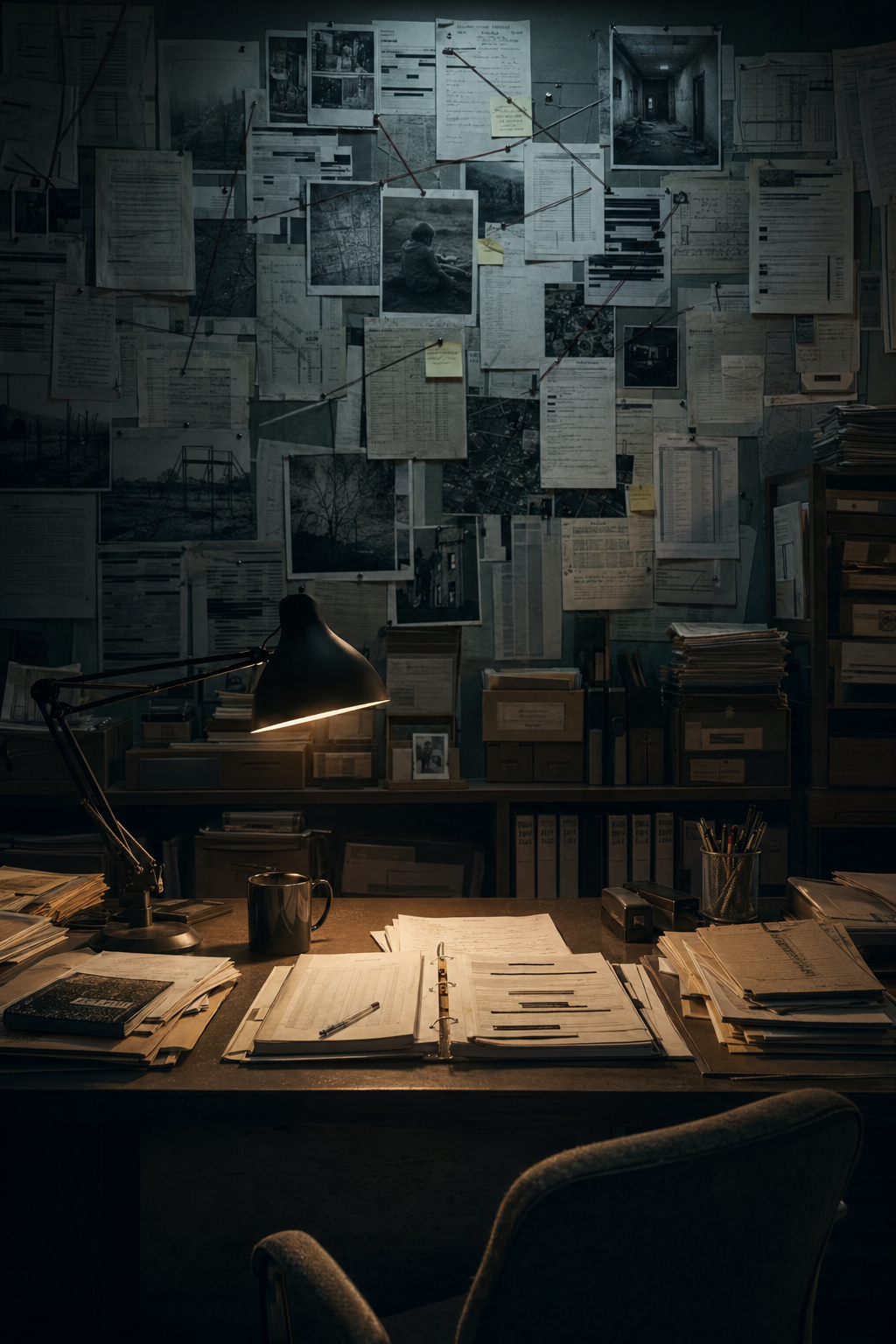
The Only Honest Room
In a child-welfare watchdog office, one investigator finds a pattern of delayed danger reports—and collides with the lawyer paid to contain it.
Chapter 1: The Discrepancy
The caseworker had falsified three home-visit reports in Region 7. The falsifications were obvious once Nora Harker put the files next to each other. The same sentence appeared in all three: Child observed sleeping in own bed. No visible safety concerns in residence. The sentence was identical down to the misplaced comma after bed. Two of the visits were supposed to have occurred six weeks apart. The weather reports for those dates did not match the descriptions in the notes. On one date the caseworker reported a backyard trampoline covered in leaves. On the other, a heat advisory had been in effect for three consecutive days.
Nora wrote the finding in the draft report. She attached the photographs, the timestamps, the supervisor's sign-off history. She cited the policy section on falsified documentation. She added the recommendation for disciplinary action. It was a routine OIG investigation. Bounded. Solvable. The kind of case that ended with a clean report and a supervisor somewhere in a regional office staring at a PDF with their jaw set.
At 6:12 PM the office had mostly emptied. The low cubicle walls made absence visible. Monitors dark. Chairs pushed in. A half-eaten granola bar on the desk across from her, left in its wrapper beside a yellow legal pad. The fluorescent panel above the printer in the northeast corner flickered once every eight seconds. Not enough to draw the eye directly. Enough to fatigue it over time.
Nora exported the caseworker's full caseload history for context. It was not strictly necessary. She did it because reports held better when the surrounding facts were stable. An isolated act of misconduct could be defended as stress, oversight, burnout. A pattern was harder to soften.
The spreadsheet loaded slowly. Region 7's system had been updated twice in three years and had never fully recovered. Column headers misaligned when exported. Date fields lost formatting. Drop-down categories from the live case-management system became free text in the extract, which meant the same event could appear under three different names if three different workers had typed it.
She sorted by placement risk designation. Then by review status.
Two of the falsified cases had high-risk flags.
She stopped typing.
The first flag had been filed ninety-four days before validation. The second had been filed one hundred twenty-seven days before validation. Both children had remained in placement during the delay. Both falsified home visits occurred inside that window.
Nora looked back at the original reports. Then at the caseload extract. Then back again.
The misconduct finding did not change. The caseworker had still lied. But the lie had occurred in a gap the system had made. A placement had already been marked high-risk. The flag had entered review. The review had not concluded. No one had been actively monitoring what happened next except the same caseworker who later falsified the follow-up.
She opened the first flagged case. Intake chronology. Routing history. Validation date. The queue log showed the flag had been referred for supplementary documentation fourteen days after filing. The supplementary documentation was submitted three days later. No further action for fifty-one days. Then reassigned to cross-functional review. The review meeting date field was blank.
Nora copied the timeline into her notes.
The second case showed a similar pattern. High-risk flag. Documentation request. Delay. Reassignment. Blank review field.
She looked at the time in the corner of her screen. 8:47 PM.
Her phone buzzed against the desk. Once. Then again.
Nora turned it face down without reading the screen.
She opened the central case-management system and requested a broader Region 7 extract limited to high-risk placement flags over the past eight years. The request wheel spun. The system hesitated, as if offended by the volume. Then accepted.
Behind her, the building settled into its night sounds. Ventilation. A copier somewhere on another floor. The distant metallic knock of the stairwell door closing. The office smelled faintly of carpet adhesive and old coffee. On evenings like this the OIG floor felt less like a workplace than a processing chamber—documents in, findings out, light unchanged.
The data populated in batches.
Nora filtered for flags with validation delays over thirty days. Then sixty. Then ninety. She cross-referenced outcomes: emergency removal, hospitalization, substantiated re-abuse, caseworker reassignment.
Four more cases appeared within the first two hours.
Not identical. Systems this large never produced identical failures. But the structure repeated. High-risk placement concern filed. Validation delayed. Placement remained stable on paper. Outcome worsened in the interval.
She created a new folder on her desktop and named it with the date.
Inside it she saved the extracts, the screenshots, her handwritten timeline transcribed into a document with no title yet. She did not know whether this was a case. It was not an allegation against a person. It was not one office, one act, one traceable lie. It was closer to weather. Conditions producing outcomes with enough consistency to stop calling them separate.
At 10:03 PM Martin Cade appeared at the end of her row of cubicles carrying his coat over one arm. Inspector General. Fifty-eight. Careful in all the ways that let a person survive three departmental directors without acquiring enemies that could be listed by name.
He looked at her screen, then at the dark office around them.
“You’re still here.”
“Yes.”
“That Region 7 report done?”
“Drafted.”
Cade nodded once. His gaze moved to the open spreadsheet. “What’s this?”
Nora did not answer immediately. She preferred complete language to speculative language, and this was still forming. “Context,” she said.
Cade waited.
She turned slightly in her chair. “Two of the falsified cases were high-risk placements before the falsification occurred. The flags sat in review for ninety-four and one hundred twenty-seven days. There are at least four more Region 7 cases with the same sequence. Flag. Delay. Worsened outcome.”
Cade's expression did not change. He was good at receiving information without showing whether he considered it dangerous. “How many more?”
“I don’t know yet.”
“That usually means too many.”
Nora looked back at the spreadsheet. “It may be a routing issue.”
“Routing issue” was what you called a structural failure before you had enough evidence to use words that made departments defensive.
Cade set his coat on the back of an empty chair. “You have anything beyond Region 7?”
“Not yet.”
“Then right now you have a local anomaly.”
Nora knew what he was doing. Boundary-setting. Scope control. The first institutional response to pattern was always reduction. Turn the architecture back into a room-sized problem. Rooms could be managed. Structures could not.
“It may not be local,” she said.
Cade pulled the chair opposite her cubicle and sat. The fluorescent light flattened his face into planes of fatigue and caution. “I’m not saying don’t look. I’m saying know what you’re looking at before you name it.”
Nora clicked open another case chronology. “I know what delay looks like.”
He watched her for a moment. “You also know what happens when OIG goes broad without a defined allegation.”
“Yes.”
“Legal gets involved.”
“Yes.”
“And if Legal gets involved before you know what you have, then you’re arguing methodology while still trying to build the record.”
Nora did not answer. Because he was right. Because he was also describing a problem she already knew how to solve by working longer.
Cade stood. He picked up his coat. “Go home at some point, Harker.”
She nodded without meaning to comply.
He paused at the end of the cubicle. “If this becomes a scope request, make it clean. No theory language. Just evidence.”
After he left, the office seemed larger and emptier. Nora returned to the data.
By 11:26 PM she had seven cases on her list. Seven was not proof. Seven was enough to justify more looking.
She printed the timelines and spread them across her desk. The papers formed a rough grid over the laminate surface. Dates. Review statuses. Outcome codes. Delay intervals. The details varied; the pauses did not. The pauses had shape. They clustered in the same places—after documentation request, before validation, inside review channels with names that sounded procedural and therefore harmless.
She circled one repeated term: regional stability review.
The phrase had no reason to matter. It appeared in the routing fields as one administrative layer among others. But the cases with the longest delays all passed through it. Stability. A word that looked benevolent until measured against what it preserved.
Her phone lit again.
This time she glanced at it. A text message preview.
Hope you’re okay.
David.
She looked at the words for three seconds. Then she locked the screen and slid the phone under a stack of printouts. Not because she did not understand the message. Because she did. Because understanding it would require a different apparatus than the one she had in her hands.
At 12:14 AM she opened a fresh document and typed:
Preliminary Observation: Region 7 high-risk placement flags may be subject to validation delays not observed in standard-risk review queues. Delays correlate with adverse placement outcomes and may create supervisory gaps in which caseworker misconduct is more likely to go undetected. Further review required.
She read the sentence twice. It was accurate. It was also too small.
She deleted Region 7 and then put it back.
Outside the windows at the far end of the floor, the city had gone dark in increments. Government buildings first, then offices, then the parking garage levels dimming one by one. Her own reflection in the glass looked like anyone who had stayed too late under bad lights: pale, sleepless, reduced to function.
Nora pulled the next extract.
The system accepted her request with a delay long enough to register as resistance.
She waited, hands flat on the desk, eyes on the progress bar.
What she had in front of her was either a local procedural weakness or the first visible edge of something with no natural boundary. She could feel the difference before she could prove it. The sensation was familiar. It was the same sensation she had known as a child when a room looked normal and was not. Not intuition. Pattern recognition at a depth the body registered before language did.
The progress bar completed.
A larger dataset opened.
Nora straightened in her chair and began again.
Set inside a state child-welfare watchdog office, the story follows Senior Investigator Nora Harker as she notices that high-risk foster placement flags are being systematically delayed inside the bureaucracy meant to protect children. What begins as a routine misconduct case widens into a seventeen-year pattern of institutional harm tied to performance metrics, buried files, and administrative self-protection. As Nora pushes toward the truth, she is forced into battle with DCFS legal counsel Leon Colfer, whose job is to manage the fallout of exactly what she is uncovering.
- —Nora Harker — A meticulous senior investigator in the Office of the Inspector General, Nora is brilliant at reading systems, files, and the gaps between official stories. When she spots a buried pattern in delayed high-risk flags, her need to map it becomes both a professional crusade and a test of the life she has built around investigation alone.
- —Leon Colfer — A senior attorney in DCFS Legal, Leon reviews investigations for liability and institutional risk, making him Nora’s sharpest adversary. Raised in foster care himself, he believes damaged systems must be managed from within, even as Nora’s findings force him toward truths he has spent decades containing.
- —Mara Landin — A former caseworker who flagged a dangerous foster placement seventeen years earlier, Mara is the buried witness at the center of Nora’s inquiry. She saw the mechanism before Nora did, documented it, and left the system carrying the knowledge that being correct does not guarantee change.
- —Ellen Marsh — The DCFS deputy director helped build the review-routing procedures that quietly slow high-risk interventions in the name of placement stability. She is not malicious, but her career and the department’s operating model depend on defending decisions that produced catastrophic outcomes.
- —Martin Cade — The cautious Inspector General supervises Nora and understands immediately how explosive her inquiry could become. He does not stop her outright, but his instinct for bureaucratic survival keeps routing the investigation through the very structures it threatens.
- —David Park — Nora’s ex-partner, a landscape architect, remains present mostly through absence: a text unanswered, a mug untouched, a life she could not inhabit while dissecting everything around her. He embodies the personal cost of Nora’s compulsion to analyze rather than simply live.
- —The Discrepancy: While closing a routine misconduct case, Nora notices that high-risk placement flags are being validated far later than ordinary ones, leaving children in danger while the system appears compliant. She starts pulling data after hours and realizes the anomaly may be structural, not local.
- —The Paper War: To widen the inquiry, Nora has to survive layers of institutional review, which puts her into a tense memo battle with DCFS legal counsel Leon Colfer. As she expands the dataset across regions and years, the pattern sharpens, and one dead child’s archived case gives the statistics a human center.
- —The Human Cost: Nora tracks down former caseworker Mara Landin and learns that the same mechanism was visible nearly two decades earlier, long before Nora began tracing it. At the same time, Leon’s challenges make Nora’s report stronger even as they expose a deeper conflict between truth, strategy, and the institution’s instinct to protect itself.
- —The Crack: After the department answers Nora’s report with procedural delay and defensive review, Mara produces an old memo proving the system had already been warned and chose not to act. That discovery breaks Nora’s faith that mapping the pattern will be enough, and in the aftermath she reaches for Leon not as an opponent but as the only person who can understand what the truth now costs.
- —The Only Honest Room: Nora and Leon finally strip away their professional roles, revealing how both of their lives have been shaped by the same system from opposite sides. Together they choose a path that forces the report outside departmental control, triggering public consequences while leaving the larger institutional problem unresolved and deeply personal.
Dark, restrained, and forensic, the prose moves with investigative precision before opening into rarer moments of emotional fracture. The sensory world is relentlessly institutional—fluorescent light, stale coffee, recycled air, filing cabinets, legal paper, database screens. Its atmosphere is procedural rather than gothic, with dread gathering through paperwork, silence, and the ordinary machinery of bureaucratic harm.