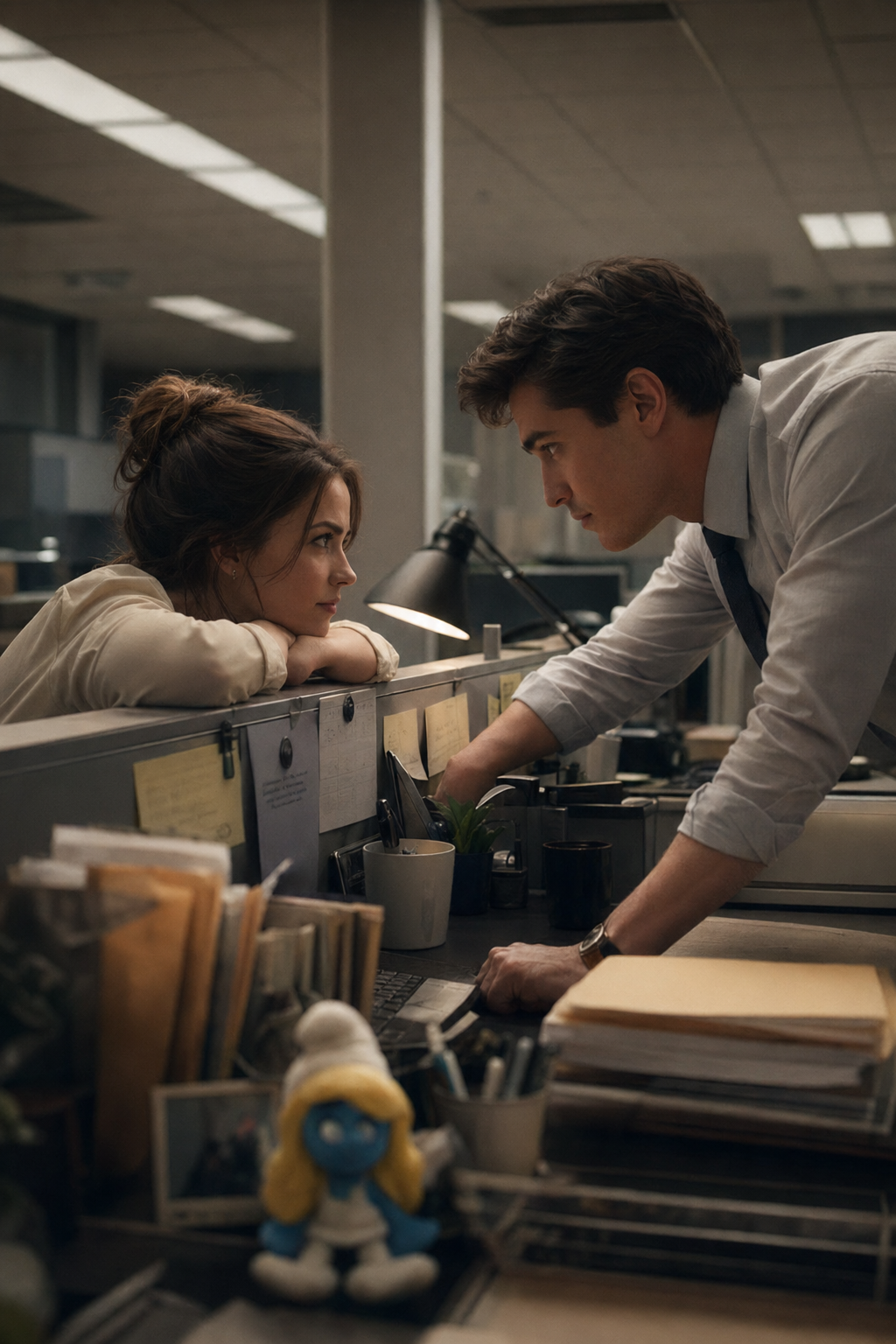
The Midpoint
In a dying branch office, two workplace rivals wage war over thermostats and calendars while noticing far too much about each other.
Chapter 1
The thermostat reads 68, which is not a temperature so much as an act of aggression.
I know this because I set it to 74 at 7:11, immediately after hanging my coat on the back hook, placing my bag under the right side of my desk, pouring coffee into the blue mug with the chipped handle, and taking the one deep settling breath I take every morning before I sit down. These are not rituals. These are procedural stabilizers required to make a fourteen-by-sixteen-foot room occupied by two adjusters and one malfunctioning HVAC unit barely habitable.
At 7:24, Theo Vance went to the bathroom.
At 7:25, I stood up, walked to the thermostat behind his desk, and found it at 68.
This is not our first engagement.
Three weeks into sharing an office designed by someone who believed the phrase collaborative sight lines was either meaningful or humane, Theo and I have established several recurring disputes. The filing cabinet. The coffee maker. Whether silence in a room this small is restful or oppressive. The radio, which I turned on once and he looked at as if I’d introduced a live raccoon. The thermostat is simply our most consistent theater of operations because it is mounted on his wall, which gives him territorial advantage, and because I run cold, which he has apparently identified as a weakness and intends to exploit until one of us dies or corporate installs central heat from this century.
I do not look at him.
He is five feet away. Not looking at him in a room this size requires an energy expenditure that should count toward my daily exercise. I feel him across the open air between our desks the way you feel a storm through a window that doesn’t quite seal.
His keyboard clicks. Short, even strokes. Baseline operations.
I sit down and pull my cardigan tighter, which is not a concession. It is wardrobe management.
“Cold?” he asks.
He doesn’t look up from the Henderson claim file on his screen. His voice is level, dry, and carrying the exact amount of false innocence required to make me want to throw my mug at the wall.
“Not at all,” I say. “If anything, I was worried the room had become dangerously hospitable to human life.”
He makes a note on a paper file. His handwriting is as irritating as the rest of him—precise, upright, impossible to mock because it looks exactly like what handwriting should look like if civilization were functioning properly.
“The temperature is within standard operating range.”
“For what species?”
That gets a pause. Not a full pause. A fractional one. Long enough to register, short enough to deny. Then: “You own coats.”
I stare at the side of his face. This is a tactical error. I know it immediately and continue doing it anyway.
Theo Vance has one of those faces that becomes more annoying the longer you work near it because repeated exposure reveals structural details. Not attractive details. I’m not saying that. I’m saying observable details. The angle of his jaw when he’s reading something carefully. The slight tightening at the left corner of his mouth when he finds an error. The stillness he goes into before disagreeing, as if internally arranging his objections in alphabetical order.
He is wearing a gray tie in a strip mall insurance office in Wren, Illinois, at 7:32 on a Tuesday morning, which remains one of the least defensible lifestyle choices I have personally witnessed.
I open the Hanson file and begin typing notes on a roof damage estimate while not noticing that he has rolled his shirt sleeves exactly one fold above the wrist. He always does that at 8:00 and never before. It is 7:32.
This is probably nothing.
This is probably not the kind of thing a person should know about a coworker after three weeks.
This is probably what happens when your office is 224 square feet and your desks face each other like a low-budget duel.
The bell on the front door jingles.
Danny leans in holding a stack of new sandwich menus like he’s delivering wartime correspondence. “Morning, insurance professionals.”
I look up with genuine relief. “Danny. A civilian.”
Theo gives him the small nod he gives everyone in the strip mall, a gesture so formal and slight it feels less like greeting and more like acknowledgment of mutual survival.
“Got the updated lunch menu,” Danny says, crossing to the partition and setting the papers down. “Added a roast beef combo. People wanted options.”
“Who are these people?” I ask. “Name them.”
Danny grins. “You okay in here? Feels like a meat locker.”
I turn my head very slowly toward Theo, a movement so deliberate it should have background music. “Interesting. An outside observer.”
Theo finally looks up. His eyes go from Danny to me to the thermostat on the wall behind him. “The HVAC system is functioning normally.”
Danny, who was born in this town and has therefore never developed a survival instinct where awkwardness is concerned, says, “Yeah, but June’s always cold.”
Silence.
Tiny, perfect, catastrophic silence.
Because of course Danny knows that. Danny knows everybody’s sandwich order, their preferred chip selection, whether they’re having a bad day based on how hard they set their keys on the counter. Danny noticing I’m always cold is normal. Danny is professionally attentive.
Theo’s expression does not change. This in itself is suspicious, because if someone had just publicly confirmed a piece of personal climate data I had been trying not to notice another person noticing, I would at minimum blink.
Danny, oblivious to the fact that he has just thrown a lit match into an office already saturated with fumes, taps the menus. “See you at lunch.”
The bell jingles again. He’s gone.
I look at my screen. The roof estimate blurs for one brief, irritating second before my eyes refocus.
Theo clicks his pen three times.
Three clicks. Pause. I have heard this pattern enough to know it means thinking, which is not information I sought out. It is ambient. Like the hum of the mini-fridge or the way the heater rattles when it kicks on and then fails to produce meaningful heat. In a room this small, everyone is forced into passive expertise regarding everyone else’s noises.
“Did Danny submit a formal climate assessment,” I ask, “or are we now crowdsourcing my body temperature through the sandwich shop?”
Theo sets the pen down. “I’m surprised that’s what concerns you.”
“What else would concern me?”
His eyes flick to my mug, then to my hands around it, then back to his screen so quickly most people would miss it.
I do not miss things. This is my entire problem.
“That your coffee is cold,” he says.
I look down.
He is correct. While prosecuting the thermostat war, I have neglected my own beverage. The coffee has reached the stage where drinking it is less enjoyment and more obligation.
“That,” I say with dignity, “is unrelated.”
“Of course.”
The worst thing about Theo is that he can fit entire arguments inside one phrase if he flattens his voice enough. Of course means: of course your coffee temperature is unrelated to the room temperature and of course you are a reliable narrator of your own discomfort and of course this has nothing to do with the fact that your fingers have been wrapped around the mug for twelve consecutive minutes.
I stand up so abruptly my chair wheels back half an inch.
He looks up again.
“I’m reheating this,” I say.
“Try not to damage the microwave. It’s older than both of us.”
I take my mug to the kitchenette alcove. The microwave plate is still missing because this office is held together by neglect and electrical tape. I set the mug in, rotate it manually to account for the uneven heating pattern, and press thirty seconds.
Behind me, paper shifts. Pen clicks twice. Not three. Not the baseline thinking pattern. Two quick clicks, then stillness.
I know that stillness too.
This is not surveillance. This is acoustics.
The microwave hums. I stare at my own reflection in the dark glass and look exactly like a woman whose life made several aggressive left turns and ended in a strip mall office arguing about interior climate with a man who alphabetizes his sticky notes.
When I turn, Theo is holding out the Henderson file.
I walk back to my desk and take it. Our fingers do not touch. The gap is maybe an inch. Less. Enough to register heat without contact, which is just physics and means nothing.
“You missed page four,” he says.
I flip the file open. Page four has a contractor estimate paper-clipped to the back. I did miss it.
I hate that I missed it.
I hate more that he noticed.
“I was getting there.”
“You were alphabetizing your annoyance.”
“I contain multitudes, Vance.”
His mouth does the smallest possible thing. Not a smile. Absolutely not. More like the structural memory of one.
“I’m aware,” he says.
There are several ways to hear that sentence. None of them are professionally useful.
The bell on the front door jingles again before I can decide whether to respond. Glenn from UPS appears with a flat parcel under one arm and the expression of a man who has been alive long enough to find other people’s workplace tension relaxing.
“Got one for the claims dungeon,” he says.
“This is not a dungeon,” I say.
Glenn looks around the fourteen-by-sixteen-foot room. “You’re right. Needs less natural light.”
He hands Theo the package, gives me a wink so terrible it loops around to almost charming, and leaves.
Silence settles back over the office.
I look at page four. Contractor estimate. Important, actually. I add the information to my notes.
Across from me, Theo types, stops, clicks his pen once, then resumes.
The thermostat still reads 68.
I know because I checked while sitting down, leaning just enough to see the display over the edge of his monitor. This was not intentional. My eyes moved there on their own. Like a reflex. Like checking a wound to see if it still hurts.
At 8:03, Theo stands up, walks to the printer, retrieves the forms he sent, and returns to his desk.
On his way back, without a word, he reaches behind him and presses the thermostat up two degrees.
He sits down.
I stare at the number over his shoulder. Then at him.
He opens a file like nothing happened.
Now, several interpretations are available here.
One: the office bully has decided 68 was too overt and has shifted to a subtler warfare strategy.
Two: the HVAC system has prompted a rare outbreak of human compromise.
Three: Theo Vance has, over the course of three weeks, noticed the threshold at which my hands stop moving properly over the keyboard and has adjusted accordingly.
The third interpretation is absurd, invasive, and unsupported by admissible evidence.
He clicks his pen three times.
I say, “Trying mercy now?”
He doesn’t look up. “Trying productivity.”
“Right,” I say. “God forbid my fingers detach.”
“That would complicate claims processing.”
I look at my screen. Then, because I am apparently committed to making objectively poor choices before 8:15 in the morning, I say, “For the record, 74 is the midpoint between civilized and hypothermic.”
“No,” he says. “For the record, 74 is a greenhouse.”
“Seventy is still hostile.”
“Seventy is compromise.”
There’s that word.
Compromise.
A ridiculous amount of air leaves my lungs over a discussion about indoor temperature in a leased office suite next to a sandwich shop.
I take a sip of reheated coffee. It’s too hot now. This is also his fault somehow.
At 8:11, the phone rings. We both reach for it out of habit, then stop, our hands hovering over our respective desks.
He looks at me. I look at him.
Five feet of air. One ringing phone. A thermostat at 70.
“Go ahead,” he says.
I pick up on the second ring. “Garrett-Lind Adjusters, this is June.”
His eyes drop back to his file, but I can feel the room register the choice the way a body registers a weather shift. Not because answering the phone matters. Because he knew I’d take it if he waited half a second. Because I knew he knew. Because in a room this small, routine becomes a form of documentation.
The client on the line is frantic about a flooded basement. I talk her down, get the claim number, make her laugh once, which helps. I’m writing notes while talking, and midway through confirming the address, I hear it: one pen click from across the room, then the slide of a file in my direction.
When I hang up, the file is already on the edge of my desk.
Municipal flood maps. Her neighborhood. Relevant forms paper-clipped on top.
I look at Theo.
He is reading his screen with the severe focus of a man who has never in his life performed a small act of anticipatory assistance for another human being. If called on it, I suspect he would characterize the file transfer as operational efficiency.
It probably is operational efficiency.
It is also, infuriatingly, exactly what I needed before I asked for it.
“Thanks,” I say.
He nods once, still not looking at me.
I take the file. My coffee is hot. The room is tolerable. The thermostat holds at 70.
Outside the window on his side, Danny flips the sign in the sandwich shop from CLOSED to OPEN.
The day, against all available evidence, has begun.
At Pinnacle Consulting Group's half-forgotten Colworth branch, seven employees keep an office alive long after corporate meant to close it. Nora Sato came there to disappear after burning out in Philadelphia, only to find herself trapped four feet from Ethan Rowe, a meticulous transfer whose seriousness threatens the low-stakes refuge she built. Their petty office war over shared space and standards masks a far more dangerous fact: they have become experts in each other, and neither can admit what that attention means.
- —Nora Sato — A sharp, funny former rising star from Philadelphia, Nora transferred to Colworth after a quiet professional collapse and reinvented herself as someone who no longer tries too hard. Her humor makes her the warmest person in the room, but it also keeps everyone from seeing how badly she wants to be understood.
- —Ethan Rowe — A controlled, intensely competent transfer from Chicago, Ethan works in a dying office as if every file still matters. After taking the fall for a junior colleague's mistake, he has turned precision into armor, but his relentless attention to Nora keeps breaking through the shell.
- —Priya Anand — A dry, incisive senior associate who became Nora's closest friend through shared silence rather than confession. She sees through deflection instantly and asks the kind of simple questions that force Nora toward the truth.
- —Deb Kowalski — The veteran office manager who has outlasted every transition and quietly mothers the branch through logistics, food, and unnerving perception. She rarely comments, but she understands the full shape of the Nora-Ethan dynamic long before they do.
- —Marcus Cole — An earnest junior associate whose first real job happens to be in an office everyone else treats like a waiting room. His mistakes, questions, and need for guidance keep forcing Nora and Ethan into reluctant teamwork and revealing how similar they really are.
- —Carla Fuentes — The extroverted client-relations engine who insists on trivia nights, birthdays, and branch bonding no one asked for. Her social schemes repeatedly create the proximity and group situations that thin Nora and Ethan's professional masks.
- —Tom Brewer — The part-time IT support presence who seems detached behind his headphones but misses nothing. He provides the deadpan outside perspective that punctures denial whenever the office tension becomes impossible to ignore.
- —Ben Langford — The unseen ghost of Ethan's Chicago life, Ben is the junior associate whose mistake Ethan covered at great personal cost. His silence after the sacrifice defines Ethan's fear that care can be given completely and still go unrecognized.
- —The War: Nora and Ethan are introduced in the middle of a polished office feud built from thermostat changes, conference-room bookings, and report edits. Their rivalry is real, but so is the unnerving precision with which they monitor each other's habits, moods, and routines.
- —The Crack: Forced proximity and tiny acts of care begin to disturb the enemy framework: an elevator stall, a late-night coffee made exactly right, an umbrella left in a drawer, an unexpectedly perfect trivia partnership. Nora keeps translating every charged moment into annoyance even as Ethan's attention becomes harder to dismiss as professionalism.
- —The Archive: As closure rumors gather around the branch, Nora learns more of Ethan's hidden history and starts seeing the loyalty, pain, and discipline beneath his control. Their work styles begin to merge, their teamwork strengthens, and the accumulation of private knowledge between them starts to feel less like rivalry than devotion in denial.
- —The Wound: External pressure intensifies when the office's future is reviewed and Nora receives a path back to Philadelphia, forcing both of them to confront what Colworth has become. A brutal fight exposes the exact injuries each carries from the lives they fled, but their quiet repair reveals that they are no longer merely surviving the same room together.
- —The Turning Point: Visits from the past strip away their last defenses, and ordinary office rituals become impossible to separate from feeling. In the compressed intimacy of one more workday, the truth finally surfaces: the war has always been the shape their attention took before either of them could bear to name it.
The voice is intimate, dry, and razor-observant, balancing workplace comedy with raw emotional precision. The prose lingers on fluorescent offices, parking-lot silences, coffee rituals, and micro-expressions, turning mundane corporate spaces into sites of ache, banter, and devastating closeness.