THE MERIDIAN
In a windowless underground lab, ten strangers must combine split clues to open seven doors while every mistake costs a life.
Chapter 1
The wristband was already in Maren Vogt's hand when she woke.
Metal. Smooth edge. No clasp. A dead weight around her left wrist that had not been there the last time she remembered falling asleep. She read the display before she sat up.
#1
10
00:00:00
Participant number. Remaining count. Timer.
She lifted her head.
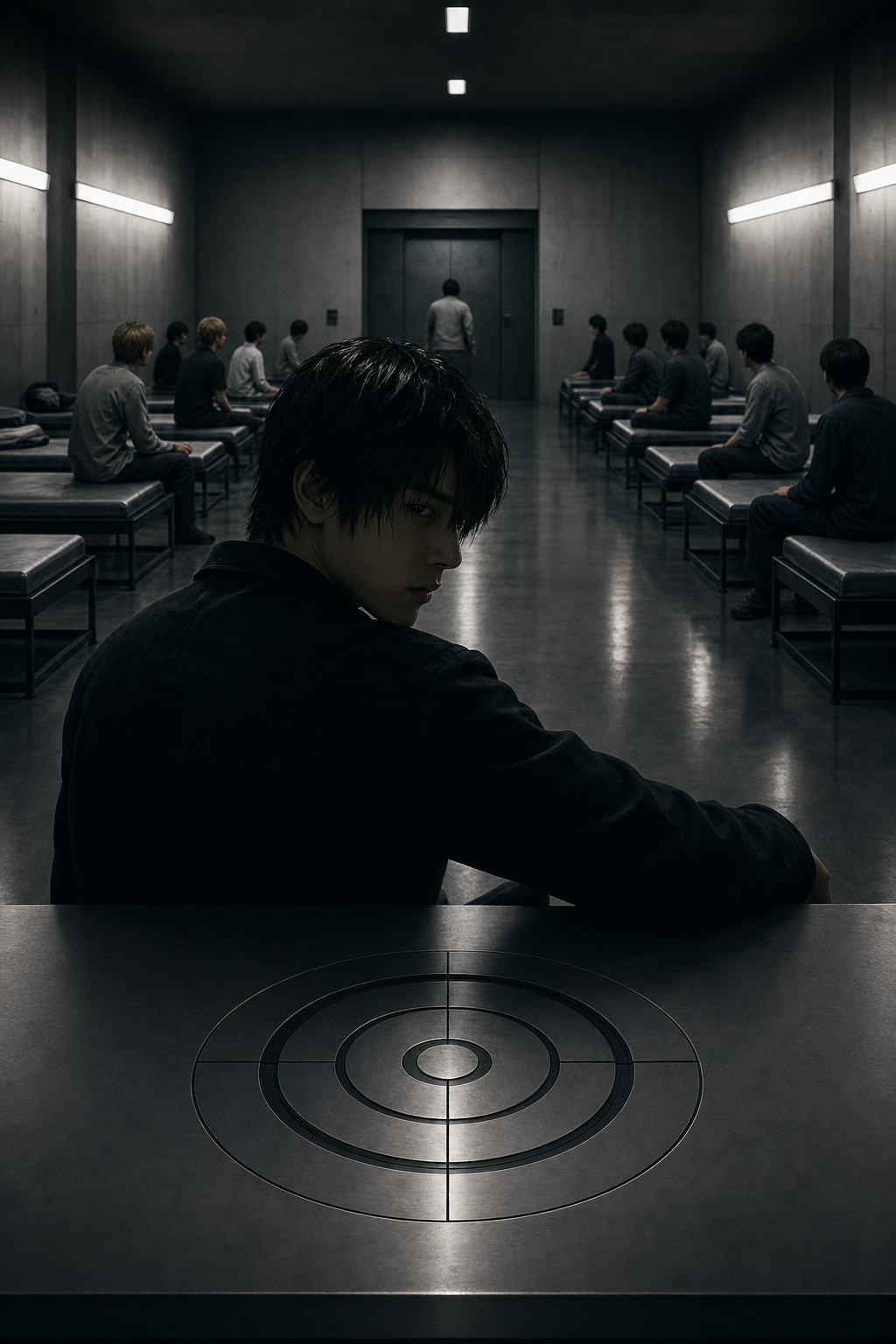
Ten cots. Steel frames, thin mattresses, gray blankets folded to regulation neatness at each foot. Rectangular room. Concrete walls. White composite panels over the ceiling. Recessed fluorescent strips throwing flat light with nowhere for shadow to collect. Water dispenser on the east wall. Ration station opposite it. One steel table in the center, no chairs. One door in the north wall, heavy, steel-faced, keypad terminal mounted beside it. Screen above.
Nine other people.
They were waking at different speeds. Startle, confusion, orientation. A man on the cot nearest the ration station sat up too fast and had to brace himself with both hands. A woman three cots down stayed very still for two full seconds before moving, as if finishing a thought she had been having before consciousness resumed. One person was already upright.
Maren counted breath rates before names existed.
Fast, unstable breathing from the man on the far left. Controlled breathing from the tall angular man on the cot opposite hers. Someone suppressing panic by freezing. Someone suppressing panic by talking under their breath. Someone scanning the room.
That last one was wrong.
The woman with wristband #3 was not looking at the screen, the door, the food, or her own wrist. She was looking at faces. Tracking them one by one with the alert, forward-leaning attention of a medic at triage. Information gathering, but not from the room. From the people in it.
Maren filed her. Anomaly.
The screen above the door activated.
White text on black.
- The Meridian contains seven sealed doors, numbered 1 through 7. Behind Door 7 is the exit.
Silence flattened across the room. Even the man who had been muttering stopped.
Maren read each line as it appeared and began building the structure before the rules had finished displaying. Seven doors. Sequential progression. Exit exists, but not here. Closed system.
- Each door requires a Solution Code to open. The Code is a sequence of digits.
Quantifiable mechanism. Good.
- For each door, two participants are designated as Lenses — Left Lens and Right Lens. The Architect assigns Lens roles.
Information bifurcated by design.
- Each Lens is escorted to a separate Observation Room. Each room displays information that, correctly interpreted, yields a portion of the Solution Code. No single Observation Room displays the complete Code.
No single actor can solve alone. Cooperation compulsory at the data level.
- After observation, Lenses return to the common area. The group has six hours to enter a Code at the door's terminal. One attempt per door.
One attempt. No iteration. Error cost significant.
-
Correct Code: the door opens. All remaining participants advance to the next level.
-
Incorrect Code: the group votes. Each participant submits one name. The participant with the most votes is Archived — escorted to a sealed holding cell and removed from the game. In case of a tie, the tied participant with the lowest wristband number is Archived.
Maren felt the rule settle into the room before anyone spoke. Not emotion first. Calculation.
Lowest wristband number loses ties. She was #1.
Every tie was a blade aimed at her throat.
She looked up. Across the room, the tall man already sitting upright had paused at exactly the same point she had. His gaze did not move from the screen, but the stillness changed. Processing, not reacting. Fast enough to register as familiar.
-
If no Code is entered within the six-hour window, the two participants who received the most votes in an emergency ballot are Archived.
-
After each correct door, a Voluntary Release is offered. One participant may choose to leave the facility immediately. Released participants are escorted out. Their status is not disclosed to the remaining group.
Release without verification. Trap or exit. Indeterminate by design.
- A participant cannot serve as a Lens twice until every remaining participant has served at least once.
Role distribution constraint. Fairness surface, pressure equalization beneath.
- Starting from Door 3, the Interference Protocol activates. Before each observation, the system may subtly alter one Lens's displayed information. Neither Lens is informed whether their observation is clean or altered.
The room shifted again.
Not just cooperation now. Cooperation under manufactured uncertainty. Even honest reports could conflict. Conflict would be undecidable from inside the system.
- Each participant wears a biometric wristband that monitors physiological state. If a participant's stress indicators exceed a critical threshold during a vote, that participant is automatically Archived. This prevents coerced or physically intimidated voting.
The muttering man's breathing sharpened. His wristband flashed yellow once, then steadied.
- Door 7 operates under a distinct protocol. Its specific requirements will be communicated after Door 6 is opened.
Known unknown. Deferred terminal risk.
The rules disappeared. For two seconds the screen was black. Then a synthesized voice, genderless and exact:
“Door 1. Lens designations: Left Lens, Participant Seven. Right Lens, Participant Eight. Lenses, proceed to the marked corridors.”
Two strips of light activated in the south wall, outlining narrow hallways Maren had not initially distinguished from the concrete seams.
Participant Seven stood first. Broad shoulders. Military economy in the movement. Participant Eight rose more slowly, older, face composed not by calm but by decision. They checked no one for permission. They walked when the voice had finished speaking, not before.
The corridors took them.
The wall sealed.
The room exhaled into fragmentation.
“Okay,” said the man with the yellow-flashing wristband. “Okay, okay, okay, so this is— this is some kind of experiment, right? This is like, it has to be, because seven doors, and voting, and what does Archived even mean, what does that mean—”
His words accelerated as his control degraded. Participant #10, a young woman with wet eyes and the posture of someone already mourning people not yet lost, moved toward him immediately.
“Can you sit?” she asked. “Just breathe first.”
He did not sit.
Maren watched his wristband. Yellow again. If stress threshold was individually calibrated low, he was already at risk.
The tall man across from her stood and crossed the room with no wasted movement. He stopped at the steel table, placed one hand on it, and looked at her.
“You’ve already modeled the vote tiebreaker,” he said.
Not a question.
Maren got off the cot. “Yes.”
His eyes flicked once to her wrist. #1. “Then you know deadlock is expensive.”
His speech was compressed, functional, absent any effort at reassurance. Academic or technical background. Comfortable with abstraction under pressure. No attempt to introduce himself first. Priority to structure over social convention.
“Yes,” Maren said again.
Recognition passed between them. Not trust. Pattern match.
Behind him, #3 had moved to the hyperventilating man. She did not tell him to calm down. She did not touch him immediately. She crouched into his sightline and said something too quiet for the room to catch. Her hand lifted only when his gaze fixed on her. Two fingers, not the whole hand. A point of focus, not comfort. His shoulders dropped half an inch.
Anomaly confirmed. Effective, method unclear.
Maren walked the room once without appearing to. Cots nearest the door had been chosen by those who woke fastest or feared entrapment most. The ration station drew one glance from #5 and none from #2. #6 had not spoken and was counting on her fingers, likely mapping combinations or vote outcomes. #4, younger, slight, said nothing and noticed everything. #10 kept herself physically between panic and the rest of the room. #3 kept orienting to distress before strategy. #2 was still watching Maren watch all of it.
No one asked the obvious question out loud: what happens if Seven and Eight lie?
They did not need to. The rule had already asked it.
Forty-one minutes passed before the south wall opened.
Seven returned first, then Eight. Participant Seven's gait was unchanged. Participant Eight's was thoughtful rather than impaired. No visible sign of physical coercion. Observation, not ordeal. Useful.
“Report,” said #2 before anyone else could flood the room with questions.
Participant Seven looked at him, then at the screen above the door, then chose the room over the man. “Visual sequence. Geometric panels. Four digits.” His delivery was clipped, almost military briefing. “First panel was a square divided diagonally into three shaded regions. Equivalent count suggested three. Second was concentric arcs, open segment on the lower right, read as six. Third—”
Maren tracked the pattern as he spoke. Clean recall. Structured reporting. Minimal filler. Either naturally disciplined or performing discipline. No immediate flags.
Participant Eight followed with slower precision. “My sequence was related but not identical. The third figure could be interpreted two ways depending on whether rotation was relevant. I read it as six, though nine is possible if rotation is intended.”
Flagged uncertainty. Good. Better than false confidence.
Maren began assembling the code before either report finished. Two four-digit segments. Independent visual encodings. Check for coherence across both halves. Constructed systems tended toward either pattern regularity or deliberate resistance to obvious regularity; this one favored the latter. No redundancy, no simple mirror, no repetition designed to invite guessing.
By the time Seven stopped speaking, Maren had a candidate. By the time Eight stopped, she had a corrected candidate. She ran it once more.
Across the table, #2 said, “Three-six—”
“—two-eight,” Maren finished.
He looked at her.
The same code.
Useful. Also dangerous.
Participant #3, still crouched near the anxious man, looked up for the first time at the screen rather than the people. Her attention moved from Maren to #2 and back again, measuring not the code but the convergence.
Maren went to the terminal.
No one objected. No one volunteered instead. The keypad was stainless steel, numbers lit white beneath her fingers. She entered the sequence with steady hands because steady hands were free and panic was not.
Enter.
A one-second delay. Two. Hydraulic locks released within the wall.
The steel door slid open.
Cold air touched the room from beyond.
For the first time, someone laughed. Short, disbelieving, involuntary.
The voice returned. “Correct Code. All remaining participants advance to Level Two.”
The screen changed.
VOLUNTARY RELEASE AVAILABLE
ONE PARTICIPANT MAY CHOOSE TO LEAVE IMMEDIATELY
TEN MINUTES
No one moved.
Maren looked at the message and did not waste time on surface interpretation. If Release was genuine, leaving now maximized survival by exiting before Interference, attrition, and coalition politics intensified. If Release was false, volunteering was self-selection for removal. The system had given them an offer with no auditable truth value. The only available data would come from a participant choosing to test it.
No one was willing to become data.
The anxious man looked at the lit corridor marked RELEASE and then at the others, searching for consensus where none existed. #10 put a hand over her own mouth. #6 never lifted her eyes. #2 stood motionless, running his own tree. #3 looked not at the corridor but at the faces of the people refusing it.
Maren understood that look less than she understood the offer.
The ten-minute countdown reached zero.
“Release window expired,” said the voice.
The door to Level Two waited open.
No one thanked anyone. No one celebrated. They began to move because the rules had created motion and the only alternative was to remain in a room that had already finished with them.
As Maren crossed the threshold, she looked back once.
The cots were still aligned. The water dispenser still full. The steel table unchanged. It had taken less than an hour for the room to become historical.
Ahead, the corridor sloped down.
Behind her, the first door sealed.
The Meridian is a seven-level underground research facility where ten participants must solve door codes to descend toward the only exit. Maren Vogt, a forensic accountant marked by an old betrayal, quickly masters the system's logic but struggles with the people forced to mediate its truth. Each round turns split information, lethal voting, and engineered suspicion into the same question: when analysis runs out, who do you believe?
- —Maren Vogt — A forensic accountant with wristband #1, Maren survives by reading rooms like balance sheets and spotting discrepancies before they become threats. Brilliant at systems and terrible at resting inside trust, she enters the Meridian convinced intelligence can manage every danger except the human one.
- —Sable Ong — A former search-and-rescue paramedic, Sable reads bodies, voices, and fear with instinctive precision. She keeps choosing openness in a game built to punish it, becoming the one person Maren cannot easily explain away or stop watching.
- —Linden Cross — An academic game theorist, Linden is Maren's intellectual mirror: calm, strategic, and relentlessly optimized for survival. He understands the system almost as well as she does, but his habit of treating people as variables makes him both indispensable ally and ominous future-self.
- —Dey Mital — A quiet applied mathematics graduate student, Dey notices structural flaws other people miss and proves reliable round after round. Their steady loyalty gives Maren her first genuine ally and eventually forces her to confront what it means to be trusted by someone else.
- —Cole Brixton — A charming self-styled consultant who is really a seasoned confidence artist, Cole can read people almost as well as Sable but uses that talent to manipulate. His ambiguity keeps everyone off balance, and his final disclosures reshape how Maren understands the game around her.
- —Tova Eld — A structural engineer with a rigorously nihilistic worldview, Tova believes the experiment has already answered its own question: trust is irrational. Her cold clarity sharpens the story's central argument by giving its bleakest interpretation a convincing voice.
- —Ren Oshiro — An ethics professor, Ren refuses to turn morality into strategy even when the system demands it. Their consistency makes them vulnerable, and their judgment of Maren becomes one of the story's deepest wounds.
- —The Descent: Ten strangers wake in a sterile underground facility and learn the rules: two designated Lenses receive split observations, the group gets one code attempt per door, and failure leads to an elimination vote. Maren quickly maps the incentives, recognizes Linden as a fellow strategist, and notices that Sable is studying people instead of the rules.
- —The First Fractures: After an early success, Door 2 fails and the group's first real loss exposes how fear, communication, and social weighting can kill as surely as a wrong number. As alliances form, Maren begins to see that clean logic does not always produce the cleanest truth, especially when Sable's unsettlingly accurate human reads keep challenging her framework.
- —The Mirror War: With Interference now supposedly active, each new round deepens distrust, and Maren's own Lens experience exposes hidden uncertainty in both the game and Linden himself. A failed synthesis, Ren's removal, and Maren's choice to withhold what she suspects about Linden force her to confront the kind of person her survival methods are turning her into.
- —The Reduction: As the field narrows, Sable and Cole become crucial Lenses, and Maren achieves a key success by trusting human texture over polished presentation. Then the Meridian demands that the remaining seven choose three people to Archive, stripping every alliance bare and leaving only Maren, Linden, Sable, and Dey in the crushing intimacy of the final levels.
- —The Final Door: With no room left for distance, Maren is forced to synthesize Linden's structural precision and Sable's intuitive certainty as equal halves of the same truth. The last code turns on admitted doubt, unfiltered observation, and a decision that cannot be fully verified in advance, bringing the experiment and Maren's private fortress to their breaking point.
Cold, precise, and psychologically tense, with close third-person prose that tracks Maren's forensic mind as it measures every room and every person. The language is lean and exact, then softens into brief, physical immediacy whenever analysis gives way to human contact. Concrete, fluorescent light, steel, filtered air, and tightening space give the story a clinical sensory signature that grows more intimate as the levels descend.