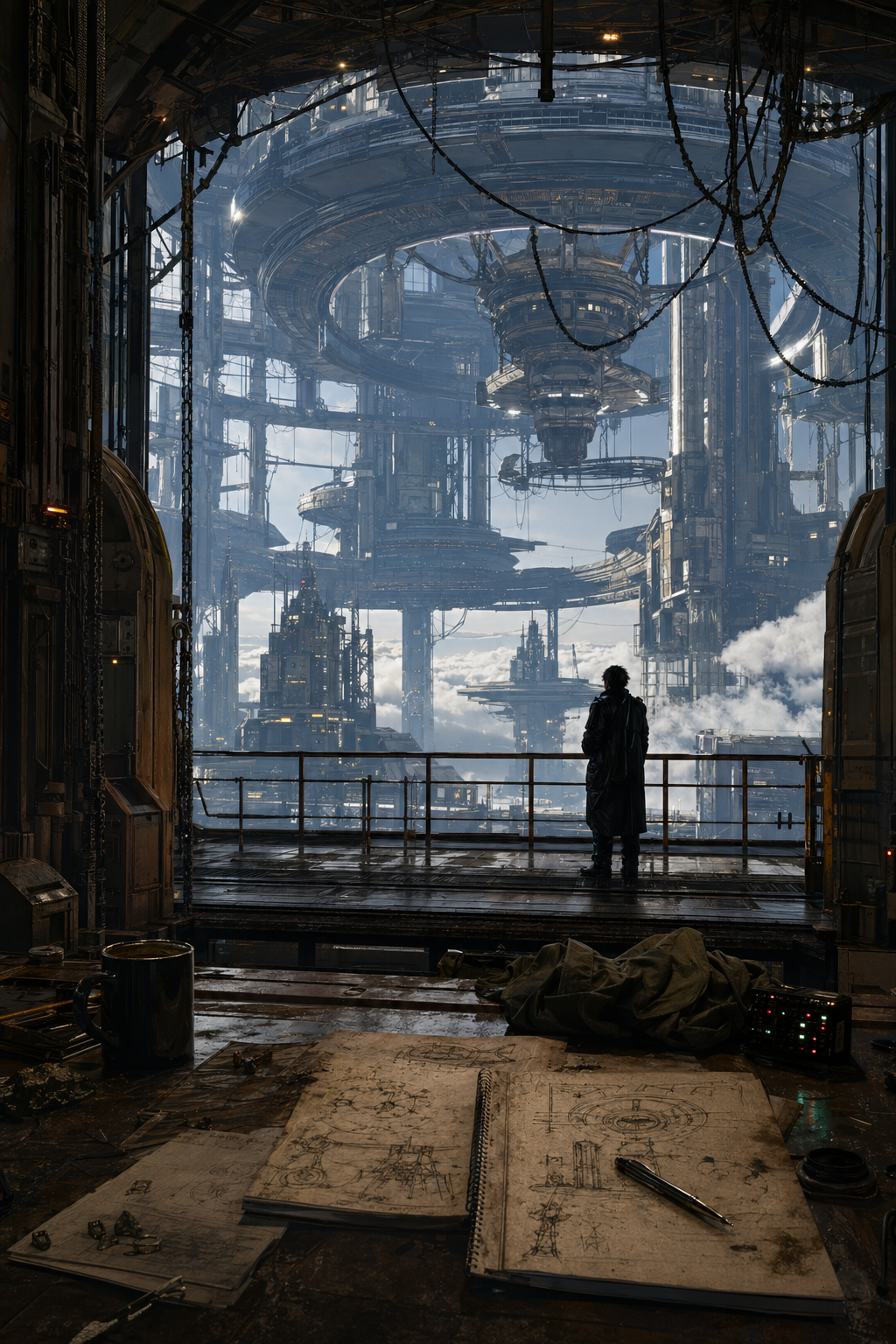
Maintenance Deferral
On a mountaintop civilization above a toxic sky, an archivist's sealed record may be the only thing standing between politics and collapse.
Chapter 1
The quarterly integrity audit began at 05:40, before the administrative rings of Arenis had fully brightened and long before Resource Coordination started issuing requests marked urgent for problems they had created the previous quarter. Maren Caide preferred the Archive before shift change. The systems were quieter then. Data moved without interruption. No one asked questions whose answers were already indexed.
The Central Archive occupied the innermost ring of Arenis's administrative core, six levels of climate-controlled stacks and live terminal floors built into the mesa's stone and wrapped around a central shaft of cables, coolant lines, and redundant power trunks. The building hummed in a dozen frequencies if one had spent enough years inside it to separate them: relay traffic in the data backbone, circulation fans in the lower climate ducts, the soft periodic correction of the pressure seals in the east wall whenever the Threshold currents shifted against the plateau. Maren heard all of it and noticed only when one sound changed.
She keyed herself into Audit Console Three and pulled the quarter's integrity net across the main catalogue.
The display populated in layers. Resource allocations first, then engineering maintenance logs, then agricultural yields, transit throughput, census adjustments, treaty variances, emergency reserve draws, all of it cross-referenced through the indexing architecture she had spent nineteen years refining until the Archive could answer questions no one had yet thought to ask. A discrepancy in Ward Nine water rights linked to a survey revision in Osten. A seed-vault requisition from Kellis drawing against a reserve designated for low-Threshold contingency. Two duplicate fabrication orders from Vrath separated by three days and one digit. She flagged them, routed them, moved on.
The work was not clerical. Clerical work stored records. This was structural. The Concordat made decisions because the Archive rendered the Chain legible enough to decide inside. Without the cross-links, budget directives floated free of maintenance consequences, trade concessions detached from regulator manufacturing capacity, census increases severed from oxygen-load projections. People spoke about governance as though it happened in the Council chamber. It happened here first, in whether the record could bear weight.
At 06:12 she found the first anomaly that warranted more than a routine query.
Thermal regulator shipment, fabricated in Vrath, routed through Arenis intake to Sector 7 atmospheric maintenance. Logged as delivered three weeks earlier. Installation confirmation absent. Maren checked the sector maintenance queue. No pending installation ticket. Checked inventory transfer. No return to central stores. Checked requisition authorization. Properly signed, budget-cleared, ordinary in every respect except for the missing end of the chain.
She opened a notation window and entered the discrepancy.
Sector 7: four regulator units logged delivered, no installation record, no inventory return. Confirm physical receipt and chain-of-custody. Priority standard.
She routed it to Engineering, tagged the relevant budget line, and let the marker settle into the audit web where it would wait for an answer. Small problems were almost never small because of scale. They were small because they were early.
The eastern windows of the terminal floor brightened by a degree. Artificial dawn in the administrative core lagged the actual sky by nine minutes this time of year, an old compromise between circadian recommendations and power-saving schedules. Beyond the pressure-rated glass, Arenis's upper terraces were beginning to wake: agricultural crews moving toward the outer hydroponic houses, transit staff opening corridor locks, the first maintenance teams crossing the industrial ring in pairs with tool cases swinging low at their sides. On clear mornings Saelen's ruined plateau could be seen from the eastern observation decks as a dark line against the horizon. From the Archive floor, the angle was wrong. Maren preferred it that way.
She was reconciling fabrication allotments against population growth in Vrath when someone set a cup beside her left hand without interrupting her field of view.
Coffee. Fresh. Correct temperature if Voss had judged the thermal retention by the walk from the lower canteen and the ambient cool of the Archive floor.
“The maintenance report needs your signature before eight,” Luc Voss said.
Maren kept reading the Vrath line item long enough to finish the comparison. “Leave it.”
“It is left.”
She reached for the coffee then, because refusal would only extend the exchange. Voss had already placed the report in the upper-right corner of her console desk, aligned with the edge, tabs marked where signatures were required. They stood with the patient stillness of someone who had learned years ago that rushing Maren only made time stretch.
“You’ve been here since yesterday,” Voss said.
“Yesterday ended at midnight.”
“You were here before that too.”
Maren took a drink. The coffee was strong, unadorned, and still hot enough that Voss could not have made it more than six minutes earlier. “You have a point?”
“Yes. It was delivered with the coffee.”
She glanced up. Voss was broader than most of the Archive staff, shoulders still carrying the physical memory of their first career in maintenance corridors and pressure lock housings. Age had gentled nothing essential. Their face remained open in ways Maren's never had been: the calm eyes, the warmth that made junior staff bring problems to Voss first because Voss answered them as though confusion were a temporary condition rather than a personal failure. They were looking at her now with the practiced assessment they used on faulty systems and overworked people.
Maren signed the top page of the maintenance report without reading it. “There. Point addressed.”
“It is a beginning.”
Voss took the signed report but not before noticing the marker on her audit screen. “Sector 7?”
“Missing installation record.”
“Hm.”
The sound contained thought, memory search, and the intention to follow up later. Voss had learned the Archive's index architecture under Emris Tove and the operational architecture under Maren, which meant they asked useful questions and almost never wasted one. Maren trusted that more than she trusted warmth, which was unfortunate given how much of Voss was warmth.
A relay notice flashed amber across the top of her display. Council priority, diplomatic channel. Maren opened it.
Formal request from the Vrachos Compact, transmitted through western relay towers at 05:58, acknowledging preliminary trade discussions and requesting negotiation agenda items. Resource exchange. Corridor passage guarantees. Joint atmospheric monitoring review. Historical incident records pertaining to the Saelen event.
Maren read the final line twice because precision required confirmation, not because the words were unclear. Her hand remained steady on the coffee cup. She archived the request to Council review, flagged it for legal and diplomatic cross-reference, and returned to the audit.
Voss had not moved. “Bad?”
“Complicated.”
“Council complicated or engineering complicated?”
“Both.”
“That’s unkind.”
Maren closed the notice window. “If the world intended kindness, it would have selected a different atmosphere.”
One side of Voss’s mouth shifted. Not quite a smile. “You say charming things before seven.”
They left with the maintenance report. The space they had occupied remained warmer for a few minutes, then the Archive's climate controls corrected.
By 09:20 the terminal floor was full. Junior catalogers moved between stations with data slates hugged to their chests. Relay technicians occupied the lower bank of consoles, monitoring inter-hub traffic where the hardlines passed through Arenis on their way north to Kellis and west to Osten. Two Advisory Board clerks argued quietly over pre-Breach treaty taxonomy until one of them consulted Maren's index revision from seven years earlier and discovered that Maren had already solved their problem before either had entered the Archive as trainees.
The audit widened beneath her hands.
Budget deferrals in one quarter produced maintenance reductions two quarters later, which produced procurement distortions in Vrath six months after that, which created repair backlogs in Arenis that Resource Coordination then classified as temporary inefficiencies and used to justify further budget smoothing. Each step, individually, was rational enough to survive a meeting. Only the full chain looked like danger.
She logged the pattern without formalizing it. Not yet. A pattern too early named became a theory, and theories attracted politics. Records were safer as records.
At 10:03, Solen Rade appeared at her station carrying three printed budget abstracts and the expression of a person who had slept less than was ideal and intended to convert that fact into efficiency. Junior Resource Coordinator, thirty-two, ambitious enough to still believe numbers could be made obedient by rearranging them.
“Archivist Caide,” Solen said, already setting the abstracts down. “The Chancellor’s office is requesting a revised consumption analysis for Archive operations. Comparative, last six years, with recommendations for noncritical expenditure compression.”
Maren looked at the top page without touching it. “Noncritical by whose definition?”
“The Chancellor’s office, eventually. At the moment, yours.”
“That is not how definitions work.”
“It is how deadlines work.”
She took the abstracts and saw, in three pages of clipped summary language, the familiar pressure: defensive infrastructure expansion, relay tower hardening, additional Threshold sensor deployment in the southern line, projected budget shortfall to be addressed through administrative efficiencies. Administrative was what resource offices called any system they depended on but did not physically maintain.
“When?” Maren asked.
“End of week.”
“Impossible.”
“End of week regardless.”
Solen exhaled through the nose, a small concession to the obvious. “I know. I’m not advocating for it. I’m carrying it.”
“Then carry back the following: the Archive’s current maintenance schedule is already at minimum tolerance for integrity assurance. Further compression increases corruption risk across all dependent systems.”
“I can carry that back,” Solen said. “Will it change anything?”
“No.”
“Good. Then we remain within expected operational parameters.”
Solen left. Maren added the request to a side queue and continued the audit, though not with the same clean internal silence. The Vrachos request sat in one corner of her attention. The budget compression in another. Somewhere beneath both, Sector 7's missing regulators waited for Engineering to answer where four pieces of life-support hardware had gone.
By midday the audit cycle closed. Ninety-three routine discrepancies flagged. Seven elevated. One requiring direct follow-up. Maren signed the integrity summary, transmitted the relevant extracts to Council support, and logged the quarter complete at 12:11.
Only then did she stand.
The motion made itself known in her shoulders first. Fourteen hours at a console had a geometry; her body recorded it whether or not she did. She carried her coffee cup to reclamation, took the east corridor instead of the internal stair, and let the city move around her.
Arenis at shift change was never quiet. Engineering crews rotated toward the atmospheric plants in the industrial ring. Children in residential gray crossed from education blocks toward the agricultural terraces. Market shutters were open in the second ring where open-air trade was permitted during stable Threshold weeks. Overhead, the sealed transit corridors radiated from the administrative core like clear arteries, carrying people and freight toward docking locks and mountain passes. Beneath it all, continuously, the processors ran. Pressure maintained. Air scrubbed. Water lifted from stone. Power drawn from heat below the mesa and translated, by design and maintenance and routine labor, into another ordinary day above a poisonous world.
Maren knew the rating tolerances of every primary seal in the east ring. She knew which archive clerk had a repetitive indexing error when tired and which relay technician habitually corrected it before formal review. She knew the annual drift of Kellis seed output against temperature variation and the failure rate of Vrath fabrication lots by supplier. A woman passing with two children looked at Maren, recognized her, and inclined her head with the respectful distance people reserved for load-bearing institutions. Maren returned the gesture a fraction late, because she did not know the woman's name.
Her quarters were four rooms adjoining the Archive's residential annex, assigned to the Chief Archivist three generations earlier on the logic that the Archive should never be more than three minutes from its keeper. The arrangement had outlived the conditions that created it. Or perhaps it had created the conditions it required. Maren entered, sealed the door, set her work slate on the narrow table, and stood for a moment in a silence different from the Archive's. Less mechanical. More vacant.
On the wall opposite the console hung no personal images. On the shelf above the sink sat three physical records in preservation sleeves, all pre-Concordat originals too fragile for routine handling and too important to trust entirely to digitization. Her rooms held what was necessary to continue work and little else.
She crossed to the console anyway and reopened the diplomatic notice from Vrachos.
Historical incident records pertaining to the Saelen event.
Outside, beyond layers of stone and engineered pressure and systems that had to keep running whether people told the truth or not, the Threshold moved according to laws no one had voted on. It would rise when it rose. It would test every seal without caring who had signed the budget or what story the Council preferred.
Maren closed the notice and stood in the dim room with her hand resting on the console edge.
In the morning, the Archive would still be there. The records would still connect. Her name would still be on the architecture.
For the moment, that was enough to keep the structure standing.
In the Atheric Chain, humanity survives on high-altitude hubs kept alive by interlocked life-support systems while a lethal atmospheric layer shifts below them. Maren Caide, chief archivist of the central hub, has spent nineteen years preserving a sealed account of the Saelen Breach, the disaster that created the Chain's current political order. When maintenance failures begin echoing the same pattern that destroyed Saelen, she must decide whether protecting stability is worth burying the truth that could save lives.
- —Maren Caide — Chief Archivist of Arenis and the keeper of the Chain's operational memory. Brilliant, exacting, and emotionally sealed, she survived Saelen and has spent decades preserving the record that could unravel her world.
- —Luc Voss — Deputy Archivist, Maren's closest partner, and the public hero of Saelen. Warm, capable, and steady under pressure, Voss is tied to the hidden record in ways even they do not fully remember.
- —Dorin Achte — Head of Engineering in Arenis, young enough to question the myths older leaders live by. Their regulator investigation turns a buried historical truth into an immediate survival problem.
- —Kethi Aroun — A Vrachos Compact envoy and diplomatic engineer sent to reopen trade and challenge the Chain's founding narrative. Her family died in Saelen, and she wants the record corrected as much as she wants political leverage.
- —Chancellor Edric Thane — The long-serving ruler of the Concordat and architect of the centralized order born after Saelen. Polished and formidable, he is also the man whose old efficiency decisions helped cause the original catastrophe.
- —Emris Tove — Maren's dead mentor and former Chief Archivist, whose choice to seal the Saelen record shaped everything that followed. Though absent, Emris remains a haunting model of mastery turned into isolation.
- —Solen Rade — A junior resource coordinator who embodies institutional logic at its most reasonable and dangerous. Earnest and efficient, Solen keeps reproducing the same budgetary patterns that once led to disaster.
- —The System: Maren moves through the daily machinery of Arenis as trade talks reopen with the estranged Vrachos Compact and engineers report odd regulator failures. What first looks like a routine resource discrepancy begins to resemble a familiar pattern of deferred maintenance.
- —The Crack: As political pressure mounts around access to Saelen's records, Maren's private audit reveals life-support degradation across Arenis. Dorin pushes for urgent action, Kethi probes the old disaster, and Voss begins to sense that the official history of Saelen does not fit their own fractured memory.
- —The Sealed Record: A minor atmospheric breach and mounting evidence force Maren back into the hidden archive, where the full cause of Saelen stands intact: internal failure, buried warnings, and compromised emergency systems. The truth does not stay contained, and the people closest to Maren begin asking what she has withheld and why.
- —The Door Opens: Maren's managed attempts to solve the crisis without exposing the past collapse under political obstruction and independent investigation. Confronted by Voss, by the likeness between herself and her dead mentor, and by the immediacy of Arenis's danger, she chooses to share the sealed record and stop carrying it alone.
- —Full Disclosure: Maren, Voss, and Dorin bring the complete record before the Chain's leadership just as a major low-Threshold event bears down on Arenis. The old lie breaks, emergency repairs race the rising toxic atmosphere, and the Archive's buried truth becomes the blueprint for survival and for a more honest future.
The prose is precise, restrained, and intensely observant, with a voice shaped by systems thinking rather than sentimentality. Politics, engineering, and memory are rendered through clean causal detail, quiet rooms, humming infrastructure, and the tactile habits of people who show care through competence. Emotional force arrives through omission, physical gesture, and the pressure of what has been left unsaid for too long.