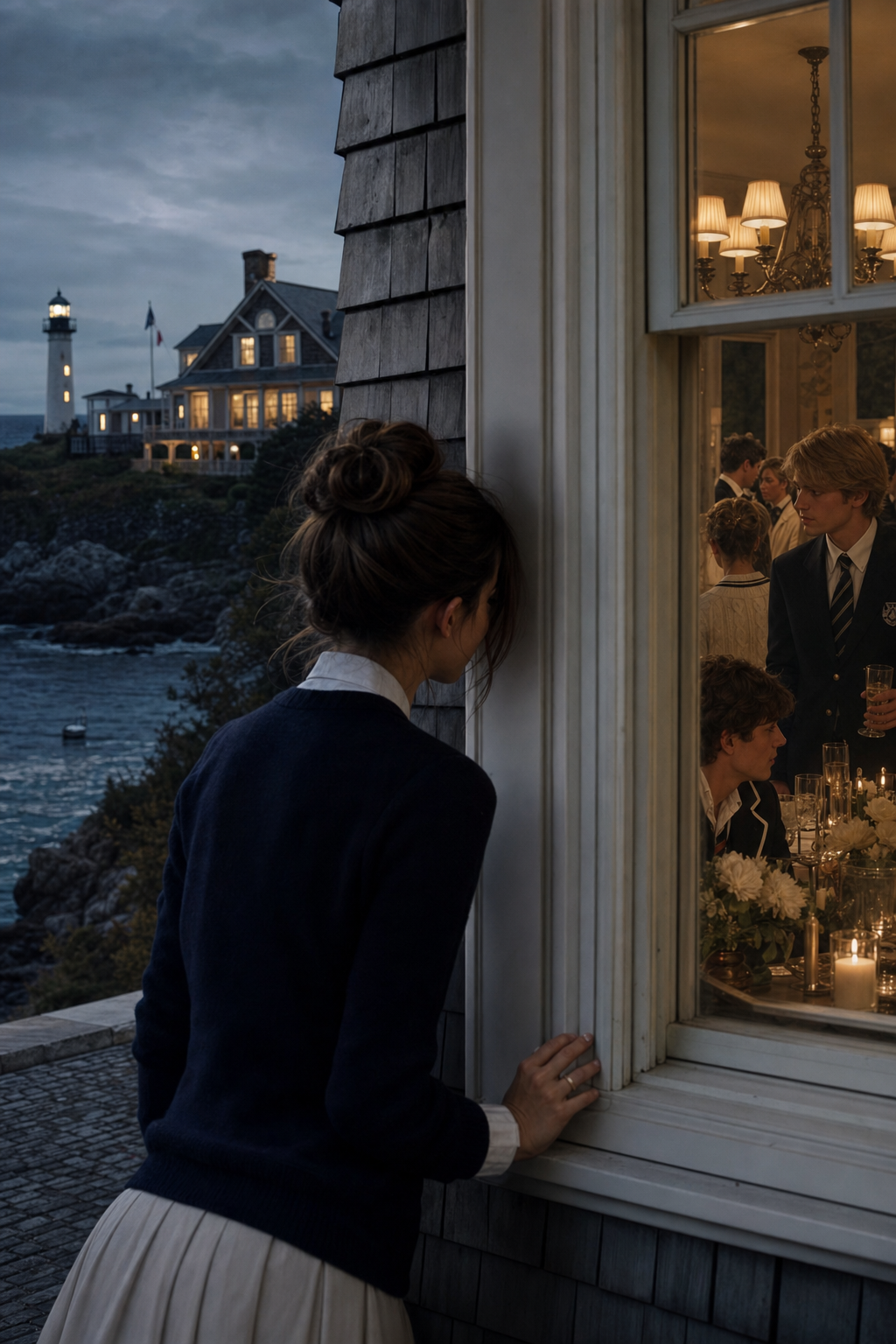
LOW TIDE
A watchful outsider enters a secretive Maine summer colony where belonging is performed, guarded, and tested by the tide.
Chapter 1
Alder Point announced itself in stages, which was a kind of courtesy. The highway thinned into smaller roads, the signs grew less frequent, the gas stations farther apart, and then even the ordinary houses began to change, their porches deeper, their lawns more deliberate, as though we were moving not just east but upward into some narrower atmosphere. I sat in the back seat of Graham's car with my laptop bag at my feet and watched the world refine itself through the window.
Claire kept both hands folded in her lap, not rigidly but with the controlled stillness of someone trying not to touch anything before she'd been told she could. She had bought a new linen blouse for the drive, pale blue, with sleeves that ended just below the elbow. The blouse fit her well. The fact that I noticed that it had been bought for this purpose was the problem.
Graham drove with one hand at the top of the wheel, humming occasionally under his breath. The closer we got, the more his body changed. It wasn't relaxation exactly. It was recognition. His shoulders lowered by imperceptible degrees, his jaw unclenched, and the soft, vague cheerfulness that was his default expression took on something steadier, as though his face had remembered the shape it was meant to make in this particular geography.
"We're almost there," he said for the second time in twenty minutes.
Claire smiled at the windshield. "I'm excited."
She sounded excited. She also sounded like someone saying the correct thing in the correct tone. The colony hadn't even seen her yet, and already she was calibrating.
I watched the road signs: SOUTH HARBOR, then a weathered one for ALDER POINT ROAD that looked less like public infrastructure than a private suggestion. The road narrowed. Trees closed in overhead, old oaks arching toward one another until their branches met and made a tunnel of leaves. The light changed under them, went green and mottled and expensive-looking. Even the shadows here seemed to have been curated.
Then the bridge.
It was shorter than I had expected, just a span over a tidal creek where the mud was exposed in broad gray bands and a heron stood as if waiting to be painted. But the bridge had the feel of a gate, not because anyone had built one there but because every arrival had to compress itself to cross it. One road in. One road out. The kind of geography that made a social order feel less like preference and more like weather.
And then the trees broke, and there it was.
The peninsula opened all at once: silver-shingled houses facing the water, lawns sloping in green, the harbor cupped on one side with its sailboats and white moorings, and beyond everything else the Atlantic, flat and bright as a blade. It was beautiful in a way that made my body react before my mind could begin its usual work. Hunger, almost. Not admiration. Appetite.
"Wow," Claire said softly.
Graham smiled without looking at her. "Right?"
I leaned toward the window. The mapping started immediately, involuntarily, the way your eyes adjust to brightness without being asked. The houses nearest the bridge were handsome but contained: four-bedroom, screened-porch, harbor-view houses, the kind that had age without flaunting it. Farther down the peninsula, where the land narrowed and the weather would hit harder, the houses grew larger and more exposed. Ocean-facing. More porch than wall. The architecture of people who considered harsh conditions a credential.
Driveways offered their own footnotes. An old Volvo wagon with a kayak strapped to the roof: settled, inherited ease, the kind of family that had been arriving long enough for practicality to become style. A dark Range Rover too clean for the salt air: recent arrival or temporary guest. A pickup with landscaping equipment parked discreetly behind a stand of hydrangeas: labor present and tucked politely out of sight.
"There," Graham said, pointing with two fingers from the wheel. "That's the store. And the Yacht Club's just up ahead."
The general store sat at the bridge end of the peninsula, small and white and slightly tilted, with a Coca-Cola sign in the window that looked authentically old rather than purchased to appear so. A few minutes later we passed a long, low shingled building near the harbor. Porch. White railings. Windows facing the water. Its casualness was too complete not to be deliberate.
Nobody said anything, but I understood that the Yacht Club was one of those places where the claim not to be important was part of what made it important.
We drove on. The road curved. More houses. More hydrangeas in impossible abundance, blue enough to look edited. I watched where the lawns ended and where paths had been cut toward the beach. I watched which houses had private docks and which made do with views. I watched the way Graham lifted two fingers from the steering wheel in greeting at a woman walking a golden retriever, and the way she lifted two back without breaking stride. Native exchange. No effort visible.
By the time we turned into the Dwyer driveway I already knew, in outline, what kind of place Alder Point was: a world arranged to appear unarranged, where every surface denied its own intention and therefore declared it more loudly.
The house stood behind a low stone wall and a spread of perennial beds that looked accidental in the highly specific way only professional maintenance can achieve. Weathered cedar shingles gone silver. Green copper gutters. A wide porch with wicker furniture whose cushions had faded evenly, meaning they had either been there for years or had been replaced at high cost with new ones designed to look as if they had. The windows faced west, toward the harbor. Not the best view on the peninsula, which told me something too.
Claire got out of the car and stood for a second with the door open, looking up at the house with the expression people have at funerals or weddings, when they know they are entering something that already existed without them and will continue to exist after they leave.
"Isn't it lovely?" Graham said.
Lovely wasn't the word, but I understood why he chose it. Lovely was manageable. Lovely implied pleasure without threat. Beautiful would have acknowledged too much.
He carried two suitcases inside. Claire and I followed.
The first thing I noticed was that the house belonged, in every visible way, to a woman who was dead.
Not theatrically. Not in the preserved-room sense. Nothing had been turned into a shrine. But the arrangement of things had the coherence of one person's taste exercised over years. Pale walls. Worn rugs. A shelf of hardcovers arranged not by author or subject but by color, which meant someone had wanted the room to read as a room before it read as a library. Small watercolors of the peninsula in narrow frames. A bowl of smooth white stones on the hall table. In the living room, a throw folded over the arm of a chair with the exactness of habit rather than housekeeping.
Margot, though no one said her name.
I moved through the rooms without touching anything. The house made touching feel like a social act.
In the kitchen, Claire opened a cabinet and found blue-and-white plates stacked in careful columns on open shelves. Portuguese ceramic, maybe old, maybe just expensive enough to imitate age properly. She took down a mug and held it in both hands.
"The cups are beautiful," she said.
What she meant was more specific. This life is beautiful. I know it doesn't belong to me. I would like, very much, not to break it.
From the window over the sink I could see the garden. Black-eyed Susans, lavender, some late roses climbing a trellis. The beds had the look of being planted by someone who understood bloom times the way musicians understand tempo. Something would always be happening here. Even absence had been planned around.
Graham came back in, cheerful with the exertion of carrying things. "We'll get you two settled, and then tonight maybe we can have dinner at the club. Keep it easy."
At the club. Not the Yacht Club, not in the formal sense. Just the club. The kind of shorthand that presumes the noun requires no modifier because there is only one of consequence.
Claire set the mug down carefully. "That sounds nice."
Graham looked from her to me with uncomplicated warmth. "Welcome home," he said.
He meant it. That was the problem too.
Because standing in Margot's kitchen, with Margot's garden filling the window and Margot's cups cooling under my mother's hands, I understood that home in a place like this was not a matter of keys or legal marriage or even invitation. Home was repetition sedimented into ease. It was knowing which cabinet held the plates without opening the wrong one first. It was walking in without noticing the beauty because beauty had become background. It was belonging so completely the room no longer needed to explain itself to you.
I looked at the open shelves, the blue-and-white ceramics, the immaculate wrongness of our arrival inside them, and felt the first clean line of the summer draw itself in me: desire on one side, knowledge on the other.
The house was beautiful.
The beauty was not ours.
And already, before anyone on Alder Point had spoken to me at all, I was mapping the distance between those two facts and understanding that the distance was where I would live.
At Alder Point, an old-money summer colony on the Maine coast, status lives in houses, seating charts, inherited rituals, and everything no one says aloud. When twenty-four-year-old Nora Arden arrives with her newly remarried mother, she becomes obsessed with decoding the colony's invisible hierarchy and its haunting late-summer rite, The Crossing. But the more precisely she reads this world, the more she risks losing the belonging she craves, especially as she is drawn to an insider who sees her just as clearly.
- —Nora Arden — A twenty-four-year-old outsider from Pennsylvania who spends the summer at Alder Point after her mother remarries into the colony. Hyper-observant and compulsively analytical, she can map every social signal in a room, but that gift keeps her at the threshold of the world she wants to enter.
- —Theo Calloway — An architect from one of Alder Point's founding families and the younger brother of the colony's late golden daughter. He wears insider ease effortlessly, yet Nora's sharp perception awakens a restlessness in him and turns mutual recognition into a dangerous intimacy.
- —Claire Arden-Dwyer — Nora's mother, a dental hygienist who has married into wealth later in life and is determined to make her new place at Alder Point work. Her strategy is careful mimicry and adaptation, which puts her at painful odds with Nora's instinct to expose what everyone else leaves unspoken.
- —Kit Calloway — Theo's older brother, a polished corporate attorney who acts as the colony's unofficial enforcer. Grieving, controlled, and fiercely protective of the old social order, he sees Nora's gaze as a threat to the delicate fictions that keep Alder Point intact.
- —Juliet Howe — A warm, strategic daughter of another founding family who quietly choreographs Alder Point's social life. She understands the colony's architecture as deeply as Nora does, but where Nora exposes patterns, Juliet preserves them.
- —Dee Morrow — The caretaker family's daughter, raised on the peninsula but never fully admitted into its social body. Blunt, perceptive, and impossible to romanticize, she gives Nora the clearest view of Alder Point's structure and the cost of living forever at its edge.
- —Margot Calloway Dwyer — Theo and Kit's dead sister, once Alder Point's flawless center and Graham Dwyer's first wife. Though absent, she dominates the summer through her house, her traditions, and a journal that reveals she understood the colony's machinery far better than anyone admits.
- —The Arrival: Nora enters Alder Point with Claire and Graham and immediately begins mapping its coded geography of houses, tables, beaches, and surnames. The beauty of the colony seduces her even as Margot's lingering presence and the colony's calibrated welcomes make clear that she has arrived inside someone else's world.
- —The Approach: As summer settles in, Nora learns Alder Point's hierarchy through parties, beach rituals, and her candid conversations with Dee Morrow. She is gradually drawn toward Theo Calloway, but every invitation and glance reminds her that inclusion here is controlled, measured, and never innocent.
- —The Exposure: A dinner with the younger set turns when Nora names a social pattern no one is supposed to say aloud, and the colony recoils behind its polished manners. In the aftermath, Theo proves he has been watching her too, while Nora discovers through Margot's journal that insiders can be just as perceptive as outsiders—and just as trapped.
- —The Pressure: Late summer tightens around Nora as Kit confronts her directly, Claire admits how much Nora's visible scrutiny endangers her own fragile assimilation, and preparations for The Crossing intensify. With the colony quietly watching to see whether she will join its defining ritual, Nora can no longer think her way around the question of belonging.
- —The Crossing: On the tidal flats to Halcyon Island, Nora steps into the colony's most sacred tradition and finds herself both participant and object of the same scrutiny she has practiced all summer. The night forces her to confront what in Alder Point's exclusions is real, what is self-protective myth, and what it means to remain present in a world she cannot fully decode.
Lush, intimate, and razor-observant, with a voice that turns every glance, silence, and seating choice into emotional evidence. The prose is elegant and socially precise, steeped in salt air, weathered wood, tidal mud, firelight, and the charged textures of old-money ease.