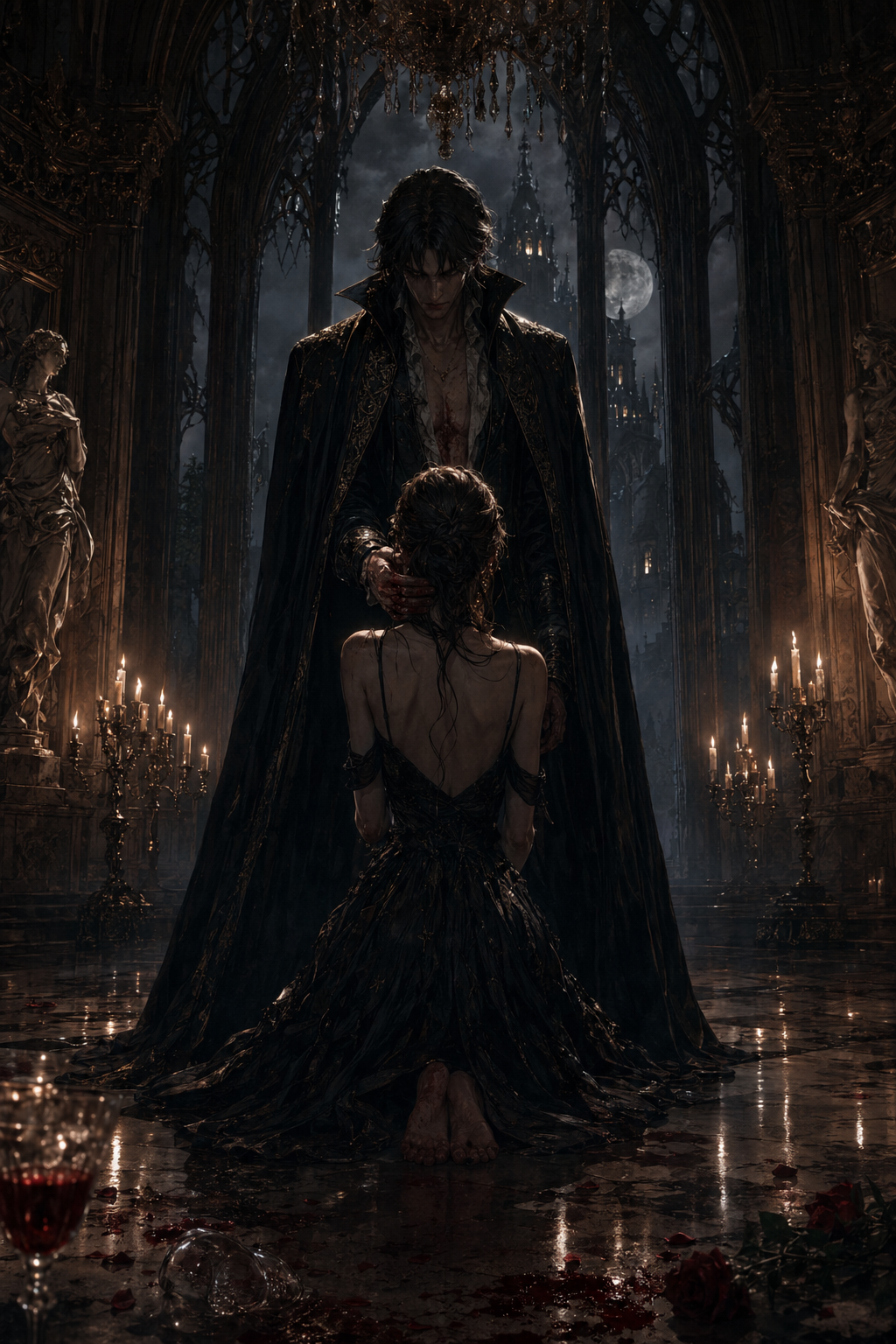
THE LONGEST NIGHT
In a sealed vampire estate, a mortal archivist survives one lethal night as an ancient lord begins to break around her.
Chapter 1
At this depth, the estate had its own kind of silence.
Not the silence of peace. Not even the silence of emptiness. The Lower Archive was twenty feet below the main level of Vael Seren, beneath the formal halls and council chambers and cold stone grandeur of the House above, and the quiet here had weight in it. It pressed down through shelves of ledgers and rolls of parchment, through the oil-thick air and the old paper smell and the steady dim amber of three carefully tended lamps. It was the silence of things kept, not used. Of lives recorded and closed.
Lira Vasht sat on the stone bench at the central table with a birth ledger open beneath her hands.
The parchment rasped softly when she turned a page. Names. Dates. Parentage. Notes in older hands, some neat, some hurried, some written by clerks dead before her mother was born. She knew the structure of the records so well that her fingers moved before thought did, tracing columns, checking ink fading, marking where a spine would need reinforcement before winter damp reached it.
The bench had leeched the heat from her through her skirt an hour ago. She barely noticed now. The cold in the archive was constant enough to become background, and she had long ago learned the difference between cold that mattered and cold that did not. This cold was harmless. Aboveground cold was another thing entirely.
Above her, the estate was changing.
She could feel it through the stone.
Not clearly. Not enough to name individual footsteps or voices. Only the low vibration of movement multiplied beyond the usual rhythm of the house, the faint intermittent tremor of doors opening and shutting in distant corridors, the occasional murmur too blurred by earth and masonry to become words. The Reckoning would begin at sundown. The visiting Houses had arrived before dusk. Vael Seren was filling.
Lira dipped her pen, shook the excess ink back into the well, and wrote a notation in the margin beside a damaged entry from sixty years earlier. The child listed there had died before his second winter. She knew that without checking the death registry; the name was already in her memory, attached to a mother who had later borne three daughters and outlived them all.
Thousands of names lived in the archive. Thousands lived in her.
No one had asked her to remember them. The ledgers would exist whether she did or not. But memory, once it settled in her, did not leave easily. Names stayed. Dates stayed. Small annotations in forgotten hands stayed. She carried them the way the shelves carried the books: without display, under pressure.
A draft brushed her wrist. One of the lamps was guttering.
She rose, crossed the narrow aisle between shelves, and adjusted the wick with the small brass tool she kept in her pocket. The flame straightened. Better. She stood for a moment with her fingers near the glass chimney, absorbing the slight warmth. Oil. Heated metal. Dust. Her own skin.
Then footsteps on the stairs.
Human. Quick, uneven, not trying to hide themselves.
Eshara appeared at the bottom of the stone steps in a rush of kitchen warmth and flour scent, one dark curl already escaping its tie.
“There you are,” she said, slightly breathless. “I was beginning to think you meant to stay down here and let the whole estate collapse without you.”
Lira set the lamp tool aside. “If the whole estate can be held up by one archivist, it was built badly.”
Eshara snorted and leaned one shoulder against the doorframe. “It was built by creatures who don’t need kitchens. Of course it was built badly.” Her gaze flicked to the open ledger. “Still at it?”
“Until I’m told otherwise.”
“You are told otherwise,” Eshara said. “By me. And by the senior steward, who sent me because apparently you cannot be trusted to stop working when there are a hundred ancient monsters upstairs and every corridor attendant is already in place except one.”
“A hundred?”
“More. I gave up counting after the third silver cloak and the seventh expressionless face.”
Lira closed the ledger carefully. The leather cover settled with a muted thump that felt, absurdly, like the end of something private. “How bad?”
Eshara considered. “The kitchens are full of blood-wine and nerves. The main corridor feels like the inside of a held breath. Mera dropped an entire tray because one of the Tharen retinue appeared beside her without making a sound.” She straightened. “So. Bad.”
Lira slid the ledger into its shelf. “That is not new.”
“No, but tonight there are more of them to appear beside us.” Eshara pushed off the frame and crossed the room, rubbing her hands up and down her forearms as if even the archive’s mild cold offended her. “You have your corridor assignment?”
“The Grand Corridor to start. Outside the Hall of Founding.”
Eshara stopped. “That is not a start. That is being thrown directly into the mouth.”
“It’s a corridor.”
“It is a corridor leading to six House lords and every creature old enough to remember when your family name meant something else.”
Lira almost smiled. “You always know how to soothe.”
“It is a gift.” Eshara reached for the second lamp and held her palms around it, stealing a little warmth. “Did you at least eat?”
“Yes.”
“A real answer or a Lira answer?”
“A piece of bread.”
Eshara looked heavenward in theatrical despair, though there was no sky down here to appeal to. “A piece of bread. Wonderful. When you faint in a formal hall and become an anecdote for someone immortal, I hope you know I’ll be furious even while dragging you to safety.”
“I won’t faint.”
“No,” Eshara said, softer now. “You won’t.”
The room settled briefly around them. Familiar stone. Familiar air. Eshara’s presence changed the archive more than the lamp flames did; she brought motion into it, and heat, and the easy noise of being known without explanation. Lira had always thought of friendship as a form of shelter no one could see from outside.
Eshara looked at her for a long second, the humor thinning into something more careful. “Are you frightened?”
Lira considered the question honestly, because Eshara was one of the very few people who made honesty easier instead of harder.
“Yes,” she said.
Eshara nodded as if she had expected nothing else. “Good. Only fools aren’t.” She set the lamp back down. “But you are not a fool, and you are very nearly impossible to unsettle, and if anyone can walk through a building full of predators carrying candles as if it’s a normal evening, it’s you.”
“That is not encouraging.”
“It is to me. I’m not the one going upstairs.”
Lira reached for the dark outer layer of her uniform hanging on the peg beside the stairs. The fabric was plain, practical, serviceable enough to be invisible. She put it on and fastened the ties at her wrists.
Eshara watched. “You look like exactly the sort of person no one notices.”
“That is usually the hope.”
“Yes.” Eshara’s mouth curved, but only a little. “Though tonight, try not to vanish entirely. I happen to like knowing where you are.”
Something in Lira’s chest shifted at that—small, warm, familiar. “I’ll come to the kitchens during the intervals.”
“You’d better. I refuse to suffer this many blood-casks without complaint unless I have someone worthwhile to complain to.” Eshara started toward the stairs, then turned back. “And Lira?”
“Yes?”
“If one of them looks at you too long, leave.”
The words were light in shape and not light at all in meaning.
Lira held her gaze. “I know.”
Eshara searched her face once more, as if trying to read a page too dimly lit to trust, then seemed to decide the reading could wait. “Good. Come on.”
They climbed.
The transition always struck her halfway up. Not a visible thing. A pressure change. The archive’s enclosed stillness loosening into the estate’s larger cold. By the final steps the air had sharpened, carrying stone and wax and the faint metallic sweetness of blood-wine from kitchens far off to the west.
When Lira emerged onto the ground floor, the estate hit her all at once.
Movement. Not frantic, but dense. Mortals crossing side passages with trays and bundles of linens and sealed message tubes. Candlelight shivering over polished stone. Voices clipped low in the formal registers used on nights when the wrong tone might travel farther than intended. And beneath all of it, threaded through the corridor like an unseen architecture, the dead zones.
Undying.
She counted without deciding to.
One at the far bend where the north hall met the gallery stairs. Two near the antechamber doors. One motionless behind the carved screen. Another crossing somewhere out of sight, registered only by the way a servant’s footsteps altered—faster, then careful, then fast again. By the time she and Eshara reached the supply alcove near the Grand Corridor, Lira had counted fourteen.
Too many. Enough that the cold no longer came in isolated drops and pockets but in a continuous low tide against her skin.
Eshara squeezed her wrist once before veering away toward the service stairs that would take her back to the kitchens. Warm fingers. Brief pressure. Gone.
Lira checked her station: replacement candles, taper, wick-knife, folded messages, clean cloth. Everything where it should be. Her pulse was elevated. Not wildly. Just enough that she could feel it in her throat if she paid attention.
She did not pay attention. She breathed in four counts. Out in four.
Somewhere deeper in the estate, a door opened. Voices lowered. The Hall of Founding waited beyond the long reach of the Grand Corridor, all carved stone and oath-bound history and old blood ritual. She could not see the sky from here, but she felt the exact moment the sun went down.
The reaction passed through the house like a single body settling.
It happened in the Undying first. A subtle collective shift, almost too slight to call motion. Not relaxation. Alignment. As though something outside the walls had withdrawn and every ancient thing within them had tilted, by one invisible degree, into its proper element.
The Reckoning had begun.
Lira picked up the nearest candelabra and steadied it as a draft moved through the corridor. The flames bent, then righted themselves.
Behind her, the silence changed.
At Vael Seren, an ancient estate ruled by the Undying, blood determines power and mortals exist to serve through an unquestioned Tithe. Lira Vasht, a quiet archivist who has spent her life preserving the names of forgotten servants, is assigned to work the estate's most dangerous night: the centennial Reckoning, when rival vampire Houses gather until dawn. Over the course of that sealed, politically volatile evening, the attention of Cael Erenis, an ancient lord who should see her as nothing more than prey or background, begins to turn into something neither of them can explain or safely survive.
- —Lira Vasht — A twenty-three-year-old mortal and Keeper of the Lower Archive at Vael Seren, Lira has spent her life among ledgers, candlelight, and the cold machinery of a world built to overlook people like her. Precise, observant, and quietly unyielding, she is forced into the Reckoning's public corridors for the first time and becomes the center of an impossible recognition she is almost too afraid to believe.
- —Cael Erenis — The ancient lord of House Erenis is a predator of immense age, discipline, and political power, defined by perfect control and a deep indifference to mortals. During the Reckoning, his composure begins to fracture around Lira in ways that threaten both his House's position and the identity he has spent centuries preserving.
- —Eshara Vasht — Lira's closest friend, a warm, sharp-tongued kitchen worker who has survived the estate through humor and frankness. She anchors Lira to the human world below the ceremony and becomes the place where Lira's fear, longing, and confusion can almost be spoken aloud.
- —Theron Aeve — A younger Undying administrator of Vael Seren, Theron is unusually courteous to mortals and has long treated Lira with gentle respect. He represents the safe, sensible path: kindness without devastation, affection without danger, and a future the world would permit.
- —Seraveth Tharen — The formidable lord of House Tharen is Cael's longstanding political rival and a defender of the blood hierarchy exactly as it stands. Sharp enough to notice the smallest fracture in his usual composure, she becomes the external force most likely to turn private anomaly into public threat.
- —Lira's Mother — Though dead long before the story begins, her memory shapes everything Lira is and wants. She was the last person to truly see Lira for herself rather than her usefulness, leaving behind the wound that makes this night so dangerous to Lira's heart.
- —The Estate: On the eve of the centennial Reckoning, mortal archivist Lira leaves the safety of the Lower Archive to serve in the corridors of Vael Seren, now crowded with ancient predators and sealed until dawn. In the opening rites she becomes aware of Cael Erenis, whose attention feels unlike any Undying notice she has ever learned to classify.
- —The Crack: As the night's negotiations intensify, Lira is repeatedly placed near Cael in corridors, chambers, and the garden, where small exchanges and microscopic shifts in his control begin to accumulate. What should be impersonal predator awareness sharpens into a dangerous specificity, and Lira realizes that his attention is becoming something she cannot safely dismiss.
- —The Recognition: Retreating to the archive, Lira is found by Cael, and their brief, strange conversation reveals that he sees the depth of her work and the self hidden inside her invisibility. Later encounters deepen the rupture: he begins naming what makes her singular, while she is forced to confront the terrifying possibility that she is being truly seen for the first time since her mother's death.
- —The Breaking: As political pressure mounts and Seraveth starts probing Cael's altered behavior, the bond turns from private anomaly into active danger. In the night's most intimate confrontations, his restraint finally gives way, and the distance between mortal and immortal collapses into open, irreversible confession.
- —The Dawn: The final Reckoning stage pushes the bond into the realm of House politics, where rivals are already prepared to exploit any weakness. When morning comes and departure becomes inevitable, what began as an impossible private recognition must face the cold public grammar of the world that forbids it.
Darkly romantic and gothic, with restrained, exact prose that builds intensity through silence, pressure, and bodily awareness rather than ornament. The sensory world is all stone cold, candlelight, blood-scent, and the unnerving shifts in air around immortal predators. The voice stays intimate and controlled even at its most emotional, letting devastation arrive through precision.