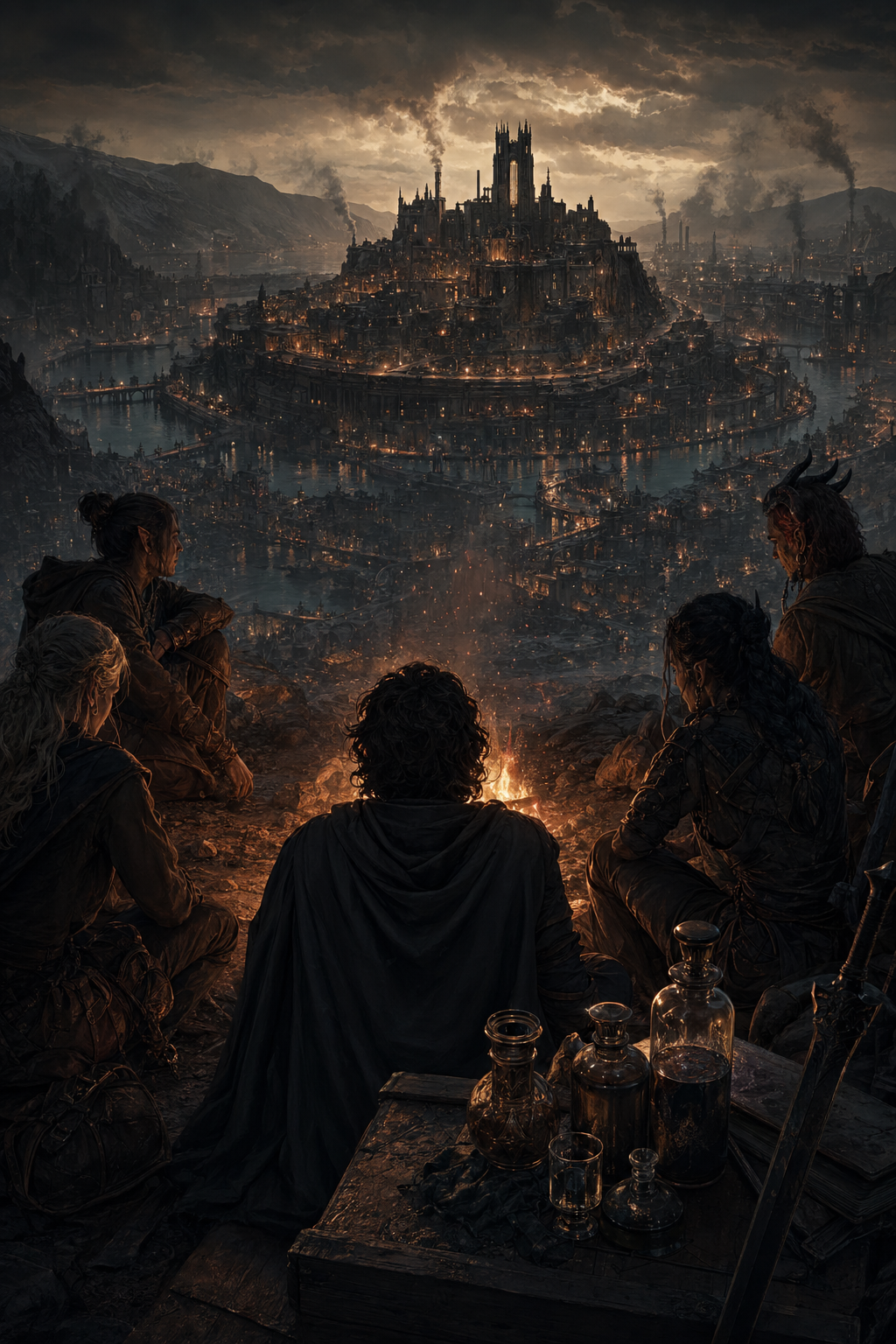
THE LAST PEOPLE WHO REMEMBER HOW TO GRIEVE
In a canal city that bottles sorrow, a worker who cannot shed grief may be the only one who can face what is rising below.
Chapter 1: The Body in the Canal
The valve had been sticking for two days.
Lira braced her feet against the canal wall, the stone warm through the soles of her work boots, and put both hands on the wheel. The metal was slick with condensation. Blue-green light moved in the water around her thighs where the algae caught and released it, caught and released it, as if the canal were breathing in its sleep.
She leaned her weight into the turn.
The wheel gave a little and then stopped. Old metal ground against older metal somewhere below the waterline. Her shoulders took the strain. The ache there was familiar, useful. A thing with edges. A thing a body could answer.
Above her, morning in the lower rings was beginning by degrees. A shutter opened. Someone on a footbridge shook out a rag. A boatman swore softly at a snagged pole farther down the canal. The city woke close here, wall against wall, window against window, everyone's sound carried by water.
“Still fighting you?” Thessa called from the next section over.
Lira did not look up. “Still losing.”
That got a short laugh. Thessa's boots splashed as she moved along the narrow ledge beside the lock gate. “Guild said if this one jams again we’re meant to report it before forcing the turn.”
Lira set her jaw and pulled harder. “Guild says many things.”
The wheel shuddered in her hands. The mechanism below gave a long complaining groan.
“Lira—”
“I have it.”
That was the thing about stuck valves. If you stopped too early, they learned your hesitation. Better to keep pressure on them until they remembered what they were for.
Warm water pressed at her hips. Steam feathered up from a nearby vent and dampened the hair at the back of her neck. She shifted her grip, callused palms settling into the wheel's worn notches, and turned.
This time the wheel moved.
Not smoothly. Not right. But it moved, sudden enough that her weight carried her half a step forward. Beneath the water, the lock mechanism lurched with a hard metallic crack that she felt through the canal wall before she heard it. The current changed under her legs. What had been resistance became pull.
Lira's head came up.
From upstream someone shouted.
The valve wheel kicked in her hands with enough force to skin a knuckle. The lock gate below released all at once. Water surged through the narrow channel in a hot, violent rush, slamming into her thighs, then her waist. She planted one boot hard against the stone seam and caught herself before the current could take her.
Behind her Thessa yelled, “Brace!”
Lira was already braced. Her whole body bent around the force. The wheel spun uselessly under her palm. Water hammered past her, frothing pale where it struck the canal wall and veering on toward the next gate.
Then came another sound. Not the rush. Not the shouts.
Impact.
Something heavy striking iron.
And after that, the particular broken shape of water moving around what should not have been there.
Lira let go of the wheel.
“Upstream,” she snapped, and Thessa was already moving.
Lira shoved through the current, boots slipping on algae-slick stone. The canal narrowed ahead where an intake grate guarded the vent channel. Two workers were on the ledge, one pointing, one shouting for rope, but Lira barely saw them. She had already read the water.
A body was wedged against the grate.
For one moment the world became only pieces. Coat caught on iron. One arm bent wrong under the torso. Hair plastered over the back of a neck she knew. The pale, rolling flash of a hand in the current.
Drefan.
She went under without taking a full breath.
Warmth closed over her head. The algae-glow turned the canal into green dusk. Current shoved at her shoulder and tried to pin her sideways against the wall, but she drove into it, eyes open just enough to find his coat. Her fingers hooked under the leather strap across his chest. The grate had him by more than cloth. One boot was jammed between two bars.
She planted both feet against the stone and pulled.
Nothing.
Her lungs clenched. She let go with one hand, reached down by feel, found the trapped boot, twisted hard. The ankle gave with a sickening looseness that might have been leather, might not. She did not stop to know. She hauled again, and this time Drefan came free all at once, heavy and dead in the water before she let herself think the word.
They broke the surface together.
Hands reached from the ledge. Not enough. Wrong angle. Lira got an arm under his shoulders and dragged him herself, half swimming, half forcing both their bodies through the current until she hit the shallows by the lock steps. Stone scraped her knees. She heaved him up onto the slick landing and followed, coughing water from the back of her throat.
“Back,” she said, though no one was in her way yet.
Drefan lay on his back, mouth open, skin already taking on the wrong color beneath the canal water. One of his boots was missing. His chest was still.
Lira knelt and put two fingers to his neck.
Nothing.
She sealed one hand over the center of his sternum and began compressions.
Water pushed from his mouth onto the stone. She turned his head, cleared his airway with two fingers, went back to his chest. The motions lived in her body, learned years ago and practiced enough times on drunks, near-drowners, stupid boys who slipped off narrow ledges in the dark. Press. Count. Breathe. Press again.
Come on.
Drefan always sang under his breath when he worked. He had a cracked tenor and forgot words halfway through most songs and made up the rest.
Press.
He brought pickled eel wrapped in paper and complained if anyone pretended not to want any.
Breathe.
He had shown Thessa how to judge current by the way trash spun at lock corners. He had shown Lira a trick for clearing silt from a jammed hinge without disassembling the whole gate.
Press.
His chest gave under her palms. Water and a little bile came up. No breath followed.
Someone said her name. Maybe once. Maybe twice.
She pressed harder.
The canal roared beside them, still running too fast through the broken lock. Voices bounced off stone. A runner's footsteps went hammering over a bridge above, probably for the guild, probably for a medic, though anyone with eyes could see a medic would only be arriving for the shape of a duty.
Lira counted under her breath and lost the number and began again. Her arms burned. Her wet sleeves clung cold at the wrists where the canal air touched them.
Nothing.
There was a point, with drownings, when the body beneath your hands stopped feeling like a person you might call back and became only weight. Not because anything visible changed. Because your own body knew before your mind would let it know. A door shut somewhere beyond reach.
Lira felt it happen.
Her hands stayed where they were, one over the other, on Drefan's soaked shirt. Then they did not move.
Water dripped from her sleeves to the stone between her knees. Her breath sounded too loud in her own ears.
The runner came back. More boots. More voices.
Lira looked down at her hands.
Canal water ran along the lines of her palms, carrying a thin red wash from where she'd skinned her knuckle on the valve wheel. It gathered at the heel of her hand and dropped, one bead at a time, onto Drefan's chest.
Across from her, the current worried at the lock gate and made the broken metal sing.
“Lira.”
Thessa's voice, close now. She must have climbed down from the ledge. Lira did not look up.
“He's—” Thessa stopped. Tried again. “The guild's been sent for. And the Bureau. Drefan's wife’s been told.”
Still Lira did not move.
Thessa came nearer. Her boots scraped on wet stone. She crouched, not too close. Lira could feel her there the way you feel warmth from a vent through a wall. “You should sit down.”
Lira was already sitting. Kneeling. The distinction seemed to belong to another kind of morning.
“He's dead,” she said.
The words came out flat, roughened by canal water. Not an announcement. Just a thing in the air now, the way steam was in the air, the way the smell of algae and hot iron was.
Thessa was quiet for a beat. “Yes.”
Workers were gathering above them. Lira heard the murmur ripple outward as people recognized the body on the stones. Drefan. Drefan from lock crew three. Drefan who sang. Drefan who had two daughters and a wife named Mirelle and a habit of leaving tools where no one else could ever find them. In another hour his name would be moving through the lower rings on a dozen practical tongues. In another day there would be a safety review and forms. In a week people would speak of the valve failure. The incident. The loss of a worker.
But now he was still warm.
Lira knew it because her knees were against his side. The warmth would leave soon. It had not left yet.
Something settled onto her then with the full blunt force of its weight. Not only Drefan. Never only the one in front of her. The weight came as it always came: cumulative. Her mother at fourteen, gone from a kitchen that had never sounded right afterward. Joren, her old shift mentor, pulled under in a breach five winters ago. The friend who had left for another city with promises to write and then became, over months and seasons, a person shaped like an absence. Every name she still carried. Every voice with nowhere left to go except inside her.
The lower rings kept moving around her. People did. Water did. Steam did.
Her hands remained still.
Thessa stood after a moment, because there were things to do and Thessa was the kind of person who did them. “I'll handle the lock report,” she said. “And wait for the Bureau.”
Lira nodded once, though she did not know if the nod meant yes or only that she had heard.
Thessa lingered. Lira could feel the uncertainty in the small pause. The not-knowing what else belonged here. Then Thessa's steps retreated up the lock stairs, quick and practical.
Lira stayed where she was.
A fly landed on the back of Drefan's wrist and lifted off again. The city breathed steam over the canal. Somewhere above, a woman called to a child to get away from the rail. Ordinary sounds. Morning sounds. The kind that continued because they had no reason not to.
Lira reached at last and pulled Drefan's coat straight where it had twisted under him in the drag from the grate. Then she put her hand, lightly now, over the center of his chest as if to keep him from rolling toward the water.
By the time the Bureau attendant arrived, the sun had not yet cleared the caldera rim, but the blue-green glow in the canal had faded thin with daylight. Lira heard the footsteps before she looked up: measured, dry-footed, not the heavy tread of dock workers or guild men. Someone accustomed to entering rooms where the air had already changed.
He stopped at the edge of the lock landing.
Grey coat. Satchel. Tall and narrow in the morning damp, one hand resting near the strap at his chest. He took in the broken valve, the gathered workers, the body on the stones, and then his gaze found Lira.
It did not slide past her the way most people's did when they looked at a person kneeling beside the dead. It rested.
Only for a moment. Long enough to register her wet clothes, her skinned knuckle, the shape of her hand on Drefan's chest. Long enough that she felt, without wanting to, the fact of being seen.
Then he moved his attention to where it belonged by the city's lights and asked, in a low steady voice, “His family has been informed?”
Someone above answered for him.
The attendant nodded and opened his satchel.
Lira looked back at Drefan. The warmth was going out of him now. She could feel that too.
Behind her, the canal kept running, patient and blood-warm around the broken gate.
Vael Tieren is a late-medieval canal city built on emotive alchemy, where grief is routinely extracted, stored, and treated as a civic inconvenience. Lira vel Daska, a lower-ring tidekeeper, is one of the vanishingly rare people whose grief cannot be removed, forcing her to carry every loss in a society that pities feeling too much. When strange tremors reveal that seventy-three years of stolen sorrow are gathering beneath the city, Lira is drawn into a fragile party of anomalies, skeptics, and survivors who must learn whether grief is damage or the missing bond that can keep people alive.
- —Lira vel Daska — A twenty-six-year-old tidekeeper who keeps Vael Tieren’s lower canals running with scarred hands and relentless competence. Her grief cannot be extracted, and the raw weight of loss has made her both deeply real and profoundly isolated in a city that no longer understands mourning.
- —Orun — A Bureau field attendant whose job is to gently remove grief from the bereaved. Years of watching what extraction leaves behind have filled his private notebook with doubts, and his fixation on Lira becomes the first act of seeing her for what she truly is.
- —Thessa — Lira’s younger canal colleague is bright, capable, kind, and a near-perfect product of the grief-extracted generation. As the city’s buried sorrow begins to leak back into daily life, she becomes both Lira’s mirror and her first true student.
- —Bren — A former Bureau vault technician fired after reporting the hum rising from the oldest grief stores. Gruff, practical, and rattled by what he heard below the city, he helps anchor the group through labor, shelter-building, and hard-earned knowledge of the threat.
- —Sila — A teenage street musician with an intuitive sensitivity to emotional resonance that most of Vael Tieren has grown too shallow to notice. She feels the coming grief-wave before anyone else and becomes both the party’s early warning system and its most vulnerable member.
- —Marek vel Daska — Lira’s older brother is a successful middle-ring administrator who had his grief over their mother extracted years ago. His love for Lira is genuine, but his emotional thinning makes him a painful embodiment of everything she fears the city has become.
- —Councillor Hessia Veln — A senior civic architect of the Quiet Reformation, Hessia helped build the system that made grief administratively manageable. Intelligent and compassionate but trapped inside her own logic, she stands for a city that reduced suffering while hollowing out its bonds.
- —The Weight: After a canal worker dies in Lira’s arms, the story reveals a city where grief is extracted as routine care and where Lira alone still carries loss in full. A Bureau attendant notices her impossible mourning, while strange hums and tremors hint that the city’s stored sorrow is no longer staying still.
- —The Gathering: Lira begins reaching toward others who can sense the buried crisis: Bren, who heard the vaults change, Sila, who feels grief in the city’s resonance, and eventually Orun, whose quiet observation turns into uneasy alliance. Their meetings start as practical exchanges, but a real party begins to form around shared perception and growing trust.
- —The Opening: A secret descent into the Bureau vaults shows them the scale of the danger: decades of extracted grief have become an active force beneath Vael Tieren. In the aftermath, Lira starts teaching the others what grief actually is, and Orun’s confession that he has been recording and understanding her for months changes the center of their bond.
- —The Breaking: The grief-wave begins striking the city in escalating surges, forcing the group to respond in the streets, in shelters, and within the Bureau itself. As people like Thessa and Marek begin feeling buried loss for the first time, Lira’s private burden becomes the only model for surviving what is coming.
- —The Return: When the vaults finally rupture, Vael Tieren is flooded not by fire or monsters but by the sorrow it refused to feel for seventy-three years. With found family, improvised shelters, music, labor, and sheer presence, Lira and her companions guide others through the wave and confront what kind of city can exist after grief is allowed back in.
Lyrical but grounded, with close, embodied prose that notices pressure, temperature, texture, and the work of hands before it names emotion. The voice is intimate, earnest, and unsentimental, balancing eerie alchemical worldbuilding with warm found-family stillness. Its sensory signature is canal water, stove heat, blue-green light, and the physical weight of feeling held inside the body.