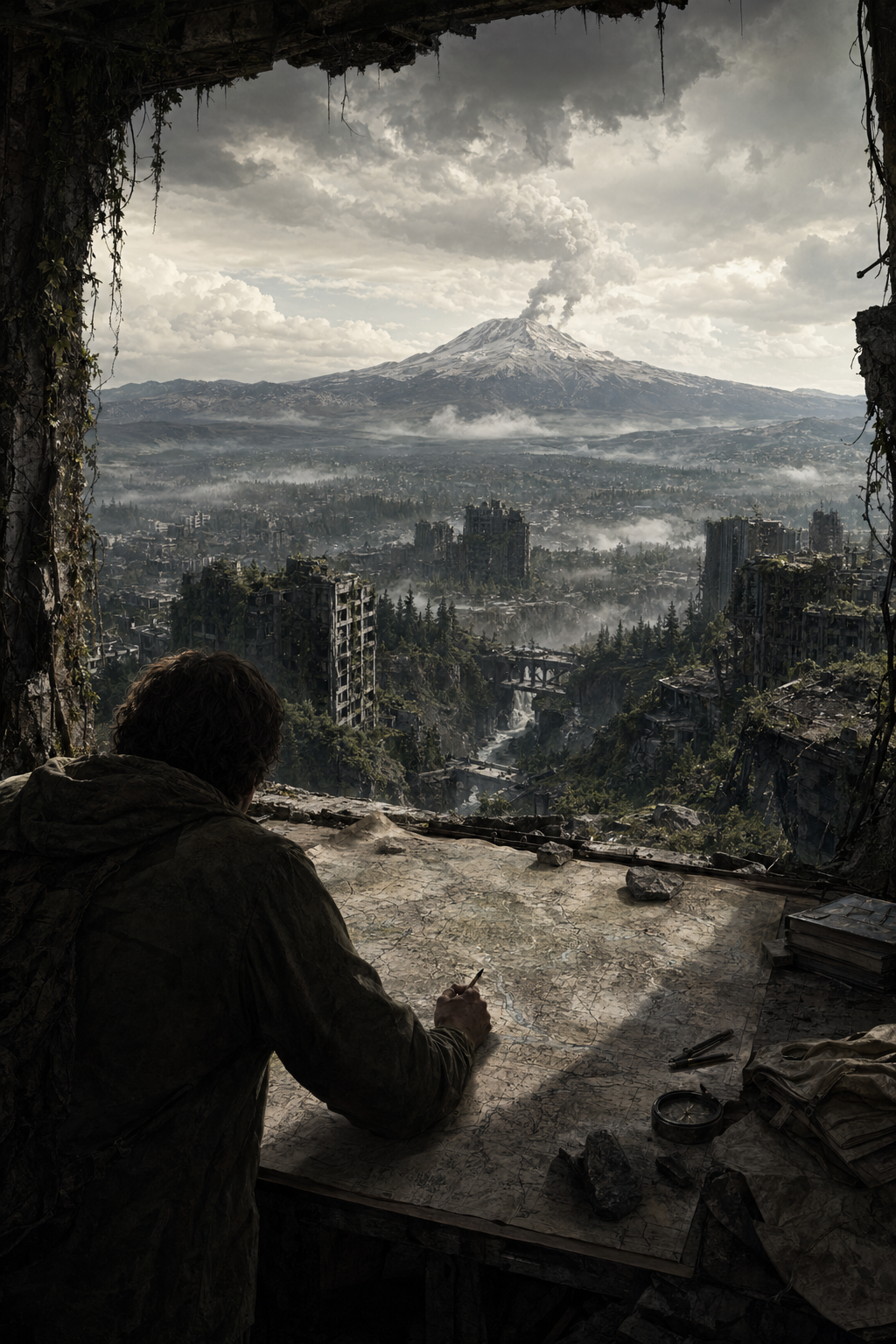
THE LAST CARTOGRAPHER
In the ash-buried Pacific Northwest, a solitary mapmaker must choose who controls the only safe road between rival settlements.
Chapter 1
The mud had a skin on it.
Gray on top. Wet underneath. It broke under her hands and swallowed them to the wrist.
She dug anyway.
Her knees were gone. She could feel them hitting buried things beneath the slurry—wood, maybe, or roof shingles, or the snapped edge of a fence—but the pain stopped meaning anything a long time ago. Her shoulders burned. Her breath kept catching halfway in, the air full of ash so fine it turned the inside of her mouth to paste. She spat and saw nothing change. Gray into gray.
She dug.
Not here.
There had been a porch here. Three steps up. White rail with one loose spindle Marcos kept meaning to fix. Lily liked to sit on the top step with both feet tucked under her and draw on the wood with sidewalk chalk until he told her not to waste it there.
The porch was gone.
She dug where the porch should have been.
Her fingers hit something soft and she made a sound that tore her throat open. She clawed harder, both hands, scooping mud so fast it slid back in around her wrists. Fabric. A blanket maybe. A curtain. Not a body. Not her. She threw it behind her and kept going.
The world had no edges anymore. No road. No yards. No houses. Just a flat, steaming field of lahar, gray and shining where water stood in the low places. The air hissed. Ash still falling somewhere beyond sight, or the mud settling, or the mountain finishing what it had started. No birds. No engines. No voices close enough to matter.
Her nails split. She did not feel that either.
Lily had been in the yellow rain boots because the storm had started before the earth moved. Red soles. One of them had a crack near the toe where she dragged her feet instead of lifting them. Wren saw the boot in her head so clearly that for a second she believed she would find it if she kept going. Yellow in the gray. Small enough for one hand.
She dug until her arms began to shake and then past that.
Something caught her under the ribs and hauled. She lurched backward, twisted, hit with her fists before she could see who had hold of her.
"Stop."
A man's voice. Ragged. Human. Hands on both her arms, not hurting her, just stronger than she was now.
She tried to throw herself forward. Another pair of hands caught her at the shoulders.
"No. No, listen to me—"
She did not listen. She kicked and clawed and dragged mud with her heels trying to get back to the place where the porch had been, where the house had been, where the room with the blue curtains had been, where Lily should still be if the world had not broken its own shape. The hands held. Patient. Unmoving. A restraint built of exhaustion and necessity, not anger.
She screamed once. It came out dry.
Then she was on her knees again, but away from the place, and the mud was out of reach, and her hands were empty.
She looked at them.
Gray in every crease. Blood at the cuticles. A thumbnail hanging loose. Mud drying over the lines of her palms like a second skin.
The men holding her said something. She did not hear it. The hiss of the settling ash had moved inside her head.
One of them let go long enough to offer her canteen water. She knocked it away. It hit the mud and vanished on its side, half buried at once.
She tried one more time to get up.
The body would not answer.
So she sat there in the ash and the ruined heat of the day and stared at her hands until the light changed.
The pen scratched steady under the lantern.
Wren drew the contour line, lifted the nib, waited for the ink to settle into the paper's tooth, then marked the washout with two short slashes and a notation in the margin: spring cut, unstable after rain.
Her left hand held the map flat. Her right moved with the small, exact economy of long practice. Outside the tarp wall, wind went over the ash dunes with a low hiss that changed pitch when it found the guy lines. Not rain. Not water. Just grit moving across grit.
She added the ford depth. Shoulder-high on a horse in thaw season. Knee-deep now, current faster on the east side. Then the stand of alder that made decent cover if someone needed to stop before the crossing. Then the scree slope above the second bend where the mountain liked to remember it was still unfinished.
At the narrowest part of the route she drew a small triangle and struck a line through it.
Weight-dependent risk. Assess before crossing.
She sat back.
Lantern light turned the fresh ink brown for a second before it dried to black. The page smelled faintly of oil and damp paper. Her knuckles were dark with ground-in graphite. Ink had worked into the cut beside her thumb and stained the skin there blue.
The map showed twelve miles of the Toutle Corridor as it existed now. Not as it had been. The old road was gone under thirty feet of ash and mud. The campground gone. The bridge gone. The creek rerouted by a slide two winters ago. This was what remained: ridgeline, ford, washout, stable shelf, dangerous shelf, water here, no shelter here, do not trust this ground after noon thaw.
The truth, as near as a person could get it.
She let the page dry while she cleaned the nib with a scrap of cloth. The shelter around her was little more than tarps and deadfall anchored low against wind, but the angles were right and the fire pit drew smoke out through the vent slit she'd cut near the top seam. Her bedroll was laid with her feet toward the back wall and her head toward the entrance. Pack within reach. Boots where she could get into them blind.
Nothing accidental.
She rolled the finished map and slid it into a waxed tube. Sealed both ends. Set it beside the pack.
Then she opened the other tube.
The old map crackled when she unrolled it. Pre-collapse paper. Government issue. Better stock than anything anyone made now. The edges had softened with years of use, but the print was still clear: roads in red, contour intervals exact, bridges marked with calm confidence by people who assumed bridges stayed where they were built.
She looked at the section north of the corridor first. Then south. Her eyes moved around the place she did not let them rest.
Longview sat on the page in neat black type. Streets in a grid. River levees. Residential blocks. School. Boat launch. A geometry of promises.
She folded that part under with two fingers and studied the corridor instead. Compared the old ridge shapes to the ones she'd drawn from memory tonight. The mountain had sent the valley elsewhere. All that work, all those names, all those measured lines—buried now under something that did not care what human beings had intended.
She rolled the map up before her eyes could drift.
The lantern hissed. Outside, the wind changed.
Wren set the old tube aside and listened.
Not with her thoughts. With the body first. Back straightening. Breath held high. Hand already moving to the knife on her left side.
The tarp wall shivered once. Twice. Then settled. No footstep. No tack rattle from a horse. No scrape of a hand on canvas. Just another gust shouldering ash down the corridor.
She waited a full minute anyway.
Then she rose, ducked through the shelter flap, and checked the anchor lines by moonlight.
The world beyond the fire's small ring was all silver and black. Ash dunes sloped away in long shallow waves. Dead conifers stood farther out, stripped to gray trunks, each one pale as bone in the dark. The sky had cleared after sunset. Stars hard and cold overhead.
She tested each stake with her boot. Tight. Tight. The north line needed another twist; she gave it one. Fed another branch to the fire and watched the coals take, orange deep in the split wood before the flame showed.
Her hands worked without waste. Pull. Twist. Set. Check.
When she crawled back into the shelter, the lantern was lower. She pinched the wick down until the light was just enough for shapes. Took off her jacket, rolled it under her neck, lay on her side with her back to the entrance.
Her jaw stayed locked for a long time.
Wind hissed over the corridor. Somewhere a pebble skittered downslope and stopped.
She put one hand over the knife. The other rested on her chest, above the inner pocket where the waterproof case lay flat against her ribs.
Her fingers found the rectangle through the fabric. Touched once. Not opening it. Not needing to.
The case held a photograph and a folded drawing. She knew the weight of both to the fraction of an ounce. The photograph had rounded corners from years in the plastic sleeve. The drawing was creased white along the folds. A square house. Four windows. Triangle roof. Three stick figures holding hands.
She knew every line without looking.
Outside, the wind kept at the ash.
Inside, she lay still enough that the body might have looked asleep to anyone watching.
It took a long time for the breathing to go all the way down.
Fourteen years after earthquakes, tsunamis, and volcanic ash shattered the Pacific Northwest, the Ashlands survive through fragile trade routes and hand-drawn maps. Wren Calder, a wandering cartographer who has built her life on accuracy and distance, becomes the only person with the knowledge to reach a buried government depot hidden in unstable terrain. When two rival settlements each offer her partial truths about what lies inside, her neutrality begins to collapse along with the ground beneath them.
- —Wren Calder — A former GIS analyst turned roaming cartographer, Wren survives by making the altered world legible for others. Her precision is both ethic and armor, but the job that keeps her moving also hides a grief she has never allowed herself to stop and face.
- —Jonas Harker — A builder and de facto power at Colson Ridge, Jonas is a practical man hardened by loss and responsibility. He wants the buried depot to free his farming settlement from dependence, but his protective love for his community and his son is curdling into control.
- —Lena Hargrove — The architect of Braden Mill, Lena is a former emergency manager whose competence holds an entire settlement together. She believes regional survival depends on cooperation, yet her habit of strategic withholding makes her vision of interdependence hard to trust.
- —Eli Harker — Jonas's twenty-year-old son is gentle, capable, and still open in ways the Ashlands have not managed to crush. His warmth draws Wren in against her will, and his presence turns abstract political stakes into something personal and painfully alive.
- —Maren Cross — Jonas's fiercest lieutenant, Maren is a scout and true believer in Colson Ridge's independence. She is quicker than Jonas to act, more willing to use force, and becomes the sharp edge of the survival logic pushing the story toward rupture.
- —Marcos and Lily Calder — Wren's dead husband and daughter are the unspoken center of her life, lost in the lahar that buried Longview. They never leave the story; their absence shapes every map she draws, every risk she takes, and every bond she tries not to form.
- —Ruth Harker — Jonas's late wife remains a quiet force in the life he built after her death. Her memory survives in the tenderness Jonas hides, and in the lingering question of how much of the man she loved still exists inside the protector he has become.
- —The Ashlands: Wren moves alone through a transformed volcanic wasteland, trading routes and updated maps between isolated settlements. At Braden Mill and Colson Ridge, Lena and Jonas separately ask for her help reaching a rumored buried depot in the unstable Toutle Corridor.
- —The Lie: Surveying the corridor, Wren confirms the depot is real and learns enough to understand its power. Trying to force a safer outcome, she gives Lena the full map but hands Jonas an incomplete version, violating the one principle that has defined her life.
- —The Descent: As Colson Ridge prepares to move without Braden Mill, Wren is drawn deeper into Jonas's settlement and into Eli's orbit. She guides Maren's team into the corridor, discovers the depot's deeper secret, and loses control of the information she tried to manage.
- —The Collapse: A Braden Mill team arrives at the depot at the same time, turning competing survival strategies into a live standoff in unstable terrain. Wren confesses the full truth just as tremors and structural failure force both sides into a desperate, improvised cooperation.
- —The Carrying: After the depot, Wren faces Jonas's anger, the damage her deception caused, and the impossible fact that she has come to belong somewhere. As Braden Mill and Colson Ridge attempt a fragile joint future, she stops living as a neutral instrument and begins carrying love openly, at risk and without guarantees.
The prose is lean, tactile, and exact, grounded in bodies, weather, tools, and damaged ground rather than abstract explanation. Its voice is restrained but emotionally charged, finding beauty in ash, mud, silence, and handmade things. The atmosphere is tense and elegiac, with flashes of hard-won warmth inside a world shaped by collapse and survival ethics.