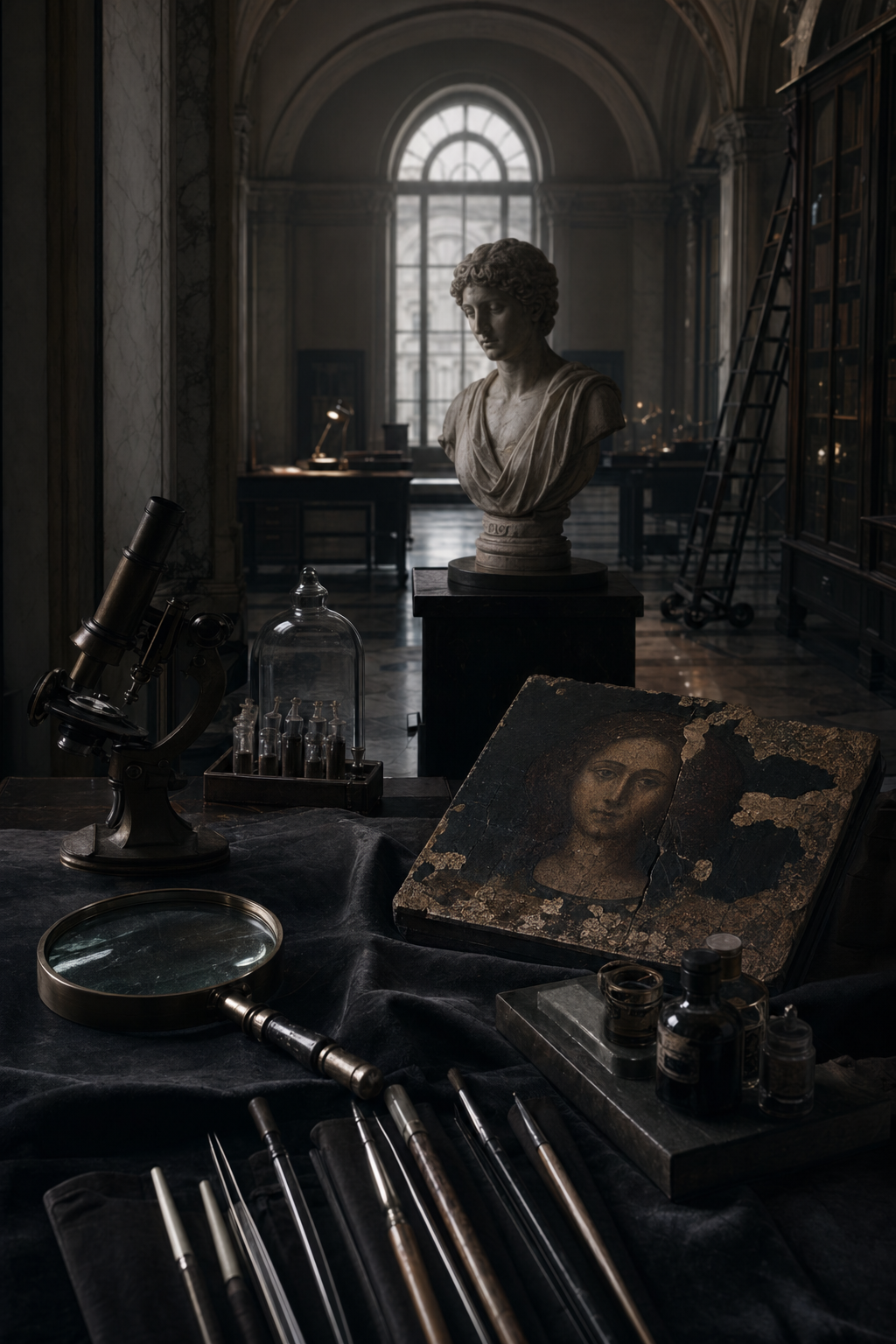
THE LANGUAGE OF WHAT REMAINS
In a cold art-forensics bureau, a gifted analyst finds someone speaking to her through impossible objects.
Chapter 1
Grey light entered Maren Laithe’s apartment in a controlled plane, filtered by the river-facing window and the cloud cover beyond it into something close to laboratory illumination. It found the shelf above her desk and stopped there first. Glass. Metal. Ceramic. A small congregation of objects that had outlived the system’s interest in them.
She lifted the porcelain fragment with two fingers and settled it into her palm. Blue-and-white underglaze, eighteenth century or a later imitation produced with better technical discipline than imagination. The break had cut through a floral border at an angle that preserved half a petal, part of a stem, and one incomplete digit of the maker’s mark on the underside. Most people would have called it broken crockery. Maren turned it toward the window and watched the glaze catch what little light the morning offered. The brush had hesitated once, in the blue line curving around the flower’s center. A correction so small it existed below the threshold of usefulness. Not evidence. Not value. Just the record of a hand deciding.
She set the fragment down exactly where it had been and went to work.
The Cultural Heritage Forensics Division occupied the upper floors of a building designed for classification. The customs house had changed its vocabulary over the last century, but not its syntax. Stone corridors still directed movement into manageable channels. Doors still marked transitions between what could cross a threshold and what could not. Even the marble floor preserved the history of institutional traffic: wear concentrated at corners where decisions were made quickly and repeatedly.
Maren crossed the third-floor corridor with a case file under one arm and her access badge clipped to the seam of her coat. The climate control met her at the examination suite door, cool and exact. Twenty degrees. Forty-five percent relative humidity. Preservation conditions, not comfort. The room smelled of stainless steel, paper, and the faint mineral note of distilled water used for humidification in the adjacent conservation lab. Institutions cleaned the evidence of occupancy more efficiently than the evidence of procedure.
Today’s intake had come from a customs checkpoint at the eastern freight terminal: three crated artworks seized on suspicion of containing trafficked cultural property concealed within legitimate shipments. Routine enough that the manifest had been preloaded into the division database before the truck reached the building. Maren signed the chain-of-custody transfer, checked the tamper seals, and moved the first crate under the examination lights.
The crate held exactly what the paperwork claimed it held. A framed landscape, late nineteenth century, oil on canvas, minor commercial value. She noted the stretcher dimensions, checked the frame joints, confirmed the shipping labels against the manifest, and dictated the preliminary condition summary into the recording system. The software transcribed her words into clean legal language, flattening cadence, preserving content. Efficient. Mostly accurate.
The second crate produced a small bronze figure on a marble plinth, documented provenance, export certificates in order, no immediate discrepancy between object and file. Maren examined the tool marks on the underside, photographed the foundry stamp, and returned the sculpture to its foam supports. The case remained what the seizure report suggested it was: a precautionary hold triggered by irregularities in unrelated freight paperwork.
The third crate contained a mid-century oil painting wrapped in Tyvek and buffered with archival foam. The documentation was complete. Acquisition records from a private estate sale, export permit, insurance valuation, lender affidavit. Maren checked the surface through the wrapping slit first, then cut the tape and folded the protective layers back with the deliberate economy that object-handling taught into the body over years. The painting itself was unremarkable in a professionally reassuring way. Legitimate age. Legitimate craquelure. The backboard labels aligned with the file.
She reached for the interior packing checklist and noticed a resistance in the space between the crate wall and the painting’s side buffer. Not enough to alter the crate’s weight on intake. Not enough to have shifted the foam. Just an interruption where the material should have yielded cleanly under her fingers.
Maren removed the side packing layer.
A silver pocket watch rested in the narrow gap, wedged between protective wrapping and wood as if the crate had been built around it. Not loose. Placed.
She held still for one second. Then she lifted it out.
The case was sterling silver, Swiss manufacture, 1920s. The hinge had the softened action of long use; this was not a decorative piece stored untouched in velvet. It had been opened and closed thousands of times by a hand that applied steady pressure to the lip rather than snapping it free with the nail. Light tarnish around the crown, deeper in the creases of the bow. The front cover bore no monogram. Anonymous surface. More interesting.
“Anything?” Jem called from the imaging station across the room.
Jem Parr was calibrating the portable X-ray fluorescence unit with one sleeve pushed above the elbow and a pencil tucked behind one ear. They did not look over immediately. Jem had learned the shape of Maren’s concentration well enough to know when interruption would damage it.
“Packing anomaly,” Maren said.
Jem glanced up then, enough to register the object in Maren’s hand. “Useful anomaly?”
“I don’t know yet.”
“That usually means yes.”
Maren did not answer. She pressed the watch’s release and opened the case.
The dial was white enamel, hairline crack between four and five, black Arabic numerals, blued-steel hands. The minute hand rested at forty-seven. The hour hand just before twelve. Eleven forty-seven. A stopped watch carried an almost unusable amount of inherited meaning; people assigned intention to halted time the way they assigned personality to handwriting. Most of the time they were wrong. Springs ran down. Mechanisms failed. Shocks displaced escapements.
She turned the watch under the light and opened the inner lid.
On the inside cover, beneath the expected Swiss maker’s marks and silver standard stamp, was a smaller engraving, machine-cut and precise. Not decorative. Inventory notation. The serial format registered before the thought had language: Rijksmuseum voor Cultureel Erfgoed. Maren had seen the code structure in inter-institutional documentation, on transfer photographs, in conservation records attached to loan requests. Dutch museum inventory systems used a different punctuation logic than CHFD catalogues. This one matched the Rijksmuseum’s legacy format exactly.
The seized shipment had no declared connection to the museum.
Maren set the watch on a clean foam block and pulled the case file closer. No item on the manifest matched it. No addendum referenced loose historical objects in the packing. No museum alert had been circulated for a missing watch.
She reached for a jeweler’s tool from the small instrument tray, fitted the blade into the back-case notch, and opened the watch’s rear cover. Movement intact. Dust minimal. No sign of impact damage. She studied the mainspring barrel, then the crown.
The spring still held tension.
She looked at the dial again. Eleven forty-seven. Crown pulled to first position.
The watch had not stopped because it could no longer run. It had stopped because someone had prevented it from running.
The distinction altered the object’s temperature in her hand. Not literally. The silver remained cool. But an object that fails and an object that has been made to fail occupy different categories of attention. One belongs to entropy. The other belongs to decision.
Jem had crossed the room without Maren hearing the approach. They stopped at the edge of the workbench, careful not to enter the working zone. “That useful?”
Maren kept her eyes on the movement. “Deliberate.”
Jem leaned slightly, not enough to cast a shadow. “How deliberate?”
“She pulled the crown back into place, tested the tension with the tool, then closed the back. “Enough.”
Jem considered this. “That sounds like your version of very.”
Maren almost smiled. “It’s not on the manifest.”
“Then someone packed a timepiece with a painting for reasons unrelated to good shipping practice.”
“Yes.”
“You going to tell the file that?”
“I’m going to tell the file what it can process.”
Jem made a small sound that could have meant agreement or sympathy; with Jem, the categories overlapped. “Coffee in ten?”
Maren nodded once. Jem returned to the spectrometer.
She photographed the watch from six angles, then one more with the case open to the engraved interior lid. She entered the item into the database under standard protocol: Unrelated Item — Packing Anomaly. Material: sterling silver. Type: pocket watch. Approximate date: 1920s. Condition: stable, mechanism intact, crown pulled, movement stopped at 11:47. Preliminary note: inventory engraving consistent with institutional cataloguing system requiring provenance verification; recommend further investigation into object history and relationship, if any, to seized shipment.
She read the note twice before submitting it. The language was measured, legally survivable, within scope. It still felt reduced. The object in her hand said more than the form had fields for. It said museum, and interruption, and intention, and a mechanism held one step away from function by a human choice. The report could manage only anomaly.
Maren sealed the watch in an evidence bag and laid it in the designated tray for secondary review. The plastic flattened the object’s weight into transparency. Through the clear surface the hands still indicated eleven forty-seven with the stubborn exactness of all machines that have been stopped without being broken.
When she returned the next morning, Aldiss’s review initials sat beside her note in the case management system. One sentence had been removed. The recommendation for further investigation was gone.
In the margin, in Director Heinrich Aldiss’s measured handwriting, a brief annotation had been added:
Outside scope of current investigation. Item logged as packing anomaly per standard protocol.
Maren read the line once. Then again, because accuracy deserved the respect of repetition even when it arrived pointed in the wrong direction.
The system had processed the object. It had named the discrepancy and reduced it to a category built for containment. The watch remained in its evidence bag on the tray below the monitor, silver case dulled by the lab lights, crown still pulled, spring still wound.
Packing anomaly, the file said.
Maren looked at the stopped hands and felt the first clean seam open between what the system could catalogue and what the object had actually done.
At the Cultural Heritage Forensics Division, objects are measured, authenticated, and reduced to evidence with near-perfect precision. Senior analyst Maren Laithe is the one person in the building who can read what objects mean as well as what they are, but her institution has no category for that kind of perception. When anomalous artifacts begin appearing across art-crime cases, Maren realizes someone is using objects as a language—and speaking directly to her through the system’s blind spot.
- —Maren Laithe — A 34-year-old senior forensic analyst at the CHFD, Maren specializes in material analysis and provenance reconstruction. She reads objects with extraordinary precision, but every institution in her life has treated that gift as overreach, forcing her to translate a richer perception into acceptable evidence.
- —Silas Verne — A former museum conservation scientist who left institutional life after refusing to truncate what objects revealed, Silas now stages interventions in museums, galleries, and archives. He shares Maren’s perceptual frequency and becomes the first person to read her completely, turning material anomalies into an intimate and dangerous conversation.
- —Director Heinrich Aldiss — The CHFD’s director is a deeply competent administrator and provenance expert who genuinely believes in the integrity of the system he embodies. He is not malicious, but his commitment to objectivity makes him the perfect enforcer of an institution that can use Maren’s brilliance only by reducing it.
- —Jem Parr — A warm, practical lab technician whose expertise lies in calibration, preparation, and the embodied realities of the workbench. Jem does not decode Maren the way others try to, but offers steadiness, care, and the only uncomplicated human refuge in the story.
- —The Anomalies: In the CHFD’s rigorously controlled world, Maren begins finding stray objects in unrelated art-crime cases: a stopped watch, a millefiori paperweight, and other items the system logs as irrelevant. As she quietly revisits archived files, she sees a pattern no one else can perceive—deliberate placements exposing what official investigations missed.
- —The Address: An anonymous daguerreotype donation contains a note that mirrors Maren’s own analytical method, and she realizes the anomalies are authored and aimed at her. She starts replying in the margins of her reports while privately tracing the intelligence behind the objects, feeling for the first time that her way of seeing may be a language rather than an error.
- —The Mirror: Maren identifies the unseen correspondent as Silas Verne, a vanished conservation scientist whose neglected writings articulate the blind spot she has lived inside for years. As the objects become more intimate and tailored to her exact habits of perception, the CHFD launches a formal investigation that threatens to recast their exchange as criminal evidence.
- —The Collision: Tracking Silas’s logic leads Maren to a clandestine meeting in an abandoned conservation lab, where arranged objects become a portrait of her own mind and the two finally speak face to face. Their mutual recognition sharpens the central conflict: the institution wants Maren to translate his language into prosecutable facts, while she now knows the system itself is too limited to understand what it is naming.
- —The Lens: When Maren resists the investigation with a devastating supplementary analysis, the CHFD sidelines her and preserves its categories unchanged. Then Silas leaves one final object—a modified lens and a precise description of Maren that proves, materially and personally, that her perception is real—forcing her to decide how to live with a truth the institution will never admit.
Cool, exact, and psychologically intimate, with prose shaped by the logic of forensic observation rather than melodrama. The voice is controlled, architectural, and sensory in a tactile way: glass, metal, paper, light, temperature, and the pressure of hands on objects carry as much meaning as dialogue. Warmth appears rarely and hits harder for it, emerging through care, stillness, and the rare shock of being fully seen.