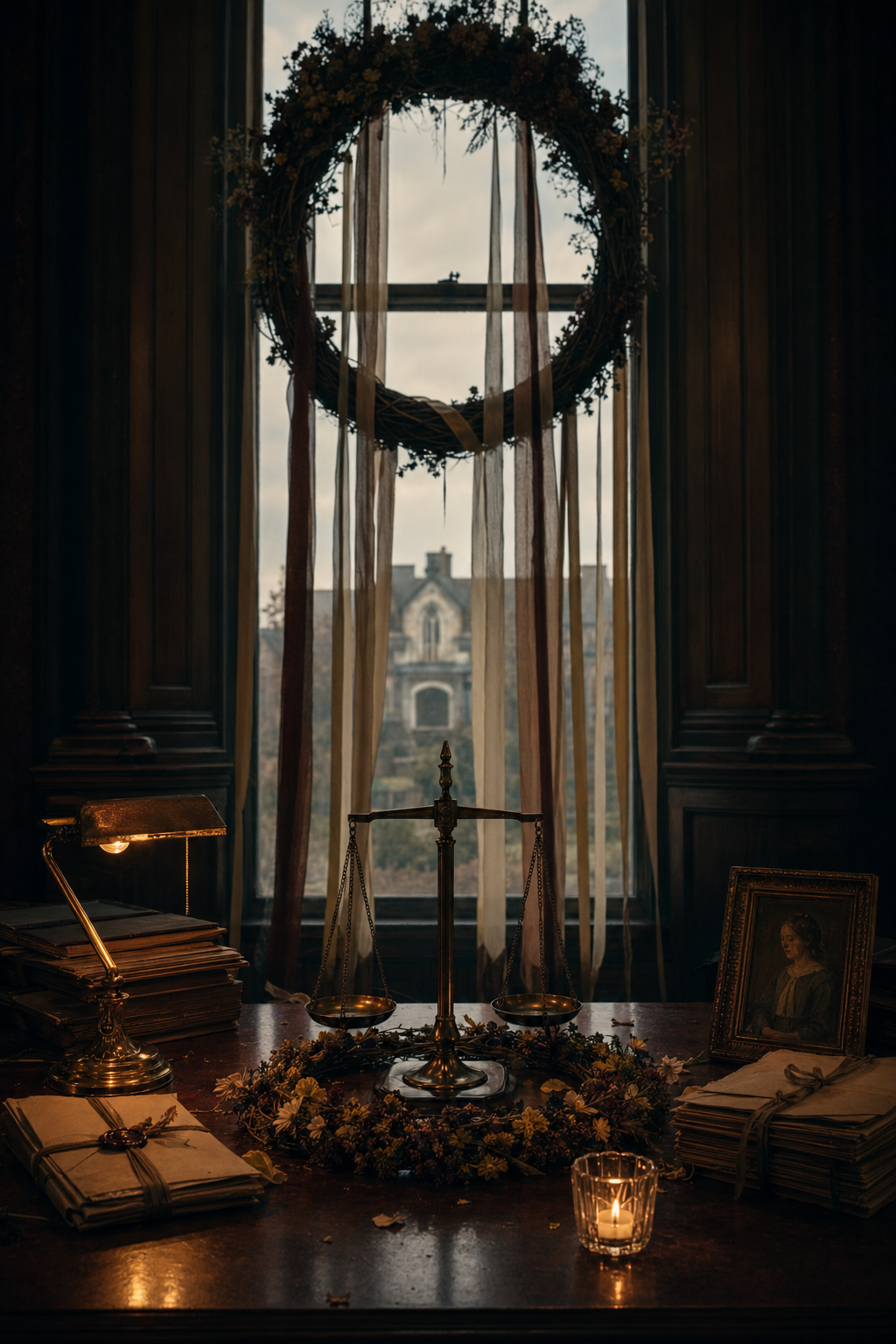
THE KEEPING OF LIGHT
In a hushed estate firm, the woman who holds old families together starts to see what her devotion has cost her.
Chapter 1
By seven-thirty the kitchen at Hargrove, Ash & Calloway held the kind of cold that old houses kept even after the radiators had begun their work, a disciplined cold that lived in the tile and the glass and the deep seams of the window frame, and Nora Calloway stood in it with the putty knife in one hand and the tube of caulk in the other, cutting away the cracked line that had opened over the summer in the upper right corner of the tall pantry window, the old seal coming loose in hard, pale ribbons that fell against the sill and stuck briefly to her fingers before she brushed them away.
Outside, the copper beech in the side yard had turned almost entirely, the leaves holding that final late-October color that was less orange than red and less red than gold, a bruised metallic brightness that seemed to gather the weak morning sun and return it to the glass in a softer form. The light through the window fell in a long rectangle across the counter and the old sink, shifting slightly whenever the branches moved. Nora worked inside it without haste. She had eleven minutes before the first client arrived. Eleven minutes was enough.
The putty knife lived in the second drawer beside the refrigerator, between a packet of tea towels no one used and a corkscrew with one arm bent out of shape years ago and never replaced. She had put the knife there herself and never thought much about it afterward. The drawer closed properly only if you lifted it a fraction before pushing. The sash on this window stuck in damp weather. The radiator in the back hall knocked twice before settling. She knew the house in the same register she knew the files: not sentimentally, not even especially consciously, but in the accumulated way of a person who had for years been the one to notice what needed attending before anyone else had seen there was anything to notice.
She pressed the fresh line of caulk into the seam and drew the flat edge of the knife across it, smoothing it firm and even. The motion had a small satisfaction in it, a resistance giving way under pressure, the line becoming clean. She went back once over a place where the bead had caught on a splinter in the wood. The frame had shifted enough, over time, that the old caulk had separated in a hairline crack no one would have seen unless they stood exactly where she was standing, in the early light, with the angle of the sun exposing the flaw. The firm paid a service to maintain the building. They came monthly, checked gutters, changed bulbs, patched what they saw. They had not seen this. Nora had.
When she finished, she wiped the knife with a folded paper towel and stood still for a moment, hands lowered, looking through the newly sealed glass at the tree. There was no distortion in the pane now. The leaves outside held steady where the branches were still and flashed when the wind turned them. Somewhere deeper in the house a floorboard gave one short complaint as the front door opened and shut. The first assistant would be arriving. In another two minutes the coffee would need starting if she wanted a fresh pot before the Henderson appointment. The day had already arranged itself in her mind: the Bellingham file before nine, the draft codicil for Mrs. Fenwick by ten-thirty, Martin’s medication reminder at noon if he had forgotten again, which lately he had.
She cleaned the sill with the heel of her hand, gathered the brittle ribbons of old caulk, and dropped them in the trash. Then she put the knife back in the drawer.
The kitchen door opened behind her.
“You’re here early,” said Helen Ash.
Nora turned. Helen stood with one hand still on the knob, coat unbuttoned, scarf loose at the throat, the cool air from the back hall entering with her. At fifty-one she had the polished, composed appearance of a person who had learned to wear authority as if it had always belonged to her, and on her it was easy to believe that it had. Her grandmother’s portrait hung in the front hall two rooms away, Eleanor Ash severe in black and white, one hand on the back of a chair. People remarked on the resemblance sometimes. Helen always smiled as if the comparison pleased and burdened her in equal measure.
“I wanted the coffee on before clients,” Nora said.
Helen glanced past her at the window, at the still-wet seam in the corner. “And apparently facilities.”
“The caulk had cracked.”
Helen laughed softly, not unkindly, setting her bag on the table. “We do employ people for that.”
Nora folded the paper towel once, then again. “It took a minute.”
Helen studied the window as if trying to locate the flaw it had contained and could no longer be seen to contain. Then she gave up, because there was nothing now to see. “I ran into Leland Pryce last night,” she said, moving toward the coffee machine. “Bar association thing at the Hilton. He asked after us all with that expression he has, as though he left a family farm and we’re all still out in the weather without him.”
Nora opened the cabinet for mugs. “How is he?”
“Thriving, from the look of it.” Helen filled the reservoir, her voice easy, almost absent. “Small office downtown, two associates, a website that would like us all to know he uses words like bespoke.” She glanced over her shoulder. “He asked about the Bellinghams.”
Nora set two mugs on the counter. The ceramic clicked once against stone. “Did he.”
“Friendly enough. Nostalgic. You know how he is.” Helen took a packet of grounds from the shelf and tore it open. “Probably just testing whether we’d wince.”
Nora said nothing.
Helen poured the grounds into the filter, level as a pharmacist. “I assume you’re already buried in the quarterly review.”
“It’s on my desk.”
“Good.” Helen pressed the switch. The machine began its low internal throat-clearing before the first water moved through. “I don’t imagine there’s anything to be concerned about. Andrew likes to posture, Thomas follows his lead, Rebecca likes an audience, and Claire trusts you more than she trusts any of them put together. Still.” She shrugged. “Keep an eye on it.”
Nora reached for the spoon jar, then stopped; Helen had taken her coffee black for twelve years. “Of course,” she said.
Helen looked at her then, directly, with the open gratitude that was one of the things Nora found hardest to bear because it was always sincere. “I don’t know what we’d do without you.”
There it was, placed between them as casually as the mugs, and because it had been said in one form or another for so many years by so many people—clients, assistants, partners, widows in black coats gripping their handbags in conference rooms while she explained what would happen next—it entered the room with the familiarity of furniture. Nora nodded once, the way she always did, accepting neither too much nor too little.
From the hall came the quickened steps of one of the junior associates, then the muted trill of the front desk phone. The day had begun in earnest.
“I’ll be in my office,” Nora said.
Helen lifted her mug. “Bellingham at nine?”
“Yes.”
“Good.” A pause. “And Nora?”
Nora turned back from the door.
“Thank you.”
The warmth in Helen’s face was real. So was the reliance. Nora inclined her head and left the kitchen carrying her coffee.
The corridor from the pantry to the main stair ran along the side of the house where the windows were tallest. Morning moved through them in pale bars across the runner. The woodwork along the walls had been kept in such careful repair for so long that the repairs themselves had become part of the finish, invisible except to anyone who knew where to look, which joints had been filled, which corners had been reset, which strip of molding beside the library door had once split in winter and been glued back so neatly that only the faint change in grain gave it away. Clients liked the house. They sat in its conference rooms and under its plaster medallions and believed, with some reason, that things handled here would remain handled. The building suggested continuity. That was part of what they paid for.
Nora climbed to the second floor, passed the closed door of Martin Calloway’s office, and entered her own. The room faced the street, narrower than a partner’s office but brighter, with shelves built into the recesses on either side of the fireplace and two lateral file cabinets beneath the far window. On her desk the Bellingham file waited where she had left it Friday evening, thick with tabbed sections and yellow notes in her handwriting. Beside it lay the quarterly distribution summary, a legal pad, three voicemail slips clipped together, and the photograph of David she kept turned slightly inward so that no one entering the room saw it head-on unless they were already seated.
She set down her coffee and took off her coat. For a few seconds she remained standing, one hand resting on the back of the chair, looking at the file. Twelve years of Bellingham distributions, amendments, private understandings, Christmas cards, emergency calls from airports, signatures obtained at hospital bedsides, arguments diffused in conference rooms before they had acquired the force of lawsuits. The trust itself occupied perhaps a third of the paper. The rest was administration, interpretation, memory. Care, if one wanted that word. Maintenance, if one wanted the more exact one.
She sat, opened the file, and turned to the page where the summary of family properties was clipped over the current investment schedule. Lake Champlain property: held by trust; occupancy rights subject to family agreement. The language was adequate as legal language went. It was not the truth. The truth lived elsewhere, nowhere formal, in a June conversation in 2004 between George Bellingham and his wife in this very office, before the final revision was drafted, when George, thinner than he had wanted anyone to notice and already tiring after twenty minutes of discussion, had said with his eyes on the window rather than on either attorney present that the lake house was Claire’s in all the ways that mattered and should remain so, whatever the document required for tax purposes and whatever Andrew chose to believe later. His wife had nodded. Nora had been there taking notes. The attorney handling the matter had died three years later. The comment had never made it into the trust language. The practical arrangement had endured because Nora remembered it.
She rested her finger lightly against the margin where there should have been more ink than there was.
Downstairs, a door opened, voices entered, the house receiving people into itself one by one. Nora drew the distribution schedule closer, uncapped her pen, and began to prepare for the meeting, her handwriting moving in its usual narrow, precise line along the yellow pad while the morning brightened at the window and the new caulk in the kitchen began, unnoticed by anyone but the person who had applied it, to set.
At Hargrove, Ash & Calloway, a genteel estate law firm in a mid-Atlantic college town, Nora Calloway has become the living memory of generations of wealthy families and their unspoken agreements. When former partner Leland Pryce begins quietly drawing away the firm's most important trust, Nora is forced to confront that the relationships she protects live less in the firm than inside her own exhausted attention. As the threat spreads through clients, colleagues, and family ghosts, she begins to see that the system consuming the firm from outside has long been consuming her from within.
- —Nora Calloway — A forty-four-year-old senior trust administrator, Nora is the indispensable keeper of the firm's memory, client histories, and unwritten understandings. Widowed and still wearing her ring, she has built her identity around being the one who holds everything together, even as the work hollows out the rest of her life.
- —Martin Calloway — Nora's seventy-eight-year-old father-in-law and the firm's previous keeper, Martin still comes to the office each day but has become a ghostly remnant of purpose without life beyond it. His fading presence shows Nora the end point of total devotion to the firm.
- —Leland Pryce — A former partner who left under a cloud, Pryce now runs his own practice and begins courting the Bellingham family trust with patient, intimate attentiveness. He is a real threat to the firm, but more unsettlingly, he embodies the version of Nora who chose to leave before the work could finish consuming him.
- —Helen Ash — The firm's managing partner and heir to its legacy, Helen is intelligent, gracious, and sincerely grateful for Nora's brilliance. Her warmth makes the trap tighter, because every expression of value also reinforces how impossible Nora has become to replace.
- —Claire Bellingham — The youngest Bellingham heir and Nora's closest client, Claire has spent years accepting the quiet inequities built into her family's trust. As Pryce encourages her to ask what she actually wants, she becomes the person through whom Nora most painfully sees her own life reflected back.
- —Ruth Calder — A forgotten former trust administrator whose old files reveal an earlier keeper erased by the firm's memory, Ruth appears only through archives, handwriting, and absence. Her vanished life exposes the firm's hidden lineage of caretakers who were consumed and then forgotten.
- —David Calloway — Nora's dead husband remains an absent center in the firm's halls, Martin's silence, and Nora's daily rituals. His death sealed Nora's deeper fusion with the work, turning grief into another form of maintenance.
- —The House: Nora moves through the old firm with ritual precision, tending files, clients, and even cracked window caulk as if every unnoticed detail depends on her. The Bellingham family trust, with its fragile unwritten understandings, reveals how much of the firm's true value lives only in her memory.
- —The Crack: Hints of Pryce's growing influence around the Bellinghams disturb the routines Nora has long treated as permanent. While tracing the threat, she uncovers Ruth Calder, a forgotten predecessor whose vanished history suggests that her own role is part of an older pattern.
- —The Mirror: Conversations with Martin and Claire begin to expose the human cost of being the one who always carries what others cannot bear. At the same time, Pryce's offer to the Bellinghams proves that what Nora has been preserving is not really the firm itself, but trust made portable through care and attention.
- —The Recognition: As Nora tries to document the vast web of unwritten knowledge she holds, she discovers that much of it cannot be cleanly separated from her own life and memory. Claire's growing distance and candid concern force Nora to confront that her permanence, once treated as virtue, has become a form of disappearance.
- —The Cessation: After a quiet reckoning at the firm's windows, Nora continues her work with a new, unsettling pause between obligation and action. She begins transferring what she can out of herself and, in small domestic gestures, tests what it means not to reach automatically for the next thing that needs fixing.
Close, patient, and intimate, the voice stays pressed against Nora's bodily perception rather than explaining her inner life outright. The prose is elegant and controlled, then gradually loosens as pressure mounts, with a sensory world of old wood, paper, glass, radiator heat, autumn light, and the thin exactness of November.