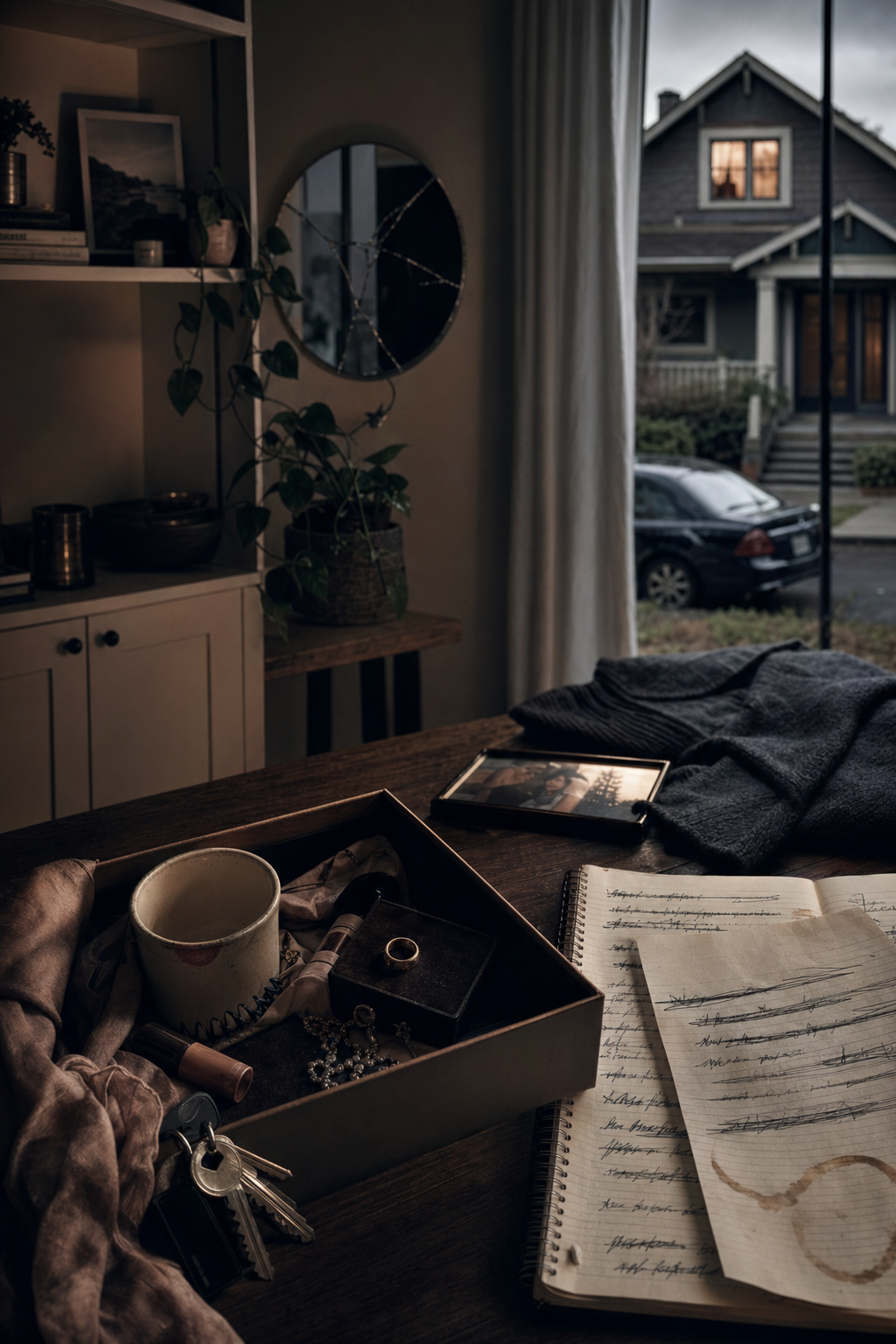
The Inventory of Us
After a wife vanishes from a perfect Portland cul-de-sac, the neighbor next door starts reading the marriage through what it left behind.
Chapter 1: The Kitchen Counter
I could tell you that Tuesday began ordinarily, but I don't believe in ordinary mornings. I believe in patterns that only look ordinary from a distance. I believe in the angle of a recycling bin, the position of a mug handle, the fact that some people answer doors as if they have just been interrupted and some answer as if they have been waiting for the knock. I believe, in other words, in the part of the story that objects tell when people are still arranging their faces.
At 8:12, I was at my desk pretending to care about a nonprofit's expense reports from the third quarter of last year and actually caring, as I usually do, about the line item that had been rounded too neatly three months in a row. My desk faces the front window because I like light and because the Avery house is directly across from me at 14 Alder Lane, though I would not say the second reason aloud to anyone on the street. My coffee had gone lukewarm. Audit was asleep on the filing cabinet with one paw hanging over the edge in a way that suggested trust in the basic structure of the world, which I have always found admirable and slightly reckless.
At 8:14, the first police car turned onto the cul-de-sac.
Not speeding. Not lights-on urgency. Just the measured, procedural roll of someone arriving to convert private panic into public paperwork.
It stopped in front of the Avery house. Two officers got out. One of them looked at a notepad before walking up the front path. The other looked at the windows, the porch, the hanging fern Nora had stopped watering in January. I noticed that because I had noticed when she stopped. Before that, she had pinched the dead leaves off every few days. Then one week she didn't. Then another. By February the fern had the brittle look of something technically present and functionally gone.
I stood up without deciding to stand. My hand was already on the edge of the desk.
At 8:16, an unmarked sedan pulled in behind the patrol car. That changed the temperature of things. A missing package does not bring an unmarked sedan. A wellness check sometimes does, but not this quickly. I watched the front door of 14 Alder Lane and waited for the person who would open it.
It was Caleb.
He came out in a gray T-shirt and navy pajama pants, arms wrapped across his chest as if holding himself together. His face was wrong in the appropriate way—drained, pinched, still wearing sleep badly. From the shoulders up, it was an excellent performance of being yanked from bed by catastrophe. His hair was flattened at one side. His mouth moved once before any sound came out, as though language had to cross a distance to reach him.
And then I looked down.
His shoes were tied.
Brown outdoor shoes, the kind he wore for yard work or hardware-store runs, fully laced, double-knotted if I was seeing correctly from this distance, which I usually was. Not slippers. Not bare feet shoved into whatever was nearest the door. Not the disorientation of a man who had discovered an absence and forgotten his own body in the process. Shoes chosen, put on, laced.
That might mean nothing. It is the kind of thing I would think. I know that. A person can put on shoes before opening the door to police because the morning is cold, because the porch is wet, because people do strange and practical things under stress. I know all the innocent explanations. I make my living distinguishing error from intent. Most discrepancies are incompetence wearing the clothes of malice.
Still.
His face said one thing and his shoes said another, and I have spent most of my adult life listening to the shoes.
The officers spoke. Caleb nodded once, then twice. He put one hand over his mouth in a gesture so familiar it took me a second to place it. I had seen him do it last summer when a client on speakerphone told him the retaining wall was over budget. Concern, moderated for an audience. Emotion with clean edges.
The thought was unfair. I filed it anyway.
My phone buzzed on the desk.
ALDER LANE NEIGHBORS, the group text June Tsai had named with the kind of exclamation-free cheerfulness that implies an HOA spirit without requiring actual legal enforcement.
June: Has anyone seen Nora this morning?
Then, before anyone could answer:
June: Police are at the Averys’. Caleb says she’s missing.
The replies came in quick, concerned, almost grateful to have a shape to move into.
Oh my god
No
I saw her car there last night
Do they need anything?
Starting coffee now
I typed, Not since Saturday, and looked at it before sending.
What I wanted to type was: Not since Saturday, when she was carrying a canvas tote bag I had never seen before and told me it was from the farmers' market in a voice that arrived half a second after her smile.
I did not type that. I sent the shorter version and put the phone face down.
Across the street, June emerged from 16 Alder with a thermos in one hand and her cardigan pulled closed with the other. June was always the first responder to any event that could be improved by hot beverages or social choreography. She crossed the street toward Caleb with the brisk competence of a woman who had made herself indispensable to an entire cul-de-sac and could no longer distinguish generosity from management. I liked June. This is not incompatible with seeing her clearly.
A minute later Peter followed, slower, phone in hand, his expression arranged into reasonable concern. Peter was a radiologist and therefore professionally practiced at looking at a thing and telling everyone else what it meant. He put a hand on Caleb's shoulder. Caleb lowered his head. From here, through glass, they looked like an advertisement for male friendship under pressure.
The police went inside. Caleb remained on the porch for a beat too long before following them, as if giving the neighbors a moment to register his grief from the curb. Then he disappeared into the house.
I sat down and reopened the nonprofit file on my laptop. A spreadsheet waited for me with rows of reimbursement requests that did not align with the supporting receipts. For several minutes I attempted to care in the disciplined, billable way I am paid to care. I highlighted a discrepancy in catering totals. I made a note about duplicated mileage claims. Outside, June handed paper cups to people as they arrived.
At 8:41, Detective Lien Hoang got out of the unmarked sedan. I knew her name because I have a habit of reading local crime reports to the end and because two years ago she had come by my door after a car break-in three houses over and written down my statement in a notebook with a green elastic band. Competent, tired eyes. Shoes sensible enough to imply she had long ago stopped dressing for TV versions of her own job.
She stood on the Avery porch and looked through the front window before going in. Not a glance. An assessment. I watched her and felt, absurdly, competitive.
By ten o'clock there were six people on the sidewalk in front of 14 Alder Lane, all standing with the awkward gravity of those who want to be useful and are mostly interested in being seen wanting to be useful. A casserole appeared, then another. Someone had brought tulips still in grocery-store plastic. The flowers looked embarrassed.
Rain started around eleven, light and directionless, the kind that makes everything in Portland look slightly unfinished. People retreated to porches and overhangs but did not go home. Going home would mean admitting there was nothing for them to do. Better to remain available to the event.
I stayed at my window.
That is the kind of sentence that can make a person sound lonelier than she is. I was not lonely. I was occupied. There is a difference. Besides, windows have been kinder to me than rooms full of certainty.
Around noon, Caleb came back outside with Detective Hoang. He had put on a flannel overshirt over the T-shirt, which suggested either someone had told him he looked underdressed or he had remembered there would be witnesses. They stood by the front steps while Hoang spoke and Caleb listened with his head tilted, jaw tight, eyes fixed not on her face but somewhere just left of it. People do that when they are trying to look devastated and attentive at the same time.
Again: possibly unfair. Again: filed.
I thought of Saturday.
I had been coming back from a run, damp-haired and annoyed at my own stamina, when Nora pulled into her driveway. She got out of her car with a tan canvas tote over one shoulder, utilitarian and plain, the sort of bag you buy for function and not because it goes with anything you own. Nora did not usually carry functional bags. Her bags were structured, small, chosen. This one looked like an object selected under constraints.
She saw me and stopped—not fully, just enough to create a gap between seeing and speaking.
“Farmers’ market haul,” she said.
“Good finds?” I asked.
“The usual.”
Then she smiled, the kind of smile people use when they are trying to close a conversation before it becomes one, and went inside.
The bag was not among the things I had seen police carry out this morning, because they had carried nothing out. Which meant either it was still in the house or it was not.
By three, the crowd had thinned. Rain will do what social discomfort cannot. The police left in increments: first one patrol car, then the unmarked sedan. Detective Hoang spoke to Caleb one last time at the curb. He nodded, both hands in his pockets now, every line of him assembled into exhausted gratitude. When she drove away, he remained in the driveway for nearly a minute, looking at nothing visible from where I sat.
Then he went back inside and shut the door.
The street held still around the absence.
I worked another hour without retaining any of it. At some point Audit jumped down and threaded around my ankles, offended by my failure to acknowledge evening as a category. I fed him. I reheated the coffee, then didn't drink it. At 6:17, June texted the group that a meal train had been set up for Caleb and that anyone with security-camera footage from overnight should please send it to Peter, who was “coordinating.”
Coordinating. Such an innocent word for custody of the narrative.
I made eggs and ate them standing at the counter. Across the street, lights came on in the Avery house one room at a time: kitchen, living room, upstairs bedroom. The pattern should have looked ordinary. It didn't. A house with all its organs intact and something essential gone from inside it does not look empty; it looks incorrect.
At 8:03, I took the black Moleskine from the drawer beside the junk mail and utility bills. I have kept one version or another of it for seven years. Not a diary. A ledger. Diaries are for feelings arranged into sequence. Ledgers are for what happened.
I opened to a blank page and wrote the date.
Then, underneath it, the first thing that had refused to leave me all day.
His shoes were tied.
On a manicured Portland cul-de-sac, a missing woman leaves behind a house full of ordinary objects that tell a far more troubling story than her husband does. Maren Weir, a forensic accountant with a private habit of cataloguing discrepancies, becomes fixated on the physical remnants of Nora Avery's marriage after Nora disappears without her phone, wallet, or car. As the neighborhood rallies around Caleb's performance of grief, Maren begins assembling a case from moved objects, unfinished habits, and hidden records that suggest Nora did not simply walk away.
- —Maren Weir — A 36-year-old freelance forensic accountant who lives next door to the Averys and watches the world with professional precision. Scarred by an earlier relationship that systematically rewrote her reality, she is both uniquely equipped and deeply frightened to trust what she sees in Nora's marriage.
- —Nora Avery — The missing woman at the center of the story, known mostly through objects, marginalia, and the traces she leaves behind. Intelligent, watchful, and increasingly trapped inside a controlled marriage, she becomes Maren's absent counterpart and the quiet force driving the investigation.
- —Caleb Avery — Nora's husband, a charismatic landscape architect whose public grief is polished, coherent, and highly convincing. He has spent their marriage authoring Nora as unstable and fragile, using patience, image management, and selective truth as weapons.
- —Detective Lien Hoang — The detective assigned to Nora's disappearance, competent and methodical within a system built to recognize cleaner forms of harm. She initially treats Maren as an overinvested neighbor, but a growing chain of contradictions begins to force a second look.
- —June Tsai — The warm, capable social organizer of Alder Lane and Nora's next-door neighbor on the other side. She noticed more than she admitted, carries her own compromises inside marriage, and becomes the keeper of a crucial record Nora meant someone to find.
- —Peter Tsai — June's genial radiologist husband and one of the neighborhood's consensus-makers, quick to recast suspicion as concern. His loyalty to Caleb helps protect the surface of the street, and his hidden complicity widens the scope of what Maren uncovers.
- —Sienna Cole — A younger woman from nearby social circles who has been secretly involved with Caleb. What she believes is an almost-finished marriage gradually reveals itself as another carefully managed fiction, making her an unwitting witness to Caleb's double life.
- —Ian — Maren's former partner, never present in the main action but central to her psychology. His past campaign of gaslighting forged Maren's obsessive need to document reality and shadows every judgment she makes about Caleb.
- —The Snag: Nora Avery vanishes from 14 Alder Lane, leaving behind her phone, wallet, coat, and car while her husband presents himself as a devastated, cooperative spouse. Watching from next door, Maren begins noting tiny wrongnesses that don't fit the neighborhood's quick consensus that Nora simply left.
- —The Reading: As vigils, interviews, and casseroles harden Caleb's version of events into accepted truth, Maren starts reconstructing the marriage through memory and the objects still sitting in the house. A borrowed book full of Nora's marginalia confirms that Nora had been privately documenting a life under intimate, invisible control.
- —The Hidden Record: Maren gains access to Nora's closet, discovers a locker key, and opens a trail that leads to a go-bag, cash, a bus plan, and a USB drive of Nora's own photographs of domestic discrepancies. The evidence proves Nora was preparing to leave, but the untouched escape bag suggests her final departure happened under sudden pressure.
- —The Counterstory: As neighbors begin treating Maren as unstable and invasive, June finally hands over an envelope Nora left behind: a list titled What Is Real that names the machinery of her marriage item by item. Maren follows further clues to a secret apartment, an affair Caleb concealed with Peter's help, and a timeline that shows Nora uncovered more than Caleb could afford to let her expose.
- —The Record Opens: Maren assembles Nora's list, the USB drive, the go-bag, the apartment, and witness testimony into a coherent inventory and brings it back to Detective Hoang. The case shifts, Caleb's surface begins to crack, and the neighborhood quietly rewrites its story while Maren remains at her window, still watching, newly certain that attention itself can be a form of truth.
Controlled, intimate, and forensic, with a first-person sensibility that treats domestic detail like evidence and every sentence like a measured deposition. The prose stays grounded in tactile household objects, subtle bodily tells, and the eerie quiet of curated suburban life. Its atmosphere is tense and observant rather than flashy, finding menace in order, repetition, and things that have been moved half an inch.