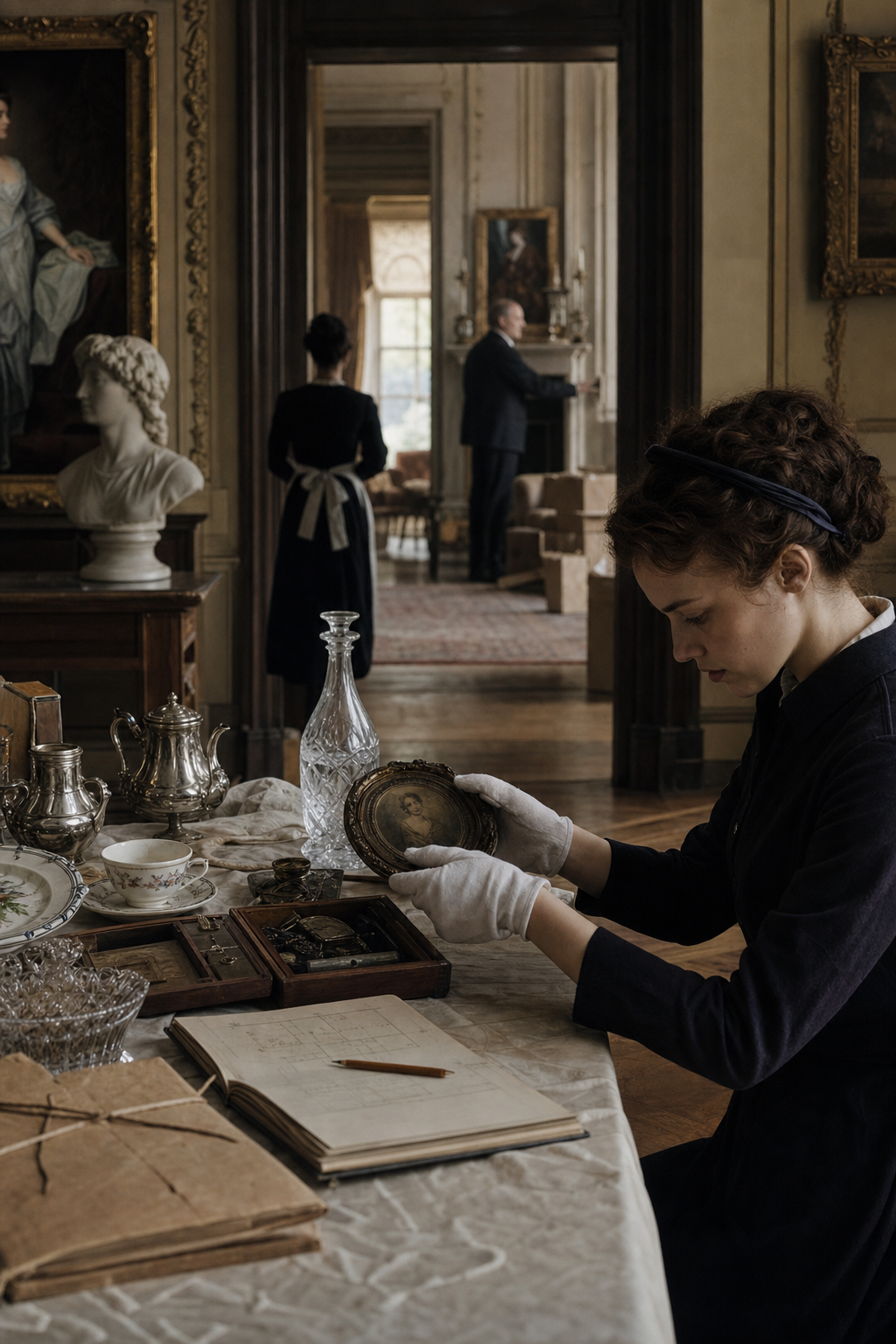
THE INVENTORY
As a dying country house is prepared for the public, a head housemaid begins reading the secrets hidden in its rooms.
Chapter 1
The morning room had been left as though absence were a temporary inconvenience that good order might correct.
Ellen set the ledger on the escritoire, placed the stack of tissue paper beside the first packing crate, and stood still for the space of one breath before beginning. The curtains were drawn to the exact angle Mrs. Carleton had preferred on clear mornings, half-open to the south so the light fell across the rug but did not strike the chair by the window full in the face. Mrs. Carleton's reading glasses remained on the side table, folded, one arm slightly splayed where they had been set down without looking. A water glass sat on its coaster, empty now for six months, the rim filmed faintly with the dullness that comes when no one has had reason to touch a thing again.
The room smelled of furniture wax and cold ash. The fire had not been lit since October. Even so, somebody had dusted the mantel that morning. The house kept up its surfaces.
She opened the ledger. Morning Room, she wrote. March 17, 1947.
The first entries were simple enough. Pair of brass candlesticks, Georgian, fair condition. Oval side table, walnut veneer, one scratch to surface. Reading chair, upholstered, green damask, worn at arms. She moved through the room with the efficiency of long practice, recording, assessing, lifting where necessary, replacing each object with care. The work ought to have been clerical. It was not in her nature to make it so.
The morning room had always belonged to Mrs. Carleton more than any other room in the house. Not officially. Officially the drawing room was hers in company, the dining room hers in management, the garden hers by inclination. But this room had held the shape of her daily life. Ellen knew the order of it the way she knew the order of her own duties. The tray at eleven. The books returned to the left-hand shelf, never the right. The vase by the window changed every third day in summer, every fifth in winter. If the water glass stood nearer the chair than the lamp, Mrs. Carleton had slept badly. If the blanket over the chair-back was folded instead of draped, she expected visitors she did not want.
No one had ever instructed Ellen in these things. Service made such knowledge necessary, and necessity, repeated often enough, became expertise.
She moved to the bookshelves.
There were four shelves built into the alcove beside the fireplace, arranged with the appearance of ease that in practice required constant correction. Poetry on the upper shelf, novels beneath, gardening books lower down, household manuals and local histories nearest the floor. Ellen entered titles, authors, condition. A Byron with a damaged spine. A Tennyson in cheap reprint. A household book on preserving fruit that belonged, properly speaking, below stairs and had never been returned there.
Then her hand stopped.
One volume on the top shelf stood the wrong way round. Not upside down, not thrust carelessly in, but turned spine inward so that the fore-edge faced the room and the title was hidden against the wall. Every other book on the shelf faced correctly. This one did not.
Ellen looked at it for a moment without touching it. A discrepancy in a room so exact was never only itself.
She drew the book out carefully. Keats. Lamia, Isabella, The Eve of St. Agnes, and Other Poems. First edition, or near enough to it to matter. The binding was dark green cloth, rubbed pale at the corners. She opened the cover.
Inside the front board, in pencil, was a line in a hand she knew at once.
Found this for J. October 1923.
Weatherell.
Not because the note was signed. It was not. But she had seen that angular script for twelve years on wine ledgers, silver inventories, memoranda tucked into drawers: two decanters sent for repair, napery counted and put by, one gravy spoon missing after the bishop's luncheon and subsequently recovered from under the sideboard. The butler's hand had been in the house everywhere. Even now, five years after his retirement, his writing remained in labels and books and the backs of cupboards no guest had ever opened.
Beneath it, in a rounder hand, lighter on the page:
The Eve is yours. I will keep the nightingale.
Ellen read the two lines again. Then a third time. They did not explain themselves. They were not meant to. Yet their shape was unmistakable. Not ownership exactly. Not conversation exactly. Something between.
The room had altered while she stood there. Nothing visible had changed. The lamp remained where it was. The glasses remained folded. The south light remained on the carpet. But the room had acquired depth, the way a wall acquires depth when one discovers there is a space behind it.
She looked at the shelf from which the book had come. The gap it left was narrow and dark.
In the passage beyond the door a floorboard sounded, then stilled. Ellen closed the cover without haste and lowered the book to the table beside the ledger.
Mrs. Hale appeared in the doorway.
She did not enter at once. Her gaze moved first over the room in a single trained sweep—the crates, the tissue paper, the open ledger—then to Ellen's hands, then to the Keats on the table. Her face, as always, was composed into the expression appropriate to a housekeeper supervising a task already underway.
“That one should go to Mr. Carleton's personal collection,” she said. “Mrs. Carleton was fond of it.”
The instruction came quickly. Too quickly for a casual decision.
Ellen rested her fingers on the cover. “Very good, Mrs. Hale.”
Mrs. Hale stepped fully into the room. “You may note the title only. There is no need to trouble over the details of each volume if they are destined for the family apartment.”
“No, Mrs. Hale.”
A pause followed. Not long. Long enough.
Mrs. Hale's eyes moved to the shelf where the book had stood, to the narrow vacancy among the poetry, then back to Ellen. The look was not questioning. It was an assessment of whether anything requiring correction had already occurred.
“If you finish here before luncheon,” she said, “the morning room accounts in the desk are to be left for Mr. Kenning. He'll require them this afternoon.”
“Yes, Mrs. Hale.”
Mrs. Hale inclined her head and withdrew.
When the door had closed, Ellen remained where she was. On the table, under her right hand, the Keats felt heavier than cloth and paper should. She opened the ledger and wrote, in the proper column, Keats, John. Lamia, Isabella, The Eve of St. Agnes, and Other Poems. Good condition. To family collection.
She did not record the inscriptions.
The omission sat in the ledger like a button left undone.
By half past eleven she had finished the shelves, the ornaments, and the contents of the writing table's upper drawer. The lower drawers she left untouched, as instructed, for Mr. Kenning. She was wrapping a porcelain shepherdess for the crate marked retain when the door opened again and a man crossed the threshold with a sheaf of papers in one hand.
David Kenning paused just inside, as people did in rooms they were not wholly sure belonged to them. He was not family and not servant, and every doorway in Hartfield seemed to remind him of it. “Miss Grainger,” he said.
“Mr. Kenning.”
He moved to the escritoire, set down his papers, and unlocked the lower drawer with a key from his pocket. He worked standing up, head bent, sorting account books into two piles, one for the estate office and one, apparently, for Mr. Carleton's review. Ellen returned to the shepherdess. The room held them both without accommodating either.
They exchanged no more than courtesy required.
“This drawer may remain empty once I've done,” he said after a moment, not looking up.
“Yes, Mr. Kenning.”
“The Trust fellows want household expenditures for the last three years.”
“Yes, Mr. Kenning.”
His voice carried none of Mrs. Hale's authority and none of Mr. Carleton's assumption of obedience. It had the careful neutrality of a man who had learned that every instruction altered according to whom he gave it to. Ellen had noticed that about him before. He belonged nowhere cleanly enough to speak carelessly.
When he finished, he gathered the ledgers, nodded once, and left the room.
Only after the door had shut did Ellen see the pen.
It lay on the far corner of the desk, not in the pen tray but on the bare wood, set at a slight angle toward the mantel where she stood. Black barrel, silver clip. His, not the household's. She had seen him use it at breakfast beside his ledgers in the servants' hall, where he sat at the side table neither among them nor apart enough to be comfortable.
She looked at the pen, then at the empty tray beside it.
The proper thing was obvious. Pens went in the tray. Misplaced objects were corrected. That was the work.
She crossed the room and picked it up. It was still faintly warm from his hand. She put it in the tray.
Then she stood for a moment longer than the task required, her gaze resting on the alignment of the tray, the ledger, the stack of papers he had left square to the desk blotter. Everything correct. Everything in order.
Everything not.
At luncheon, the servants' hall was noisy by Hartfield's present diminished standards, which meant Peggy talked while Mrs. Lennox served the suet pudding and Mrs. Hale let the talking continue because stopping it would have acknowledged it. Peggy had heard from the kitchen maid at the vicarage that the National Trust lady coming next month wore trousers in the country. Mrs. Lennox said women had worn stranger things in wartime and the nation had not yet collapsed, though it continued to make a fair attempt. Mrs. Hale ate in measured silence at the head of the table. Mr. Kenning sat at the side table with his papers and his separate plate, turning pages while he ate as though the act required no companionship and expected none.
Ellen listened with enough attention to answer if spoken to and no more. She knew the angle of Mrs. Hale's shoulders meant strain. Six weeks to prepare the principal rooms was too little. She knew Peggy's chatter increased when anxious. She knew Mr. Kenning did not belong at the side table by nature but by necessity, and that he held his body in the servants' hall with the same caution one used crossing polished floors in wet shoes.
When the meal was done and the dishes cleared, Ellen went upstairs again.
Her own room was small and cold, under the eaves in the servants' wing, with a narrow bed, washstand, and one trunk at the foot of the bed containing all that was hers. She shut the door, took off her apron, and from its pocket drew the small notebook she had kept for years. Not an official record. Her own. The entries were brief and in pencil, useful things at first—Mrs. C dislikes chrysanthemums in the morning room after rain; blue guest soap kept in lower linen cupboard now—and over time less useful in any practical sense and more difficult to stop making.
She turned to a fresh page.
Keats, she wrote. Spine in. Two hands.
She looked at the words after writing them. Then she closed the notebook and slid it beneath her folded nightdress in the drawer.
Outside her window the house stood in its March light, forty-seven rooms and fewer fires than before the war, the east wing dim, the long façade composed. Somewhere below, a door shut softly. Somewhere farther off, beyond the lime avenue, a rook called from the bare branches.
In the morning room, on the shelf where every other volume faced outward, there remained a narrow gap where one book had stood turned toward the wall, waiting for a hand that knew enough to notice.
In austerity-era England, Hartfield House is being catalogued before its grand rooms pass to the National Trust. Ellen Grainger, the house's sharp-eyed head housemaid, is assigned to inventory the late Mrs. Carleton's rooms and begins finding a hidden language written in books, garments, silver, and placement. As the evidence points toward a decades-long secret attachment within the household, Ellen is drawn into a struggle with the housekeeper over what should be preserved, erased, or left unread.
- —Ellen Grainger — Hartfield's thirty-four-year-old head housemaid is quiet, exacting, and exceptional at reading what rooms and people reveal without meaning to. Tasked with leading the cataloguing, she becomes the interpreter of the house's hidden grammar even as it begins to mirror her own guarded way of feeling.
- —David Kenning — The estate secretary is a war-returned outsider who belongs neither upstairs nor below stairs. His gift for reading documents, omissions, and material traces lets him recognize Ellen's precision, and their connection begins in the same oblique language of objects she is uncovering in the past.
- —Mrs. Hale — Hartfield's formidable housekeeper governs the reduced household with total composure and fierce loyalty. She has spent years protecting Mrs. Carleton's silences, and Ellen's discoveries turn her into a courteous but implacable opponent.
- —Judith Carleton — The late lady of the house appeared to be the perfect mistress of Hartfield: gracious, cultivated, and dutiful. Through marginalia, hidden keepsakes, and secret spaces, she emerges as the unseen author of a long private attachment conducted entirely through the house's objects and rituals.
- —Thomas Weatherell — Hartfield's retired butler lives alone in a cottage on the estate, still carrying the discipline of service in every gesture. He is the living half of the buried story Ellen is excavating, and his restraint gives that story its deepest ache.
- —George Carleton — The master of Hartfield is a decent, practical widower trying to shepherd his family house into a diminished future. He lives wholly in the visible order of the estate, and his sincere grief for his wife becomes one of the story's hardest moral facts.
- —Mrs. Lennox — The cook keeps the house running with warmth, pragmatism, and a talent for smoothing over what ought not be examined. Her comfortable explanations reveal how many people have quietly helped maintain Hartfield's fictions.
- —Peggy Innes — The young under-housemaid is competent, sociable, and untouched by Ellen's compulsive depth of perception. She shows how much easier the house is to live in when one sees only what is on the surface.
- —The Opening: With Hartfield House being prepared for public stewardship, Ellen begins cataloguing Mrs. Carleton's rooms and immediately finds signs that objects in the house have been arranged as messages rather than mere possessions. A spine-turned book, paired annotations, and small irregularities awaken her sense that the estate contains a second, submerged order.
- —The Reading: As Ellen moves through the library, guest rooms, silver pantry, and dressing room, separate clues resolve into a decades-long hidden exchange between Judith Carleton and the former butler, Thomas Weatherell. She also realizes the silence around that exchange has been collectively maintained by the household, even as David Kenning begins speaking to her in the same oblique language of objects.
- —The Resistance: Mrs. Hale's efforts to steer, bury, or dispose of certain finds make clear that the inventory is also a battle over memory and control. Ellen's conflict with her stays outwardly professional, but each disputed object sharpens the question of whether reading these traces honors the dead or violates the silence that sheltered them.
- —The Descent: In the attic, Ellen discovers unsent room-descriptions in Judith's hand that reveal a devotion built from total attention, and a formal dinner makes the hidden code collide painfully with the house's public rituals. The search leads at last to a concealed room with two plain teacups, the private center of a bond the household was built to deny.
- —The Arrangement: After carrying what she has learned to Weatherell and witnessing the cost of a life lived under perfect restraint, Ellen faces the question of what to do with the hidden archive before Hartfield becomes a monument. She chooses through placement rather than confession, preserving the secret grammar inside the house even as her own connection with David remains suspended in that same charged language.
Measured, elegant, and quietly devastating, the prose is precise rather than florid, with feeling carried through observation, omission, and material detail. The voice stays close to Ellen's disciplined perception, attentive to hierarchy, gesture, and placement. Its sensory world is candlelight and weak electric lamps, waxed wood, cold corridors, paper, linen, silver, and the hush of a house becoming a museum.