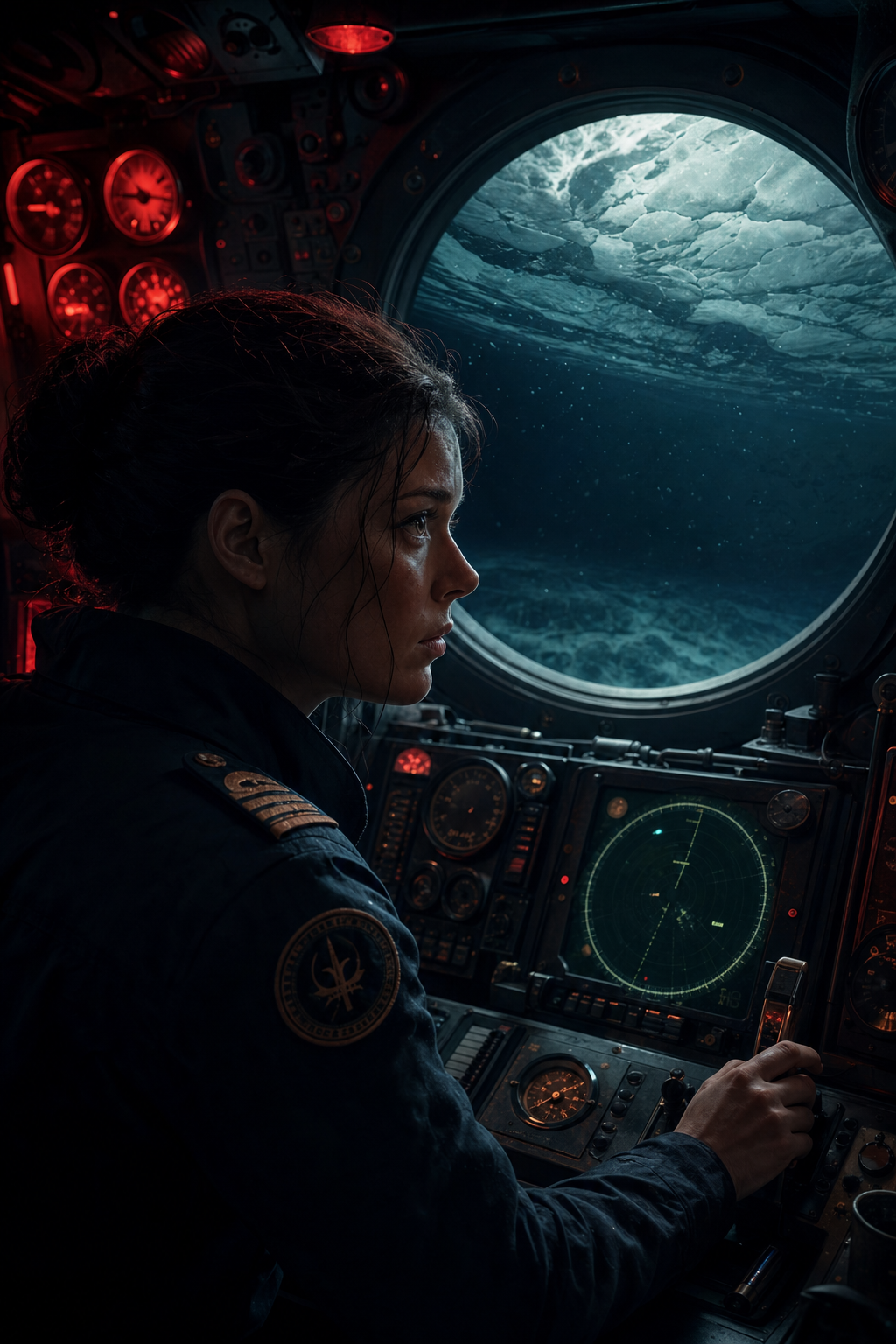
THE HULL
Beneath Arctic ice, a submarine XO must keep a damaged boat alive as command itself begins to fail.
Chapter 1
The number four ballast pump had developed a knock.
It sat beneath the boat's ordinary voice as a soft arrhythmic tick under the recirculation system's steady drone, faint enough that anyone who had not spent eleven days inside the Vanguard would have missed it entirely. Maren Lindqvist had been listening to it for forty minutes. The interval had not widened. It had not tightened. It stayed where uncertain things stayed on submarines: between healthy and failing, not yet a problem, already a trajectory.
She filed it with the others.
Half a degree of list to port that the trim tanks had corrected only to within tolerance, not preference. Okafor in engineering running double shifts since Voss had gone down with the stomach virus two days before the dive. Fourteen hours to the first deep-channel waypoint. Sixty-eight hours to the polynya.
The boat hummed around her. Reactor, ventilation, ballast cycling, the low electrical grain of the control systems, all of it layered into a single sustained chord that healthy machinery held without effort. The periscope housing under her palm carried a fine vibration from the deck. Ahead, Chen sat at the helm with both hands resting lightly on the controls, making corrections small enough to live more in his fingers than in the boat. Reznik leaned toward her sonar console, one hand cupping the edge of a headphone earpiece as if pressure from her own fingers could improve resolution. The red night lighting flattened faces and softened corners. Every station was occupied. Every sound belonged where it belonged.
Under the ice, that was as close to safety as the world allowed.
“Bearing of charted keel, two-one-zero,” Reznik said. Her voice was quiet, shaped to the room rather than sent through it. “Range twelve hundred.”
Carrow stood on the command platform with one hand on the rail. He had the stillness good captains cultivated deliberately, the kind that bled into the crew and lowered pulse rates by example. “Come right three degrees,” he said.
Maren repeated it without thinking. “Right three degrees.”
“Aye,” Chen said.
The correction was so small she felt it first through the soles of her boots. The deck angle changed, then settled. The list indicator on the panel shifted and steadied. Somewhere aft, the number four pump kept knocking in its faint, unresolved way.
Carrow glanced once at the chart projection, not at Reznik’s live returns. The chart placed the ice keel at forty-five meters below the surface. Reznik’s passive feed showed a density consistent with that, though the return was blurred at this range, a shape more inferred than seen. He did not ask her for confirmation.
Maren noticed it and filed it.
Not an error. An omission. Known data weighted over live data. In open water it would have meant nothing. Under the ice, everything meant something eventually.
The last transmission from shore had come six minutes before they passed beneath the ice edge. Weather update. Confirmation that the polynya was expected to remain open for the next ninety-six hours. Nothing in the coded burst had carried a human voice. The communications mast had been retracted before the dive. Since then there had been only the submarine's own sounds and the water pressing on the hull.
Sealed.
Watts passed the after side of the control room hatch carrying a toolkit, moving toward the weapons spaces with his usual methodical pace. A moment later the faint, regular click of his tool check began from forward. Wrench seated in outline. Next wrench. Next. The same order every time. The sound moved through the hull like a metronome.
Crewed, Maren thought, though she did not say it because there was no reason to.
She shifted her attention to the trim readouts. The backup pump was cycling harder than she liked, drawing a little more current than it should have needed at this depth. The note of the motor sat a quarter-tone high. It did not require action. It required memory.
“Passive returns on overhead ice are broadening,” Reznik said. “Ceiling irregular. Likely pressure ridge.”
Carrow nodded once. “Maintain depth. Keep speed.”
Maren relayed. Chen obeyed. The boat continued northeast beneath a ceiling none of them would see.
The corridor from the Barents side into the under-ice channel had narrowed over the last hour. The charts said it would open again after the next deep-water contour. The charts also said the keel they had just cleared was clean and regular, which had been true enough at a distance to count as correct. Maren watched Chen’s hands, then the depth gauge, then the trim. Her body kept track of the rest without being asked. The slight coolness in the deck plates. The ventilation cycle staying within its normal rhythm. The exact place in the boat’s chord where the pump knock lived.
A submarine that was healthy sounded occupied. A submarine that was failing announced it by subtraction.
She crossed to Reznik’s station, steadying herself with two fingers against the console edge as the Vanguard passed through a patch of slightly rougher water. Reznik did not look away from the display.
“Give me the raw return on the ridge.”
Reznik toggled the feed. “Resolution’s muddy at this angle. Thermocline interference.”
On the screen the overhead terrain looked less like a map than a judgment call. Ambiguous edges. False depths. Sound bent by cold water and returned altered.
“Confidence?” Maren asked.
“Seventy percent on the floor. Sixty on the ice.”
Maren nodded and straightened. Sixty percent under ice was usable. It was also how people hit things.
Behind her, Carrow said, “Mark our time to waypoint.”
Chen read it off. Maren listened to the answer and converted it automatically against current speed, remaining battery margin, reduced engineering staffing, and the known strain on the ballast backup. The arithmetic lived in her body by now. Not conscious, not verbal. A model held under the sternum and updated every few seconds.
She moved to the hatch and stepped into the passage toward midships. The air changed by almost nothing, but enough for her to notice. Slightly cooler. Slightly wetter from galley steam that had not fully cleared the compartment. Harlan was in the medical bay doorway, inventory sheets in one hand, glasses low on his nose. He looked up as she passed.
“Any change in Voss?” she asked.
Harlan shook his head. “Hydrating. Miserable. Not useful.”
“Keep him off-watch.”
“As if he had an alternative.”
Maren moved on. In the crew quarters a pair of off-watch sailors were asleep in stacked bunks, mouths slightly open in the recycled air, their curtain straps tied back for ventilation. In the galley, a mug had been left beside the sink with a tea bag drying against the enamel. Small signs of ordinary function. Biological systems nested inside mechanical ones.
From aft came the denser, steadier hum of engineering. She did not need to go there. She went anyway.
Okafor was bent over a panel with a diagnostic lamp clipped above his shoulder. He straightened when he sensed her rather than when he heard her, wiping one hand across a rag before touching the control surface again. His movements in engineering always had the same quality: economy without haste, nothing extra, no borrowed momentum. The burn scar on his left forearm caught the light pale against dark skin and disappeared again.
“How’s the AIP module?” Maren asked.
“Stable.” He glanced once at a gauge. “Coolant temp running clean. Number four backup’s pulling harder than it wants.”
“I hear it.”
“I know.”
No further explanation was needed. Between them, explanation was wasted time once the problem had been jointly observed.
“You’ve been up too long,” she said.
Okafor adjusted a valve one incremental notch. “So has the boat.”
Maren accepted that because there was nothing else to do with it. She let her hand rest briefly against the bulkhead near the panel. The metal was warm here from machinery, a living heat generated at cost and held against an ocean that would strip it away without effort. She listened. Reactor. Pumps. Ventilation. No new note of distress.
“Call me if the current draw shifts.”
“I’ll call before it shifts.”
She nodded and turned back toward control.
By the time she returned, Watts’s tool check had ended. The absence of the clicking was immediate and distinct, the way silence was immediate after a pump cut out. Carrow had not moved from the platform. Chen still held the course. Reznik had settled deeper into her headphones, chin tilted slightly, listening into cold water and ice.
Maren took her place by the periscope housing again. The uselessness of the retracted scope under ice did not matter. It was still where she stood. Still where the boat arranged itself in her mind.
“Overhead profile sharpening,” Reznik said. “Pressure ridge confirmed. Keel extends deeper than chart by... stand by.” She adjusted the earpiece with two fingers. “Correction. No. Return is scattering. Could be false depth.”
Carrow looked at the chart. “Hold course.”
Maren’s eyes moved to Reznik’s display, then back to Carrow, then to Chen’s hands. Nothing in the room changed. The order was reasonable. The data was uncertain. Still, something in her assessment failed to settle.
The number four ballast pump knocked softly beneath everything else.
She let her attention widen until it held the whole boat again: cold water beyond the hull, ice above, crew at stations, Okafor aft, Harlan midships, Watts forward, Voss sick in his bunk, sixty-eight hours to the polynya. The Vanguard moved under the Arctic ceiling on electric breath, all thirty-four lives contained in steel and procedure and the competence of the people inside.
Carrow said, “Log the ridge and continue.”
Maren logged it.
The boat went on humming.
Aboard the KNM Vanguard, a Norwegian attack submarine on a sealed under-ice transit, Commander Maren Lindqvist serves as executive officer in a world ruled by pressure, machinery, and irreversible decisions. When collisions, flooding, and system failures begin to cascade through the boat, her gift for ruthless operational triage becomes indispensable. But as her captain's judgment quietly deteriorates, every correct call saves the submarine by cutting away part of the crew, the chain of command, or both.
- —Commander Maren Lindqvist — The Vanguard's executive officer is a veteran submariner with an uncanny instinct for diagnosing cascading failure and making the cut that saves the whole. Her strength is triage under pressure, but every sacrifice she orders erodes the crew and command structure she depends on most.
- —Captain Karl Carrow — Carrow is the submarine's respected commanding officer, calm, credible, and deeply trusted by his crew. After an early head injury, his judgment degrades by degrees, forcing a devastating conflict between legitimate authority and operational reality.
- —Chief Engineer Tomás Okafor — Okafor rules engineering with quiet precision and is the crewmate Maren trusts most completely. Their bond is built on shared competence rather than confession, and his injury makes visible how much the boat and Maren rely on his hands.
- —Lieutenant Wei Chen — Chen is the Vanguard's navigator and helmsman, a still, exacting operator who guides the submarine through impossible spaces with almost no wasted motion. His trust with Maren is geometric and wordless, expressed through course changes measured in fractions.
- —Petty Officer Irina Reznik — Reznik is the young sonar operator on her first under-ice deployment, talented enough to matter and inexperienced enough to be tested hard. As the submarine's ears, she becomes the crew member closest to approaching danger, hearing threats long before anyone can see them.
- —Lieutenant Brian Watts — Watts, the weapons and damage-control officer, believes in procedure and chain of command with near-religious rigor. He becomes Maren's chief internal antagonist because his loyalty to the same structure she values leaves him unable to accept the moment she breaks it.
- —Lieutenant Commander James Harlan — Harlan is the medical officer whose subtle diagnosis reveals that the captain may no longer be fit to command. He cannot make the crisis self-evident, only state the truth and leave Maren to decide what that truth demands.
- —Petty Officer Costa — Costa is an efficient torpedoman in the forward compartment, more known by his place in the boat than by grand personal drama. His fate gives hard proof that survival aboard Vanguard comes with an ordinary human cost, not an abstract one.
- —The Sealed System: The Vanguard disappears beneath the Arctic ice on a seventy-two-hour transit with no communication, no surfacing, and no margin for error. XO Maren Lindqvist monitors a boat that still functions as a disciplined whole, while tiny faults and a subtle lapse in her captain's judgment begin to register.
- —The Crack: An uncharted ice keel triggers the first collision, damaging sonar, ballast, and key systems while Captain Carrow suffers a head injury that appears survivable. As cold, fatigue, and equipment loss accumulate, Maren starts making necessary sacrifices and quietly learns that Carrow's thinking may be deteriorating.
- —The Cut: When a major under-ice impact triggers simultaneous flooding and reactor danger, Carrow makes the wrong call and Maren overrides him to save the submarine. The boat survives, but a crewman is lost and the authority structure fractures, forcing Maren to formally relieve the captain on medical grounds.
- —The Long Dark: Now in command of a crippled submarine, Maren must carry a divided crew through the transit's hardest stretch with fewer systems, less trust, and an injured chief engineer. The voyage becomes a grind of attrition until the crew achieves a brief, perfect synchronization threading a deadly under-ice choke point.
- —The Run to Air: That hard-won unity is immediately tested by a hostile submarine blocking the approach to the polynya. With weapons gone, the hull overstressed, and every earlier compromise coming due at once, Maren must gamble what remains of boat and crew on one final push for open water.
The prose is tight, disciplined, and diagnostic, anchored in Maren's operational attention to sound, pressure, heat, and mechanical drift. Crisis scenes compress into clipped, procedural intensity, while quieter passages widen just enough to let exhaustion, dependency, and grief register through physical detail. The sensory signature is all steel, cold water, failing systems, and the intimate acoustics of a submarine under strain.