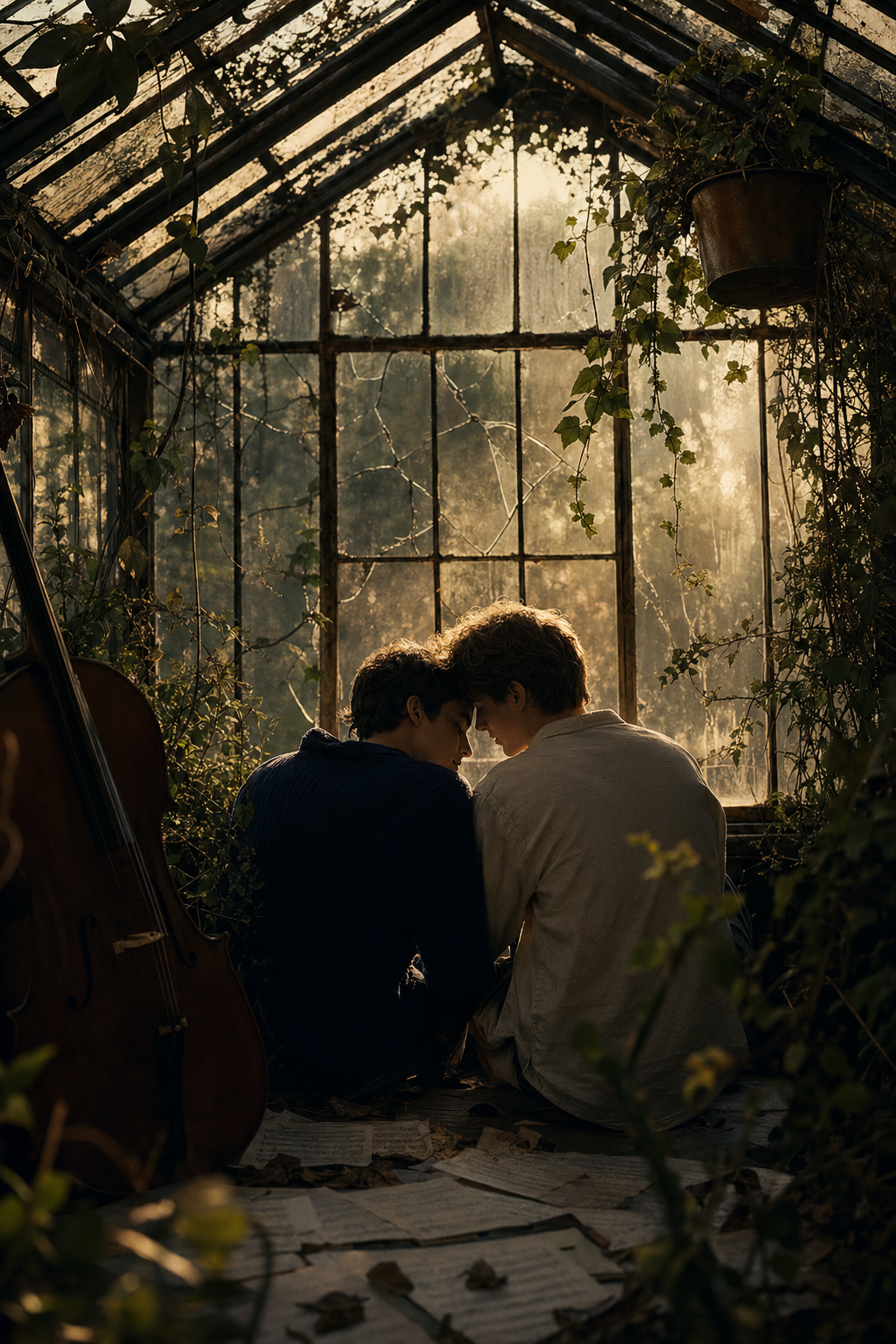
THE HOUSE WHERE WE LEFT OUR VOICES
At an elite music conservatory, two queer love stories echo across decades in a greenhouse built for seeing and hiding.
Chapter 1
The Great Hall at Thornfield smelled of floor polish, damp wool, and the faint old-paper scent of a building that had spent too many years teaching people how to sit still in rows.
Margot Calder sat in the third row with her cello case leaning against her knee, both hands folded over the handle because there was nowhere else useful to put them. Around her, the new term arranged itself in small, familiar noises: the rustle of blazer sleeves, a cough quickly suppressed, the low murmur of students who already knew one another and students pretending not to mind that they didn't. Grey September light came through the tall windows in long, diluted bars. It made the dust visible. It made the portraits along the paneled walls look as though they were emerging from weather.
On the stage, Dr. Whitmore stood behind the lectern with the patient gravity of a man who had been welcoming gifted adolescents to Thornfield for twenty years and still believed the speech mattered.
“...discipline,” he was saying, “is not the opposite of feeling, but the means by which feeling becomes intelligible—”
Margot kept her face arranged in what she hoped was attentive seriousness. She was good at this part. Good at first mornings, good at institutional rituals, good at producing the expression a room required before the room had fully decided to require it. She had been at Thornfield less than a week and already knew where to sit, when to nod, how to hold her shoulders so she looked composed rather than tense. Her mother would have called it carrying herself well.
Her thumb pressed, without thought, into the callused pad of her left index finger.
To her right, James Barrow shifted in his seat and nudged his clarinet case closer to his shoes with the side of one polished black loafer. He had introduced himself at breakfast with the easy cheer of someone who had never once doubted that new places would like him. Margot liked him immediately for it, though she suspected she would never understand the mechanism.
Dr. Whitmore went on, his voice echoing gently against the high plaster ceiling.
“...you have all arrived here because you possess unusual talent. Talent, however, is only the beginning—”
Someone two rows ahead moved.
It was nothing. A minor adjustment, the ordinary resettling of a body on a hard wooden chair. And yet Margot’s eyes went to it before she had decided to look.
A girl sat slightly left of center, the back of her neck visible above the collar of her white shirt. Her hair was cropped short at the nape in a way Margot had not seen much at home, practical and careless at once, and one side of her collar had folded inward. She lifted a hand and tugged it straight without seeming to think about it. Quick fingers. A small, unselfconscious gesture.
Margot looked back at the stage.
Dr. Whitmore’s mouth was moving. Students around her were still and listening. Somewhere near the back of the hall, a chair creaked.
She had not heard the last sentence.
Heat moved through her, not dramatic, not even nameable. Just a brief change in temperature, as though someone had opened a door somewhere in the building and a different current of air had found her where she sat. She pressed harder into the callus on her fingertip and fixed her attention on the principal’s tie, a sober burgundy with a small repeating pattern that looked, from this distance, like notation marks.
“...the privilege of studying here,” Dr. Whitmore said, “is inseparable from the responsibility—”
The girl turned slightly to whisper something to the person beside her.
Margot looked again.
This time she saw the line of a cheek in profile, the corner of a mouth lifting around whatever private remark had just been made. Not a polite smile. Something warmer, less arranged. The expression was gone almost immediately, given to someone else and not meant to be witnessed from the third row by a stranger with a cello case between her knees. But it had already landed.
The room altered around it.
Not visibly. The Hall remained itself: wood paneling dark with age, winter-weight curtains tied back from the windows, the Thornfield crest painted over the stage in gold that had dulled slightly with time. The students remained students. Whitmore remained Whitmore. Nothing changed except the position of Margot’s own attention, and that was enough to make the next few seconds feel bent, as though she were looking at them through old glass.
She forced her gaze forward.
Do not be ridiculous, she told herself, though the thought arrived without much force. She had no clear idea what exactly was meant to be ridiculous. Looking at people was not a crime. Noticing things was not a crime. A room this full all but required one’s eyes to land somewhere.
Beside her, James leaned a fraction closer and whispered, barely moving his mouth, “If he says ‘musical excellence’ one more time, I’ll expire quietly in the aisle.”
The joke was mild, but Margot laughed anyway, a real small sound before she had time to smooth it into something more decorous. James grinned at having earned it and sat back. Dr. Whitmore paused just long enough that a few heads lifted guiltily, and then continued with the unhurried patience of a man accustomed to being endured before he was appreciated.
Margot folded her hands more tightly over the cello case handle.
She was here. That fact kept arriving in pieces, as if her mind had not yet finished believing what her body had already enacted: the train south from Edinburgh, the drive from the station through wet green countryside, the first sight of Thornfield rising out of trees like something from a novel set in a century with fewer practical inconveniences. Thornfield Hall. Converted estate, elite conservatory, all its old stone and strict timetables and corridors lined with photographs of former students who had gone on to become people other musicians spoke of with particular care. She had wanted this. Had worked for it. Auditioned for it with hands so cold afterward she could barely fasten her case.
And now she was in the Great Hall in a neatly pressed uniform, listening to the welcome address, exactly where she was meant to be.
On the walls, the portraits looked down with their permanent air of having survived judgment and therefore earned the right to pass it on.
Margot was good at belonging to places like this, or at least at making herself useful to them. She showed up early. She learned names. She knew when to speak and when to let silence do the work. Even at seventeen she understood that reliability softened most rooms before you entered them. If you made yourself easy to teach, easy to praise, easy to place, people tended to hold their affection steady.
The thought arrived and left so quickly she barely felt it: easy to place.
The principal’s speech moved toward its end. Something about discipline again. Something about community. Something about the honor of joining a lineage. Students shifted with the subtle collective anticipation of release.
Two rows ahead, the girl with the cropped hair leaned back for a moment, resting her weight on her hands. Margot saw one narrow wrist disappear into the cuff of a blazer that looked slightly too large, as if borrowed from an older sibling or bought secondhand and made to do. There was a scuff on the heel of her shoe.
Margot looked away before the girl could turn.
This time she kept her eyes on the stage long enough to hear the final lines.
“We ask much of you here,” Dr. Whitmore said. “Not because we are cruel, but because music asks much of anyone who would serve it honestly. Welcome to Thornfield.”
The applause was immediate, relieved. It filled the Hall and bounced off the high ceiling in a softened roar. Students began rising in uneven rows, gathering instruments, smoothing skirts, adjusting bags onto shoulders. The spell of forced stillness broke all at once.
James stood, then bent to retrieve his clarinet case. “Come on,” he said. “If we’re not swift, the second-years will strip the dining hall of everything edible.”
Margot rose with him, one hand on the neck of her cello case. Around her, the hall became motion and fabric and voices crossing over one another. She could have let the crowd carry her toward the doors without thinking. Instead, against her better judgment and with no practical purpose whatsoever, she looked once more over the shifting line of shoulders ahead.
The girl was standing now.
She had turned partly sideways to let someone pass, and Margot saw her face properly for the first time: small and quick and entirely unguarded in a way Thornfield did not yet seem to encourage. Expressive mouth. Dark brows. Eyes alive with some private impatience. She was saying something to the student beside her, and whatever it was made them both laugh.
Then the crowd moved between them, a blur of navy blazers and instrument cases, and she was gone into the aisle.
“Margot?” James said.
“Yes. Sorry.”
She adjusted her grip on the cello case and followed him out with the others into the corridor, where the building closed around them in dark wood and muffled sound. Somewhere behind one of the doors farther down the hall, someone had already begun practicing scales. The notes came thinly through the wall, steady and impersonal.
Margot walked at James’s side, nodding in the right places, answering when spoken to. Her face had found its proper expression again. If anyone had looked at her, they would have seen a first-year cellist making her way sensibly toward lunch on the first morning of term.
Only once, as they turned toward the stairs, did she feel the slight wrongness inside her settle into place.
Not gone. Just shifted. Like a piece of furniture moved half an inch from where it had always been, enough that you would catch your hip on it in the dark for weeks before your body learned the room again.
At Thornfield Hall, a prestigious English music conservatory where every practice room has a glass door, students learn to turn feeling into performance and keep their private selves hidden. In 1998, gifted cellist Margot Calder is drawn to the openly bisexual Helen Ashworth; in 2019, Margot's son Isaac arrives carrying the same instinct for silence and finds himself falling for violinist Noel Perreira. Across both timelines, the same question haunts the greenhouse at the edge of campus: what does it cost to be truly seen?
- —Margot Calder — A gifted Scottish cellist in 1998, Margot is disciplined, admired, and skilled at being exactly what Thornfield rewards. She knows she is attracted to women, but has locked that truth away so completely that love feels more dangerous than failure.
- —Helen Ashworth — Margot's fellow cellist is brilliant, scholarship-funded, emotionally direct, and openly bisexual in a world that prefers discretion. She becomes the person who sees through Margot's poise and asks to be chosen in daylight, not just in private.
- —Isaac Calder — In 2019, Margot's eighteen-year-old son returns to Thornfield as a sensitive, well-liked pianist with a carefully managed life. He has long understood his attraction to boys, but has never let that knowledge change the shape of his world.
- —Noel Perreira — A luminous violinist who is already out, Noel is quiet, exacting, and far more emotionally brave than he first appears. As Isaac's duet partner, he offers honesty without spectacle and eventually refuses to accept half-measures.
- —Professor Eleanor Voss — Margot's cello instructor embodies Thornfield's values: control, polish, and emotion shaped into beauty. She is not cruel, but her guidance teaches Margot that excellence depends on containment.
- —Professor Alan Moss — Isaac's piano teacher is younger and outwardly progressive, urging his students to bring more of themselves into the music. Even so, he still speaks the institution's language of curated feeling rather than disruptive truth.
- —Fiona Grant — Isaac's kind girlfriend back in Edinburgh represents the easiest version of his future. She is not an obstacle so much as the visible shape of the life Isaac can maintain if he keeps performing.
- —Ruth Okonjo — Noel's close friend is a warm, perceptive vocalist who quickly understands the tension between him and Isaac. Her presence grounds the story and quietly pushes the truth closer to the surface.
- —The Glass World: At Thornfield Hall, talent and visibility are inseparable: students rehearse behind glass, perform under scrutiny, and learn that vulnerability is acceptable only when beautifully controlled. In 1998 Margot begins her first term and notices Helen; in 2019 Isaac returns for spring term and feels his bond with Noel shift into something far more dangerous.
- —The Greenhouse: In both timelines, the neglected greenhouse becomes the one place where the institution's gaze loosens and private honesty can almost happen. Margot and Helen grow close through quiet conversations and charged silences, while Isaac and Noel deepen their connection through rehearsals, lingering talks, and the intimate demands of a violin-piano sonata.
- —The Almost: Each pair reaches moments of real exposure that are immediately followed by retreat. Helen names the loneliness and restraint at the center of Margot's life, while Noel hears Isaac truly open in music before watching him pull away from what that honesty means.
- —Inheritance: Pressure tightens around both stories: Margot moves toward a public milestone as fear and self-protection overtake her, and Isaac's inability to reciprocate leaves Noel hurt and distant. When Margot returns to Thornfield as a parent and reacts to the greenhouse with unmistakable longing, Isaac finally senses that his silence is not entirely his own.
- —Breaking the Pattern: Faced with losing Noel and becoming a version of his mother's unfinished life, Isaac enters the greenhouse and speaks plainly for the first time. The final movements braid past and present together as Margot's old wound is acknowledged and Isaac's music, choices, and relationships begin to move out of performance and into truth.
Lyrical but restrained, with intimate close-focus prose that tracks the body before it names emotion. The voice is tender, observant, and steeped in sensory detail: warped greenhouse light, damp heat, polished corridors, muffled scales through walls, and the physical charge of two people almost touching.