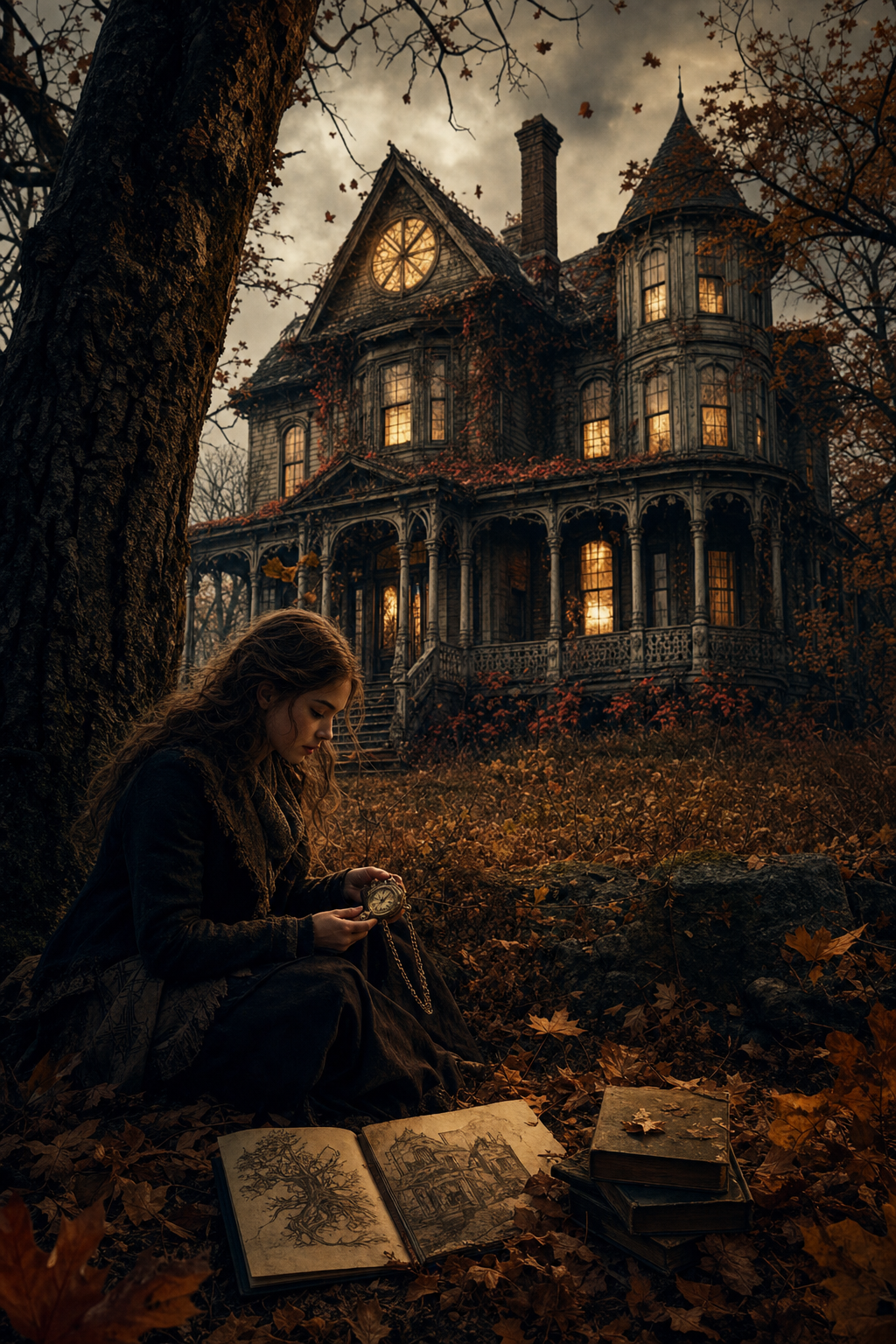
THE HOUSE THAT REMEMBERS
After her mother's death, a woman returns to an old New England house where grief opens a staircase below the world.
Chapter 1
Elena left Boston at four-thirty in the morning, when the city was still more absence than place, its windows dark, its traffic thinned to the occasional passing set of headlights moving through black intersections like fish beneath ice. She had not slept much. For six months now, sleep had come to her in narrow pieces, never enough to feel like rest, only enough to separate one waking from the next. She drove with both hands on the wheel and the radio off, letting the engine and the tires make the only sounds the car contained.
North, the road narrowed. The towns grew smaller without announcing that they were doing so. Streetlights became less frequent. Houses sat farther back from the road, their porches dark, their yards littered with leaves that the wind had pushed into drifts against stone walls. It was late October, the part of the season when beauty had already begun its conversion into skeleton. The maples were mostly bare. The oaks still held on, their leaves the color of rust and dried blood, and when her headlights caught them they flashed briefly like old copper before the dark took them back.
She did not think, in any deliberate way, about why she was driving to Harrowfield. The estate had to be settled. Papers had to be found. The house had to be sorted. These were true things, and they were the kind of truths that could be spoken aloud to a lawyer, to Tom, to anyone who required a reason that fit inside daylight. The real reason had no daylight shape.
The house remembers your name. Go down when you’re ready.
Her mother had said it in a hospital room in Springfield that smelled of antiseptic and overheated air, with fluorescent panels whitening everything they touched. Eighteen months of illness had reduced Iris Morrow one faculty at a time. In the last three months, speech had mostly left her. What remained had come in fragments, some lucid, some drifting. Elena had never known which this sentence was. For six months she had carried it without answering it, turning it over in the closed chamber of her chest until the words had worn smooth without growing any lighter.
By the time she reached the state route that forgot itself into gravel, the sky had begun the slow, grudging brightening that passes for dawn on a cloud-covered October morning. Not sunrise. Just a lessening of black into iron gray. The final stretch of road was lined with oaks leaning toward each other until their branches knit overhead. The arch they formed was darker than the road behind it, and deeper, as though the lane passed for a moment through another season before opening into the clearing.
Then the house stood before her.
It had always looked less built than settled, as if it had lowered itself into the clearing and let the years grow around it. Two stories. Gray-white clapboard. Porch swing unmoving in the still air. The windows reflected the weak morning light without giving anything back. Elena cut the engine and sat for a moment with her hands still on the wheel, listening to the small metallic ticking of the car cooling.
When she opened the front door, the smell met her first.
Woodsmoke. Dried lavender. Old paper. And beneath all of it, the cold mineral scent that belonged not to rooms but to what lay under rooms. The underneath-smell. The one she remembered from childhood without ever having named.
She stood in the hallway and listened.
Old houses were never silent. They clicked, settled, breathed through their walls. But there was another sound here, low and steady and nearly beneath hearing, a hum so faint she might have mistaken it for blood in her ears if it had not seemed to rise from below the floorboards.
The wallpaper in the hallway still wore its pattern of climbing vines, green gone dim with age. As a child she had sometimes stood here too long and watched the pattern until the leaves seemed to shift against the paper. Iris had never told her not to stare. She had only said, once, “Some things move more slowly than we do.”
Elena set her bag down by the stairs and moved through the house in the careful way one moves through the rooms of the dead, trying not to disturb the shape their absence has left behind. In the kitchen, herbs still stood in jars on the windowsill, their leaves crisped to pale ghosts of themselves. In the living room, books were stacked on every surface in the practical, inhabited disorder that had always been Iris’s version of tidiness. The fireplace was clean. The ashes had been swept out before the hospital, before the end, before the house had become a place waiting.
In Iris’s bedroom the bed was made. That undid her more than the smell had. The bed was made because Iris had made it on the morning she left for Springfield and had never come back to unmake it. The coverlet lay smooth, the pillows plumped, the ordinary discipline of a life interrupted at the exact point where habit expected continuation.
On the nightstand sat the fairy-tale book.
It was where it had always been, though she had not seen it in years: dark leather, edges softened by generations of handling, thick with pages that did not belong to any single printer or century. Elena lifted it with both hands. The leather was warmer than the room. When she opened it, it did not fall where a book left undisturbed should fall but somewhere near the back, to an illustration of a woman descending a staircase cut into stone. The woman’s face was turned away. Her hands, long-fingered and reaching, might have been Elena’s own.
She closed the book too quickly and set it down.
In the hall, a clock ticked once and stopped. Elena looked up sharply. The pendulum had not moved in years, yet somehow now the minute hand stood at 3:17, and some childish part of her knew before the adult part caught up that this was the time the hospital nurse had written down six months ago.
She went into Iris’s study because there were papers to find and drawers to open and because practicality, once begun, could still sometimes hold. She opened a box of sweaters first, though she had not meant to. The smell came up all at once when the cardboard flaps parted: not perfume, not detergent alone, but the exact human scent that cotton keeps after years of being worn by one body and no other. Elena picked up the top sweater, blue wool with one cuff gone slightly thin, and pressed it to her face.
The grief did not arrive as tears. It arrived as a collapse of distance. The six months since the funeral disappeared; the hospital disappeared; she was nowhere but here, holding the shape her mother’s arms had left in cloth. She stood in the middle of the room with the sweater against her mouth and breathed as quietly as if someone were sleeping nearby.
Then the hum below the floor changed.
Only slightly. A shift in pitch no larger than a held breath released. But it had direction now. Intent. Elena lowered the sweater and turned her head toward the kitchen, toward the cellar door.
The house had never locked that door. Iris had said there was no point locking what belonged to the house itself. Elena crossed the kitchen without hurrying, though every part of her body had already gone ahead of her and was waiting there. Her hand on the knob felt smaller than it should have. When she opened the door, cold air rose from below, carrying earth and stone.
The steps were just as she remembered them.
Stone, narrow, worn in the middle by a century and more of use. She descended automatically counting, because she had counted them as a child and because the body returns to old rituals when the mind has nothing else to trust.
One. Two. Three.
The hum deepened as she went down, though whether it grew louder or she simply moved nearer to it she could not have said.
Four. Five. Six.
At the bottom lay the root cellar she knew: packed earth floor, shelves with jars of tomatoes and beans, hand-hewn stone sweating cold. Nothing impossible. Nothing but a cellar beneath a house in Massachusetts where women had stored winter against the long dark.
Seven. Eight. Nine. Ten. Eleven.
She stepped off the last stair onto the cellar floor and stood there breathing the old, damp air. The hum was gone, or hidden. She felt foolish at once, and with the foolishness came a hot, defensive embarrassment so sharp it was almost relief. Of course. Of course grief made the ordinary tilt strange. Of course six months of too little sleep and too many half-read sentences from old books had made her hear intention in settling wood.
She turned to go back up.
Her foot, seeking the first stair, found the edge of a step where no step had ever been.
For one suspended second her body knew what her mind refused. Weight shifted into emptiness and did not fall. Stone met the sole of her shoe. Not level ground. Not the cellar floor. A step. Going down.
She did not look immediately. She stood with one foot on the familiar earth and one on the impossible, and in that divided posture the air around her ankles changed. Warmer by a degree. Then another. The smell changed too, leaving behind the blunt cold of cellar stone for something older and stranger, a sweetness threaded through mineral damp the way honey threads through tea.
Very slowly, Elena lowered her gaze.
There, beneath the place where the cellar floor should have ended, another stair descended into amber dimness.
The house hummed.
The sentence from the hospital room moved through her with the terrible softness of something opening.
The house remembers your name.
She did not go down. Not yet. She stood with her hand gripping the wall, her breath shallow, every nerve in her body lit by the knowledge that the thing she had not let herself believe in was under her foot and warm. Then she stepped back onto the cellar floor, climbed the eleven known stairs, and closed the door behind her with care so precise it was almost reverence.
In the kitchen, the room looked unchanged. Counter. Sink. Window. The weak morning light on the boards. But the air had altered. Or she had. There was no way now to tell where the change belonged.
On the table lay her phone, dark-screened, inert, already carrying the first call she knew would come from Tom before noon. On the nightstand upstairs, the fairy-tale book waited with its pages full of women descending. Beneath her feet, the twelfth step existed whether she looked at it or not.
Elena stood in the middle of the kitchen and listened to the house listening back.
In late-October Massachusetts, Elena Morrow returns to her dead mother's secluded house to settle the estate and find out what her mother's last impossible words meant. Beneath the root cellar lies an older layer of reality that opens only to grief, where stories take physical form and every revelation demands a price. As Elena descends, she must choose between the manageable surface life waiting above and the terrible, beautiful truth calling her downward.
- —Elena Morrow — A thirty-two-year-old archive cataloger who has always noticed what other people miss, Elena returns to her childhood home six months after her mother's death. Her grief has become dense and silent, and the house offers her not comfort but a way to move through what has broken open inside her.
- —Thomas "Tom" Morrow — Elena's older brother is a structural engineer, practical, loving, and firmly rooted in the ordinary world. He wants to help her through grief in sensible ways, but his language for loss cannot reach the depth Elena is entering.
- —The Keeper — A tall, silent custodian of the world beneath the house, the Keeper guides Elena through the threshold spaces without ever explaining them. It is patient, unreadable, and loyal to the laws of the place rather than to Elena herself.
- —The Woman in the Walls — This stone-and-root figure is not Elena's mother, but the shape left behind by Iris Morrow's many descents. She carries Iris's cadence, some of her knowledge, and the devastating truth of what memory can preserve and what it cannot.
- —Iris Morrow — Though dead before the story begins, Elena's mother saturates the house, the book, and the hidden world below. Her final words send Elena back, and her hidden history reveals that she chose stories and distance over bringing her daughter into the dark too soon.
- —The Fairy-Tale Book — A handmade volume passed down through generations, filled with tales written by the women who descended beneath the house. It is both family record and coded map, preserving the grammar Elena will need to survive what waits below.
- —The Return: Elena drives back to her mother's house in Harrowfield under late-October skies, carrying the unresolved weight of her mother's final words. Inside, the familiar rooms feel subtly altered, and the sound beneath the floorboards draws her toward the cellar.
- —The Crack: A twelfth step appears where only eleven should exist, leading Elena into a buried Library-Forest where stories have become objects. She returns to the surface certain the hidden world is real, but the first descent strips away the numbness that had made her grief livable.
- —The Record: As the house grows thinner and stranger around her, Elena finds her mother's journal and learns that the fairy tales of her childhood were instructions, not inventions. A deeper descent brings her to the Woman in the Walls, who reveals the long lineage of women before her and the choice Iris made when Elena was born.
- —The Cost: Back above, Elena discovers that each answer below has an exchange attached to it, and the loss is intimate enough to make the surface world feel both loving and unbearable. Tom's calls, the garden path, and the fading afternoon force her to decide whether she will retreat into ordinary life or descend fully.
- —The Well: In the final descent, Elena reaches the underground garden and the ancient well at the bottom of the house's memory. There she faces the deepest temptation the place can offer and must decide what kind of life she can still claim if she returns carrying what she has learned.
Lyrical, grave, and intimate, with plain language made heavy by image and cadence. The surface world is rendered in clipped, practical detail, while the hidden world opens into longer, more incantatory prose. Stone, roots, amber light, old paper, beeswax, and cold earth give the story its sensory signature of beautiful dread.