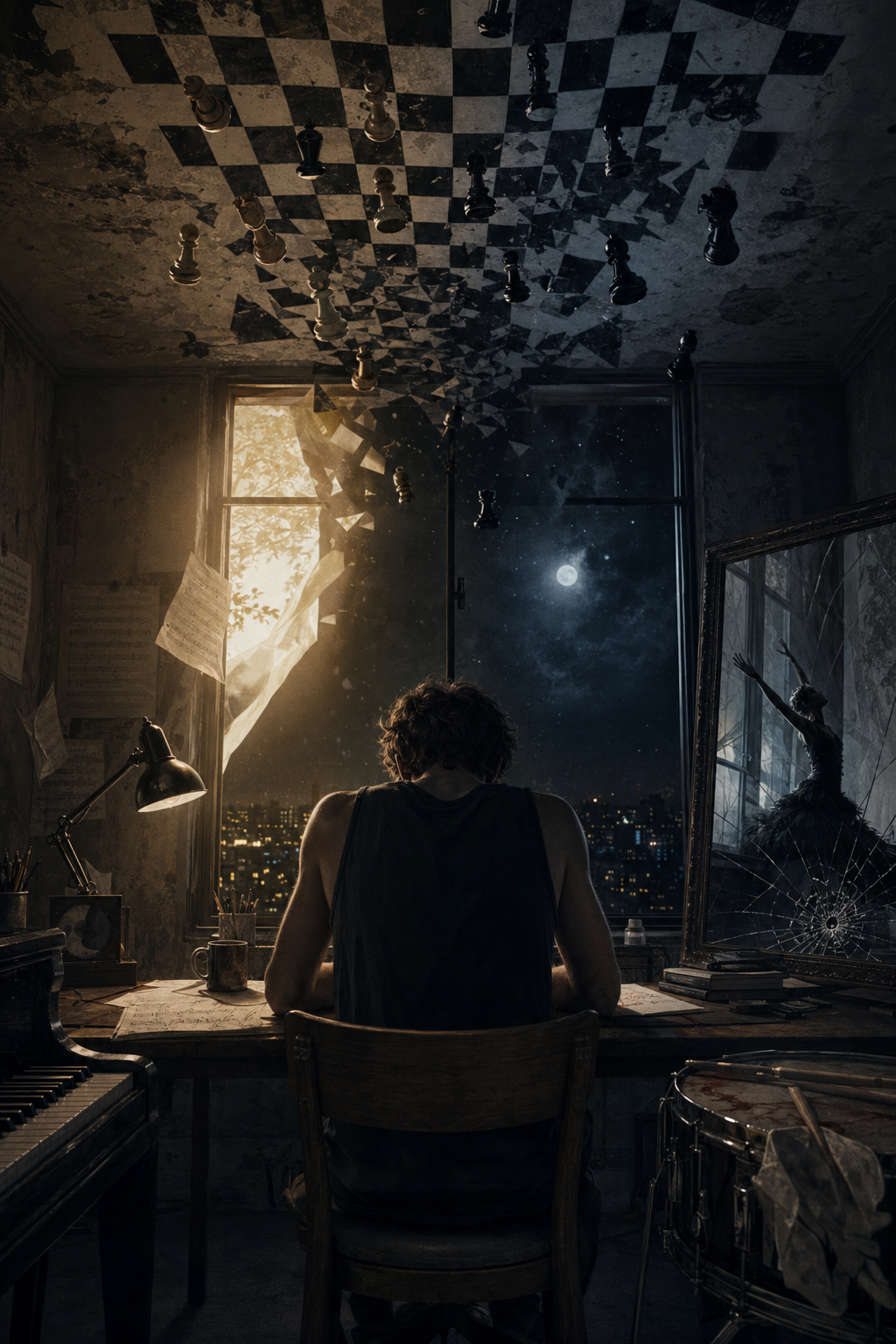
THE HOURS BETWEEN
In a world where night grants genius but erodes identity, a young violinist chases the one sound worth losing herself for.
Chapter 1: Two Cents
The recording said the passage was clean.
Hana listened once through the phone speaker, then again through the wired headphones she trusted more, eyes on the waveform as if the shape of the sound might confess something the sound itself had concealed. No clipped attacks. No audible shift in bow contact. Intonation across the ascent and return held within two cents, which was close enough that most faculty at Kessler would have called the phrase finished and meant it. The third transition, where the line crossed from the A string to the D on the seventh beat, was stable. The harmonic bloom in the upper register arrived on time. The descent did not drag.
Clean. Correct. Dead.
She deleted the take and lifted the violin back under her jaw before the silence in the room could settle into something that resembled rest.
Practice Room 4B had the same dimensions as every other room in the basement corridor: narrow, over-insulated, fluorescent light with a faint pulse in the left fixture, one chair, one stand, one wall clock that ran nineteen seconds fast. The clock read 2:14 AM. Curfew had been at midnight. The building logs would show no authorized occupancy on this floor. Security did not come down unless someone complained, and no one complained from 4B because the rooms on either side were empty and the students who used the basement at this hour understood the etiquette of shared trespass.
She set the bow at the contact point she had been calibrating for three nights—closer to the bridge than comfort allowed, enough pressure to keep the tone dense without forcing the surface noise Schein would hear instantly if he were in the room—and began again.
The second movement opened under her hands exactly as it had opened fourteen times already: technically obedient, dynamically proportioned, each phrase turning where it was supposed to turn. She knew, in the first eight bars, that she would not keep this one. The line was breathing in the right places but not for the right reasons. It sounded interpreted. Worse, it sounded earned. She needed it to sound like the music had never had to pass through effort at all.
Measure thirty-one. The vibrato on the sustained note narrowed correctly, then held. Measure thirty-two. String crossing. The quarter-second of transit between one plane of sound and the next.
That was where the piece either continued or stopped and replaced itself with something shaped convincingly enough like music to satisfy everyone in the world except the person holding the bow.
She stopped in the middle of measure thirty-three, rewound, and played only the crossing. Then only the beat before it. Then the beat after. Then the space where the bow left one string and had not yet found the next. The space was the problem. The notes were fine. The notes had been fine for hours. The failure lived in the gap between them, in the tiny corridor where conscious control either dissolved into inevitability or remained visible as labor.
Again.
The fluorescent light buzzed. Somewhere in the wall, a pipe knocked once and then was still. Hana played the crossing twelve times, altered the angle of her right wrist by what felt like nothing and was in fact measurable, shifted half a millimeter closer to the bridge, and tried the full phrase again.
Better. Not right.
She recorded it anyway. On playback the difference was audible, but only to someone already listening for it. The phrase connected. It did not compel. It moved from one emotional state to the next in a way that was coherent, tasteful, structurally defensible. It was a daytime solution wearing the clothes of something deeper.
She deleted that take too.
Her left hand was beginning to shake. Not the daylight tremor—though that had been worse this week, a fine rhythmic vibration she could usually hide by pressing thumb to fingertip until the muscles remembered stillness. This was fatigue, coarser and less useful, a random disruption in the small stabilizing muscles along the forearm. She lowered the instrument and pressed the pads of her fingers together one by one, index to thumb, middle to thumb, ring to thumb, little finger to thumb, feeling the pulse in each contact point.
The shaking eased. Not enough.
She checked the time. 2:43.
The shift used to arrive earlier.
At seventeen she could enter the shallows by one in the morning if the room was quiet and the day had not touched her too heavily first. At twenty-three the threshold had moved. Now the first two hours after dark belonged to craft, not integration. Even after midnight the state came reluctantly, like something no longer convinced she was worth visiting. Three nights in a row she had felt it brush the edge of consciousness and fail to take hold. Three nights in a row the music had opened a fraction and then sealed itself again.
Tolerance, some of the neurologists called it, though the term was imprecise. Deep integration was not a drug. It did not flood the system with pleasure and then demand larger doses. It recalibrated perception. The more completely a practitioner heard the architecture at night, the less satisfying daylight translation became, until the old level of access no longer altered enough of the internal map to register as arrival. The state had not weakened. Her hearing had changed.
She thought of that and raised the violin again.
Measure twenty-eight through thirty-four. No recording this time. She did not need an external artifact of failure. She needed the thing itself.
The first phrase laid itself down correctly. The second followed. By the time she reached the transition she was no longer thinking about bow speed in language, only in pressure vectors and the changing resistance of horsehair against string. The corridor opened. Not wide. Enough.
Then it happened.
Four bars. Possibly five. No more than twelve seconds.
The music stopped feeling sequential. The phrase did not move forward because she pushed it there; it existed whole, all at once, and her body was only the surface across which that wholeness became audible. The crossing from A to D did not require management. It was inevitable before it occurred. The note at the top of the line did not sound produced but remembered, as if the room had known in advance where the air was supposed to vibrate and her bow had only uncovered the fact.
Her right hand disappeared first. Then the left. Not physically. More exactly than that. They ceased to feel like separate instruments of command and became part of the same continuous event as the string, the wood, the pressure under her jaw, the narrow room, the silence around the sound. The distinction between playing and hearing thinned to transparency.
Then she noticed it.
Not with thought. With the reflex that ruins everything worth having the moment it becomes aware of itself.
The state broke.
The next note was merely played. The phrase dropped back into sequence. Her fingers returned as fingers, the violin returned as object, and the distance between what had just happened and what was now happening reopened so fast it was almost physical pain.
Hana lowered the bow without finishing the line.
The room was the same room. The fluorescent light still buzzed. The clock still ran nineteen seconds fast. Her pulse was high and irregular in her throat.
Twelve seconds.
She knew better than to trust memory under adrenaline, so she hit record and tried to reconstruct the passage immediately. The first take after the break was too tense. The second was technically superior and spiritually irrelevant. The third was farther away than the first. By the sixth attempt she could hear herself compensating for the lost inevitability with expression, adding weight where the architecture should have carried weight on its own. Decoration. Fraud.
She stopped recording.
At 3:22 she sat down. At 3:24 she stood again because sitting felt too much like surrender. At 3:31 she played the four bars in isolation until the muscles in her shoulder hardened. At 3:47 she got the intonation perfect and the sound wrong. At 4:03 she missed a shift she had not missed in months, not because the shift was difficult but because fatigue had begun to roughen the edge of every command she sent through her hands. At 4:19 she reached something adjacent to the state and lost it sooner, after perhaps three seconds, which was worse than not reaching it at all.
By 4:47 the coarser tremor in her left hand was visible even while the violin was down. She set the instrument in its case with the attention one gives a wound and stood motionless for a full minute before switching off the room light.
The basement corridor outside 4B smelled faintly of dust, old rosin, and radiator heat. Her footsteps were too loud after hours of controlled sound. She walked up the service stairs because the elevator mirrored too much at this hour and she did not want to look at herself under fluorescent ceilings. In the courtyard, pre-dawn had begun the slow work of defining edges. The stone paths were still mostly night, but the upper windows of the dormitory had started to separate from the sky.
She noticed the light the way one notices a conversation at a distant table: present, coherent, irrelevant.
In her room she did not undress. She sat on the bed with the violin case against the wall and pressed her fingertips together until the shaking became small enough to ignore. On the desk, under the spill of the lamp she had forgotten to switch off before leaving at ten, lay the marked score of the Korngold with Schein’s pencil notes in the margins: narrower here, let the line carry itself, no sentiment where structure will do.
Eleven weeks until the Year-End Recital.
Two hours after midnight used to be enough. Now two hours delivered only the edge of the lobby, a brush of the state and nothing more. The integration was arriving later each night, and when it arrived it required more stillness, more darkness, more time without interruption before it would open fully. If the threshold had moved, then the response was obvious. Start earlier, stay later, descend farther.
The math was simple. The math was always simple.
She lay down without turning off the lamp. Sleep did not come. The twelve seconds repeated behind her eyes with the precision of a wound that refused to clot. Not the whole phrase. Only the crossing. The quarter-second corridor between strings where the music had stopped being a translation and become itself.
At 5:12 she sat up and wrote in the margin of the score, beneath Schein’s note in measure thirty-two:
Not enough time.
Then she closed the book, set it on the floor, and waited for morning as if waiting were a task that could be completed correctly.
In a contemporary world where daylight allows only ordinary mastery and nighttime unlocks transcendent cognition at the cost of the self, the greatest artists are those willing to let the dark remake them. Hana Voss, a prodigiously gifted violinist at the elite Kessler Conservatory, has already heard the real music that exists beyond safe limits and cannot accept a merely sustainable life in art. As a career-defining recital approaches, she is pulled between technical discipline, human connection, and the escalating nocturnal descent required to close the gap between what she can play and what the night has shown her.
- —Hana Voss — A 23-year-old violin prodigy whose identity is fused to the distance between her current ability and the transcendent sound she has heard at night. Brilliant, ascetic, and already showing the tremor of nocturnal erosion, she will sacrifice almost anything to make daylight performance equal the music she hears in the dark.
- —Maren Althaus — A legendary visiting violinist who has survived deeper nocturnal immersion than almost anyone alive. She recognizes Hana instantly, not as a student but as a successor, and becomes the one witness whose approval means more than prizes, safety, or reputation.
- —Jonah Reed — A gifted cellist and Hana's closest bond to warmth, balance, and a sustainable musical life. He represents the future she could choose if she valued being whole more than being transcendent, which makes his care both a comfort and an accusation.
- —Professor David Schein — The head of Kessler's violin program, a severe master of daytime perfection who once stood on the same threshold Hana now approaches. He pushes her toward technical greatness while trying to hold her below the depth that nearly destroyed his own life.
- —Alexei Soren — Kessler's top-ranked violinist, polished, disciplined, and extraordinary within the rules. He is not a villain but a living argument for the honest ceiling, the rival who proves how far Hana is willing to go beyond what the system rewards.
- —Elise — Hana's mother, a conservatory-trained violinist who recognized her daughter's gift early and tried to impose limits before the night could claim her. Though mostly offstage, she haunts the story as the first person who understood both Hana's talent and its danger.
- —The Ceiling: Hana spends her nights in secret practice, chasing brief flashes of true integration while her daytime teacher, David Schein, urges her toward the highest sustainable form of mastery. Her technical brilliance grows, but so does her certainty that ordinary excellence is only a translation of something deeper and more real.
- —The Witness: The arrival of legendary violinist Maren Althaus shatters Hana's sense of scale when Maren performs at a level that reveals how vast the ladder of mastery truly is. Hana seeks her out, discovers that nocturnal integration has deeper layers than she imagined, and begins descending with new purpose despite visible neurological cost.
- —The Erosion: As Hana pushes further into the night, her playing acquires frightening new depth while her memory, body, and relationships begin to fracture in daylight. Jonah becomes the clearest image of the life she is abandoning, and Maren's attention offers the dangerous solace of being fully seen by someone who understands the price.
- —The Edge: With the year-end recital approaching, Hana's symptoms accelerate into unmistakable identity drift even as she reaches private states of performance beyond anything she has known. She decides that merely approximating the night will no longer suffice and resolves to bring deep integration onto the public stage, no matter the risk.
- —The Hours Between: At the recital, Hana reaches a level of music that breaks every previous measure of what is possible, but the depth she touches is inseparable from the damage it exacts. In the morning after, the question is no longer whether the sound was real, but what remains of a person who has heard it and knows she will follow it again.
The prose is taut, precise, and unsentimental, with a clinical attention to craft, body, and psychological fracture. Musical detail and neurological cost are rendered with equal intimacy, creating a sensory world of bow pressure, tremor, silence, exhaustion, and the eerie vastness of sound perceived from inside obsession.