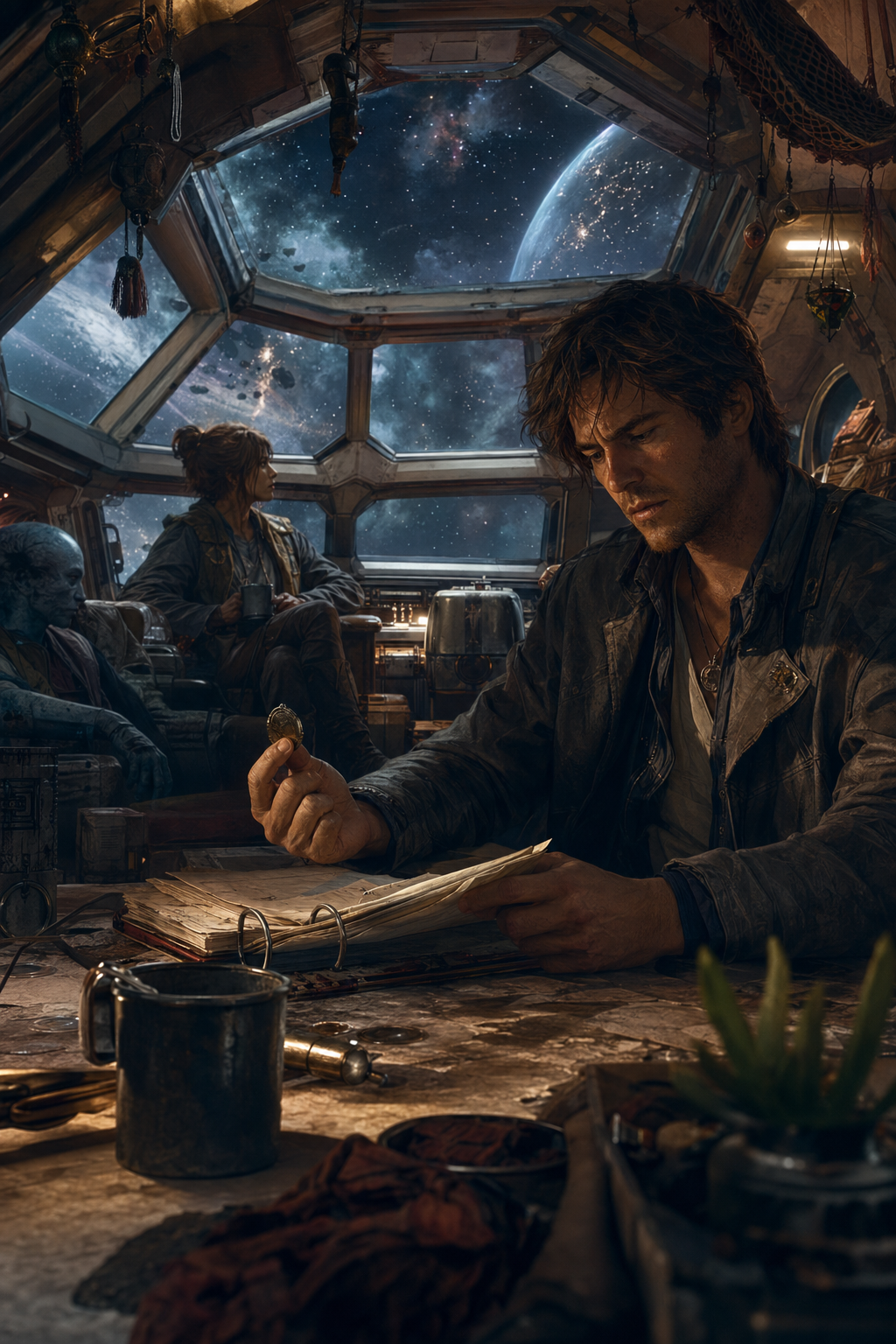
THE HARROW
In a lawless frontier of collapsing FTL routes, a lone salvager is forced to shelter a dead captain's heir and the truth she ran from.
Chapter 1
The cutting torch made a sound through the derelict's hull like bacon hitting a hot pan, which would have been a useful comparison if Kael Maro had eaten anything worth calling bacon in the last six months.
She killed the torch, caught the panel before it drifted free, and shoved it aside with her shoulder. The freighter's bridge console sat open in front of her, guts exposed, cabling hanging in brittle loops. The navigation processor was mounted deep in the housing, older make, good shielding, still worth credits if Carrack Station's buyers weren't feeling artistic about market rates this week. Which they probably were. People with ledgers always got artistic when it was time to pay someone else.
Her helmet lamp painted the dead bridge in a flat white cone. The rest of the ship stayed dark. No emergency strips, no active displays beyond one little status panel cycling a distress notice on backup power that had outlived the crew by eight months.
DISTRESS TRANSMISSION FAILED: THREAD ACCESS UNAVAILABLE.
That tracked.
Kael braced one boot under a torn console support and leaned into the wrench. The bolt gave with a metallic snap that carried up her arm. Around her, the freighter told its story in surfaces. Blast scoring around the port airlock, tight grouping, meant boarders. Life support manifold ruptured from the inside after that, probably during the fight. No blood in the bridge that she could see, which meant either the crew had died elsewhere or someone had been tidy under circumstances that didn't reward tidiness. The Reach did this all the time: left you a body with the organs rearranged and dared you to call it mystery.
She got the final mount loose and lifted the processor free. Heavy. Good. Weight was honesty.
The tether on her belt reeled in as she pushed away from the console and drifted through the ruined bridge toward the hatch. Her breath sounded too loud inside the helmet. Cold crept through the knees of her work suit where the freighter's dead temperature had soaked into the metal. Behind her, the distress panel kept blinking to no one.
No thread. No rescue. No surprise.
The Harrow waited outside the bridge viewport, squat and ugly in the freighter's shadow, exterior floods cutting white wedges through the black. Kael felt the usual small shift in her chest at the sight of it. Not sentiment. Recognition. A body seeing its own hands.
She cycled through the derelict's airlock, crossed the tethered gap, and came in through the Harrow's cargo bay with the nav processor tucked under one arm and a crate of hull sealant bumping along behind her on a line. The bay smelled like old metal, dust, and the faint cooked-plastic note the environmental system produced when it got sulky. She liked it better than most station perfumes.
Helmet off. Gloves off. Processor on the workbench.
The cargo bay lights hummed overhead with the half-sick flicker they always had. She gave the crate of sealant a look, decided it was worth the floor space, and keyed the hatch shut. The Harrow answered with a clunk through the frame and the deep settled vibration of a ship that knew its own shape.
“Paid for,” Kael muttered to the bay, which was as close to praise as the ship usually got.
She took the ladder two rungs at a time to the cockpit. The Harrow was a Kessel-class cutter, which meant whoever designed it had believed strongly in the principle that if something could be made smaller and less comfortable, it probably should be. Kael moved through it without thinking. One hand on the hatch frame, duck the conduit run near the galley, shoulder past the storage locker that never quite latched right, into the cockpit before the portside thruster could wheeze again and make her say something rude to machinery.
It wheezed anyway.
The sound came up through the deck plating as she dropped into the pilot's chair: a strained, rhythmic cough from aft port, like a dog trying to clear its throat and getting offended by the effort.
“Yeah, I hear you,” she said.
The Harrow's cockpit was warm from electronics and too much use. The seat foam had long ago compressed to the exact shape of her spine. The canopy showed the derelict field as a scatter of black hulks and hard reflected light, ships dumped here when a thread had collapsed eight months ago and never reclaimed because the Reach had a short memory for bad luck and a shorter one for debt. Consoles glowed amber and green across her hands. Her sidearm sat in its clip by the port panel. A jacket that had once been waterproof hung over the co-pilot's chair, which existed mostly as storage because there was no co-pilot.
She keyed the cargo manifest. One nav processor. One crate hull sealant. Miscellaneous stripped copper and relay parts. Enough, maybe, to cover fuel to Carrack and dock fees if Carrack was feeling charitable, which it wouldn't be, plus maybe enough left over to buy whatever the portside thruster needed if whatever it needed turned out to be free and blessed by saints.
The numbers on the ledger did what they always did: sat there with the blunt confidence of bad news.
Kael scrubbed a hand over the back of her neck. The cockpit smelled like solder, coffee gone stale in its pot, and the oil she'd gotten on her sleeve two repairs ago. Outside, the floods lit drifting debris that turned slow as weather.
At the edge of her console, half under a rag, sat the bit she'd pulled from the freighter's secondary paneling. Small metal plate, blackened, stamped with a faded Crucible insignia. She looked at it for half a beat. Old military salvage turned up everywhere in the Reach, like bones from a dead animal weathering out of dirt. Didn’t mean anything. Usually.
She tossed it into the tray beside the processor and brought up a course solution for Carrack Station. Three-day conventional burn to the local thread, six hours through if the corridor held its shape, then Carrack's secondary lanes if she wanted to avoid paying main-ring rates. Which she did. Main-ring rates were for people with solvency and optimism, both of which struck her as recreational habits.
The scanner pinged once.
Not proximity. Range update. Something at the edge of detection, cold and intermittent.
Kael leaned forward and dialed the gain by hand because the automated filter on the Harrow was lazy. Contact bloom sharpened on the scope. Small signature. Running dark or dying. Hard to tell at this range.
She let the scanner sweep again. The contact tumbled in and out of return, which meant spin. Shuttle-sized, maybe. Nothing in a derelict field stayed put unless it was attached to a wreck or out of fuel.
“Not my circus,” she said, mostly because saying it out loud made it official.
She started to commit the Carrack route.
The scanner pinged again, higher and sharper this time as the object crossed inside a cleaner bracket of range. Civilian shuttle. No visible weapons package. Drive signature almost gone. Broadcasting automated distress on a public frequency.
Kael's hand hovered over the nav controls. A stranded shuttle in a dead field was a problem, and problems cost fuel. The Reach was full of people having bad days, and if she stopped for all of them she'd be broke in a more organized way than usual. She thumbed up a bypass vector that would take the Harrow around the shuttle by twenty thousand klicks and still keep her burn window.
The portside thruster gave another phlegmy complaint through the hull, as if chiming in.
“Don't start,” Kael told it.
She keyed the bypass.
The distress frequency on the comms board changed.
The broad automated tone cut out mid-cycle. For one second the speaker gave her empty static. Then a narrowband transmission snapped onto the Harrow's receiver so clean it might as well have been sitting in the room.
A voice. Young. Hoarse. Tired enough to sandpaper the edges off the words.
“Kael Maro,” it said. “If this is the Harrow, don't leave.”
Her hand stopped over the console.
The cockpit got smaller. Not physically. The dimensions stayed the same: cramped seat, scarred panels, canopy frame held together by bolts she'd replaced herself. But the weight of the room changed. Air different. Gravity different. The way it changes when something has stepped over a threshold and brought weather in with it.
Kael looked at the scanner.
The shuttle tumbled there on the scope, a weak heartbeat at the center of black.
On the comms board the voice came again, fighting static this time.
“My name is Voss Tarack,” it said. “My parent told me to find you.”
The name hit hard enough that for a second she thought the ship had taken debris.
Her jaw locked. Her hands went very still on the controls.
Outside the canopy, the derelict field went on being what it was: dead ships, drifting metal, cold light. The Harrow's engine hummed under her boots. Somewhere aft, the portside thruster wheezed like it had an opinion.
Kael cut the bypass vector. Brought up intercept calculations. Her fingers moved because they knew how, because hands were good at work and bad at denial.
On the scope, the shuttle rolled once, slow and helpless, and kept drifting toward nowhere.
The Atheric Reach is a loosely settled space frontier held together by unstable thread corridors, station deals, and reputation. Kael Maro has spent seven years alone aboard her salvage cutter, the Harrow, surviving wreck by wreck and never staying anywhere long enough to owe anyone. When a drifting shuttle brings Voss Tarack and a sealed archive tied to a dead crew from Kael's past, Combine agents close in and the life she built on distance starts to come apart.
- —Kael Maro — A hard-used salvage operator who has spent seven years living alone aboard the Harrow, trusting her hands more than her history. Exceptional with wrecks and repairs, she has built her identity around leaving before anyone can matter too much, until the return of her past makes that story impossible to sustain.
- —Voss Tarack — A sharp, mechanically gifted seventeen-year-old carrying a sealed archive and the legacy of their dead parent, Ren Tarack. Resourceful rather than helpless, Voss becomes both living proof of Kael's unfinished past and an essential new hand aboard the ship.
- —Dez Korrin — A former Crucible officer turned independent freight captain whose steadiness shows up as logistics, watchkeeping, and practical care. As he falls into effortless formation with Kael, he becomes the reliable shoulder the Harrow never meant to have.
- —Lorna Dace — The Wren's Passage's surviving navigator, now a solitary thread-mapper marked by old burns and a permanent limp. She carries the clearest account of the disaster Kael fled, and her reappearance forces the story's buried truth into the open.
- —Sable — A sardonic information broker based at Turnpike Station, deeply wired into frontier rumor and trade networks. Their help is transactional, but their long memory and sharp eye make them indispensable once the archive draws wider attention.
- —Harken — A Meridian Combine operations director who prefers leverage, negotiation, and clean solutions to brute force. Calm, credible, and relentless, he represents the institutional power determined to bury what the archive contains.
- —Ren Tarack — The dead captain of the Wren's Passage, present only through logs, testimony, and the people still orbiting her choices. As the archive opens, Ren emerges not as a legend but as a capable, flawed, stubborn truth at the center of everyone's broken memories.
- —The Intrusion: Kael's solitary salvage routine is broken when a crippled shuttle drops into her path broadcasting her name. Inside is Voss Tarack, a sealed data core, and a connection to the lost Wren's Passage that Kael has spent years outrunning.
- —Forced Formation: A Combine retrieval notice turns Voss and the archive into live cargo, and Kael's attempt to offload the problem collapses almost immediately. With Dez drawn into the escape and frontier jobs demanding more than one pair of hands, the Harrow begins functioning like a crew before Kael will admit it.
- —The Past Speaks: At Turnpike, the archive begins to open, and Ren's recorded voice contradicts Kael's long-held version of the Wren's Passage's final days. The pressure tightens when Harken makes a polished offer for the data, and Sable points Kael toward the one survivor who can finish breaking the lie.
- —The Turn: Lorna's testimony makes plain that Kael did not merely leave a doomed ship; she abandoned a crew under attack, and people died because of it. Kael nearly repeats the pattern and runs, but the Harrow no longer feels empty enough to vanish in, so she turns back and asks the others to help finish what Ren started.
- —The Run: With Lorna mapping the way, Voss preparing the archive, Dez committing his ship, and Sable ready to spread the signal, the crew commits to exposing the Combine's hidden corridor and weapons operation. Their final push through the classified thread forces Kael to choose, under fire, whether she will leave someone behind again.
The prose is lean, tactile, and unsentimental, with dry humor and a steady warmth under the steel. It lingers on ship noise, station bars, burned insulation, coffee, weld seams, and the bodily strain of thread travel. The voice treats the frontier as worn-in rather than ruined: harsh, practical, and alive enough to make belonging matter.