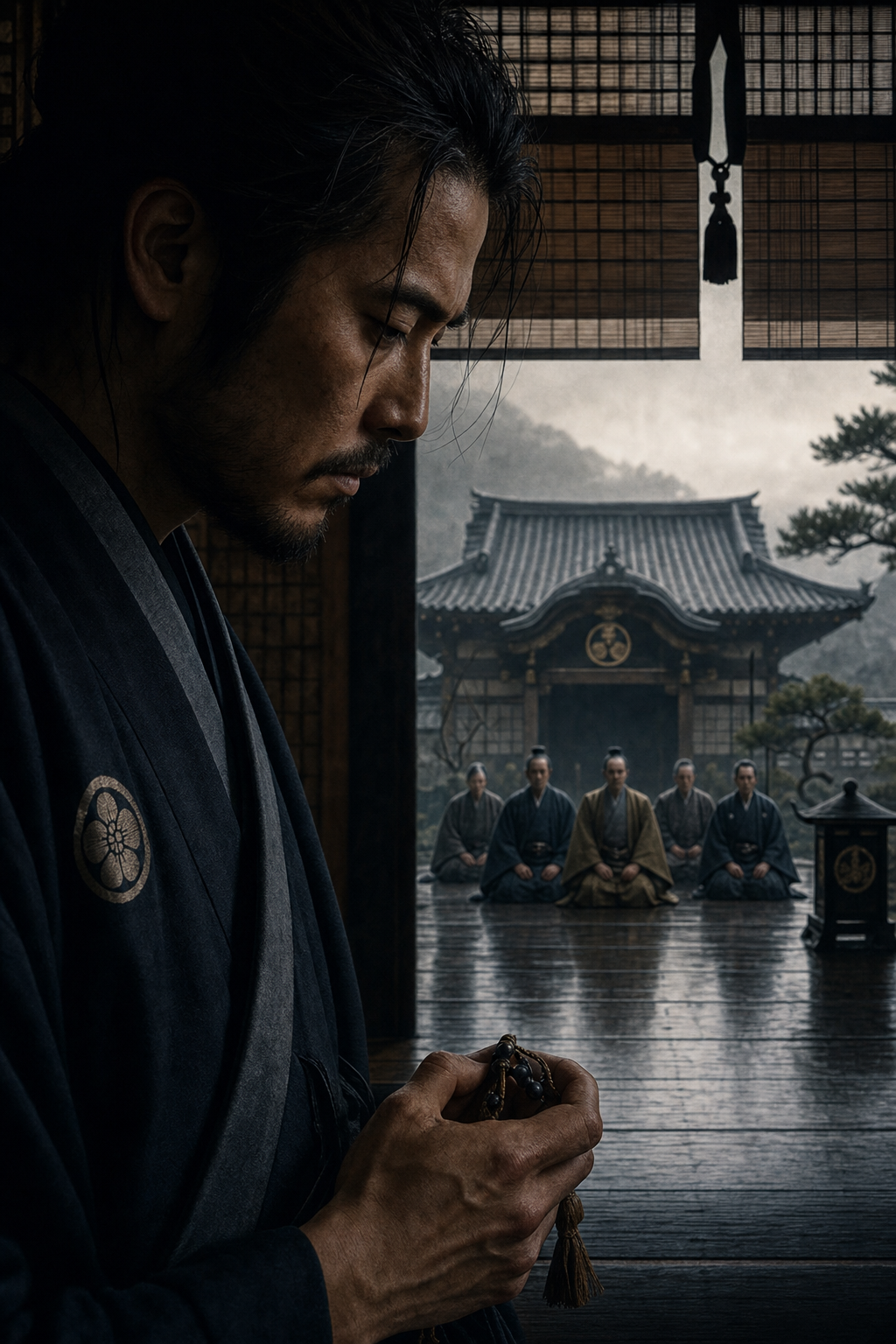
THE HAND AND THE FLAME
In Tokugawa Japan's mountain backroads, a fugitive retainer guards a hidden heir while a corrupt domain closes in.
Chapter 1
The dust rose to Shinobei's ankles and stayed there, pale against the darker cloth of his leggings. It had not rained on this road in six days. He knew that from the cracks in the wheel-ruts and the way the cedar needles at the roadside had gone brittle underfoot. The mountain held late autumn in layers: bare branches where the deciduous trees thinned along the ridge, cedar green lower down, mist caught white in the valley's first crease.
He walked.
The child slept on his back. Tsuki's head rested against his shoulder, turned inward, mouth slightly open in the deep, unguarded sleep that belonged only to the very young and the very exhausted. Shinobei's gait did not change beneath the extra weight. His body had long since made room for it. One hand steadied the child's leg when the road narrowed. The other hung loose at his side, close enough to the wrapped sword across his back to reach it without hurry.
At each bend he turned his head before his feet followed. Ridge first. Treeline second. The hollow of the ditch where someone could crouch unseen. Then the road again.
Below, on a shelf of land where the mountain relaxed, stood the black frame of a farmhouse burned to its posts. The roof had gone in. One wall had collapsed outward into the weeds. The threshold remained. Shinobei's eyes stayed on it for the span of one breath.
Then he went on.
By midday he reached a stream that cut across the road in a line of clear cold water. He stepped into its shallows, knelt, and lowered the child with the same care he used every day: one hand supporting the neck, one guiding the knees, the transfer from back to ground done without jarring the spine. Tsuki stirred as his feet touched stone. His eyes opened at once. He took in the stream, the trees, the light, and did not ask where they were.
Shinobei cupped water in both hands. The boy drank from them. Some of it ran through the scar-lines of his knuckles and back into the stream.
They ate cold rice from a wrapped bundle. Tsuki sat on a flat stone and held his portion in both hands. Shinobei ate standing, his eyes moving over the road above and below the crossing, over the alder growth near the far bank, over the slope where old leaves had gathered against exposed roots. No fresh tracks beyond their own. No cut branch. No place where brush had been pressed down recently by more than weather.
Tsuki finished and held out the cloth. Shinobei took it, folded it once, then again, and tucked it into his sleeve.
They climbed until the light began to slope west. The road narrowed into a shelf cut from the mountain's side. The valley dropped away through cedar trunks to a river he could hear but not see. Wind came up the slope after sunset. It carried cold with it.
Shinobei left the road where a game trail broke off through low bamboo. Twenty paces uphill, the ground opened into a shallow hollow screened by rock and brush. It gave him sight of the road through two gaps in the leaves and hid any firelight from below if he kept it small.
He set down the pack. Tsuki stood where he was placed and waited while Shinobei walked the perimeter. The circuit was quick and exact. He checked the far side of the rock, the line of the trees above the hollow, the leaf litter for old ash or footprints. Nothing recent. No smell of man. He returned.
By then Tsuki had crouched beside the unlit fire pit, hands folded in his sleeves against the cold.
Shinobei cleared the pit with the edge of his hand. He built the fire from split sticks he had taken dry from the pack, then fed it with what the hollow offered. The flame took slowly. The wind came down the mountain in measured gusts, flattening the smoke first one way and then another. He shifted two stones to narrow the opening and changed the angle of the kindling. The flame steadied.
He warmed water. He mashed rice with a little salt and the last of the dried fish and set the bowl in front of the child. Tsuki ate without haste. When he finished, Shinobei took the bowl, wiped it clean with hot water, and set it upside down on the cloth to dry.
Darkness settled between the trees. The road below vanished. The river's sound came up clearer now, widened by night. Tsuki curled beneath Shinobei's outer garment and was asleep before the stars showed.
Wind poured through the hollow after the moon rose. The fire bent low under it. Shinobei's hand moved without thought. He cupped it around the flame, fingers spread just far enough to shield without smothering. Firelight caught the ridges of old scars across his knuckles. The flame steadied inside the cage of his hand.
He held it there a moment longer than the wind required.
Then he reached for the wrapped sword.
The cloth came loose under his fingers in a knot tied with practiced exactness. He unfolded it and laid the blade across his knees. In the firelight the steel held a depth plain iron never carried. The edge took light and kept it. He drew a packet of cleaning paper from the pack, then the powder and cloth, and began the work.
His hands changed when they worked the blade. Not softer. More precise. Each stroke ran the same line, from base to tip, pressure constant, eyes checking what fingers already knew. He inspected the notch of the hilt, the crest near the guard, the line where steel met polish. The sword did not belong to the road. That fact sat in the hollow with them as plainly as the child and the fire.
When he finished, he wrapped it again in the same cloth, the same folds, the same knot.
The night deepened. Somewhere down the mountain a branch cracked under weight, then went still. Deer, perhaps. Or not. Shinobei did not turn his head toward the sound. His hand rested near the sword and stayed there until the silence around the crack settled back into its previous shape.
Tsuki coughed once in his sleep. Dry. Light.
Shinobei looked over. The boy had worked one arm free of the garment and the small hand lay palm-up against the dirt, open to the cold. Shinobei reached across the space between them, tucked the hand back beneath the cloth, and drew the edge of the garment higher along the child's shoulder.
The cough did not come again.
He sat through the first watch and into the second. The fire burned low. He fed it once, then let it settle to coals. His eyes worked the dark by habit: the black mass of rock, the gap between cedar trunks, the slice of stars above the hollow. When he blinked, he did it one eye at a time.
Near midnight, footsteps sounded on the road below.
Two sets. Slow. Human.
Shinobei's hand went to the sword, not the hilt but the wrapping just above it. His breathing shortened by half a measure. He listened.
The footsteps passed beneath the hollow without pause. Travelers walking later than was wise. Their voices rose once, too low to make out, then faded down the road toward the river. Shinobei waited until even the rhythm of their steps had dissolved into water and wind before he eased his hand away.
He looked at the child.
Tsuki had not woken. The boy's face was turned toward the banked coals, faint red light touching one cheek. There was dirt at the edge of his collar where the road had dried into the weave. Shinobei lifted his hand and brushed it away with his thumb. The movement was small. It changed nothing.
By the time the eastern sky paled, the dust on the road below had gone gray with dew. Shinobei rose without sound. His knees answered the night's stillness with a brief stiffness that disappeared after the first step. He packed the bowl, the cloth, the papers for the blade. He stamped the last heat from the fire and scattered the ash with the sole of his sandal until the pit looked old and empty.
Then he knelt beside the child.
Tsuki opened his eyes before being touched. He looked up at Shinobei, at the whitening sky through the branches, at the pack already tied.
"How many days?" he asked.
Shinobei held up his hand. Five fingers.
The child looked at them, nodded once, and pushed himself upright.
They ate what remained of the rice. Shinobei bound the fresh cord tighter around one sandal where the old tie had loosened in the night. He settled the sword across his back, then crouched for the child.
Tsuki climbed on without needing to be told where to place his hands. One went around the shoulder. One found the fold of cloth at the collar and held there.
Shinobei rose. He stepped down from the hollow to the road.
The dust lifted around his ankles again. The valley ahead still held mist. Far below, unseen through the trees, the river moved north.
He walked.
In the uneasy first years of Tokugawa rule, the Aoyagi domain rots beneath a flawless surface of ceremony, duty, and silence. Former Sword Inspector Aoyagi Shinobei flees through mountain roads with a five-year-old child and the heir's ceremonial blade after the regency brands him a thief and traitor. Every mile that keeps the boy alive also deepens the danger: the true heir cannot reclaim his birthright while hidden, and Shinobei's code of absolute containment is beginning to imprison them both.
- —Shino / Aoyagi Shinobei — A former Sword Inspector of the Aoyagi domain, Shino travels as a nameless wanderer with a wrapped ceremonial blade and a child on his back. His devotion is absolute and nearly wordless; he protects through precision, discipline, and a silence so complete it becomes both shield and prison.
- —Tsuki / Aoyagi Tsukimaru — A quiet five-year-old boy who does not know he is the legitimate heir of the Aoyagi domain. Shaped by years on the road, he survives by reading Shino's posture, hands, and pauses with uncanny accuracy.
- —Chihaya — A traveling healer cast out by a samurai household after she chose her medical code over their corruption. She recognizes discipline in Shino at once, and her growing, careful understanding becomes the closest thing the story allows to intimacy.
- —Onishi Tadashige — The Aoyagi domain's chief retainer, outwardly impeccable and inwardly convinced that seizing power is necessary to save the domain. He is not a brute but a master of the code's language, using duty, decorum, and procedure to turn betrayal into policy.
- —Mukai Gennosuke — An administrative retainer and Shinobei's closest companion within the castle, warm where Shinobei is severe and outspoken where he is contained. His discovery of financial corruption and his fatal haste to act become the hinge that destroys the old order.
- —Josuke — A disciplined domain retainer sent to recover the stolen blade and capture the supposed thief. As he tracks Shino across villages and mountain roads, the evidence of what he sees begins to break the official story he serves.
- —Lord Aoyagi — The dying lord whose quiet integrity shaped the domain's code before it was hollowed out from within. In his final acts, he entrusts the heir's ceremonial blade and the future of his line to Shinobei's keeping.
- —Hayashi Soemon — A retainer of a neighboring domain linked to Lord Aoyagi by a hidden contingency plan. He represents the first lawful opening through which the surviving heir might be made visible again.
- —The Road: Shino and the child move through mountain roads, villages, checkpoints, and bad weather with practiced caution, their life defined by silence, routine, and constant evasion. The world reveals itself as beautiful but thoroughly surveilled, while hints accumulate that the wrapped sword and the boy's identity matter far more than either can safely say.
- —The Castle: Without warning, the story slips into the past and shows Shinobei inside Aoyagi Castle as the domain's Sword Inspector and the heir's unseen final shield. There, Lord Aoyagi's failing health, Mukai's suspicions, and Onishi's immaculate maneuvering expose how a code built on discipline can be exploited by men who wear the same outward forms.
- —The Pursuit: Back on the road, Chihaya enters and begins to read Shino through medicine, gesture, and routine, while Josuke gives the hunt a patient, human face. As Tsuki's cough worsens, wanted notices spread, and political rumors tighten the clock, every act of survival starts to look less like escape and more like postponement.
- —The Break: The past reaches catastrophe: Lord Aoyagi dies, Mukai uncovers too much, and Onishi's conspiracy frames loyal men as traitors. Mukai's death and the forged case against Shinobei force him to flee the castle in a single night with the sleeping heir and the ceremonial blade, turning institutional duty into exile on the road.
- —The Flame: In the present, Tsuki's fever, Chihaya's intervention, and Hayashi's reentry into the plan push Shino toward the choice he has delayed for two years: remain hidden or make the heir visible. Josuke finally confronts him, the truth emerges through action rather than confession, and the boy is delivered to safety at terrible personal cost, leaving Shino with an emptied burden and a silence that has at last been understood.
Measured, restrained, and tactile, the prose favors clear declarative lines over flourish and lets meaning gather through action, ritual, and omission. Its sensory world is built from mountain weather, wood, steel, paper, breath, and the minute behavior of hands. Emotion arrives compressed inside discipline, so tenderness, grief, and recognition land through gesture rather than speech.