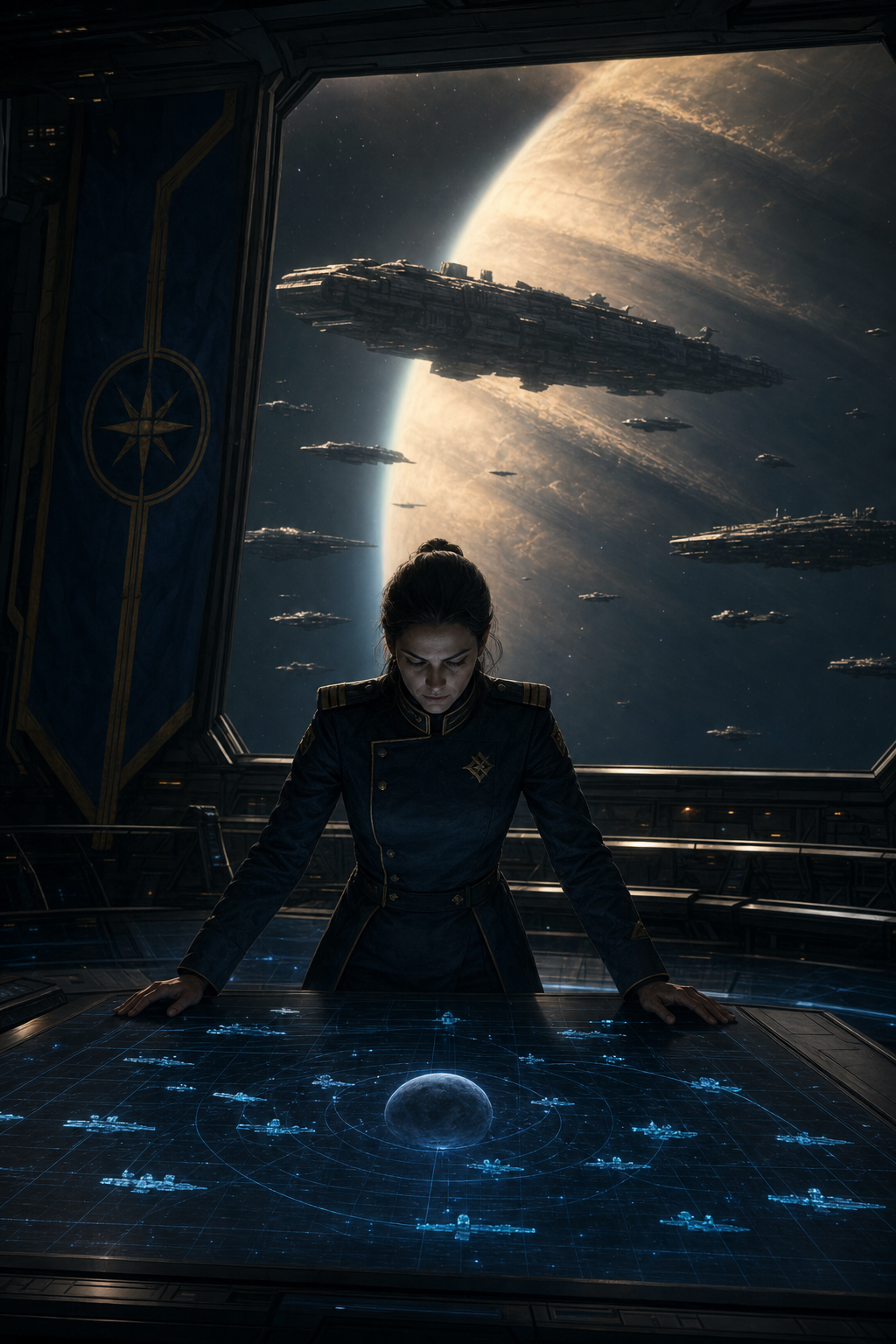
THE FORMATION HELD
A refugee fleet fleeing an alien hegemony can reach its promised world only by paying for every jump in ships, fuel, and lives.
Chapter 1
The damage summary arrived in columns.
Compartment. Function. Crew complement. Status.
Lost.
Lost.
Lost.
Salvageable.
Blank.
Blank.
Sable Vasari read the list once. Then again, slower, while the bridge of the Valediction shuddered around her and the corridor warning chime repeated at four-second intervals.
The two blank lines were the flag bridge and the forward sensor well. No telemetry. No structural echo. No debris track inside scanner range. The corridor instability had not breached them. It had removed them.
A hand touched the edge of her console and withdrew. Someone asking for orders without using the word. Vasari closed the damage summary and opened the transit board.
Fleet status flickered across the display in hard white lines. Twenty-three vessels had entered Corridor 3. Twenty-three were still on the board, but three signatures were unstable, and the resonance map ahead no longer matched the parameters Admiral Chen had used at transit initiation. The corridor's frequency band had shifted three point six percent to port. Enough to shear hull plating off older ships. Enough to turn the remaining transit time into a grinder.
The bridge was missing sounds. The forward command relay had been in one of the blank lines. A low diagnostic pulse that normally repeated every nine seconds was gone. So was Chen.
Vasari keyed the fleet command channel.
"All ships. New corridor solution incoming. Update drive calibration to packet Vasari-three. Execute on receipt. Maintain formation."
She transmitted the packet before anyone could ask why her authorization code was on it.
At navigation, Pell's hands moved across the console with the quick precision of someone too young to have learned hesitation. "Commander," they said, then stopped, as if the word had arrived before permission.
Vasari did not look up. "Time to corridor exit."
"Twenty-one minutes on previous profile. Twenty-four on the new one."
Three more minutes inside a dying corridor. Three more minutes of matched-frequency strain on ships already running old drives and thin maintenance budgets. She ran the numbers anyway. Reverse transit required fuel they had not budgeted and a second passage through the unstable section that had just taken the flag bridge off her ship. Continuing was worse only if Pell's recalculated resonance model was wrong.
She checked Pell's solution line by line. There was one correction to phase compensation on the Hale, whose old drive always lagged by fractions the hardware manuals still insisted were theoretical. She amended the packet and resent it.
"Fleet acknowledgments," Djan said from tactical.
His voice was low. Always lower when the situation worsened. Vasari heard the list without turning.
"Horizon, confirmed. Solemn Meridian, confirmed. Provender, confirmed. Brandt, confirmed."
One by one, the ships answered with the language that mattered. Receipt. Execution. Still here.
A new alert flashed. Escort Ander: hull stress exceeding tolerance. Corvette Hale: resonance mismatch trending upward.
Vasari opened both feeds. The Ander could compensate by shedding speed and falling deeper into the formation's center. The Hale did not have the margin. If its frequency drift widened, it would start losing plating, then structural members, then compartments.
She keyed the channel again.
"Ander, reduce drive output by four percent. Fall in behind Carey. Hale, adopt revised compensation delta now. Pell, transmit direct assist."
Pell was already transmitting.
Djan had the tactical display split three ways: current formation, predicted exit geometry, casualty projection if the Hale lost coherence inside the corridor. He did not ask whether she wanted the third screen. He knew she did.
The casualty projection was ugly and exact.
She minimized it and opened fuel.
The crossing from Anaxis to Meridian had been built on a ledger. Every transit burned mass they could not replace except by luck, salvage, or old depots still functioning somewhere in the Reach. Transit 3 had been planned to the tenth of a ton. The recalibration cost more. Not much. Enough.
Enough was the measure everything now used.
Behind her, someone said, "Forward section pressure is gone."
No one answered. The pressure was gone because the section was gone.
The corridor warning chime stopped. For one beat the bridge was almost quiet except for the ship's engine hum, altered now by the damage forward. Then a new tone rose from the navigation pit.
"Exit envelope stabilizing," Pell said. "Assuming no further drift."
Assuming.
Vasari watched the countdown. Nineteen minutes. Eighteen. Seventeen.
A red line jumped across the display.
"Hale is off-band again," Djan said.
"By how much?"
"Point eight and widening."
Vasari opened the Hale's telemetry. The numbers came in ragged, delayed, half-chewed by corridor noise. Engine harmonics drifting. Hull temperature rising along the spine. The ship was old, and they all knew it. Losh had said before departure that the corvette's frame would not like ungated transit. The frame had not been consulted.
"Pell."
"On it."
"Not enough," Djan said quietly. "She needs shielding."
Vasari looked at the formation. Twenty-three icons stretched through abstracted corridor space, each one a mass, a velocity, a fuel burden, a crew count. The Horizon could move to screen the Hale from the corridor's worst shear zone, but shifting Djan's tactical ship would expose the convoy's outer edge. The cryo carrier sat in the center of that edge, carrying one hundred forty-eight thousand sleepers who would never know how close the corridor wall came.
She did not spend the sleepers for the corvette.
"Hale gets direct nav assist only," she said. "All other ships maintain."
Djan said nothing. He had already known the answer. That was why he had framed it as shielding and not rescue. Rescue had not been in the math.
The Hale's line on the display shook, then steadied.
Pell let out one breath through the nose and kept working.
Twelve minutes.
Ten.
Nine.
The bridge had settled into the kind of silence that belonged only to ships and people who understood there was nothing left to say. Reports came in when they were necessary. No one filled the space between them.
Whisper, the flagship's navigation system, laid status updates along the edge of Vasari's screen.
Commander authorization transferred by succession protocol.
Flag bridge telemetry lost.
Admiral Chen status: unconfirmed.
Command hierarchy updated.
She dismissed the notifications one by one. The fourth tried to remain. She dismissed it again.
At six minutes to exit, the fleet began to emerge from the worst of the resonance distortion. Sensor fidelity improved by degrees. The stars on the projected exit map stopped smearing. Hull-stress alerts downgraded from red to amber on three ships, then on two.
"Ander holding," Djan said.
"Hale holding," Pell said, and then, after a beat: "Barely."
Barely counted. Barely was a category the fleet would be using often.
Vasari kept her eyes on the countdown until it reached zero and the corridor opened them back into real space.
The transition hit the ship like a hand releasing its grip. The engine hum deepened. Bridge lights steadied. External telemetry flooded in.
Real stars. Real vectors. Real damage.
"Report," Vasari said.
Djan answered first. "Formation intact. Ander off line by three hundred kilometers and correcting. Hale suffered outer hull shedding along sections two through four. No breakup."
Pell: "Transit complete. Corridor behind us remains unstable. Recommend immediate clearance burn."
Vasari nodded once. "Execute."
The fleet burned clear of the corridor mouth. On the main display, the twenty-three ships reassembled into a geometry that was still recognizable as a formation, though one side of the pattern sagged where damaged ships had fallen out of ideal position.
She finally opened the casualty channel.
The dead from the forward section populated the manifest automatically where the system had enough certainty. Eleven names. Admiral Renn Chen at the top, rank and serial appended by procedure. Two officers from command. Three bridge technicians. A comms specialist. Four ratings.
Two entries remained unresolved, waiting for confirmation from compartments that no longer existed.
Calloway's medical flag appeared in the corner of her display. No audio request. Just patient mortality count updated. She accepted the file and read it.
Active crew: 38,389.
Cryogenic passengers: 148,200.
Total fleet population: 186,589.
The numbers were lower than departure. They would not rise again.
"Commander."
It was Djan.
She turned for the first time since the damage report arrived. He stood at tactical, broad shoulders still, one hand resting on the edge of the plot. There was soot on his collar from a console short somewhere during transit. His face was unreadable unless you knew him. She knew him well enough to read the question beneath the word.
Do we stop. Do we mark it. Do we say Chen is dead out loud.
Vasari looked back at the display. Twenty-seven transits to Meridian before Corridor 3. Twenty-seven minus one now. The number on the navigation console had changed while Chen died.
"Set course for Transit 4," she said.
Djan held her gaze for one beat. Then he nodded and turned back to his board. "Tactical plot updating."
Pell began the next calculations without being told.
Only then did Vasari open the fleet manifest.
She did it on her personal terminal, not the command display. The names appeared in plain text. No rank insignia. No color coding. Just names, assignments, status. She selected Admiral Renn Chen. The cursor waited.
Her hand did not shake when she struck the line through his name. It paused once between the family name and the serial number, then completed the motion. One line darkened. One life moved from active to lost.
She did the next eleven the same way.
When she finished, she closed the manifest and opened fuel.
Reserve: 312.4 tons.
Projected consumption to Meridian on current route: 467.9.
Deficit: 155.5.
The number sat on the screen in hard white light. Clean. Indifferent. Larger than the margin of any correctable error.
The fleet had survived the corridor. The math still did not close.
Vasari checked the number again.
Then she opened the route tables for Transit 4 and began.
After the Rho Combine destroys Kaelen, Commander Nara Vasari inherits a battered refugee fleet carrying 40,000 survivors toward Meridian, a surveyed world fourteen irreversible transits away. In a galaxy where every ship burns its own fuel and nothing spent can be replaced, she must keep the fleet alive through pursuit, scarcity, and the arithmetic of sacrifice. The central struggle is not just reaching Meridian, but deciding what can be lost without destroying the people the fleet is trying to save.
- —Nara Vasari — A brilliant, emotionally contained operations officer who becomes commander because everyone above her dies. She survives by turning grief into procedure and measuring worth through competence, even as command begins to hollow her out.
- —Edric Solen — Vasari's taciturn tactical second-in-command, a former marine with an instinct for three-dimensional battle. Their bond is never named, but it runs through shared watch rotations, clipped shorthand, and the way he keeps himself in her formation.
- —Maret Tan — A civilian refinery engineer forced into the flagship's chief engineer role when the old chain of command collapses. She is the fleet's voice of material truth, defining exactly what the ships can do and no more.
- —Lien Cassar — The fleet's chief physician aboard the overcrowded hospital ship Mercy, tracking suffering in hard numbers and triage curves. She keeps the story anchored in bodies, reminding command that every percentage point is a life.
- —Kael Renn — A young scout pilot who lost his parents in Kaelen's fall and grew up inside the fleet's necessity. Fiercely loyal to Vasari because she once refused to spend his life cheaply, he represents the generation shaped entirely by the crossing.
- —Dace Mikkol — Kaelen's former population administrator, now responsible for the civilian heart of the fleet. He clashes with Vasari's austerity but becomes essential in turning frightened refugees into participants in their own survival.
- —The Rho Combine — An expansionist interstellar power that pursues the remnant fleet not out of hatred but strategic calculus. Its cold, logistics-driven war machine serves as the story's external pressure, always narrowing Vasari's margins.
- —Exodus: Kaelen falls, the evacuation breaks apart, and Vasari inherits command in the middle of catastrophe. From the first jump, she learns the fleet does not have enough fuel, enough ships, or enough margin to reach Meridian cleanly.
- —Attrition: The remnant fleet scavenges, reroutes, and strips itself down to survive hostile space while irreversible losses begin to define every future choice. Overcrowding, failing systems, and the first hard triage decisions make it clear that survival will be cumulative damage, not heroic escape.
- —Encirclement: Combine pursuit closes from behind while a flanking force appears ahead, forcing Vasari to split the fleet and fight with ships she cannot afford to lose. The battle wins time but shatters the combat screen, leaves key vessels crippled, and deepens the fuel crisis into something nearly impossible.
- —The Price: As damaged hulls are dismantled for parts and the ledger finally fails to balance, Vasari is forced to sacrifice the Anvil's warship identity to make the remaining jumps possible. The fleet can still move, but its commander has traded away her last real ability to protect it by force.
- —Approach: Defenseless and exhausted, the fleet slips past the last threats and drives toward Meridian on shrinking reserves and accumulated wounds. What awaits is not a simple reward for endurance, but a final reckoning with what the crossing has made of both the fleet and the woman who carried it.
Lean, exact, and unsentimental, with military and engineering language carrying most of the emotional weight. The prose favors hard data, clipped dialogue, and procedural detail, then lets silence and tiny physical gestures do the human work. Its sensory signature is the hum of damaged ships, the chill of rationed life support, and the constant pressure of numbers that never stop counting down.