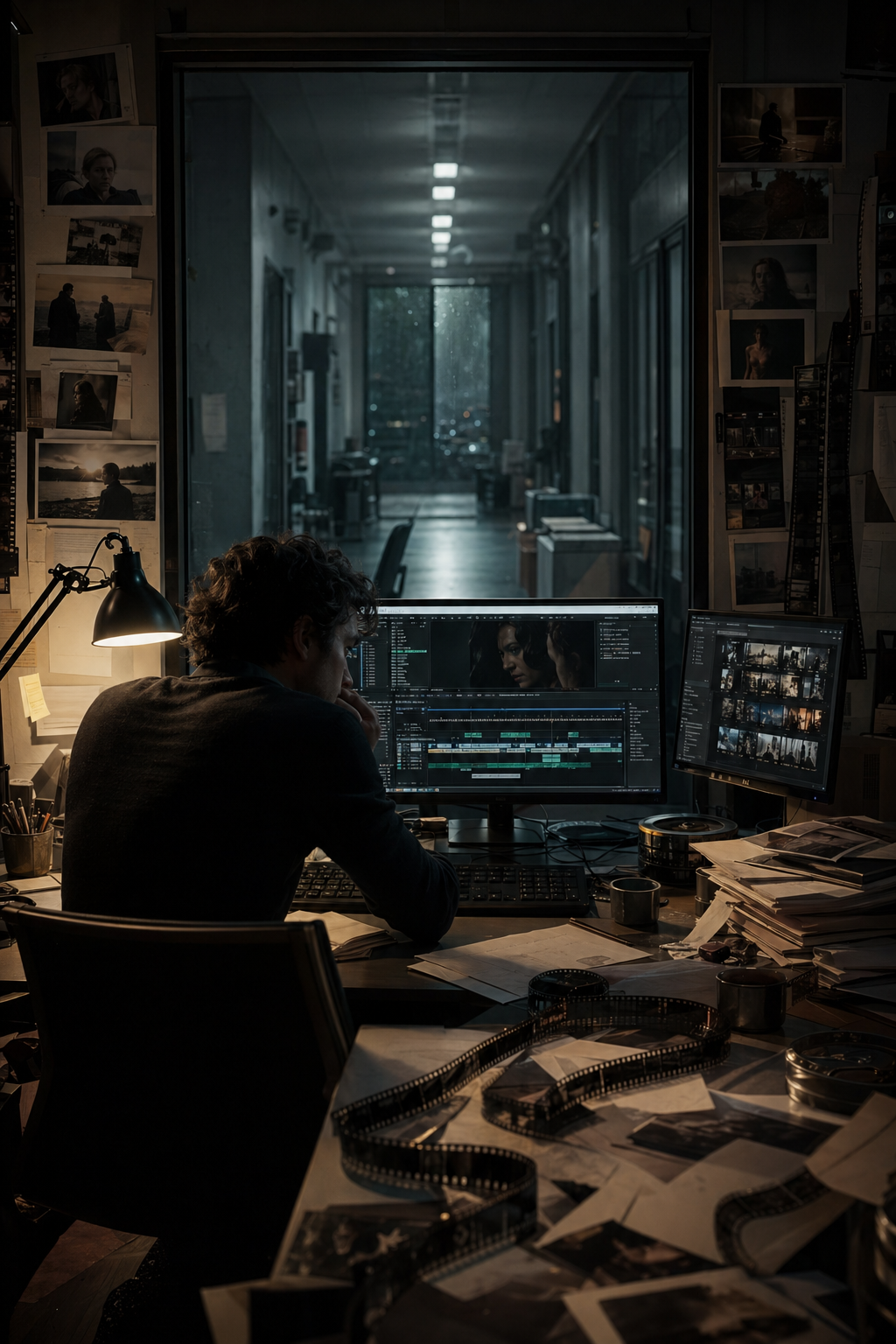
EVERY VERSION
In a windowless London edit suite, a documentary editor discovers a dead novelist has turned his final footage into a trap.
Chapter 1
The first frame was a face already prepared to be remembered.
Noor knew that before she knew anything else about the footage, before she'd opened the estate's email or touched the corkboard or adjusted the chair in Room B4 down two notches to undo whatever height the previous editor had preferred. The man on the screen sat in a leather armchair with books behind him and late-autumn light flattening itself against the window glass. He looked directly into the camera, which was to say directly into her, and smiled with the unforced confidence of someone who had spent half his life arranging other people's gaze toward him.
“Shall we begin?”
The smile arrived exactly on cue. Warm. Practiced. Not false, which was the more irritating thing. False performances were easy; they had seams. This one had the density of use, the smoothness of an expression worn so often it had become musculature. Noor let the clip run three more seconds, watching the corners of his mouth, the movement around his eyes, the almost imperceptible settling of the shoulders after the line had landed. Nothing. Or too much nothing. She stopped playback.
The room reappeared around her in pieces, as rooms do when concentration loosens: the hard edge of the desk against her forearms, the dry artificial cold piped through the vent overhead, the faint industrial smell that had survived the building's conversion from textile factory to post house as if old labor could soak permanently into brick. Somewhere in the hallway a door shut. The freight elevator groaned in its shaft, a sound so tired it felt personal.
She rewound. Pressed play again.
“Shall we begin?”
He smiled.
Noor marked the clip with a color label she reserved for first impressions she distrusted.
On the wall to her left, the corkboard still carried traces of the editor who had occupied this room before her. Glossy printouts from the footage. A rough chronology in timecodes and arrows. Post-its in a cramped, impatient hand. Most of them meant nothing yet. One did. It had been stuck dead center, as if meant to be unavoidable.
HE KNOWS THE CAMERA IS THERE.
Yes, Noor thought, eyes still on Elliot Calder's face. That wasn't exactly the problem.
The problem was that he knew how to use the fact.
She had arrived at Halcyon just after nine, carrying a tote bag that was heavier than it needed to be because she never learned to travel to a new room without bringing too many things that might make it briefly hers: notebook, two pens that wrote differently enough to matter, headphones she preferred to the studio pair, a sweater for the specific kind of cold only office ventilation could produce, a Tupperware container of rice and chicken she would forget to eat until three. Lev Borodin had met her in the third-floor corridor with his usual immaculate energy, all dark wool and expensive restraint, and walked her through the building as if introducing her to a compromise he hoped she'd find charming.
“It's not glamorous,” he'd said, with the confidence of someone who had built a career on naming deficits before other people could. “But it functions. Usually.”
The Wi-Fi dropped on rainy days, he told her. The kitchen tap on the second floor ran lukewarm no matter how long you left it. If she heard clanging in the walls after six, it was only the heating. The suites downstairs were sound-treated but not perfectly. “You may occasionally hear someone else's problem through the wall,” he said. “I've always thought this was healthy.”
Then the project hard drives, four of them, compact and matte-black and strangely serious lined up in his hands. Approximately sixty hours each. The estate wanted a rough assembly by Christmas. A fine cut by February. Delivery in March. “Geoffrey Calder's notes are in your inbox,” Lev had added, with a diplomacy refined enough to make warning sound like weather. “Consider them priorities, not commandments.”
And then, because he was good at what he did and because what he did often involved saying the true thing in the most survivable wording, he had paused by the threshold and said, “James had difficulty aligning with the project's vision.”
James. Not even James Chen, just James, the vanished predecessor reduced to first-name cautionary tale.
Noor had nodded as if this were information and not atmosphere.
Now she was alone with the footage and the room had begun its slow contraction around the work. That was the actual beginning of any project, not the handover or the briefing or the producing-language of objectives and timelines. The beginning was the first hour alone in the dark with material that did not yet belong to you and would, if you stayed with it long enough, begin to shape the inside of your skull.
She watched the opening clip through twice more, then abandoned it for the bin of raw footage and started moving chronologically, not because chronology was truth — she was not naive enough for that, not anymore, or trying not to be — but because chronology was one of the few neutral lies available at the start of an edit. Before structure, before argument, before the seductions of theme, there was simply what happened first, then what happened next, and even that was only useful until it wasn't.
Elliot in his study. Elliot at a literary festival. Elliot on a sofa in what looked like a borrowed flat, talking about memory with the soft certainty of a man who'd been told for twenty years that his thoughts on memory mattered. The footage was beautiful in the way beauty in documentary can be faintly alarming: too composed to be accidental, too patient to be merely observational. Margot Linden's camera, Noor thought, before she'd consciously realized she was already distinguishing the cinematographer's hand from the subject's performance. The frame held longer than most directors would trust. It liked hands, windows, the negative space around a body before speech began. It was a camera that understood waiting as an action.
Noor scrubbed forward. Stopped. Rewound. Marked. Moved on.
At eleven-thirteen she found herself leaning toward the screen hard enough that her shoulders had climbed nearly to her ears. At eleven-forty she took off her glasses, cleaned lenses that weren't dirty, put them back on. At noon she remembered the coffee she'd made in the shared kitchen and discovered it cold beside her keyboard, drank it anyway, didn't taste it. There was a particular kind of concentration that removed not just time but hierarchy from the world; bodily discomfort, hunger, the ache gathering at the base of the neck, all downgraded themselves beneath the urgency of pattern recognition.
What she was looking for had a dozen names in the industry, most of them embarrassing. Access. Intimacy. Truth. The real moment. Noor hated the phrase and used it anyway because there wasn't a better one, only more pretentious approximations. The thing itself was simple to describe and difficult to prove: the instant when a subject's self-construction loosened just enough for something unintended to pass through. Not the opposite of performance. Nothing so crude. More like the moment a performance revealed the pressure it was under.
That was her reputation, if she had one that extended beyond a line in closing credits and the occasional review note about “exceptionally sensitive editing.” She found those instants. She built around them. Directors hired her because she could watch a hundred hours of a person talking and identify the six seconds where the talking failed in an illuminating way.
Which meant, of course, that every project began with the fear that this one would be the one where there was nothing to find.
By one in the afternoon she had watched enough of Elliot Calder to understand the scale of the problem. He was not simply articulate on camera. He was metabolically articulate. Even his pauses had shape. Even his meandering anecdotes seemed to know where they were headed. The charisma was real; that was what made it professionally inconvenient. A fraud is easier to cut against. A genuinely magnetic person forces you to examine whether your resistance is ethical or merely temperamental.
She clicked into hour eight because fatigue had begun to dull the earlier material into a single long note and she needed variation, needed the body on screen to have changed in some visible way. Here he was thinner. Here the skin around his eyes had taken on the translucent, overhandled look illness gives people before the rest of the body has fully announced itself. Same study, same chair, same books behind him, but the line of the jaw was sharper now and his hands, when he lifted them to emphasize a point about his third novel, tremored very slightly before settling again.
Noor sat up.
Not the tremor itself. That would have been too easy, too vulgar a read. Illness wasn't revelation. Physical deterioration was not moral access, however much documentary liked to pretend otherwise. She kept watching.
Elliot was talking about narrative theft, amusingly enough, about the accusation repeated through most of his career that he borrowed too freely from life. He gave the answer people quoted in profiles because it sounded gnomic enough to be wisdom and shameless enough to be honesty.
“Writers,” he said, “are accused of stealing from life by people who secretly believe life belongs to them.”
A small smile, aimed not at the camera now but somewhere just to its left, perhaps at Margot behind it. Noor made a note to check whether the smile always shifted off-lens when he thought he'd landed a line.
He continued. Two more sentences about transformation, memory, the alchemy by which a lived event ceased to be biography and became art. Smooth. Bright. Controlled.
Then he stopped.
Not performatively. No writer's pause calibrated to imply depth. A stoppage. His eyes moved left, farther this time, to something off-screen Noor couldn't see. His mouth opened as if the next sentence had presented itself and then withdrawn. For less than a second the face unarranged itself. Not collapsed, exactly. Simply lost the agreement it had with itself. Fear, Noor thought, and immediately distrusted the word. Exhaustion. Pain. The sudden private memory that the body was failing and the camera was still there. Whatever it was, it had not been offered.
Then the smile returned, not the exact same smile but a repaired version of it, and he said, lightly, “Sorry. Chemo does marvellous things to the continuity.”
Noor's hand was already on the keyboard. Mark. Reverse three seconds. Play. Watch the face change. Play again.
There you are, she thought, and the satisfaction that moved through her was immediate enough to be embarrassing.
It was always embarrassing, that rush. Too close to hunting. Too close to the part of herself she preferred to describe in more flattering language: pattern recognition, professional instinct, a respect for complexity. All true. Also true: she felt most coherent when she found the seam.
She watched the half-second five more times, partly to confirm it existed and partly because repetition was the fastest route from excitement to analysis. By the fourth viewing the emotion she'd first named fear looked less stable. By the fifth it looked almost like irritation. By the sixth she no longer trusted herself to say. Which was better, actually. Certainty this early was amateurism in nicer shoes.
The room had gone darker without her noticing. Not from evening yet; just the particular flattening produced by hours of monitor light in a space with no windows. She rubbed the heel of one hand against her sternum, a small unconscious pressure she sometimes applied when a cut felt right or a problem announced itself, and let her eyes drift from the screen to the corkboard.
HE KNOWS THE CAMERA IS THERE.
She stood, crossed to the wall, and read the other notes around it for the first time with something like attention.
Hospital too early? Brother as structure? He performs sincerity best when tired. DON'T USE THE DAUGHTER YET. And, lower down, nearly hidden beneath a printed still of Elliot at a lectern: who is this film punishing?
Noor looked at that one for a long time.
Then she sat back down, put her headphones on again, and returned to the clip she'd marked. Elliot's face filled the screen. The stop. The flicker. The repair. Noor dragged the moment into a selects sequence she'd labeled, without irony but with a little contempt for herself, POSSIBLE CRACKS.
Outside the suite, somewhere far enough away to sound unreal, someone laughed in the corridor. The heating knocked in the walls. Her phone buzzed once with what was probably a message she would answer hours late. On the desk the hard drives emitted their low insect hum, storing four hundred-odd hours of a dead man making himself available and unavailable at once.
Noor leaned in until the screen was almost all she could see.
The footage moved forward. She followed.
Late autumn in London, documentary editor Noor Hassani is hired to salvage a post-production nightmare: a film about the recently dead novelist Elliot Calder, built from intimate footage shot by his former partner. Working inside a claustrophobic Hackney edit suite, Noor tries to find the "real" man in the material while the Calder estate pushes for a legacy-friendly portrait. But the footage, the filmmaker who shot it, and the dead author himself all resist any clean truth, forcing Noor to confront how much of the story she is shaping is really about her own need to matter.
- —Noor Hassani — A thirty-seven-year-old Iranian-British documentary editor known for finding the supposedly unguarded moment in raw footage. Hired to replace an editor who walked away, she enters the Calder project professionally fragile and privately dependent on the act of shaping material to hold herself together.
- —Margot Linden — An acclaimed cinematographer and Elliot Calder's former partner, Margot shot the fourteen months of footage that make up the documentary. Cool, precise, and nearly impossible to impress, she understands both Elliot's performances and Noor's editorial blind spots with unsettling clarity.
- —Elliot Calder — A celebrated British novelist who built his reputation on blurring memory and fiction, now present only through footage shot during his final illness. Charismatic, manipulative, brilliant, and impossible to pin down, he has left behind material that seems designed to expose whoever tries to define him.
- —Lev Borodin — Halcyon Post's senior producer, Lev mediates between Noor's instincts, the estate's demands, and the realities of release and reception. Intelligent and pragmatic, he is dangerous precisely because his compromises often improve the work.
- —James Chen — The previous editor, absent except through notes, leftover assemblies, and the trace of his refusal. His disappearance becomes a warning about what happens when integrity chooses silence over creation.
- —Geoffrey Calder — Elliot's older brother and the estate's representative, a solicitor who wants the film to preserve his brother's dignity and legacy. His pressure is not crude censorship but an expression of grief, which makes Noor's resistance far harder to sustain.
- —The Inheritance: Noor arrives at Halcyon Post and takes over the abandoned Calder documentary in a cramped, windowless edit suite still haunted by the previous editor's notes. As she begins combing through the footage, she finds the first apparent crack in Elliot Calder's polished persona and believes she has found her way into the truth.
- —The Pressure: The estate's formal notes begin reshaping the edit, and Noor discovers that some of the footage she resents being told to use actually strengthens the film. When Margot arrives and dissects Noor's unconscious editorial choices, Noor is forced to admit that the footage is not raw evidence but already a constructed act of looking.
- —The Mirror: Researching the vanished first editor closes off Noor's fantasy of clean refusal, and deeper dives into the late reels bring her closer to Elliot at his most vulnerable and most creative. A strange improvised story told alone at night unsettles her entire belief that truth appears only when performance drops away.
- —The Breach: Margot names what Noor cannot: the documentary Noor is making is also a disguised self-portrait, driven by her own hunger to prove she was here. Soon after, a hidden reel reveals Elliot addressing the unknown future editor directly, insisting that every version of him in the footage is real and that the final portrait will reveal the editor as much as the subject.
- —The Third Cut: Freed from the illusion of objectivity, Noor builds a new cut that makes the film's own construction visible and holds together saint, monster, artist, witness, and mourner without collapsing them into one verdict. Lev and Geoffrey force final concessions, but the finished documentary becomes an honest work of authorship under pressure, leaving Noor changed enough to begin shaping her own material next.
The prose is intimate, analytic, and sharply controlled, moving with the recursive precision of an editor thinking in cuts, juxtapositions, and withheld frames. Its sensory world is enclosed and electric: blue monitor glow, humming drives, cold coffee, fluorescent hospital light, rain beyond sealed windows. When pressure peaks, the language strips down suddenly, letting silence and physical detail carry the dread.