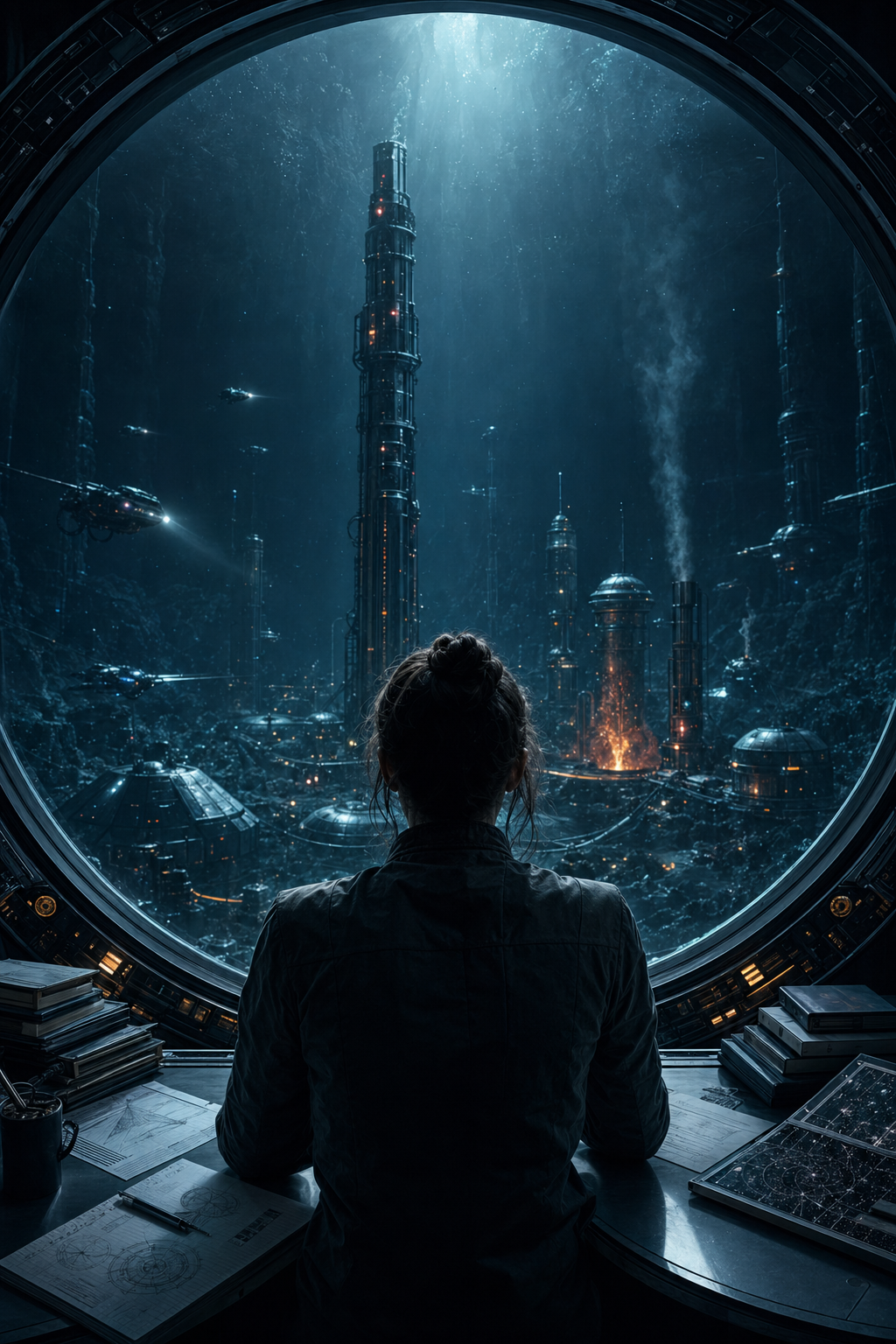
THE DEPTH OF THE READING
At a deep-ocean station powering a fractured coast, one analyst's perfect model could save the world—or break the system first.
Chapter 1: Normal Variance
At 0340 station time, the central operations hub was running eighteen percent below daytime staffing and one person above minimum safe watch.
Maren Leath preferred the hub at this hour. The station's daytime conversations had not started yet. The political traffic was light. The instruments were honest.
She sat at Cross-Systems Station Three with six live feeds arranged across her primary display: geothermal tap performance on the left column, biosequestration colony output on the right, seismological baseline across the lower band, and station internal systems in a narrow strip at the top where anything truly urgent would announce itself without her help. Beyond the glass partition, the rest of the hub held its night-shift posture: low light, muted displays, the steady hum of circulation pumps and computational cooling. CDO was never quiet. It was merely less occupied.
The station's water reclamation loop had dropped 2.3% in efficiency for the third consecutive cycle.
Maren saw it because she always checked the internal systems strip before settling into her primary work, the same way her father had checked battery charge states before loading a vehicle. Input first. Then trend. Then action.
She pulled the last nine cycles.
The decline was shallow. Individually, each dip sat within maintenance tolerance. Together, they formed a clean negative line.
She flagged the trend, routed it to engineering maintenance, added a note—third consecutive cycle, recommend filter membrane inspection—and watched the confirmation icon turn from amber to green. Handed off.
Then she returned to the work that justified her position on CDO's organizational chart and irritated every department head who preferred their problems to remain local.
Weekly cross-reference: biosequestration metabolic output against geothermal thermal performance, with seismological baseline overlays where available. Routine. Slow. Often unrewarding. The station's three mission domains generated enough data to keep a room of analysts occupied full-time; Maren's job was to sit where the categories blurred and see whether one system had begun speaking in another system's language.
Tonight's cross-reference centered on Vent Cluster 7.
The bacterial colonies there were performing well by the metric that mattered to the surface. Carbon fixation output sat eleven percent above baseline. If Priya's quarterly report went up unchanged, the Science Directorate would call it evidence that the expansion program had worked. More carbon drawn down. More credits justified. More room for factories and ports on the surface to keep pretending the arithmetic was under control.
Maren did not start with the headline metric. She rarely did. Systems that wanted to be misunderstood advertised their best number first.
She opened the deposit composition feed instead: spectral analysis of mineral output from Colony Cluster 7 over the last thirty cycles. The station biolab sampled the deposits weekly, ran them through standard characterization, and stored the spectra in an archive so large most people only touched it when a report required a figure. Maren used it for trend work.
At first glance the signatures looked ordinary. The dominant peaks remained where the design models said they should be. Calcium carbonate still dominated the structure. But the secondary peaks were moving. Not dramatically. Not enough to alarm anyone who compared this week's sample to last week's and then went home.
She expanded the time window to six months.
The shift became visible.
She expanded it again to eighteen months.
Now the pattern held. The iron-associated peaks had been climbing slowly, almost politely, while the expected profile drifted just enough to avoid tripping any threshold built for abrupt failure. The software's variance shading still labeled the changes acceptable. The problem was that acceptable changes did not usually travel in one direction for this long.
Maren rebuilt the line manually. She preferred doing it herself once before trusting a tool optimized for operational convenience.
Point by point, the data loaded across the display. Each sample landed within variance. Each one made sense alone. Together they produced a slope.
Normal variance did not have a slope.
She leaned back half an inch in her chair and checked the metadata. Same instruments. Same calibration standards. No obvious sampling discontinuity. No software revision that would explain a long slow skew. She tagged the dataset and cross-referenced it against the date of the Cluster 7 expansion.
Fourteen months ago.
The drift began shortly after.
She brought geothermal performance for the adjacent tap zone into the left display column. Taps near Cluster 7 were stable at the level operations cared about. No shutdown flags. No major thermal excursions. But when she narrowed the range and stripped out seasonal compensation, tiny deviations appeared in the heat exchange efficiency curves. Not enough to matter by themselves. Not enough even to brief. But enough to notice.
Her fingers moved without hurry. Historical spectra. Tap thermal microdeviations. Vent chemistry. Local substrate survey data. She built a temporary overlay and let the system render it. The processing bar crawled across the screen.
Behind her, somewhere in the ring of the hub, a relay clicked. Pumps compensated. CDO adjusted itself by fractions. The station always sounded healthiest when it was working hard enough to remain invisible.
The overlay resolved.
There was no proof in it. Not yet. Proof required targeted sampling, better substrate data, and time on an ROV that belonged, in budgetary terms, to Tomás Herrera and the Pacific Energy Consortium. What the overlay provided was a chain of possibility with intact links. Altered mineral output could mean altered local geochemistry. Altered geochemistry could mean a change in upper basalt porosity. Changed porosity could affect thermal conductivity. Thermal conductivity changes could alter the way the tap network was exchanging heat with the substrate.
Could. Could. Could.
Maren distrusted arguments built from conditional verbs. She also distrusted people who treated conditionals as reasons not to prepare.
She started a report.
Cross-system anomaly flag. Vent Cluster 7. Colony metabolic output nominal-to-positive relative to carbon fixation baseline. Secondary mineral deposit composition diverging from design parameters over eighteen-month horizon. Drift consistent with possible substrate interaction outside current biosequestration model assumptions. Recommend expanded spectral monitoring and geological survey of substrate adjacent to Cluster 7. Secondary review suggested for nearby geothermal thermal performance trends.
She paused at the distribution list. Priya Chandrasekaran, Station Director. Required. Tomás Herrera, Chief of Operations. Required, because no geological survey happened on this station without engineering assets. CCA liaison, per standing protocol, because anything that might touch substrate behavior near the seismological array belonged in Safety's inbox whether Safety liked the ambiguity or not.
She attached the trend line.
Then she added one more file: her manual reconstruction of the spectral slope, because automated summary graphics often made gradual problems look decorative.
Send.
The message left her terminal and entered the station's internal routing architecture, where institutional logic would begin reducing it to manageable fragments. Priya would want more data. Tomás would ask what exactly broke if they waited. The CCA liaison would ask whether this affected the seismological baseline, and Maren would have to answer honestly that she did not know.
She saved a duplicate to her private workspace.
Across the top strip, the water reclamation maintenance ticket came back with a standard reply: within normal variance; scheduled for routine inspection next cycle.
Maren read it once, then opened the reclamation dataset again. Three cycles. Same 2.3% decline. Same slope.
She did not answer the ticket. Maintenance would either look harder or it would not, and arguing over internal loop membranes at 0412 would spend political capital she might need later. She tagged the water trend to her personal watchlist and moved it to the edge of her display.
Questions the system couldn't answer yet had a way of organizing themselves if she kept them visible.
She rose long enough to get water from the dispenser at the back of the hub. The cup came out warm, as it always did before the internal chillers finished their night recalibration. She drank half of it standing up and looked through the operations glass toward the communications module beyond. Dark. Engineering feed quiet. Seismology active in one corner where a single blue display indicated Jun Wen was probably still awake in his bay, reading waveforms no one else could hear.
The station felt balanced. That was the danger of it. Stable systems often announced instability first through correlations too small for any one department to care about.
Back at her station, Maren reopened the spectral line and enlarged it until the slope occupied most of the screen.
There it was. A clean drift across eighteen months in a system designed, funded, and politically defended on the assumption that it was operating inside known parameters. Nothing dramatic. No alarms. No rupture. Just a line going somewhere no one had modeled.
She logged the timestamp and added a note for herself.
Check native species interaction literature. Pull pre-expansion substrate chemistry if available. Ask Jun for local background noise near Cluster 7 and 5.
At 0507, the hub lights brightened by one increment to mark transition toward day shift. The station's chronosystem believed in gradual adjustment. Maren respected that. Abrupt changes made people stupid.
Her report remained unread in Priya's queue. Tomás's terminal had received it but not opened it. The CCA liaison's acknowledgment tag had appeared automatically and nothing more. The station hummed, processed, delayed.
Maren closed her eyes for exactly two seconds.
Then she opened them and began building the larger model.
In 2071, Cascadia Deepwater Observatory sits on the ocean floor, balancing geothermal power, engineered carbon capture, and tsunami early warning under three rival authorities. Systems analyst Maren Leath discovers that altered bioengineered microbes are changing the geology beneath the station, linking biology, infrastructure, and seismology in ways no institution is built to understand. The more accurately she maps the cascade, the more her findings threaten the crew, the station, and the political order holding both together.
- —Maren Leath — A brilliant cross-systems analyst at CDO, Maren specializes in seeing how geology, biology, and infrastructure interact. Her gift for synthesis makes her indispensable just as it turns her into the station's most dangerous political variable.
- —Tomás Herrera — CDO's Chief of Operations and PEC's engineering lead, Tomás is a veteran subsea infrastructure expert with an intuitive grasp of machinery under pressure. He respects Maren's models but measures every theory against the brutal realities of metal, heat, and survival.
- —Dr. Priya Chandrasekaran — Station Director and architect of the biosequestration program, Priya is the foremost expert on the engineered colonies now behaving outside their design. She is rigorous, cautious, and painfully aware that the anomaly may expose the limits of her life's work.
- —Kael Oduya — Officially CDO's communications specialist, Kael is in practice the station's sharpest reader of institutional behavior and social fracture. While others track machines or microbes, Kael tracks fear, loyalty, and the way bad information can break a crew before any hull does.
- —Jun Wen — The station's young seismologist, Jun reads waveforms with uncanny precision and becomes the first to detect that the biological anomaly is contaminating the geological baseline. His data opens the deepest layer of the crisis and forces the station to confront risks far beyond itself.
- —Daniela Mossberger — The Cascadia Coastal Authority liaison on CDO, Daniela represents the safety regime that depends on the station's seismological data. Her mandate to minimize risk makes her both an ally and a threat once the anomaly begins to compromise the warning system.
- —The Anomaly: During routine cross-system analysis, Maren spots a subtle drift in mineral deposits around one vent cluster and realizes the pattern has been growing for months. Her warning is acknowledged but deferred by a station already split between science, energy production, and safety oversight.
- —The Coupling: Working with Jun and under Priya's guarded supervision, Maren confirms that the engineered bacterial colonies are interacting with native life and changing the geology beneath the station. The discovery reveals a hidden coupling between biology and seismology, while Kael shows that Maren's reports are already destabilizing the political balance aboard CDO.
- —The Fracture: As Maren's model expands, the crew's readings diverge along institutional lines: engineers want to protect the taps, biologists need more time, seismologists fear corrupted baselines, and regulators move toward shutdown. A unified briefing to the surface backfires, fragmenting authority further and forcing Maren into increasingly dangerous choices about what to share, when, and with whom.
- —The Cascade: The substrate begins to fail in ways the station can no longer dismiss, and the early-warning system is shown to be actively compromised by the very intervention meant to stabilize the climate. With no institution willing to own a cross-domain crisis, the crew secures a narrow window to attempt an improvised intervention built from incomplete models and mutual trust.
- —The Relay: The intervention tests every layer of the station at once, demanding coordinated action from engineering, biology, seismology, and command under extreme uncertainty. In the aftermath, the crisis becomes not a solved problem but a new understanding: the system is deeper than anyone's model, and survival depends on passing that hard-won knowledge forward.
Precise, controlled, and intellectually immersive, with prose that treats data, procedure, and institutional logic as sources of tension. The voice is cool but not cold, finding emotion in competence, silence, and small acts of operational care. Its sensory world is pressure hulls, dim instrument light, thermal readouts, mechanical hum, and the constant awareness of an ocean that does not forgive mistakes.