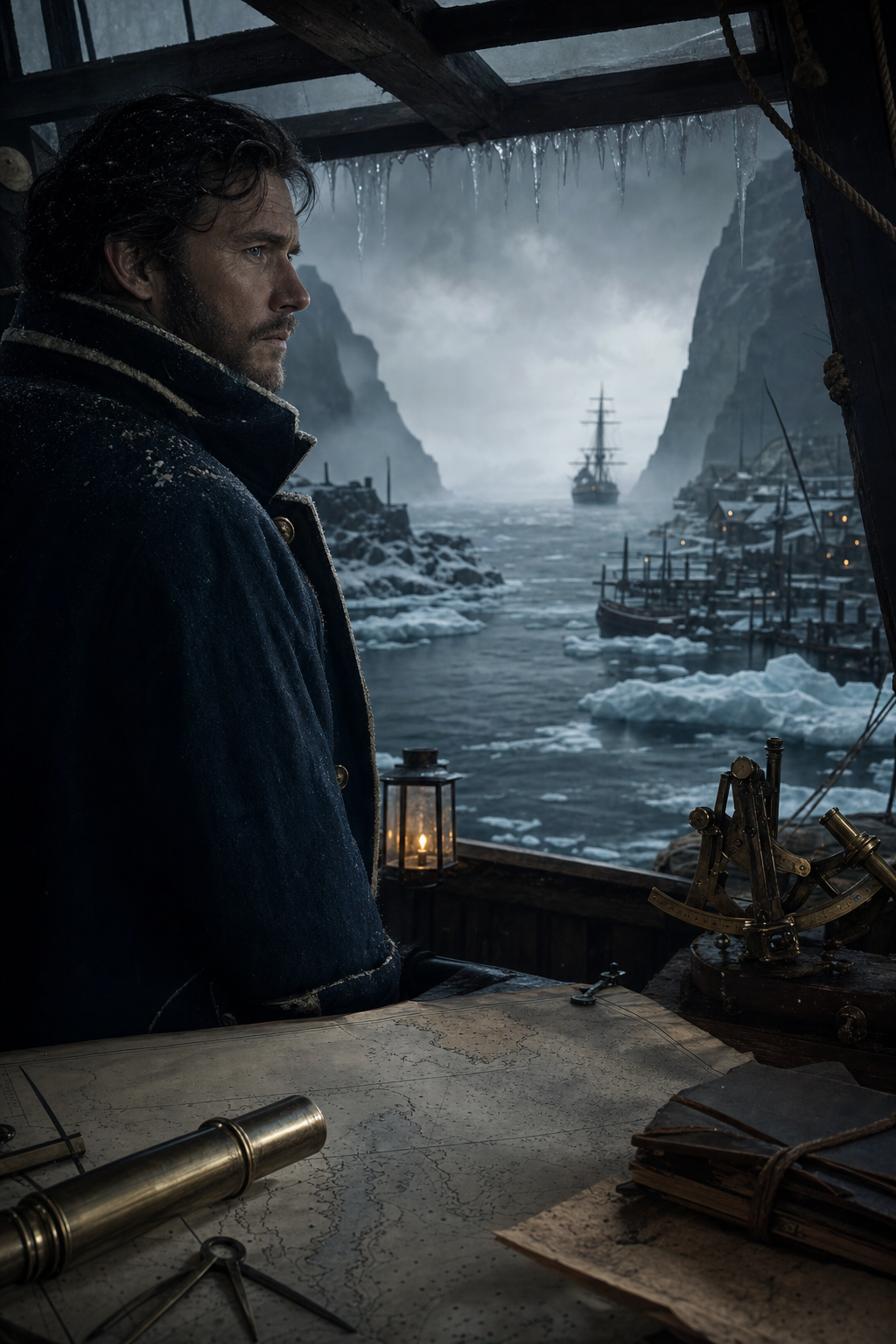
DEAD RECKONING
In the fogbound Shear, a supply captain with failing hands must trust an unfinished chart to keep a starving outpost alive.
Chapter 1
The barometer had fallen a tenth of an inch since the middle watch, and the fog, which before dawn had lain in streaks among the southern headlands, was drawing together into a single body — close, wet, and of that pale iron-grey that promised no quick lifting. James Aiken stood by the weather rail with the sextant under his coat to keep the brass from the worst of the cold and watched the dim line of cliff to port show and vanish as the Dovetail moved north into the Shear.
There was just light enough to work by. The sea itself could not properly be seen; it announced its form through the brig's motion — a low, deliberate lift under the forefoot, a brief pause, then the quiet descent into the next hollow. Rath had the deck and the helm, and had the ship in hand well enough, but Rath looked at water as a carter looked at a road: useful so long as it bore the load required of it. Aiken looked at it as at handwriting whose meaning altered with every change of light.
"Keep her two points off the port headland," he said.
"Aye, sir. Two points off."
The order was small, but in the Shear small orders kept hulls whole. The southern reaches gave a man room to correct his errors if he discovered them promptly. Farther north, where the passage narrowed and the tidal race drew hard between the basalt points, correction came dear.
He took the sextant from under his coat. The metal bit through his glove at once. October cold had a particular way of entering through brass: not upon the skin only but into the joints beyond, as though the instrument and the hand that held it had agreed to conduct the weather inward together. He flexed his fingers once, brought the sextant up, and waited for the thin whitening in the east to separate itself enough from the fog for a horizon.
A pale disc of sun showed through the murk, weak as a lamp seen through sailcloth. Enough. He adjusted the index arm, brought the reflected image down, rocked the instrument gently until the lower limb kissed the horizon in the brief, exact way that meant the reading was true, and called for the time.
"Seventeen past six," said the boy from the companion, reading from the slate on which the chart-room watch had copied the Penrose.
Aiken repeated the minute, fixed it in his head with the observed altitude, and lowered the sextant. The first reading of the day went down on the slate in his own hand. Clean enough. The figures were narrow, upright, disciplined by long use. He glanced once more at the fog, at the headland's black shoulder to port, and went below.
The chart-room lamp had been turned low against the dawn, but the candle at the traverse table gave sufficient light. The Penrose chronometer sat in its gimballed box against the bulkhead, ticking with that soft, self-contained assurance by which a good instrument declares its usefulness. Aiken opened the sight-reduction tables, set the slate down, and worked through the arithmetic. Latitude first; then the correction; then the line of position, laid with care upon the chart of the southern approaches. The fix fell where he had expected it to fall: in the channel's safe water, with room enough to stand on for the next twenty minutes before the turn northward toward the narrows.
He marked the point in the ship's log, closed the cover, and remained a moment with the pencil between his fingers, looking not at the chart but at his right hand.
It was still.
He flexed it once and put the pencil away.
When he came up again the fog had thickened by a degree so slight that Rath, who had not the habit of measuring such things, would have called it the same. Aiken could see the change in the way the nearest water had lost its distinctions. The sea had been grey before; now it was merely wet darkness carrying a little light within it. The cliff to port stood farther off than it had a quarter-hour ago, though the ship had not altered her distance from it. Such distortions were the fog's common deceit.
Torve stood by the forechains with the leadline coiled, not yet needed but ready. The old man's hands rested on the line as if feeling a pulse no one else could detect. He nodded once to Aiken and received a nod in return. There were men who worked with words and men who worked with their fingers. Torve had long ago committed himself entirely to the latter profession.
Aiken raised the sextant for a second sight.
The first instant of the motion was ordinary. The second was not. Before the instrument settled to his eye, the muscles at the base of his thumb contracted sharply, then ran into the fingers in a minute, rapid disturbance. The horizon in the glass began to jump. The sun's pale image slid, struck, lifted away, returned, and would not hold.
He lowered the sextant at once.
No one had spoken. Rath was watching the jib luff against the fog-bright air ahead and saw nothing. Torve's eyes remained on the water. The boy at the companion had turned to spit lee-ward and, thank God, had his back half-turned.
Aiken shifted the sextant to his left hand and flexed the right, once, twice. The tendons stood out along the back of the hand like lightly drawn cordage. The tremor ran on for perhaps four seconds more. Then lessened. Then stopped.
He waited the length of ten slow breaths, not because ten were needed but because haste, in such matters, was a form of confession. When he raised the sextant again the hand was steady. The reflected sun came down cleanly. The horizon held. He called for the time and got it, and this reading, when taken, had all the correctness the first had possessed.
He went below with the instrument under his arm and worked the second sight in silence. The resulting position differed from the first by little enough that a careless man might have congratulated himself on consistency. Aiken laid the rule across both and saw what the sea would have made of the difference farther north. Half a mile, perhaps a little less. In the open southern reach, nothing. In the narrows, a question of whether the channel was beneath the keel or rock.
He opened the ship's log and entered only the second reading.
Then he unlocked the sea-chest under the stern windows, took out the small notebook he kept there, and opened it to the page already ruled by dates in his cramped private hand. Beneath the morning's date he wrote one word only.
Present.
He looked at the word for a moment, at the slight pressure mark the pencil had made when his fingers tightened unexpectedly on the last letter. Then he closed the notebook, locked it away, and returned to the deck before Rath should have reason to wonder why the master's calculations required so much time.
The southern narrows announced themselves first by sound. In fog a channel's walls gave back the sea-noise differently: close water had a shorter echo, and the wash under the cliffs came back hard and immediate, without the softening interval that open water allowed. Aiken heard it before the headlands showed. Then the basalt points emerged together, one off either bow, black and wet and immense, their upper halves gone into the low cloud.
"Hands by to trim when I call," he said.
The crew moved without waste. These men had not shipped with the Dovetail for glory. They had shipped because the brig paid on time and because Aiken, whatever else he was, brought vessels through water that treated carelessness as a claim upon the dead. A working trust bound such crews more tightly than affection.
The tide had just turned. He could feel the first set of the race under the hull — not yet hard, but gathering. The Shear's currents did not strike like weather. They took hold with a long, muscular insistence, as if the whole passage had put one hand upon the keel and meant to draw it where it pleased unless countermanded by superior force.
"Starboard a spoke."
Rath shifted the helm. The brig answered, her foreyard creaking lightly.
"Meet her there."
A dark line of disturbed water showed for a breath through the fog ahead: the race's first visible seam. Aiken watched it, then the cliff to larboard, then the swing of the brig's head. There were orders one gave from theory and orders one gave from the body's memory of what the ship had done in such water ten times before. These belonged to the second class.
"Keep her so."
The current caught them fully then. The Dovetail heeled a fraction and slewed, not dangerously, but enough that the man at the helm felt it through the tiller and Rath looked quickly to Aiken for the next correction. Aiken gave it before the look was complete. The brig steadied, drove, and slid through the constriction with the inevitable, workmanlike grace of a vessel properly handled. The black shoulders of the headlands fell astern. Beyond them the passage widened again by degrees.
Carrstone inlet lay somewhere ahead in the greater grey. The settlement itself could not yet be seen, but Aiken knew the water that led to it — the deep approach, the shape of the enclosing land, the way the swell altered once a ship came under the inlet's protection. They had another mile, perhaps little more.
Rath let out a breath he had been holding and said, "That was neat enough."
Aiken gave no answer. He was looking north, where the fog was whitening over the hidden inlet, and listening to the vessel settle after the narrows. Beneath his coat sleeve his right hand had begun, very faintly, to stir again — not yet enough to show, not yet enough to impair anything, but present all the same, like a weakness in a charted line that only the man who drew it can see.
He put that hand on the rail until the wood steadied it.
Present, he thought, not as complaint and not as surprise. Merely as entry.
A shape emerged ahead, first no more than a darker grey in the fog, then the blunt certainty of timber pilings and a jet of gravel shore beyond. Carrstone dock. On its outer end a single figure stood waiting, motionless in the cold, as if the settlement had sent down not a man or woman but a mark made upon the edge of the world to show where the next sounding ought to be taken.
In the late 1830s, the Shear is a sub-Arctic passage of fog, tides, ice, and wrong charts, the only lifeline to the remote settlement of Carrstone. Captain James Aiken knows these waters better than anyone, but his hands have begun to tremble at the very moment the route grows more dangerous and the settlement's winter survival depends on repeated supply runs. The only hope of making the passage safer lies with hydrographic surveyor Maren Sult, whose incomplete work and shared need for a single chronometer bind their fates together.
- —James Aiken — Master of the brig Dovetail, Aiken is a seasoned navigator whose authority rests on quiet, proven competence in impossible waters. His hands are beginning to fail, and an old wreck on the same coast haunts every decision he makes.
- —Maren Sult — A hydrographic surveyor stationed at Carrstone, Sult is methodical, exacting, and almost alone in the work of correcting the Shear's deadly chart. Her survey is behind schedule, and the progress reports she sends south conceal how much danger remains unmapped.
- —Rath — Aiken's mate is orderly, dependable, and built for routine rather than improvisation. He represents the institutional trust in Aiken's command, but he lacks the depth to carry the passage if that trust breaks.
- —Denny — Carrstone's factor keeps immaculate ledgers and understands the settlement as arithmetic: barrels, rations, days remaining. He is competent on paper, yet badly suited to the living pressure of scarcity, weather, and delay.
- —Torve — The Dovetail's aging leadsman reads the sea through rope, tallow, and touch with uncanny precision. His bodily knowledge of depth and bottom becomes essential when instruments and charts can no longer be relied upon.
- —The Esperance — The ship Aiken lost seven years earlier functions as the story's ghost, a remembered wreck on the same coast that left six men dead. It shapes his guilt, his need for mastery, and his refusal to admit uncertainty until he can no longer hide it.
- —The Approach: Aiken brings the Dovetail through the Shear on the season's first supply run, and a brief tremor during a sextant reading exposes the crack beneath his practiced command. At Carrstone he begins an exacting exchange with surveyor Maren Sult, whose shore-based corrections suggest the official chart is more dangerous than it appears.
- —The Grind: As repeated supply runs reveal tightening provisions, worsening fog, and early ice, Aiken and Sult become linked by the Penrose chronometer and the need to trade time against safety. Their work remains professional, but shared chart corrections and small exchanges of data begin to turn parallel competence into collaboration.
- —The Fracture: Aiken's hands fail at sea badly enough that he must navigate by dead reckoning and Torve's leadline, only to learn from Sult's unfinished chart that the route he trusted has been killing ships by inches. In Sult's workroom, his tremor is finally seen and her survey's true incompleteness is finally spoken, ending both of their performances of sufficiency.
- —The Combined Passage: With the season closing, Aiken delays departure just long enough to help Sult survey a possible western channel, merging her geometry, his seamanship, and Torve's tactile skill into a usable route. When he finally leaves, Sult hides a set of field notes inside the chronometer case, giving him her observations of the coast to carry into the fog.
- —The Chart: Aiken survives the return passage by navigating through combined knowledge rather than solitary mastery, then sends Sult his own sea-based observations in the same case. After a winter of endurance and a spring reunion, their exchanged notes and shared labor become a finished chart of the Shear, honest enough to outlast them both.
The prose is precise, restrained, and steeped in the language of navigation, surveying, weather, and work. Its sensory world is cold brass, wet rope, ticking instruments, grey water, and the pressure of fog against wood. Emotion is carried through action, silence, and material detail rather than overt declaration.