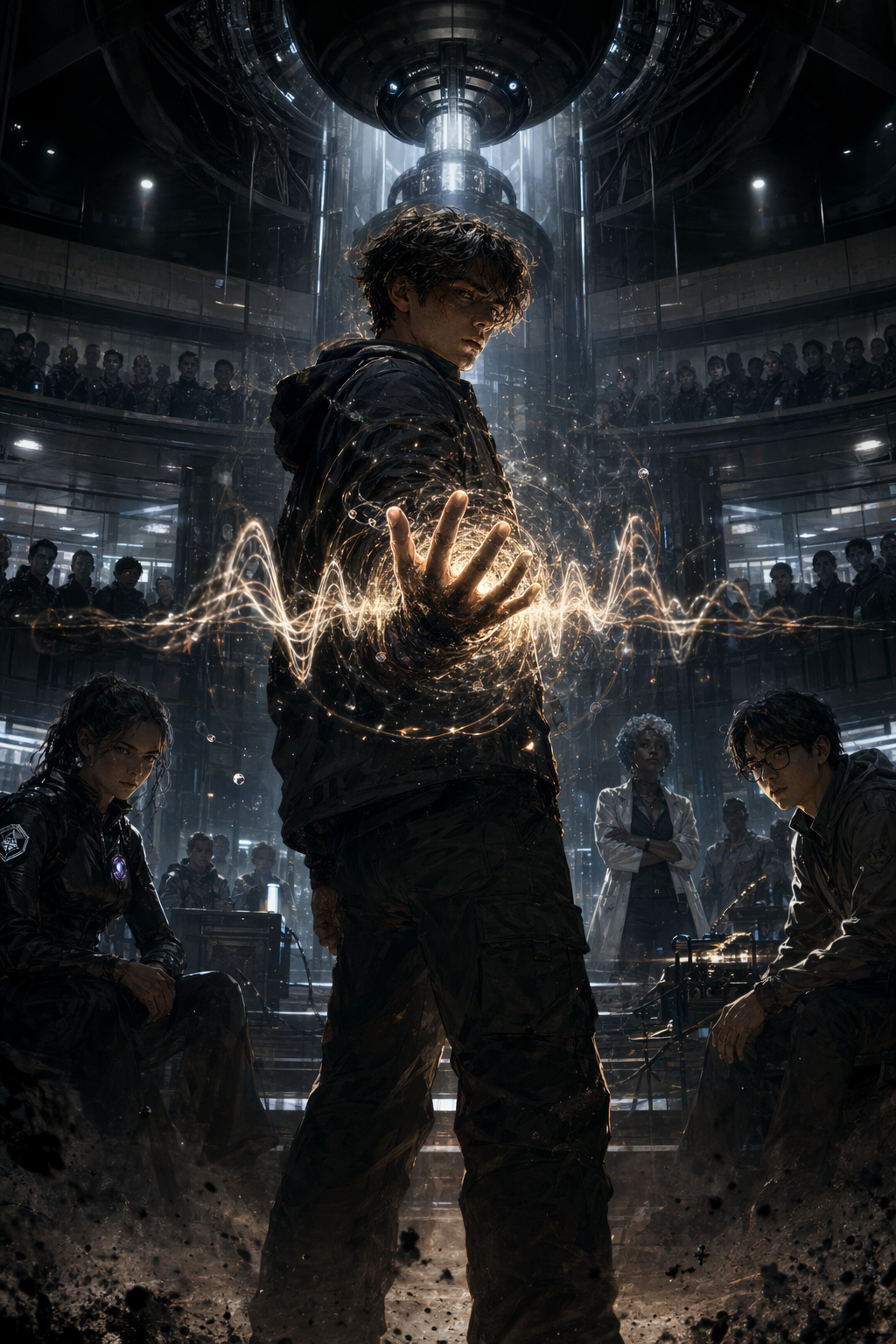
DEAD BAND
In a near-future world ruled by public power rankings, a dismissed Tier 1 discovers the system filters out the most dangerous frequency of all.
Chapter 1
The Meridian Scanner hummed in a pitch Eli Cade could feel in his teeth.
He sat in the molded assessment chair with the headband clamped over his temples and watched the intake tech pretend not to be bored. The tech was Tier 3—Operative, according to the blue marker floating beside her on the public display—and she had the efficient, detached expression of someone processing luggage rather than people.
Leeds Open Assessment occupied a converted exhibition hall near the station, all polished concrete and modular partitions under banners printed with the International Resonance Institute's clean blue logo. Around him, scanners pulsed, displays flashed, and candidates shifted in their seats with the contained tension of people hoping twelve seconds might rearrange the rest of their lives.
Eli kept his hands still on the chair arms.
The scanner's test frequencies swept through the four standard bands in sequence. Structural. Kinetic. Thermal. Neural.
And there—between thermal and neural, or maybe braided through both—he felt it.
Not a standard pulse. Not noise. The dead band.
It brushed his nervous system like a fingernail against a glass rim, a frequency the machine discarded even as it passed through him. The sensation lasted less than a second. Long enough to confirm what he already knew.
The scanner finished with a cheerful tone.
The display populated overhead for everyone in the intake lane to see.
ELI CADE
TIER 1 — PASSIVE
Amplitude: 0.3 JE/s
Bandwidth: Sub-1
Precision: N/A
The tech glanced at the result, glanced at Eli, and moved on with the verbal script.
“Demonstration group C. Wristband stays visible. Arena three in twelve minutes.”
That was it. No follow-up. No academy brochure. No polite encouragement. Just category assigned, value noted, next.
A man two seats over, broad-shouldered and wearing a Tier 2 pre-assessment band, let his mouth twitch like he was trying not to laugh. His friend murmured something Eli didn't catch. He didn't bother looking at them.
Instead, he leaned very slightly to read the calibration tag on the scanner housing.
Meridian-7, third generation. Argent Systems manufacture. Last calibration six months prior. Within spec.
Good. If he broke expectations today, he wanted the machine above reproach.
He stood, rolled one shoulder loose, and walked toward arena three.
The staging area beyond intake held maybe forty candidates and three assessors behind a waist-high barrier. Most were young, some trying too hard to look calm, others visibly vibrating with adrenaline. Tier colors floated on public overlays above each registered band: a scatter of Tier 2 Actives, a few Tier 3 hopefuls here for contract visibility, and several Tier 1s with the specific posture of people attempting optimism against statistical evidence.
Eli took a place near the back wall and watched.
That was the part he liked. Not the institutional theatre. The data.
A Tier 2 woman reinforced a steel rod with decent Structural control, raising its stress tolerance by twenty-three percent according to the display. A kinetic candidate produced a respectable force pulse and earned a few impressed murmurs when it cracked one of the floor tiles under the target dummy. A thermal practitioner transferred heat from one metal plate to another with enough precision to bring both within safe tolerance.
All standard. All measurable. All exactly what the system expected them to be.
Eli tapped his thumb against his index finger in a quiet four-beat cycle. Then a fifth beat in between.
The dead band had never shown up on any IRI schematic he'd read. But he'd built detectors from forum scrap, cooked his own nerves half to death in his parents' garage, and spent three years learning what happened when you stopped treating filtered signal as noise just because the manufacturer told you to.
“Eli Cade.”
One of the assessors, Tier 4 according to her display, didn't bother looking up from her slate as she said it.
He stepped into the demonstration zone.
The arena was simple: target wall, materials station, sensor pylons, floor markings. The composite test wall stood at the far end, reinforced and instrumented, made to register standard-frequency output cleanly. The monitoring displays were live above the assessors' heads.
“Declared domain?” the assessor asked.
“None,” Eli said.
That got her to look at him.
“No declared domain?” she repeated.
“I’m not using a standard band.”
Now all three assessors were watching.
One of them, a man with a Tier 4 Specialist marker and the kind of expression that suggested his life had never contained an unsorted variable, said, “This assessment measures recognized resonance domains only.”
Eli nodded at the wall. “Then this should be quick.”
A few people in the waiting section laughed softly. The wrong kind of laughter—dismissive, already decided.
Fine.
He walked to the floor marker and inhaled once.
The room's sound thinned. Not vanished. Just sorted itself into useful and irrelevant. Scanner hum. Sensor pulse. Air handling in the ceiling. The faint field-pressure of the arena's years of demonstrations baked into concrete and metal. Resonance memory. Most people couldn't feel it. Eli felt it everywhere.
He let the standard bands pass by his awareness without touching them.
Structural was too blunt. Kinetic too loud. Thermal too diffuse. Neural too electrically clean.
In the spaces between them, the dead band waited.
He tuned.
The sensation always started small, a narrow alignment in the center of his chest and behind his eyes, like a gear tooth finding its notch. Then the surrounding field answered. The wall in front of him had been hit by standard resonance techniques thousands of times. It carried residue. Stored pattern. Ambient density. Harmonic traces the Meridian sensors flattened into background wash.
Eli matched the frequency and pushed.
The monitoring displays stayed flat.
No standard output detected.
One of the assessors exhaled through her nose, halfway to writing him off.
Then the test wall made a sound like ice cracking under weight.
A spiderweb of hairline fractures bloomed across a square meter of reinforced composite. Not explosive. Not dramatic. Precise. The wall's surface didn't crater; it failed along interlocking fault lines that shouldn't have appeared without a recorded structural attack.
The room went quiet.
The sensor pylons remained blank.
No S-freq event. No K-freq impulse. No T-freq transfer. No N-freq interference.
Just a wall full of cracks.
Eli let the tuning go before the feedback bit him. The field snapped loose from his nerves with a familiar afterburn that made his left hand tingle. He flexed his fingers once and kept his face neutral.
The Tier 4 with the slate checked his display, frowned, then checked the wall as if one of them had insulted him personally.
“Again,” he said.
“Different section?” Eli asked.
“Yes.”
Eli moved two steps right, aligned, and tuned a second time. Less ambient memory there. Cleaner material. Harder. He adjusted by a fraction, found the harmonic seam where old resonance saturation in the floor met the wall anchoring, and nudged.
This time the panel dented inward in a narrow, impossible groove, as though an invisible wedge had pressed into the material at molecular depth. The sensors still read nothing.
The waiting candidates weren't laughing now.
The woman assessor stood up from her chair. “What frequency are you using?”
“If you have to ask,” Eli said, “your scanner doesn’t measure it.”
A couple of the candidates made startled noises—half amusement, half disbelief. The Specialist assessor did not appreciate the line.
“You are claiming undocumented resonance output in an accredited assessment arena.”
“I’m demonstrating it,” Eli said. “Claiming would be less work.”
The man's jaw tightened. “Step away from the floor marker.”
Eli did, because there was no reason not to. He'd already done what he came to do.
The three assessors conferred in low voices over their slates. One called for a technical review. Another requested a scanner diagnostic. The word anomaly appeared twice on a side display before someone hid the screen from public view.
Eli watched them, dryly interested.
He did not feel triumph. Not yet. This wasn't proof. Proof meant replication, instrumentation, a framework sturdy enough that institutions couldn't dismiss it as trickery or equipment fault. This was a crack. Useful, visible, but still only a crack.
Across the arena, someone had stopped near the entry barrier to watch the assessors argue.
She wore academy-standard training gear and moved with the balanced stillness of someone who knew exactly where her body was at all times. Tall. Athletic. Dark hair tied back. Her public marker identified her before Eli placed the face: NOOR ASARI, TIER 4 — SPECIALIST.
She wasn't looking at the cracked wall.
She was looking at him like he was a problem she intended to solve.
An assistant hurried over to the assessors with a fresh scanner wand. The Specialist straightened, public composure settling back into place.
“We will conduct a secondary verification,” he said. “Until then, Mr. Cade, your assessment status is under review.”
Eli slid his hands into his jacket pockets.
“Good,” he said. “That means you noticed.”
Eight years after physics uncovers the Resonance Field, society is reorganized around a global Tier system that measures and monetizes human potential. Eli Cade, a working-class twenty-one-year-old written off as Tier 1 Passive, has spent years secretly training a harmonic frequency the official scanners discard as noise. When his impossible demonstrations expose gaps in the system's science, he is forced into a fight against the institutions that built their power on incomplete measurement.
- —Eli Cade — A dry, stubborn Tier 1 from Castleford who should be functionally useless by every official metric. His private experiments in the scanner's 'dead band' let him access harmonic resonance the system cannot measure, making him a threat to the hierarchy that dismissed him.
- —Noor Asari — A Tier 4 kinetic prodigy forged inside the academy system, brilliant, disciplined, and deeply invested in the framework that rewarded her. Eli first disrupts her worldview as an unexplained variable, then becomes her closest collaborator as she risks everything to learn the layer her training hid from her.
- —Ren Tanaka — A maintenance-scholarship Tier 1 with an engineer's instinct and no institutional prestige. He becomes Eli's indispensable partner, building the sensors, amplifiers, and hardware that turn dead-band theory into something real and scalable.
- —Dr. Yara Osei — An exiled early resonance researcher whose harmonic work was suppressed by the IRI years before the story begins. Sharp, exacting, and not wholly selfless, she gives Eli the theoretical framework to turn instinct into a teachable system while seeking vindication for her own buried discoveries.
- —Soren Kiel — A polished Tier 5 heir to the system, trained with every privilege the hierarchy can offer and talented enough to deserve his rank. He begins as the embodiment of institutional legitimacy, then fractures when Eli reveals a deeper layer his own maximized training has made him deaf to.
- —Councilor Venn — A Tier 6 Architect and founding power broker who understands the harmonic layer better than the institution admits. He is not a cackling tyrant but the future Eli could become: someone who climbed through forbidden knowledge and chose to keep the door closed behind him.
- —Mira Chen — A quiet Tier 2 student whose low standard output hides exceptional harmonic sensitivity. As Eli helps her trust abilities the system never rewarded, she becomes living proof that the Tier hierarchy is misclassifying entire kinds of talent.
- —Dex Okafor — A near-failing Tier 1 thermal student with sharp theoretical instincts and no platform. His vulnerability inside unsafe experimentation gives the conflict a human cost and forces Eli to confront what happens when advancement stops being abstract.
- —The Verdict: Eli enters a public Open Assessment and is publicly reaffirmed as Tier 1, only to shatter expectations by using a frequency the Meridian Scanner cannot detect. The demonstration wins attention, suspicion, and just enough access to prove the official system may be measuring the wrong thing.
- —The Hidden Layer: As Eli digs deeper into the dead band, he forms uneasy alliances with Noor, Ren, and eventually the exiled researcher Yara Osei. Together they confirm the existence of harmonic resonance, uncover how the IRI suppresses it, and begin turning Eli's garage-born insight into a coherent practice.
- —The Cost of Proof: Training escalates into conflict as Eli's group tests harmonic synthesis in secret, recruits overlooked students, and collides with academy politics and IRI containment efforts. Public demonstrations and private failures reveal that the hidden frequency is both revolutionary and dangerous, especially for people the system has already failed.
- —The Public Fracture: At the Regional Crucible and beyond, Eli starts beating opponents the Tier hierarchy says should be untouchable, forcing rivals like Soren to confront the limits of official resonance doctrine. Harmonic techniques spread from anomaly to movement, and the IRI's attempt to classify, bury, or absorb the breakthrough only makes the flaw in the system more visible.
- —The Choice at the Summit: The final confrontation shifts from personal advancement to a battle over who gets to own the future of resonance itself. Faced with offers of elite inclusion, institutional crackdown, and the need for coordinated trust rather than solitary brilliance, Eli must decide whether to become another gatekeeper or force the door open for everyone behind him.
The prose is sharp, kinetic, and technically grounded, treating resonance like a rigorous system rather than mysticism. Action scenes are precise and tactical, while the emotional current stays controlled, surfacing through pressure, implication, and small fractures in otherwise disciplined characters. The world feels polished and institutional: glass, metrics, scanners, training halls, and the electric hum of a hierarchy built to look objective.