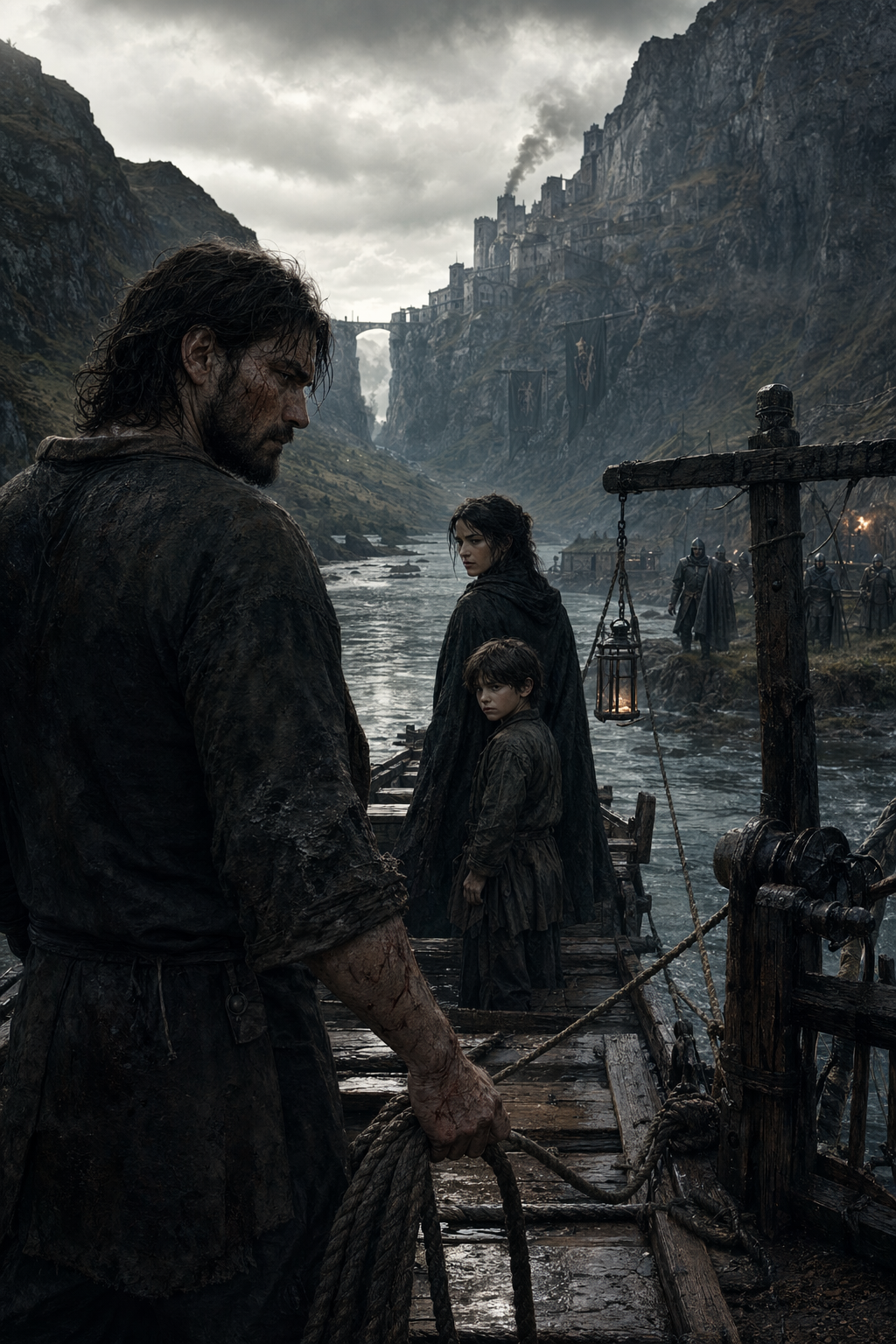
THE CROSSING
A scarred ferryman rebuilds the valley’s only crossing as the same bureaucracy that forged him closes in again.
Chapter 1
Dawn came up grey over the river.
Mist lay low on the water and clung to the limestone bluffs, turning the opposite bank into a shape more guessed than seen. At the base of the south bluff a man knelt on wet stone with an awl in one hand and a mallet in the other, working at an iron ring bolted deep into the rock face. Rust had swollen around the bolt-heads. The old rope threaded through the ring had gone the color of rot. Hemp and iron had fused together over years of damp.
He worked without hurry.
Each tap of the mallet was measured. Each twist of the awl knew where the weak fibers would give. Cold seeped through his trousers where his knees touched the stone. The river sounded below him, ten feet down, pulling hard over the rocks at the narrowing between the bluffs. It never stopped sounding. Even in sleep it would have been there, moving in the bones of the place.
When a length of rope finally came free, it did not come free cleanly. It came in a sodden clump that broke apart in his hands, leaving red-brown streaks on his palms. He set the tools down, took the loosened strand in both hands, and pulled. More rotten hemp slid out of the iron ring with a wet rasp. He coiled it beside him in heavy loops.
The mist thinned by degrees. Across the water the opposite ring became visible in the north bluff, a dark circle set into pale stone. Empty now. Waiting.
He drew the last of the old rope free and sat back on his heels.
For a moment he held the rope in both hands. Wet. Cold. Decayed almost to pulp. It smelled of river water and rust and the sweet stale smell of old fiber gone soft. His thumbs pressed into it once, as if testing whether there was any strength left in it. There was none.
He dropped it onto the coil.
His hands stayed where they were a moment longer.
The hands were broad and thick across the palms. Calluses layered one over another. Old scars crossed the knuckles. The left hand had two knuckles that had healed wider than they were meant to. Rust stained the creases red. These were working hands. But not only working hands. The hard places were wrong for ferry rope. Too much thickness at the base of the fingers. Too much wear where a grip closed around something narrower, harder.
He wiped them on his trousers, picked up the tools, and stood.
He was tall without looking tall, because there was nothing loose in him. Lean, dense, built the way a beam was built. Water-dark hair cropped short. Stubble on the jaw and a scar running under it along the left side where beard-shadow did not quite hide the pale line. His face held no expression anyone could use. It was not hostile. It was simply shut.
He looked across the river.
A small bird called from somewhere in the brush on the opposite bank. Sharp, clear, carrying strangely well over the water.
Something in him went still.
Not listening. Held.
The stillness lasted one breath. Then he turned from the river and climbed the short path up to the yard.
The crossing lay half-built around him. Timber stacked under rough cover. New planks drying on trestles. Iron fittings laid out on a bench beside oil, tar, and wrapped tools. Beyond the yard, built into the foot of the bluff, stood the lean-to: stone on the lower half, timber above, roof pitched low against weather. Smoke stains marked the vent over the fire pit. The place was rough, small, and entirely functional. Nothing in it had been made for comfort.
He ducked inside and set the tools down on the bench beside the door.
The single room held a pallet, a shelf, a pot, a bowl, a knife. A cloak hung from one peg. On another peg hung nothing at all, though the wood there was polished smooth from years of use. Near the back wall stood a ferryman’s pole and two old oars. One had a split near the blade, repaired long ago with iron strap and care.
He stood in the doorway looking into the room as if he had entered it by accident.
Then he turned back out, took up the coil of rotten rope, and dragged it into the yard.
The fibers left a dark trail over the damp earth.
He set the coil near the woodpile and began separating salvage from waste. Little enough to salvage. Most of it came apart at the touch, strands breaking into soft grey hair that clung to his fingers. He worked through it piece by piece, saying nothing because there was no one there to speak to and no reason to speak if there had been.
By full morning the mist had burned off. The river showed itself—wide, fast, green-grey over stone. The narrowing between the bluffs was the only honest crossing for miles. Upstream the banks ran wild and uneven. Downstream the water deepened and spread. Here the distance between the banks was shortest, and the rock below the surface would hold anchors if you knew where to place them. That had been the point of the ferry. A platform, a rope, iron rings, a man who knew the pull of the current well enough to work with it instead of against it.
The yard still carried the shape of that life.
A groove worn in the threshold where heavy coils had been dragged across it for years. Deep cuts in the chopping block. A worktable polished by forearms, rope, timber, weather. He moved through these traces without touching them more than the work required.
Near midday he took a pry bar and went back down to the river to inspect the ring again. The sun had found the bluff now, drawing damp from the stone in a faint mineral smell. He wedged the bar under the lower edge of the iron housing and leaned his weight into it. The ring gave a fraction. Not enough to loosen. Enough to tell him the anchor in the rock still held.
Good.
He straightened. Flexed his hands.
Across the water the north bank was empty. Alder brush. Pale rock. A narrow path climbing up toward the road. Nothing moved there except the shine of current.
He could have stayed looking longer. He did not.
By afternoon clouds had drawn back over the valley. The light flattened. He carried new-cut planks from the stack to the platform frame laid out near the bluff and began fitting them one by one. Each plank had to be set true. The ferry would bear carts when it was done. Oxen, timber, people, grain. Weight distributed badly would kill a crossing faster than rot.
He checked the grain of the wood, planed one edge, set it in place, drew it back out, shaved another curl, set it again. His body understood the work so fully that thought only slowed it. Lift, measure, fit, mark, trim. Hammer blows rang dull and clean. Tar thickened in a pot near the fire pit. The smell of it mixed with fresh-cut timber and river damp.
When the light began to fail, he stopped.
He cleaned the plane blade with an oily rag, wrapped the adze head in cloth, covered the unfinished frame against the night's damp, and banked the small fire he had used to heat the tar. Only then did he wash his hands.
There was a rain barrel against the lean-to wall. He dipped the ladle, poured water over his fingers, rubbed away tar and rust and wood-dust. The water ran brown into the mud.
His hands paused under the last pour.
Cold water slid over the scars. Over the hard pads in the palms. Over the knuckles that had broken and been set badly or not set at all. He stood with his head slightly bent, watching the stream of water run off his hands into the earth.
A sound came from the river then—not unusual, only the sudden slap of current against stone after a shift in flow—but his shoulders locked as if expecting another sound under it, some remembered thing just out of hearing.
Nothing followed. Only the river.
He set the ladle down.
Evening settled early in the valley. He lit the hearth inside and put the pot on with water and barley. The room warmed slowly. Smoke drifted wrong for a while before finding the vent. He sat on the bench by the door with the bowl in his hands after it was done and ate without appetite or dislike. Fuel. Salt would have helped. There was none left.
Outside, the dark filled the crossing yard and the river became a moving blackness with a voice.
He did not light a second lamp.
When the bowl was empty he set it aside, took up the knife, and trimmed a frayed length of new hemp by firelight. Good rope. Coarse. Heavy. It had cost him work in trade downriver and would cost more before the crossing was finished. He ran the fibers through his fingers, testing twist and strength.
For one moment the grip changed.
Not testing. Remembering.
A larger hand over his own. Rough palm. The pull of a taut line through both sets of fingers. Water pressing against a wooden platform. A voice that used few words, saying none now because none were needed.
The memory came without warning and struck as cleanly as a blow.
He set the rope down at once.
The room had gone too quiet around the river's noise. He could hear the fire settling in the hearth. Could hear his own breath. Could hear, impossibly clear, the old morning creak of rope on pulley from years gone and not gone at all.
He stood. Took the bowl and spoon to the shelf. Lay down on the pallet fully clothed.
The dark pressed close in the small room. He put one forearm over his eyes. Sleep did not come quickly, but he waited for it the way he waited for weather: with no belief that wanting it would matter.
Outside, the river kept moving past the crossing, past the bluffs, past the half-built ferry and the empty opposite bank, carrying the cold of the north down through the narrow valley as it had every day before he returned and every day while he was gone.
In the dark, Kael lay still and listened.
In a narrow river valley ruled by the Graycloaks, a former conscript returns to his dead father’s derelict ferry and tries to rebuild the only reliable crossing for miles. Kael wants work and solitude, but the arrival of a fugitive woman and her silent son forces him into human proximity he no longer knows how to bear. As the bureaucracy that took him once begins to notice them, the real struggle becomes whether his hands can become a bridge again instead of a weapon.
- —Kael — Kael is the ferryman’s son, a lean, scarred man who came home after years of conscription, war, and absence. He rebuilds the crossing with obsessive competence, but every reflex in his body has been forged for violence, not closeness.
- —Lida — Lida is a practical survivor fleeing Thornfeld with her young son after life under a Graycloak officer became another form of captivity. She needs passage, not rescue, and recognizes in Kael the exact shape of damage she carries herself.
- —Bren — Bren is Lida’s six-year-old son, watchful, quiet, and trained by fear to make himself small. His wary attention to Kael’s hands becomes the story’s clearest measure of whether Kael can be safe for anyone.
- —Arn — Arn is Kael’s father, the old ferryman whose life of rope, timber, and silence shaped the person Kael might have become. Though dead before the present story begins, his labor, tools, and memory haunt every plank of the crossing.
- —Drem — Drem is Kael’s closest companion from the garrison years, a warm, dry-humored conscript whose humanity kept Kael anchored inside the machine. His meaningless death by the river is the wound Kael still lives inside.
- —Commander Sorren — Sorren commands Thornfeld during Kael’s conscription and sincerely believes the Graycloaks are the valley’s shield. He is dangerous not because he is monstrous, but because his vision cannot distinguish protection from the machinery that devours the people it claims to serve.
- —Voss — Voss is the present-day face of Graycloak rule, a young tax collector with a ledger, good manners, and no imagination beyond procedure. He does not hunt people out of cruelty; he simply processes irregularities until they become arrests.
- —Maren — Maren is an older village woman who keeps bringing Kael food and practical company whether he asks for it or not. She is the stubborn proof that connection in the valley has not fully let go of him.
- —The Old Rope: Kael returns to the abandoned ferry crossing after his father’s death and begins the heavy work of restoring it. In alternating glimpses of the past, his childhood on the river and his forced removal to Thornfeld reveal the life that was taken from him.
- —The Arrivals: Lida and Bren reach the crossing needing passage south, and Kael’s first response is practical, distant help. Their presence unsettles the sealed order of his solitude, while the garrison past deepens through Drem, training, and the first signs of what the Graycloaks turned him into.
- —The Forging: As Kael rebuilds the ferry, Bren starts watching his hands at work rather than only fearing them, and Lida begins to trust the difficulty of his gentleness. In the past, Sorren’s purpose curdles into the crushing logic of Braith, where Kael’s training is used against people who resemble his own home.
- —The Knock: A fragile domestic rhythm forms around meals, river work, and the first successful crossings, but it is shadowed by Voss’s procedural visits and the fact that the system has begun to notice Lida and Bren. Kael’s old combat self surges back whenever the Graycloaks press near, even as Bren’s trust and Lida’s recognition pull him toward another way of being.
- —The Same Water: The full wound of Drem’s death by the river finally surfaces, clarifying why Kael’s body still grips every rope like a weapon. With the bureaucracy closing in and the crossing no longer just a structure but a human bond, Kael is forced to decide whether he will answer pressure with the old violence or let his hands become a means of carrying others across.
Bleak, intimate, and physically grounded, with a severe prose style that opens into moments of devastating tenderness. The language dwells on wet rope, cold stone, scarred hands, smoke, fish, rust, and river current until labor itself becomes emotional texture. Its voice is quiet and unsentimental, but every silence carries pressure.