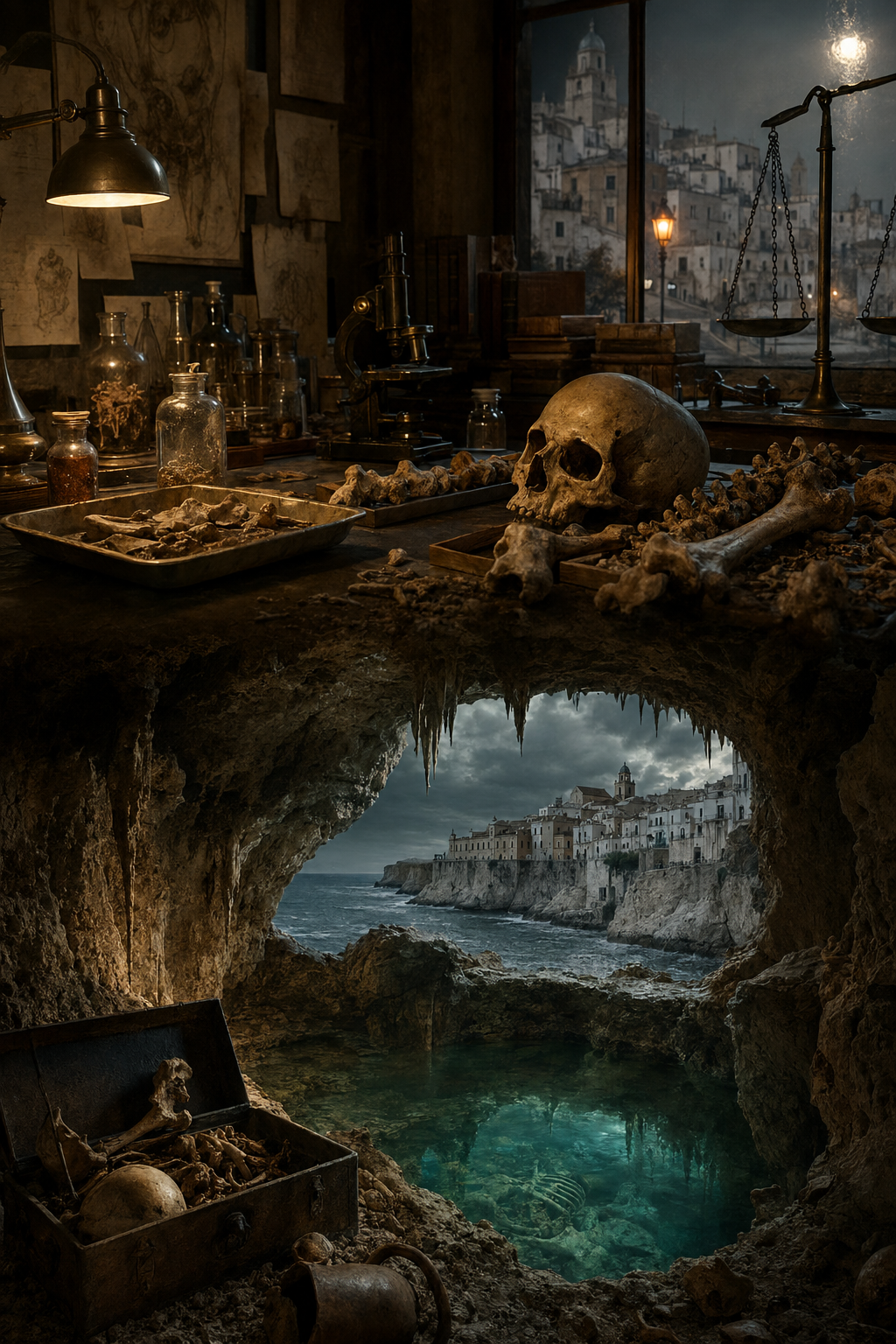
COMMINGLED
In a karst coast where stone petrifies the disappeared, a forensic osteologist finds evidence the living cannot afford to face.
Chapter 1
The overhead fluorescents buzzed at two slightly different frequencies. One tube near the far sink was beginning to fail; its light pulsed a fraction slower than the others, enough to alter the color temperature above the stainless-steel tables. Dr. Lena Márkova noted it on entering the laboratory and deprioritized it immediately. Electrical maintenance was not relevant to the remains on Table Three.
The specimen trays from Site 4 had already been laid out in attempted anatomical groupings by the previous osteologist. Cranial fragments to the left. Long bones and major postcranial elements to the right. Smaller boxes of hand and foot bones, loose teeth, and unassigned fragments arranged in a line between them. A paper tag wired to the central tray read: SITE 4 / REASSOCIATION PHASE / EST. 15–20 INDIVIDUALS. The handwriting was narrow, hurried, and slanted too far forward. Someone who wrote quickly to avoid dwelling.
Lena set down her bag, pulled on gloves, and began with the central tray.
She always started the same way. Inventory before interpretation. Surface before depth.
The remains had been recovered from a karst sinkhole in the Litoral interior eighteen months earlier and stabilized to the extent possible. Stabilized, in this context, meant cleaned of loose sediment, dried under controlled conditions, photographed, labeled, and then left in a state that was less resolved than the paperwork implied. The limestone had done what limestone did. Several cortical surfaces were sheathed in thin calcite film. Two femoral shafts retained pale mineral accretions at their distal ends. The bones had not merely been buried. They had begun the longer process of becoming terrain.
She lifted a partial occipital fragment first. Adult. Outer table intact except for postmortem edge damage. Weathering moderate. She set it aside and moved to the next. A right innominate, incomplete. Broad sciatic notch, probably female. Then a left humerus shaft, cortical thickness consistent with an adult male of moderate build. She measured, recorded, placed. Her hands moved with the economy of long practice: pick up, rotate under the ring light, assess density and morphology, note taphonomic alteration, return to tray or reassign.
There was a smell beneath the disinfectant and paper dust of the lab, faint but persistent. Preservative chemicals, salt air from the harbor beyond the warehouse walls, and the sweet-sour residue of old decomposition that no cleaning protocol ever entirely removed from a room where the dead were translated daily into evidence.
At the far end of the laboratory, a ventilation unit cycled to a lower register. Someone crossed the corridor outside; the footfalls were brisk, then gone. Lena did not look up. The first ninety minutes of any reassociation required uninterrupted pattern acquisition. Interruptions introduced noise.
She moved to the box of hand bones.
The previous osteologist had labeled it ADULT MALE B / MIXED MANUAL ELEMENTS. The category was provisional to the point of uselessness. She tipped the contents gently onto a clean tray and spread them with a gloved fingertip. Metacarpals. Proximal, middle, and distal phalanges. Most were consistent with adult remains from the larger assemblage: cortical bone fully matured, epiphyses fused, dimensions within expected ranges. She sorted them automatically into rough ordinal groups.
Then her fingers paused on a proximal phalanx of the right hand that was too light.
Not subjectively. Measurably.
She lifted it between thumb and forefinger. Rotated it once under the ring light. The bone surface was smoother than the others, the cortex thinner, the metaphyseal region not yet carrying the dense finality of full maturity. The epiphyseal margin was wrong. Not fused. Or not fully.
She reached for the calipers.
Length: 22.3 millimeters.
She set the phalanx down on a sterile tray, adjusted the light, and measured again.
22.3.
Adult male proximal phalanx of this type would have been significantly longer. The comparative discrepancy was not marginal. She brought the bone closer to the lamp and examined the surface texture. No pathological remodeling. No taphonomic distortion sufficient to explain the size reduction. The periosteal surface retained the faint unfinished quality of active growth.
She did not speculate. She photographed it from three angles, then opened her reference file.
The lab door opened behind her. She heard a pause, then a voice from several meters back.
“You’re Márkova.”
The speaker had approached quietly enough that the sentence arrived without preparatory footfall. Lena turned.
A woman stood in the doorway holding a thin folder and a staff keycard on a blue lanyard. Tall, silver hair cut with exactness, linen jacket despite the coldness of the warehouse interior, wire-rimmed glasses catching the fluorescent light. Dr. Maren Voss did not have to be introduced; her professional self-possession was more distinctive than any badge.
“Yes,” Lena said.
Voss’s gaze moved once across the workstation. Not intrusive. Comprehensive. “Have they given you your archive clearance forms?”
“Not yet.”
“They will.” Voss stepped farther into the lab, the folder still in her hand. “How far are you into the Site 4 reassociation?”
“Ninety minutes.”
“And?”
Lena turned back to the tray and lifted the phalanx with forceps so the director could see it without crossing into her workspace.
“Among remains provisionally cataloged as adult male,” she said, “there is a manual element inconsistent with adult status. Proximal phalanx, right hand. Incomplete epiphyseal fusion. Length twenty-two point three millimeters. Preliminary age estimate approximately eight to ten years.”
The room remained quiet for one beat longer than the information required.
Voss removed her glasses, cleaned one lens with the corner of her handkerchief, then replaced them. “Certainty?”
“The estimate will narrow if I locate associated elements. On this specimen alone, the developmental status is clear.”
“No listed child from that sector,” Voss said, not quite to Lena and not quite to herself.
“No.”
Voss came close enough to look without touching. Her face gave nothing away beyond concentration. “Document it,” she said. “Continue the reassociation. We’ll cross-reference with the family submissions and the original recovery maps.”
Lena nodded.
Voss’s gaze stayed on the bone for a moment. Then she looked at Lena directly, as though evaluating not her conclusion but the method by which she had reached it.
“You’ve worked commingled contexts in Bosnia.”
“Yes.”
“And Argentina.”
“Yes.”
“Then you know this terrain teaches patience.”
“I know.”
A slight inclination of Voss’s head. Approval, or simple acknowledgment. “Good. We require it here.”
She left as quietly as she had entered. The door clicked shut. The ventilation resumed its place as the room’s dominant sound.
Lena returned to the phalanx.
A child, she wrote in her notes, was not a narrative. It was an evidentiary problem. Problems could be solved if enough material remained.
She continued through the box, but the resolution of her attention had changed. Each manual element was now measured against the possibility of smaller articulations, unfused margins, immature cortical density. The assemblage recalibrated around the anomaly. What had been a tray of mixed bones was now a tray from which a child might be reconstructed.
By midday she had isolated three additional elements that did not belong with the adult remains: a partial middle phalanx consistent in size and density with the first specimen, a fragment of metacarpal shaft with incomplete development, and a small carpal element whose mineral staining matched the first bone more closely than it matched any of the adults. Not enough for a profile. Enough for minimum number of individuals to shift.
At fourteen hundred, a younger man with limestone dust on his boots appeared beside her table carrying excavation forms and a mug of coffee he had forgotten to finish. He introduced himself as Ivo Petrić, forensic archaeology. He spoke quickly, with the visible effort of someone trying not to look too long at the trays.
“Site 4 paperwork,” he said, placing the forms beside her notebook. “Spatial logs, context photos, recovery coordinates. If you need the original sinkhole maps, Tomás has the witness overlays.”
Lena glanced at the coffee mug. “You’re leaving residue on the forms.”
Ivo looked down, shifted the mug to his other hand, and gave a brief, embarrassed exhale that was not quite a laugh. “Right. Sorry.”
His eyes moved to the isolated child elements on the secondary tray. His expression changed before he could organize it.
“That from Site 4?”
“Yes.”
“There weren’t supposed to be children there.” The sentence came out too quickly, as if speed could reduce its meaning.
Lena looked at the forms. “The remains disagree.”
Ivo was silent for a moment. He nodded once, the way people nodded when the evidence gave them no useful room for denial, and left.
By evening the warehouse had quieted. Doors shut down the corridor. Voices thinned and disappeared. Somewhere in the administrative wing a printer ran briefly, then stopped. The harbor beyond the high windows had turned from white daylight to the dense blue-gray of late October.
Lena remained at Table Three.
She had completed the first-pass inventory and revised the minimum number of individuals upward in her notes: at least seventeen adults, one child. The adults remained unresolved, still waiting for full reassociation. The child existed so far as fragments and measurements. A phalanx. A second phalanx. A carpal. A metacarpal fragment. Four small declarations against the paperwork that said no child belonged here.
The failing fluorescent tube near the sink finally flickered hard enough to darken and recover. Lena noted the interval this time: irregular, accelerating.
She set the child’s proximal phalanx under magnification.
Under the ring light, the bone was smaller than her thumb. The growth margin at one end remained unfinished, as clear and ordinary as any developmental marker in any healthy child. No pathology. No deformity. Just immaturity, stopped.
She adjusted the focus one increment finer.
Outside, beyond the warehouse walls, the harbor water struck the quay in a slow repeated rhythm she could hear only when the ventilation dropped. The lab smelled of steel, old paper, and minerals. On the tray before her, the child’s bone held its measurements and gave nothing else away for free.
Lena recorded the final line of the day’s note in her usual hand, precise and compressed:
Manual element inconsistent with assigned adult assemblage. Juvenile remains present in Site 4.
She set down her pen. Picked up the phalanx again. Rotated it once in the light.
A child no one had reported. A grave that should not have contained one. A record that did not account for what the bone preserved.
The fluorescents buzzed. The ring light hummed. On the steel table, under the controlled circle of amber-white illumination, the inconsistency remained.
In the Litoral, a coastal region scarred by political disappearances, the earth itself preserves the dead inside limestone caves, sinkholes, and calcified graves. Dr. Lena Márkova returns to identify commingled remains for a commission forbidden to name perpetrators, but an unrecorded child's bones begin to point past identification and into a buried architecture of communal silence. As her evidence collides with institutional restraint, Lena is forced toward truths hidden in both the landscape and her own family history.
- —Dr. Lena Márkova — A brilliant forensic osteologist from the Litoral, Lena has built her life around making damaged evidence legible. When a child's remains surface in a grave that should not contain one, her disciplined search for truth begins to erode the sealed history beneath her own family story.
- —Tomás Herrera — A former detective now working for the identification commission, Tomás specializes in witness testimony and the behavioral grammar of silence. Where Lena reads the dead, he reads the living, and their partnership becomes essential as the case deepens into both conspiracy and intimacy.
- —Dr. Maren Voss — The commission's director is a world-class forensic pathologist whose belief in managed truth comes from hard evidence, not cowardice. She opposes Lena not to hide the dead, but because she knows exactly what unstable truths can do to the living.
- —Ivo Petrić — A young forensic archaeologist from the Litoral, Ivo works the excavation sites with technical skill and visible feeling. His openness and shock make him a vivid counterpoint to Lena's severe containment.
- —Katya Sorel — The fiercest public advocate for the families of the disappeared, Katya presses the commission to move faster and dig deeper. She does not yet know that one of the story's most devastating missing names belongs to her own family.
- —Ana Márkova — Lena's mother has spent decades in London maintaining a careful, practical silence about the past. Her composure hides the truth of Lena's father and serves as the personal mirror of the commission's sealed archive.
- —Father Josip — An elderly village priest with failing health, Father Josip kept unofficial records during the years of disappearance. His water-damaged notes preserve names and family connections that official history omitted.
- —The Surface: Lena joins the commission in Vela Strana and begins reassociating remains from a karst sinkhole known as Site 4. Her first major anomaly is a child's bone among adults, evidence that immediately suggests the official record is incomplete.
- —The Excavation: As Lena builds a profile of the child, Tomás uncovers a matching pattern of witness silence around the same place and time. Their combined work begins to reveal a systematic method of killing, while Voss insists that the commission's mandate ends with identification, not attribution.
- —The Breach: Access to old recovery files places Site 4 inside Lena's own childhood landscape, and a misfiled archive index ties her father to the operational sector under investigation. The discovery does not stop her work, but it changes its weight, especially as she realizes the child was killed deliberately by the same trained method used on the adults.
- —Bedrock: DNA evidence identifies the child as Milo Novak and exposes an old false account of his survival that Voss once accepted, revealing the blind spot in her ethics of restraint. At the same time, Lena confirms that her father was not a casualty of the era but one of its perpetrators, and Tomás becomes the first person able to receive that truth in the only language she can speak: evidence.
- —What Remains: Milo is finally named and returned to his family, while Voss yields the sealed file on Lena's father without pretending the moral conflict is solved. The commission continues its work, but Lena now labors inside a changed silence: no longer sealed off from herself, and no longer excavating alone.
Controlled, precise, and atmospheric, with prose shaped by forensic observation rather than melodrama. The sensory world is all wet limestone, fluorescent hum, preserved paper, steel tables, salt air, and the cold patience of excavation. Its voice is gothic by geology and mystery by method, carrying obsession, grief, and intimacy through exacting detail.