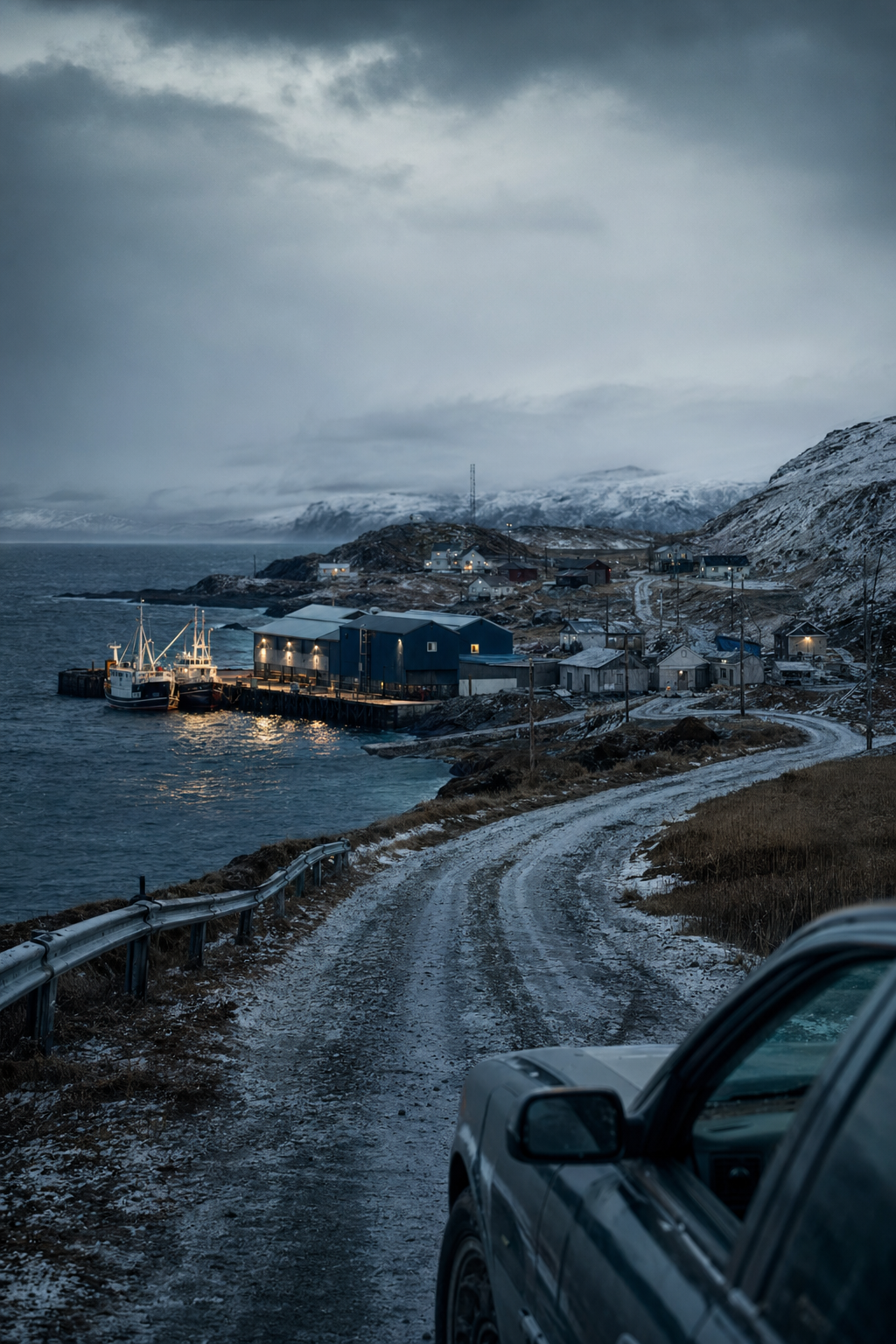
THE COAST ROAD
After a deadly plant explosion forces a remote fishing village onto one storm-lashed road, its lone nurse starts following what the fire erased.
Chapter 1
The clinic smelled of antiseptic, wet wool, and smoke.
Maren stood at the sink with her hands under the tap and watched the water run pink, then clear. The burns had been bad on two of them. Flash burns across the backs of the hands, one face, one neck. Smoke in the lungs of the boy from the night watch. Geir Stord's cut had been shallow and messy, more blood than damage. She had closed it with five stitches while he sat on the exam table with soot in the lines of his face and answered every question she asked as if she were asking about weather.
Time of injury. Near the plant. Loss of consciousness. No. Anyone else with him. No.
She turned off the tap. The pipes knocked once in the wall.
It was 5:40 in the morning. She had not slept. The explosion had come at 11:40 the night before, a sound big enough to wake the whole village and shake frost from the clinic windows. Since then there had been sirens that barely worked, men shouting over wind, the hard smell of diesel burning, and the long practical work of triage under bad light. Now the building had gone quiet. The waiting room chairs were empty. The kettle in the break room had boiled dry and clicked itself off an hour ago.
She dried her hands on a paper towel and walked to the window.
From the front room of the clinic the harbor was visible between two houses and the school roof. The light outside was the thin gray of northern morning, not yet day so much as less dark. The processing plant stood at the water as a black frame of steel and char. Part of the roof was gone. The loading bay had collapsed inward. What was left of the fuel depot was a low ruin of twisted metal and scorched concrete. One section of dock had burned. The pilings were still there, black and wet. Smoke came up in slow threads and blew east across the village.
Vehicles were moving already. Headlights slid over the road by the harbor. Men in hats and work jackets crossed from truck to truck. People were awake because there was too much to do and because sleep after a night like this came badly, if at all.
Maren stood with one hand on the windowsill and counted without meaning to. Three vehicles at the harbor lot. Two by the plant road. One outside the Stord office shed.
Her eyes caught on a black pickup near the front of the lot. Geir's. The bed was loaded high under a tarp and roped down tight.
She looked at it a moment longer than the others. Then she turned away.
In the back room the shelves were metal and the files were boxed by year, then by household. The room was cold. She had shut the radiator off in September when it began knocking and had never called anyone to fix it because she knew no one would come before winter and because she had sweaters. She switched on the overhead light.
Medical records lined one wall in labeled binders. Emergency stock on another. On the floor beneath the lowest shelf sat a cardboard box with LINDGREN written on the side in blue marker.
Maren crouched and pulled it out.
The cardboard was soft at one corner where something had once leaked onto it. Inside were folders, clipped reports, photocopies of water tests, correspondence with the county health office. Dr. Kristin Lindgren had left two years ago in April. The daffodils by the school had not yet come up and the ground was still hard under the top inch of thaw. She had loaded her car in a raincoat and left before noon. Patients had stopped booking appointments. The school board had begun discussing whether Kaldnes needed a full-time physician. By then Maren was already back on the island and already covering more than half the clinic work. Lindgren had handed her the box without speechifying. Just this, and then, Keep what matters.
Maren lifted the top folder. Water analyses. East-side wells. Dates three years apart, one hand writing over another. She looked at the first page and saw the columns she knew by memory: lead, cadmium, solvent residue, bacterial counts.
She put the folder back and closed the box.
For a moment she stayed crouched there with her hand on the lid. Then she stood, slid the box under the shelf again, and crossed to the radio on the desk.
Static. Then a voice from Storvik emergency coordination, clipped by weather and distance. Road conditions. Harbor damage. Fuel loss. Another voice she knew from the volunteer rescue service. Then more static.
Maren took a notebook from her pocket and wrote down what mattered. Wind increasing northeast by afternoon. Ferry suspended until further notice. Fuel supply critically compromised. She kept the pencil moving because moving it was work and work was simpler than standing still.
At 7:15 the radio crackled hard enough to fill the room. She turned the volume up.
A man from the regional emergency authority read the order twice. Mandatory evacuation of Kaldnes. All residents to depart by road no later than noon. Temporary shelter arranged in Storvik. Storm front expected within thirty-six hours. Harbor inoperable. Fuel depot destroyed. Residents advised to bring essential medicines, identification, warm clothing.
Maren wrote the time beside the note and set the pencil down.
For a second nothing happened. The clinic hummed. Wind pressed at the window. Somewhere outside a truck door slammed.
Then she moved.
She took two field kits from the cabinet and checked them in sequence. Dressings. Saline. Sutures. Syringes. Blood pressure cuff. Stethoscope. Thermometer strips. Prenatal doppler. The controlled substances lockbox from the dispensary drawer. She packed medications next: insulin, nitrates, inhalers, antibiotics, blood pressure tablets, two cartons of pediatric fever reducer. The older people would forget half of what they needed in the rush. The young would remember the children and not themselves. She knew how this would go because she knew all of them.
When the medical bag was full she set it by the door and went back for the files.
Not the whole clinic. There was no room and no time. She chose what she could carry and what could not be replaced: current medication lists, the vulnerable patients, pregnancy charts, the emergency contact binder. Then her own notebook ledger from the last three years. Then the folder of correspondence with Arne Halvorsen at the county office.
She stopped with the ledger in her hand.
Then she went to the shelf and pulled out the Lindgren box.
The box was heavier than it looked. She carried it to the front desk and set it beside the medical bag. Her breath had shortened from the lift. She stood still until it leveled.
By 8:20 she had locked the medicine cabinet, shut off the break room kettle at the wall, and taped a note to the clinic door directing anyone in acute distress to find her in the convoy. She walked through each room once before leaving. Exam room one. Exam room two. Store room. Back office. Waiting room. The chairs straight. The magazines old. A child had left one mitten under the radiator sometime in the week and no one had come back for it.
She picked it up and set it on the counter.
Outside, the cold hit her face at once. The air smelled of salt and old smoke. Her pickup was parked behind the clinic, white under a film of ash and road grit. Ten years old, rust starting at the wheel arches, heater slow to wake. It started on the second turn, same as always.
She loaded the medical bag behind the seat. Then the binders. Then the ledger. Then the Lindgren box, which she placed on the passenger side floor and wedged with a blanket so it would not slide on the road.
When she shut the passenger door she looked down the lane toward the harbor again.
The village was fully awake now. People moved with the hard speed of people trying not to think ahead. Children in hats too thin for the weather. Men carrying fuel cans that were no use now. Women with bags over shoulders, making lists aloud to no one. The school bus sat idle by the church. The sea beyond the harbor was slate-colored and already whitening at the tops.
Geir Stord's truck was still at the head of the harbor lot. Loaded. Engine running. Geir stood beside it talking to two men from the plant, his hands in the pockets of his jacket, his forehead bandaged under his cap. He turned his head once toward the clinic road, not enough to look at her, then turned back.
Maren stood with the truck key in her hand and watched him for one beat, then another.
His truck had been packed before the evacuation order came over the radio.
She got into her own truck and shut the door. The heater blew cold for the first minute. She kept her gloves on and waited. Through the windshield she could see the houses of Kaldnes, low against the land, the school flagpole bare, the road leading down to the burned plant and the damaged dock. Beyond that the sea. Beyond that nothing that mattered today.
She rested one hand on the wheel and the other on the top of the Lindgren box where it showed above the blanket.
The cab warmed slowly. Outside, the village kept moving.
At 8:43, with the engine idling and the first trace of heat reaching her hands, Maren put the truck into gear and drove toward the harbor to join the line south.
Kaldnes is a tiny fishing village at the end of a remote northern peninsula, sustained almost entirely by a family-owned processing plant and the silence that protects it. Maren Solheim, the village's nurse practitioner, has spent years documenting a pattern of illness she suspects is tied to the plant's poisoned runoff. When an explosion kills the owner's younger brother and triggers a mass evacuation down the coast road, scattered clues begin aligning into a truth the community cannot bear to face.
- —Maren Solheim — A 37-year-old nurse practitioner and the only medical professional in Kaldnes, Maren is practical, disciplined, and built for endurance. After nursing her mother through a fatal cancer and documenting a troubling illness cluster in the village, she becomes the one person unable to participate in the silence around what is happening.
- —Geir Stord — The head of the Stord family and owner of the fish plant, Geir is the village's unelected center of power: competent, controlled, and indispensable. He believes survival justifies terrible choices, and his effort to protect Kaldnes has bound him to the very damage he refuses to name.
- —Vidar Stord — Geir's younger brother, dead in the plant explosion before the story opens, was warmer, more trusted, and more loved than the family patriarch. In death he becomes the story's hidden engine, because he had begun gathering proof of the contamination and trying to send it beyond the village.
- —Beth Stord — Vidar's widow is grieving, frightened, and fiercely focused on protecting her son from further collapse. She knew enough about her husband's investigation to fear where it would lead, making her both a witness to the truth and a participant in the silence around it.
- —Lars Stord — Vidar and Beth's ten-year-old son is quiet, observant, and carrying words he does not fully understand. His trust in Maren makes him the child who passes along the crucial instruction his father left behind.
- —Solveig Haugen — A local schoolteacher and Maren's closest friend, Solveig is warm, sensible, and deeply tied to the community's need to hold itself together. Her care for Maren is genuine, but when the crisis sharpens she becomes the clearest example of loving complicity.
- —Dr. Kristin Lindgren — The former village doctor never appears in person, but her abandoned files and unfinished warnings haunt the story. She was the first outsider-insider to notice the health pattern, and her quiet expulsion from Kaldnes shows how the village punishes people who keep looking.
- —Einar Moe — An elderly retired fisherman with failing health, Einar has spent years noticing more than he says. His small acts of honesty and presence make him the story's quiet witness and its last source of human steadiness.
- —The Break: The fish plant explodes overnight, killing Vidar Stord and destroying Kaldnes's fuel supply on the eve of a major storm. As the village prepares for emergency evacuation, Maren packs her medical files and notices small irregularities that suggest the disaster is not as simple as it appears.
- —The Road: The entire community heads south in a fragile convoy along the only coast road out. Mechanical trouble, forced stops, and cramped rides place Maren among grieving neighbors, and each encounter gives her another piece of the hidden pattern: Vidar sent a registered letter, Geir is tracking her records, and the plant's waste system was altered years earlier.
- —The Seal: Storm delays strand the evacuees overnight, tightening the village's social pressure around Maren just as the evidence becomes clearer. A direct exchange with Geir, the old doctor's margin notes, and a midnight confidence from Lars reveal that Vidar hid a surviving copy of what he found.
- —The Return: While the convoy pushes farther from home, Maren turns back alone into the storm and drives toward the emptied village. In the old Stord house she finds the blue box: test results, correspondence, internal records, and proof that the contamination, the cover-up, and Vidar's death are linked.
- —The Handoff: Maren reaches the evacuation center in Breivik and places the documents in outside hands, finally moving the truth beyond Kaldnes's closed circle. She returns to her people not as a triumphant accuser but as the same nurse they still need, carrying the knowledge of what the village has survived by refusing to see.
The prose is austere, precise, and unsentimental, built from concrete detail rather than explanation. Its sensory world is cold wind, diesel, wet wool, metal, antiseptic, and bitter coffee, with a steady voice that never flinches from hardship or overstates emotion.