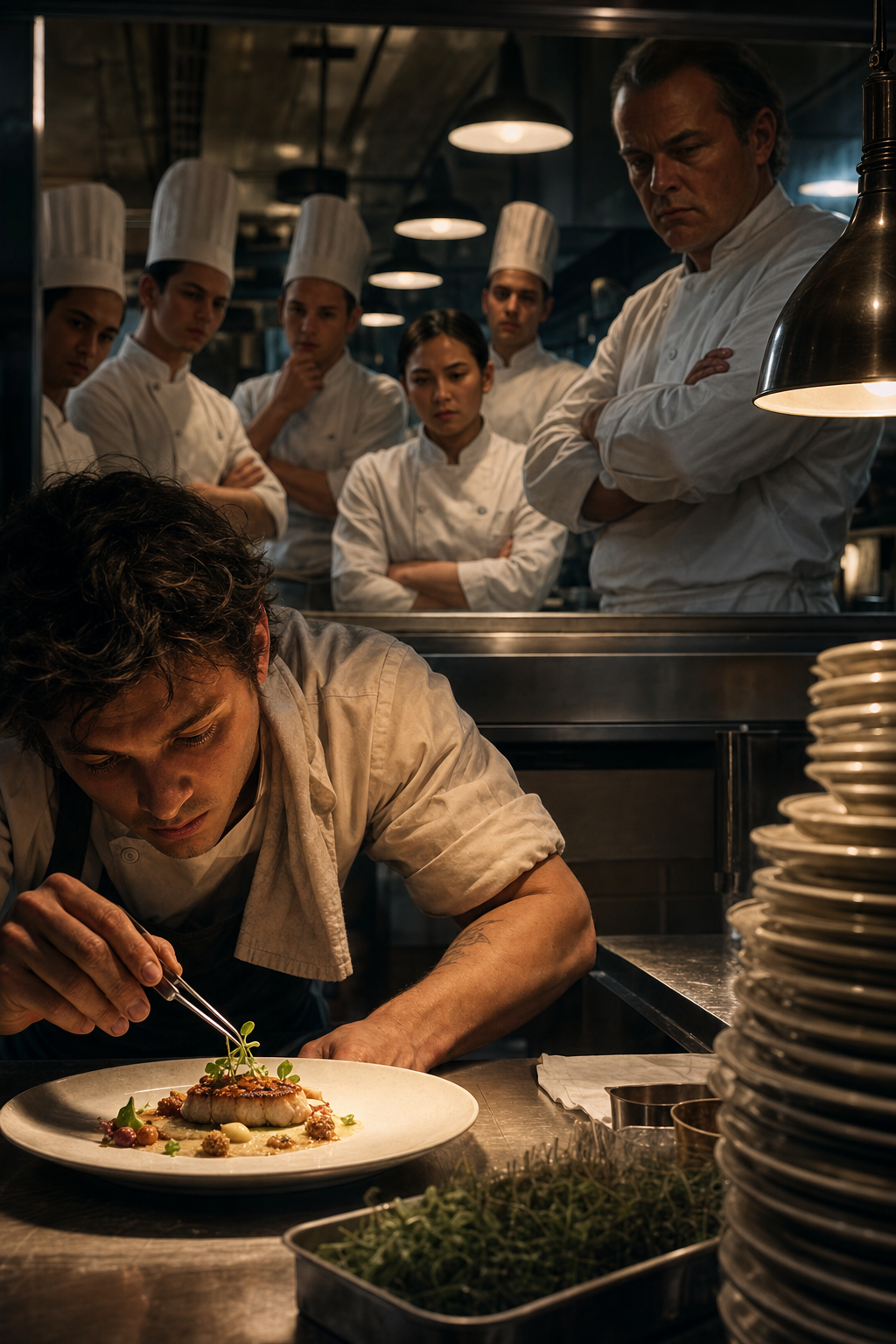
CLEAN STATION
In New York’s elite kitchens, a self-taught line cook risks everything to prove that a plate can speak louder than pedigree.
Chapter 1
Cass ran the tip of the boning knife along the branzino's spine and felt the blade click against bone. Good fish. Not too cold in the flesh, not warming out either. The skin was tight and silver under the prep light, the scales already gone, the body still carrying that clean mineral smell that meant it had not spent too long on ice. She turned it with her left hand, thumb hooked under the gill plate, and changed the angle of the blade by a degree. The first cut was about finding the line. The second was about staying honest to it.
Steel whispered against rib cage.
She opened the fish in one long pull, letting the knife ride the skeleton instead of fighting it. The flesh separated clean and pale. No tearing. No waste. Her wrist stayed loose. You didn't muscle a fish like this. You listened to where it wanted to come apart and helped it get there.
Around her, Laszlo's was waking up for service. Stockpots muttered on the back burners. Someone at garde-manger dropped a hotel pan and swore under their breath. The dishwasher banged racks into place with the mechanical violence of a man already tired and not yet halfway through his day. Overhead, the hood vents pulled heat and grease into their throats with a steady industrial roar. The kitchen smelled like onions sweating in butter, bleach from the morning mop, and the faint iron scent of raw protein waiting its turn.
Cass lifted the first fillet free and laid it skin-side down on the board. Her knife moved to the pin bones. Short strokes now. More delicate. She flattened her palm over the fish and felt for the raised line with her fingertips, then slid the blade under them and shaved them out in a single strip. Beside her station, a quart container held saffron blooming in warm cream, threads loosening their color into the liquid. Deep gold already. On the lower shelf, micro basil and chervil sat wrapped in damp towels.
"That the special?" Mateo asked from pastry without looking up from his sheet tray.
Cass didn't look up either. "Yeah."
He gave a low whistle. "For this place?"
She set the second fillet down next to the first. "Fish doesn't know the address."
That got half a laugh out of him. Then the printer at expo spat a strip of paper for lunch prep and the room went back to work.
She trimmed the belly flap, squared the edges, saved every usable scrap. The frames would go into stock if Morales was paying attention, or the trash if he wasn't. Probably the trash. Laszlo's wasn't a bad restaurant. It was worse than that. It was a restaurant with enough money to buy decent product and not enough imagination to deserve it.
She wiped her blade on a side towel and turned to the sauce. Butter into the pan first, then shallot cut fine enough to disappear. No color. Saffron cream after that, then a splash of fumet she had bullied out of yesterday's fish bones before anyone could throw them away. The sauce came together in a slow tightening swirl, yellow deepening toward amber, the surface taking on that satin look right before it was ready to nappe. She pulled it off the heat before it got thick. People oversauced fish because they were afraid fish wasn't enough.
On the edge of her station sat the chalkboard menu for the night, still blank but for the heading:
CHEF'S SPECIAL
She looked at it once and went back to plating in her head.
Two hours later the board was full, the burners were all live, and service hit like weather. Pans snapped onto flame. Oil shimmered. The air thickened with steam and shouting. Cass worked fish station with the narrow focus of a person whose body knew the map better than her mind did. Salmon to medium. Scallops hard sear, baste, pull. Halibut dragging a minute because table twelve fired late. She moved with no wasted steps, reaching for salt before she needed it, towel over shoulder, left forearm already taking fresh heat where the pan rims kissed skin.
When the first branzino order came in, she heard it through the noise the way a musician hears the right note in a mess of sound.
"Special, one!"
"Heard."
She patted the fillet dry again even though she'd dried it twenty minutes earlier. Moisture was the enemy. Hot pan. Neutral oil. Fish down away from her so the oil wouldn't spit up her arm more than necessary. The skin seized, then relaxed. Good. She pressed lightly with the offset spatula just long enough to keep it flat. The smell changed from raw sea to toasted protein. At the edge of the pan the flesh climbed from translucent to pearl.
She turned the heat down a notch, tipped the pan, and basted with foaming butter. Not too much. Let the skin stay crisp. Off heat before the center tightened. Rest for a breath. Sauce on the plate in one curved pull, not a pool but a line wide enough to catch the fish. Branzino over it, skin up. Micro basil. Chervil. Flake salt at the last second so it stayed itself.
She set the plate in the pass.
Even under Laszlo's bad lights it looked wrong for the room. Too clean. Too precise. A dish from a restaurant where someone out front knew how to describe acid without saying bright three times in one paragraph.
Morales came up beside her, already wiping his hands on the apron he wore like a flag of office. Thick neck, loud voice, the smell of grilled meat and aftershave clinging to him no matter how hot the kitchen got. He glanced at the plate and grunted approval as if he had anything to do with it.
"That's the blogger's table?" he asked expo.
"Table nine."
Morales lifted the plate himself.
Cass reached for the next ticket.
From her station she could see only a slice of the dining room through the pass window. White tile edge, a flash of wineglass, Morales's shoulder as he leaned over table nine with the practiced warmth he kept for guests who might matter later. The food blogger was young, phone already half-raised, his smile wide and hungry in the wrong way.
Morales set down the plate and put one hand over his chest, explaining. Cass couldn't hear him through the line noise, but she knew the shape of it. Local branzino. Saffron butter. Inspiration. Clean flavors. My special tonight.
She turned back to the stove before the blogger took the first bite. A ticket for two salmon, one scallop. She wiped the lip of a pan with her towel and dropped in more oil.
Nobody on the line said anything. Nobody needed to. This was how it worked. Specials went up under the chef's name because that's what the chalkboard said and that's what the dining room bought. Cass cooked. Morales presented. The city ate what invisible hands made and thanked the wrong mouth for it.
By the end of service her shoulders ached and the web of skin between her thumb and forefinger had gone tender from a hundred grips on hot metal. The special sold out. Table nine sent compliments to the chef. Morales read them aloud once, loud enough for the room to hear, then moved on to talking about Saturday covers.
Cass scrubbed her station down to bare steel. Burners off. Fish drawer wiped. Board sanitized, towel bucket changed, knives washed by hand and dried immediately. Clean station. Always. The last thing her father had ever taught her, if he had taught her anything at all, was that a cook who left a dirty station was telling on themselves.
When she finally stepped out into the night, Manhattan was damp and bright in the way it got after summer rain. The city smelled like wet concrete, garbage, fryer oil blowing from somewhere half a block away. Her apartment was four flights up in a building with a front door that stuck in humid weather. She climbed by habit, key already in hand.
Inside, the place was small enough that the kitchen was less a room than a fact. Narrow counter. Two burners that ran hot. A window over the sink looking onto brick. On the counter, exactly where she'd left it, sat the journal.
Worn brown leather. Corners rounded soft. The spine split near the middle and repaired years ago with clear tape gone yellow at the edges. The pages had swollen from steam and old spills, stained with oil, turmeric, stock, life. She set her knife roll down and washed her hands before she touched it.
The book opened easily to the middle. Branzino — the simple way.
Her father's handwriting, or what she had always believed was her father's handwriting, moved down the page in tight, careful script. Not a recipe so much as a conversation with the thing itself. Start with a fish that doesn't need apologizing for. Dry it more than you think. Skin-side first. Don't oversauce. Let the fish argue for itself.
Cass traced the last line with the pad of her finger. The ink had bitten deep into the paper. She could almost feel the pressure that had made it.
In the kitchen at Laszlo's, under the vent noise and the ticket chatter, she could move all night without thinking about anything except the next pan. Here, in the silence after midnight, the room let the rest of her catch up.
She turned a few pages back and found what she wanted.
Potato soup, for cold nights.
Nothing showy. Onion. Butter. Potatoes. Stock. Cream. Nutmeg. A note in the margin: Let it go slow. Better if nobody's waiting.
She set a pot on the burner.
Butter first. Onion sweating soft, no color. Potatoes cut uneven on purpose because this wasn't restaurant food and didn't need to pretend. Stock in. Simmer. She stood over it while the apartment filled with the smell of starch and dairy and the soft sweetness of cooked onion. Steam touched her face. Her shoulders came down a little.
When the potatoes gave up and the liquid thickened around them, she hit it with the immersion blender until it went smooth. Cream after. Nutmeg just enough that you noticed its absence if it wasn't there. She tasted with a spoon, added salt, tasted again.
The soup wasn't impressive. It wasn't meant to be. No acid balance to show off. No textural contrast. No garnish except black pepper and the last teaspoon of chives from her fridge, cut rough with kitchen shears. She poured a bowl and ate standing at the counter in her socks, one hand around the ceramic, the other resting on the journal to keep it open though she didn't need it anymore.
Outside, a siren moved downtown and thinned into distance.
She took another spoonful. Warm. Full. Honest.
On the page, beneath the recipe, another note in the same hand:
Good food doesn't ask permission.
Cass read it once. Then again.
The apartment was quiet enough that she could hear the spoon touch the bottom of the bowl. No dining room. No pass. No Morales making speeches over her work. Just the soup, the book, the heat from the pot still fading off the stove.
She finished eating, rinsed the bowl, and left the journal open on the counter.
Her hands hovered for a moment over nothing at all, fingers flexing once before they settled.
Tomorrow there would be prep again. Fish to break down. Sauce to tighten. Someone else to feed under somebody else's name.
For now the kitchen was clean, the pot still warm, and the words on the page sat under the light like something said directly to her.
Let the fish argue for itself.
Contemporary New York’s restaurant world runs on pedigree, but the Bellamy Prize is the one arena where food itself can overrule status. Cass Lannier, a brilliant self-taught line cook trapped in a mid-tier kitchen, enters the country’s most prestigious culinary competition with a dubious endorsement and a private faith in a dead father’s recipe journal. As she rises through the rounds, the truth behind her supposed lineage threatens to strip away the only story that ever made her feel she belonged.
- —Cass Lannier — A twenty-seven-year-old self-taught line cook whose technique was forged in diners, banquet kitchens, and relentless private practice. She is extraordinary at the stove and nearly voiceless everywhere else, staking her entire identity on what her hands can make.
- —Ren Matsuda — Cass’s steady fellow cook at Laszlo’s and the quiet center of her emotional life. He expresses love through presence, labor, and food, and becomes the one person who insists on seeing Cass apart from her output.
- —Théo Marchetti — The heir to a celebrated culinary dynasty and the Bellamy’s expected favorite, armed with elite training and immaculate technique. As Cass’s rival, he becomes an unexpected mirror: she fears she has no pedigree, while he fears pedigree is all he has.
- —Elise Lannier — Cass’s mother, a practical, weathered woman who built her daughter an invented culinary inheritance out of love and desperation. Her forged endorsement and fabricated recipe journal gave Cass a door into a world that would otherwise never have opened.
- —Helen Zhao — The country’s most feared food critic, a former chef whose palate is exact and unsentimental. She stands as the final authority in a world obsessed with taste, and her judgment cannot be won by reputation alone.
- —Louis Fain — A veteran pastry chef and Bellamy judge who once worked at Marcel Thibault’s restaurant. He recognizes the fault line in Cass’s story, exposes the lie surrounding her father, and preserves the one true memory of David Lannier at a stove.
- —Chef Derek Morales — Cass’s head chef at Laszlo’s, competent, loud, and perfectly at ease taking credit for talent beneath him. He embodies the everyday hierarchy that keeps gifted cooks invisible unless they find a larger stage.
- —David Lannier — Cass’s dead father, remembered as a cook but in truth a janitor who loved food and possessed real, unrealized talent. He survives in fragments, myths, and one witnessed omelette that becomes the story’s hidden inheritance.
- —The Door: Cass’s life in a middling New York kitchen shows both her brilliance and her invisibility, especially when her work is credited to someone else. When her mother secures her entry into the Bellamy Prize, Cass steps into the one competition where food might outrank pedigree.
- —The Proving Ground: Cass survives the Bellamy’s early rounds through instinctive mastery, earning grudging respect from judges and a wary technical rapport with favored contender Théo Marchetti. Away from the competition, her bond with Ren and her reliance on her father’s journal reveal how completely craft and identity are fused in her.
- —The Fault Line: As Cass reaches the upper tier of the Bellamy, Louis Fain connects her family name to a buried truth: her father was not the cook she believed him to be. The revelation leads her back to Elise, where she learns that the endorsement and even the treasured journal were built on a loving fabrication.
- —The Dark Kitchen: Stripped of the lineage that anchored her, Cass stops cooking and drifts through work and home as if her language has been taken from her. Ren and Louis each, in their own way, force her to confront a harder truth: the lie opened the door, but the gift was always hers.
- —One Dish: Cass returns to the Bellamy resolved to stand on her own hands alone, while Théo arrives at the final with a more personal dish of his own. In the blind last round, with names and credentials removed, she cooks the simplest and most exposing plate of her life, and the contest becomes a test of whether truth on the tongue can outweigh every story told around it.
Lean, tactile, and exact, with prose that treats cooking as physical labor, high craft, and emotional speech all at once. The voice stays close to bodies, heat, texture, and timing, letting butter, steel, steam, and silence carry the drama. Its sensory signature is all kitchen pressure and intimate nourishment: rendered fat, trembling eggs, clean stations, and food made with dangerous sincerity.